On This Page
Description
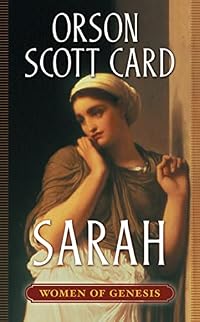
From bestselling author Orson Scott Card comes a vivid and imaginative portrayal of the biblical Sarah, Abraham's loyal wife and Isaac's loving mother. Forced finally to share her husband after a lifetime of devotion, rebuked by the Lord for her unbelief, and grappling with fears that her beloved Isaac will be displaced by Hagar's Ishmael, Sarah is nonetheless a triumphant figure. Covering the events recorded in Genesis up to the birth of Isaac and Sarah's confrontation with Hagar, this show more first of a series of novels on biblical women is an epic tale of loyalty and resilience before God and before Abraham. show lessTags
Recommendations




















Member Reviews
Sarah is the first book in Card's Women of Genesis series. The series is an attempt to flesh out the stories of the lives of the wives of the early patriarchs described in the book of Genesis, in this case focusing on Sarai/Sarah. Card notes that compared to other contemporaneous literary sources that the book of Genesis is loaded with women who feature prominently in the narrative, which he asserts makes this a fertile source of inspiration. Unfortunately, it seems that some clumsy storytelling plus some weak source material saps the life out of the book.
The outline of the story will be familiar to anyone who has read Genesis. Sarai marries Abram, they go to Egypt where he pretends she is his sister to avoid being killed by the show more Egyptians, they return to Canaan, Abram shares his flocks with his nephew Lot, Sarai is unable to conceive and offers her handmaid Hagar to Abram who bears him Ishmael, and then Sarai becomes Sarah, Abram becomes Abraham, Sarah gets pregnant at an advanced age and has Isaac. Along the way Sodom is destroyed, and Ishmael and Hagar are driven away from Abraham's camp.
Obviously, a book that focuses on the wife of Abram/Abraham is going to be laden with religious meaning, a fact that Card freely admits in his afterward. But one of the primary problems with the book is that while the author clearly takes Abram/Abraham's faith seriously, he doesn't take any of the competing faiths of the other characters seriously. The God of the Hebrews is assumed to be true for the purposes of the book, but the religious backdrop presented in the book does not give the impression of a small cadre of followers of the true faith surrounded by a host of pagan adherents to competing faiths because Card does not treat those pagan faiths as being worthy of belief. Instead, the book gives the impression of a cadre of followers of the true faith surrounded by a host of hypocritical unbelievers. This distinction may seem small, but it means that when Abram/Abraham persuades others to give up their pagan practices, the accomplishment feels hollow, since they didn't have any faith in the other gods to begin with. Even Sarai/Sarah's own conversion of the God of Abram/Abraham seems empty: God is so clearly assumed by all the characters to be right, that one doesn't see any reason any character would follow any other faith.
This is reinforced by the venality of the other faiths, and the forced interconnectedness that Card asserts between the various faiths, including the Abramic/Abrahamic faith. The practitioners of the other faiths are all shown to be hypocrites, arranging miracles and using religion to advance their political agendas. While this is probably true to a large degree, there appears to be no one who actually believes in the pagan gods, and those that do, such as the Pharaoh of Egypt who features heavily in the early part of the book, do so only insofar as their religion is asserted to be connected with the Abramic faith. The typical pagan thinks nothing of arranging fake miracles to impress others, although given the overall weakness of most pagan belief as displayed in the book, one wonders why they bother. All other faiths are subsumed into the Abramic faith: Asherah is identified as Eve, Ba'al is identified as an alternate name for God, and so on. Given this, the later imposition of the first of the ten commandments seems a bit odd. Those few pagans who actually seem to have faith in their pagan Gods seem to shed that faith as soon as they discover the corruption of one of their leaders. I suppose this means we should abandon our Christianity because Peter Popoff has been exposed as a charlatan and Ted Haggard has been exposed as a fraud.
But even those who believe in the God of Abram/Abraham seem to grasp at fairly thin straws to bolster their faith. Several miracles are attributed to God in the narrative that seem to stretch the definition of miracle to insensibility. God tells Abram/Abraham to go to Egypt, but tells him in the form of inspiration: Abram/Abraham thinks of the idea and attributes it to God. When there, Abram/Abraham becomes afraid that the Pharaoh will kill him to be able to marry into Sarai/Sarah's royal lineage, so he is inspired to lie. Sarai/Sarah can't have children, so she has the inspiration to give Abram/Abraham her handmaiden Hagar to have children. These, and most of the other communications asserted by the narrative to come from God are merely internal flashes of insight, which seems to me like a pretty weak basis to conclude that Abram/Abraham's God is the one true God. Sarai/Sarah even comes to the conclusion that the entire purpose of the trip to Egypt was solely pick up Hagar so she should bear Abram/Abraham's children. Later, when Hagar fights with Sarai/Sarah for primary position on Abram/Abraham's camp and then later Ishmael tries to kill Isaac (with Hagar cheering him on) no one questions why God's plan would turn out this badly.
The only miracles in the story that seem to actually be anything resembling miracles, are Sarai/Sarah's old age pregnancy (although one wonders why God decided to make her wait until she despaired and handed another woman to her husband and until her pregnancy would debilitate her) and the events surrounding the destruction of Sodom, including the intervention of the angels sent to Lot's home who blind the mob bent on harming Lot and his guests. The Lot story is interpolated into the Abram/Abraham story by the device of making Lot's wife Sarai/Sarah's sister, an unpleasant woman named Qira. Qira is made to be an unpleasant woman because she wants to live in the “clean” city of Sodom and avoid the “dirty” herds of livestock of the desert dwellers (such as Abram/Abraham and Lot), a lifestyle Sarai/Sarah virtuously adopts. But this is yet another element that pulls one out of the story: ancient cities like Sodom were festering sewers of filth (and not because of the sinfulness of the inhabitants). That many people living in close proximity without modern plumbing, to put it bluntly, would stink. Plus, most people living in the city would keep livestock nearby anyway (no food preservation and shipping infrastructure of note being in existence yet). In comparison, a herdsman’s camp would probably smell quite nice. But Qira has to be mean and nasty so she can be mean and nasty to Sarai/Sarah and so the reader is happy when she is killed, so she is made to love the cleanliness of cities.
But the inclusion of the Lot story, to me, shows how weak the story is. Although Sodom is destroyed, and Lot's wife killed, Card departs from the text of Genesis and does not have her turned into a pillar of salt. Card asserts, in his afterward, that he simply doesn't find the pillar of salt story to be convincing. But that raises the question, why is this miracle not true, but the others are? The Lot portion of the narrative also ends immediately after Lot flees the destroyed city with his daughters, probably to avoid the embarrassment of including the sequence where Lot's daughters get him drunk and sleep with him to become pregnant. The obvious question to ask, had this been included, was why Lot hid out in the hills instead of going to live with his loving uncle Abram/Abraham, putting his daughters into the situation of having no men other than him around.
It seems to me that, having noted the weakness of the miraculous nature of God in the story, Card felt that he had to bolster God, and does so by having Abram/Abraham have secret knowledge about the nature of the stars that corresponds with modern astronomy. But there isn't anything in Genesis that suggests this to be true, and as a result, the inclusion of this material feels like the author is simply playing dirty pool in order to bolster the bona fides of his faith. Card also feels the needs to puff up Sarai/Sarah by having her come from a bloodline of kings. He similarly elevates Abram/Abraham by having him come from a bloodline of priests that everyone (pagan and Hebrew alike) acknowledges as having a superior legitimacy to most other claims to priestliness. It is as if Card does not believe that the reader will be impressed with the authority of the central characters unless they are inflated in this way. The story also requires sin and sinners to be condemned (the Pharaoh, after all, sins against Abram/Abraham by trying to keep he and Sarai/Sarah apart, and the sinners of Sodom and Gomorrah have to be punished) and the righteous to be rewarded. But since things like the Ten Commandments and the laws laid out in Leviticus are in the future, Card is required to be pretty vague about what constitutes sin. It seems that he ends up using what seems to be a modern viewpoint on sin that seems to a certain degree to be incompatible with a world in which keeping slaves and sleeping with one’s wife’s handmaid are acceptable.
Sarai/Sarah's sister Qira is added to the story, but mostly to give a sinful character to be mean and spiteful towards Sarai/Sarah, who bears her sister's venom with saintly grace. This seems to be a common theme in Card's works, as the virtuous put up with outrageously nasty behavior from other characters, and even though their inner thoughts countering the obnoxious behavior of their tormentors may be revealed to the reader, they never respond to their actual tormentor. Apparently, in Card's world it is better to suffer nastiness in silence than speak one's mind. The story of Hagar is dealt with in disappointing manner. Hagar steps in to be nasty to Sarai/Sarah almost as soon as Qira is eliminated from Sarai/Sarah's life. Hagar's story is also told in a way that it seems like Card is trying to make an antislavery argument, seemingly missing the fact that Hagar's story in Genesis has clear undertones of showing what happens when a servant steps above their station. But Abram/Abraham and Sarai/Sarah are thoroughly modern and egalitarian in their thinking, so the story of Hagar has to be molded to fit that mind-set, and Hagar simply becomes a nasty (and murderous) woman.
The book, in attempting to create a believable account that humanizes Sarai/Sarah and Abram/Abraham instead makes them more unbelievable. Card excises some redundancies from the original text in the interest of streamlining the story, which makes sense, but he also excises things that he simply doesn't think sound plausible. But, if one can pick and choose among the narrative of Genesis to select only those things you like, how valid does the source text remain? This, plus the weak nature of the included revelations from God (which seems to undermine the claim that God is the one true God), and the weak faith of pagans (which makes converting them seem not that impressive), seems to make the original story seem shallow and weak as well. It was clearly not Card's intention to create this sort of effect, and from that perspective, one cannot call Women of Genesis: Sarah anything but a failure.
Even if one takes the book merely as a story, it comes up somewhat short as well. The language is too overblown in many places, with prayers laden with "thee"s, "thou"s and "O God"s in the same text as people using modern expressions such as "that pretty much killed the pleasure". Plus, the story is fairly slow, the central characters are idealized to the point of being almost inhuman, and the religious aspect is so interwoven into the narrative that all of the problems with the religious aspects of the book that I pointed out before undermine the story. As a result, the book gets a lukewarm rating.
This review has also been posted to my blog Dreaming About Other Worlds. show less
The outline of the story will be familiar to anyone who has read Genesis. Sarai marries Abram, they go to Egypt where he pretends she is his sister to avoid being killed by the show more Egyptians, they return to Canaan, Abram shares his flocks with his nephew Lot, Sarai is unable to conceive and offers her handmaid Hagar to Abram who bears him Ishmael, and then Sarai becomes Sarah, Abram becomes Abraham, Sarah gets pregnant at an advanced age and has Isaac. Along the way Sodom is destroyed, and Ishmael and Hagar are driven away from Abraham's camp.
Obviously, a book that focuses on the wife of Abram/Abraham is going to be laden with religious meaning, a fact that Card freely admits in his afterward. But one of the primary problems with the book is that while the author clearly takes Abram/Abraham's faith seriously, he doesn't take any of the competing faiths of the other characters seriously. The God of the Hebrews is assumed to be true for the purposes of the book, but the religious backdrop presented in the book does not give the impression of a small cadre of followers of the true faith surrounded by a host of pagan adherents to competing faiths because Card does not treat those pagan faiths as being worthy of belief. Instead, the book gives the impression of a cadre of followers of the true faith surrounded by a host of hypocritical unbelievers. This distinction may seem small, but it means that when Abram/Abraham persuades others to give up their pagan practices, the accomplishment feels hollow, since they didn't have any faith in the other gods to begin with. Even Sarai/Sarah's own conversion of the God of Abram/Abraham seems empty: God is so clearly assumed by all the characters to be right, that one doesn't see any reason any character would follow any other faith.
This is reinforced by the venality of the other faiths, and the forced interconnectedness that Card asserts between the various faiths, including the Abramic/Abrahamic faith. The practitioners of the other faiths are all shown to be hypocrites, arranging miracles and using religion to advance their political agendas. While this is probably true to a large degree, there appears to be no one who actually believes in the pagan gods, and those that do, such as the Pharaoh of Egypt who features heavily in the early part of the book, do so only insofar as their religion is asserted to be connected with the Abramic faith. The typical pagan thinks nothing of arranging fake miracles to impress others, although given the overall weakness of most pagan belief as displayed in the book, one wonders why they bother. All other faiths are subsumed into the Abramic faith: Asherah is identified as Eve, Ba'al is identified as an alternate name for God, and so on. Given this, the later imposition of the first of the ten commandments seems a bit odd. Those few pagans who actually seem to have faith in their pagan Gods seem to shed that faith as soon as they discover the corruption of one of their leaders. I suppose this means we should abandon our Christianity because Peter Popoff has been exposed as a charlatan and Ted Haggard has been exposed as a fraud.
But even those who believe in the God of Abram/Abraham seem to grasp at fairly thin straws to bolster their faith. Several miracles are attributed to God in the narrative that seem to stretch the definition of miracle to insensibility. God tells Abram/Abraham to go to Egypt, but tells him in the form of inspiration: Abram/Abraham thinks of the idea and attributes it to God. When there, Abram/Abraham becomes afraid that the Pharaoh will kill him to be able to marry into Sarai/Sarah's royal lineage, so he is inspired to lie. Sarai/Sarah can't have children, so she has the inspiration to give Abram/Abraham her handmaiden Hagar to have children. These, and most of the other communications asserted by the narrative to come from God are merely internal flashes of insight, which seems to me like a pretty weak basis to conclude that Abram/Abraham's God is the one true God. Sarai/Sarah even comes to the conclusion that the entire purpose of the trip to Egypt was solely pick up Hagar so she should bear Abram/Abraham's children. Later, when Hagar fights with Sarai/Sarah for primary position on Abram/Abraham's camp and then later Ishmael tries to kill Isaac (with Hagar cheering him on) no one questions why God's plan would turn out this badly.
The only miracles in the story that seem to actually be anything resembling miracles, are Sarai/Sarah's old age pregnancy (although one wonders why God decided to make her wait until she despaired and handed another woman to her husband and until her pregnancy would debilitate her) and the events surrounding the destruction of Sodom, including the intervention of the angels sent to Lot's home who blind the mob bent on harming Lot and his guests. The Lot story is interpolated into the Abram/Abraham story by the device of making Lot's wife Sarai/Sarah's sister, an unpleasant woman named Qira. Qira is made to be an unpleasant woman because she wants to live in the “clean” city of Sodom and avoid the “dirty” herds of livestock of the desert dwellers (such as Abram/Abraham and Lot), a lifestyle Sarai/Sarah virtuously adopts. But this is yet another element that pulls one out of the story: ancient cities like Sodom were festering sewers of filth (and not because of the sinfulness of the inhabitants). That many people living in close proximity without modern plumbing, to put it bluntly, would stink. Plus, most people living in the city would keep livestock nearby anyway (no food preservation and shipping infrastructure of note being in existence yet). In comparison, a herdsman’s camp would probably smell quite nice. But Qira has to be mean and nasty so she can be mean and nasty to Sarai/Sarah and so the reader is happy when she is killed, so she is made to love the cleanliness of cities.
But the inclusion of the Lot story, to me, shows how weak the story is. Although Sodom is destroyed, and Lot's wife killed, Card departs from the text of Genesis and does not have her turned into a pillar of salt. Card asserts, in his afterward, that he simply doesn't find the pillar of salt story to be convincing. But that raises the question, why is this miracle not true, but the others are? The Lot portion of the narrative also ends immediately after Lot flees the destroyed city with his daughters, probably to avoid the embarrassment of including the sequence where Lot's daughters get him drunk and sleep with him to become pregnant. The obvious question to ask, had this been included, was why Lot hid out in the hills instead of going to live with his loving uncle Abram/Abraham, putting his daughters into the situation of having no men other than him around.
It seems to me that, having noted the weakness of the miraculous nature of God in the story, Card felt that he had to bolster God, and does so by having Abram/Abraham have secret knowledge about the nature of the stars that corresponds with modern astronomy. But there isn't anything in Genesis that suggests this to be true, and as a result, the inclusion of this material feels like the author is simply playing dirty pool in order to bolster the bona fides of his faith. Card also feels the needs to puff up Sarai/Sarah by having her come from a bloodline of kings. He similarly elevates Abram/Abraham by having him come from a bloodline of priests that everyone (pagan and Hebrew alike) acknowledges as having a superior legitimacy to most other claims to priestliness. It is as if Card does not believe that the reader will be impressed with the authority of the central characters unless they are inflated in this way. The story also requires sin and sinners to be condemned (the Pharaoh, after all, sins against Abram/Abraham by trying to keep he and Sarai/Sarah apart, and the sinners of Sodom and Gomorrah have to be punished) and the righteous to be rewarded. But since things like the Ten Commandments and the laws laid out in Leviticus are in the future, Card is required to be pretty vague about what constitutes sin. It seems that he ends up using what seems to be a modern viewpoint on sin that seems to a certain degree to be incompatible with a world in which keeping slaves and sleeping with one’s wife’s handmaid are acceptable.
Sarai/Sarah's sister Qira is added to the story, but mostly to give a sinful character to be mean and spiteful towards Sarai/Sarah, who bears her sister's venom with saintly grace. This seems to be a common theme in Card's works, as the virtuous put up with outrageously nasty behavior from other characters, and even though their inner thoughts countering the obnoxious behavior of their tormentors may be revealed to the reader, they never respond to their actual tormentor. Apparently, in Card's world it is better to suffer nastiness in silence than speak one's mind. The story of Hagar is dealt with in disappointing manner. Hagar steps in to be nasty to Sarai/Sarah almost as soon as Qira is eliminated from Sarai/Sarah's life. Hagar's story is also told in a way that it seems like Card is trying to make an antislavery argument, seemingly missing the fact that Hagar's story in Genesis has clear undertones of showing what happens when a servant steps above their station. But Abram/Abraham and Sarai/Sarah are thoroughly modern and egalitarian in their thinking, so the story of Hagar has to be molded to fit that mind-set, and Hagar simply becomes a nasty (and murderous) woman.
The book, in attempting to create a believable account that humanizes Sarai/Sarah and Abram/Abraham instead makes them more unbelievable. Card excises some redundancies from the original text in the interest of streamlining the story, which makes sense, but he also excises things that he simply doesn't think sound plausible. But, if one can pick and choose among the narrative of Genesis to select only those things you like, how valid does the source text remain? This, plus the weak nature of the included revelations from God (which seems to undermine the claim that God is the one true God), and the weak faith of pagans (which makes converting them seem not that impressive), seems to make the original story seem shallow and weak as well. It was clearly not Card's intention to create this sort of effect, and from that perspective, one cannot call Women of Genesis: Sarah anything but a failure.
Even if one takes the book merely as a story, it comes up somewhat short as well. The language is too overblown in many places, with prayers laden with "thee"s, "thou"s and "O God"s in the same text as people using modern expressions such as "that pretty much killed the pleasure". Plus, the story is fairly slow, the central characters are idealized to the point of being almost inhuman, and the religious aspect is so interwoven into the narrative that all of the problems with the religious aspects of the book that I pointed out before undermine the story. As a result, the book gets a lukewarm rating.
This review has also been posted to my blog Dreaming About Other Worlds. show less
An interesting departure for the sci-fi writer, who is, evidently, a devout Mormon. Sarah traces the life of Abraham’s wife from her childhood until Isaac’s teens. It is also the story of her sister Qira—Card’s own invention in the role of Lot’s wife—who keeps seeking happiness in all the wrong places. Like all writers who attempt works of this type, Card’s task is tricky—it is the attempt to give context to stories that don’t always place biblical heroes in a flattering light, to make sense of bible stories without contradicting them. And he does an admirable job. His invention of Qira, for instance, is a plausible and interesting way to give shape to “Lot’s wife.” He rejects the pillar-of-salt story as a later show more interpolation, and is not afraid to admit (as, evidently, some apologists are) that Abraham lied to Pharaoh in telling him that Sarah was his sister. And Sarah’s casting out of Hagar and Ishmael, which sounds so cruel, becomes here an essential step to save Isaac’s life and Ishmael’s soul. Hagar, her soul twisted by slavery, will surely egg on Ishmael until he has killed the boy, as soon as Abraham and Sarah are dead. And while Abraham and to a lesser extent Sarah are people of faith, Card resists heavy-handed religiosity, admitting the doubts they sometimes feel. Writing a book like this must be a fascinating journey for a person of faith to take; in his afterward, Card says he found his research stymied by the obvious ideological leanings of the two camps of biblical scholars, the apologists—who want to make everything literally true, instead of admitting that the Bible was written by people—and the rejectionists, who are determined to deny that any such people ever existed. I enjoyed it very much. show less
Card does a spectacular job here. Not only should it be difficult for Card to write so well from the perspective of a woman, but it should have also been difficult to so strongly embellish what is known while keeping continuity with scripture. Card doesn't let any of the difficulty show through; you'll be completely sucked into Sarah's world, sharing in her sorrows and joys, and sorrowing yourself when the book comes to an end.
The author has done his research on women in the old testament of the Bible. He said that some of the information contradicted other documents so he made decisions also based on what made good fiction. I like that he is paying attention to women who don't get much credit or much mention in the Bible. This made for interesting reading starting with Sarai being a young girl in her father's home (a former king). Abram (later called Abraham) arranges the marriage of Sarai''s (later Sarah) sister to Lot. Abram promises to return within 10 years to marry Sarai and does so. Card had two other books in this series, Rebekkah and Rachel & Leah. I am not particularly religious but have liked other books about characters in the Bible. These books show more made these people and their lives real and explains how the stories about them may have started. show less
Fun read to those familiar with the story, but its utterly unsympathetic treatment of Hagar smacks of racist undertones.
The book of Genesis is pretty skimpy on details when it comes to the story of Abraham and Sarah so this novel provides a glimpse of how things might have played out and definitely helps make the ancient figures of the Bible come alive as real people with faults and frustrations. What I most enjoyed was seeing how faith fit into their daily lives. In Mr. Card's imagining of Sarah, I found a woman I could admire and like.
Sarah by Orson Scott Card breathes life into the bible story of Sarah and the profit, Abraham. Sarai, the daughter of an exiled king of Ur, is ten years old when she first meets Abram. She has been promised to the Goddess Asherah but Abram tells her that he will return in ten years to make her his wife. This comes to pass and Sarai becomes a devoted wife always working beside her husband. Unfortunately, their union is not blessed with children, and as the years pass, Sarai becomes more and more convinced that Abram must become a father.
The author takes the basic facts of this story and gives it substance, character and soul. As God speaks to Abram and eventually to Sarai they become his devoted servants and follow his wishes. They show more change their names to Abraham and Sarah. Sarah convinces her handmaiden Hagar to lie with Abraham and conceive a son. This son is called Ishmael and they believe he will be the only child Abraham will have. But God once again speaks to Abraham and tells him he will have a child with Sarah, this child will be called Isaac and he will become the father of a strong nation. Each man in Abraham’s tribe undergoes a ceremony that marks this covenant, and the tradition of cutting away the foreskin was to be continued throughout the generations.
Given the restrictions of having the story already laid out in the bible, I think the author did a good job of fleshing Sarah into a real women, with real emotions, drive and energy. His interpretation of Sarah and Abraham makes an interesting read into a time period we know very little about. I found Sarah to be an engaging and well-researched story. show less
The author takes the basic facts of this story and gives it substance, character and soul. As God speaks to Abram and eventually to Sarai they become his devoted servants and follow his wishes. They show more change their names to Abraham and Sarah. Sarah convinces her handmaiden Hagar to lie with Abraham and conceive a son. This son is called Ishmael and they believe he will be the only child Abraham will have. But God once again speaks to Abraham and tells him he will have a child with Sarah, this child will be called Isaac and he will become the father of a strong nation. Each man in Abraham’s tribe undergoes a ceremony that marks this covenant, and the tradition of cutting away the foreskin was to be continued throughout the generations.
Given the restrictions of having the story already laid out in the bible, I think the author did a good job of fleshing Sarah into a real women, with real emotions, drive and energy. His interpretation of Sarah and Abraham makes an interesting read into a time period we know very little about. I found Sarah to be an engaging and well-researched story. show less
Members
- Recently Added By
Lists

Genesis in literature
47 works; 7 members
Author Information

575+ Works 213,250 Members
Orson Scott Byron Walley Card, was born in 1951 and studied theater at Brigham Young University. He received his B.A. in 1975 and his M.A. in English in 1981. He wrote plays during that time, including Stone Tables (1973) and the musical, Father, Mother, Mother and Mom (1974). A Mormon, Scott served a two-year mission in Brazil before starting show more work as a journalist in Utah. He also designed games at Lucas Film Games, 1989-92. He is best known for his science fiction novels, including the popular Ender series. Well known titles include A Planet Called Treason (1979), Treasure Box (1996), and Heartfire (1998). He has also written the guide called How to Write Science Fiction and Fantasy (1990). His novel Ender's Game and its sequel Speaker for the Dead, both won Hugo and Nebula awards, making Card the only author to win both prizes in consecutive years. His titles Shadows in Flight, Ruins and Ender's Game made The New York Times Best Seller List. He is also the author of The First Formic War Series, which includes the titles Earth Unaware, Earth Afire, and Earth Awakens. (Bowker Author Biography) show less
Some Editions
Awards and Honors
Notable Lists
Series

Work Relationships
Is contained in
Common Knowledge
- Original publication date
- 2000
- People/Characters
- Sarai, mother of Issac
- Dedication
- To Jill Locke, whose voice has been heard
reading aloud, filling our home
with the language of love, and whose music
is gold that we hold in our hearts - First words
- Sarai was ten years old when she saw him first.
- Last words
- (Click to show. Warning: May contain spoilers.)But when you take my love out of your secret hiding place, my husband, my son, and look at it, you'll see that even though it's as small and dull as a pebble compared to the stars, I have polished my love so long and so fervently, and you hold it now so close, that surely, surely it must shine.
Classifications
Statistics
- Members
- 1,085
- Popularity
- 23,387
- Reviews
- 23
- Rating
- (3.67)
- Languages
- English
- Media
- Paper, Audiobook, Ebook
- ISBNs
- 20
- ASINs
- 5