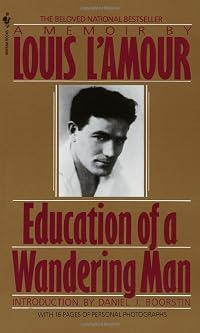
Education of a Wandering Man
by Louis L'Amour
On This Page
Description
From his decision to leave school at fifteen to roam the world, to his recollections of life as a hobo on the Southern Pacific Railroad, as a cattle skinner in Texas, as a merchant seaman in Singapore and the West Indies, and as an itinerant bare-knuckled prizefighter across small-town America, here is Louis L'Amour's memoir of his lifelong love affair with learning--from books, from yondering, and from some remarkable men and women--that shaped him as a storyteller and as a man. Like show more classic L'Amour fiction, Education of a Wandering Man mixes authentic frontier drama--such as the author's desperate efforts to survive a sudden two-day trek across the blazing Mojave desert--with true-life characters like Shanghai waterfront toughs, desert prospectors, and cowboys whom Louis L'Amour met while traveling the globe. At last, in his own words, this is a story of a one- show lessTags
Recommendations




Member Reviews
Louis L'Amour was the best selling author of Western fiction probably of all time, but he also wrote short stories, poetry, non-fiction and a historical novel, "Walking Drum." He was entirely self educated, and wrote this memoir to be "about education." Obviously, a big part of that education came from books. Starting around 1930, at age 22, he started keeping a list of the books he read; thus, he does something here few writers have done -- present an account of his reading and education. I am appreciative that one of the best selling authors of all time made the effort to do that since we can see where he got his ideas -- from his reading and life experiences before he started writing. (L'Amour had been a hobo in the years before the show more depression, a ranch hand, a miner, a merchant seaman in the East Indies, worked in a lumber camp and sawmill, and earned money fighting all before he attempted to sell his first stories.). This book motivated me to start listing the books I have read and record them on this site. I have forgotten dozens if not hundreds of them, so I wish I had started keeping a list when I was younger.
There are many worthwhile observations here. He believes, for example, that historical novels are "without question" the best way of learning history. And: "a book is less important for what it says than what it makes you think." He mentions so many authors who are largely forgotten. I will look several of these up on Amazon like "Travel Diary of a Philosopher" by Count Herman Keyserling, and "Black Sparta" by Naomi Mitchison, and many others.
This book was written in 1989, more than 30 years ago, yet in addition to saying how he was influenced by the "greats" of western civilization, he mentions with approval the work of black poets like Claude McKay who wrote "Harlem Shadows" and said he very much enjoyed the work of Paul Lawrence Dunbar, a black poet who wrote in dialect. He chides readers for concentrating so much on the history of Egypt, Mesopotamia, Greece and Rome. He was a lover of eastern culture and praised "Dream of the Red Chamber" as one of China's finest novels, as well as Outlaws of the Marsh, translated by Pearl Buck, which he deemed "exciting." He noted that Americans would have to deal in the future with changes led by the rise of India and China (this long before that was obvious). He says the key to understanding any people is through their art, including writing, painting and sculpture.
I gave it four stars only because the book cited no sources supporting some remarkable statements (at least I thought they were). Like Hannibal might have defeated Rome except the "peace party" in Carthage at the time refused to support him, thus Carthage was defeated and destroyed. Also, according to L'Amour, Rome had a trade deficit with India so severe that it was a cause of the collapse of the Roman empire, and an entire Roman legion sold its services to the Chinese and served as mercenary soldiers in "many of their wars." Really? Perhaps so, but I'd like to see some sources to follow up on these assertions.
In sum, they don't make them like Louis L'Amour any more. He didn't graduate from creative writing school but from the school of hard knocks. I would compare him more to Jack London than Wallace Stegner (who also wrote beautifully about the west). One other thing: in addition to his voracious reading, he collected over 10,000 books. He wanted to preserve books "as books" and to have a historical record of the eras he found most important. His memoir made me look at all the books on my bookshelf and consider why they are there, and ask how they have contributed to my education. show less
There are many worthwhile observations here. He believes, for example, that historical novels are "without question" the best way of learning history. And: "a book is less important for what it says than what it makes you think." He mentions so many authors who are largely forgotten. I will look several of these up on Amazon like "Travel Diary of a Philosopher" by Count Herman Keyserling, and "Black Sparta" by Naomi Mitchison, and many others.
This book was written in 1989, more than 30 years ago, yet in addition to saying how he was influenced by the "greats" of western civilization, he mentions with approval the work of black poets like Claude McKay who wrote "Harlem Shadows" and said he very much enjoyed the work of Paul Lawrence Dunbar, a black poet who wrote in dialect. He chides readers for concentrating so much on the history of Egypt, Mesopotamia, Greece and Rome. He was a lover of eastern culture and praised "Dream of the Red Chamber" as one of China's finest novels, as well as Outlaws of the Marsh, translated by Pearl Buck, which he deemed "exciting." He noted that Americans would have to deal in the future with changes led by the rise of India and China (this long before that was obvious). He says the key to understanding any people is through their art, including writing, painting and sculpture.
I gave it four stars only because the book cited no sources supporting some remarkable statements (at least I thought they were). Like Hannibal might have defeated Rome except the "peace party" in Carthage at the time refused to support him, thus Carthage was defeated and destroyed. Also, according to L'Amour, Rome had a trade deficit with India so severe that it was a cause of the collapse of the Roman empire, and an entire Roman legion sold its services to the Chinese and served as mercenary soldiers in "many of their wars." Really? Perhaps so, but I'd like to see some sources to follow up on these assertions.
In sum, they don't make them like Louis L'Amour any more. He didn't graduate from creative writing school but from the school of hard knocks. I would compare him more to Jack London than Wallace Stegner (who also wrote beautifully about the west). One other thing: in addition to his voracious reading, he collected over 10,000 books. He wanted to preserve books "as books" and to have a historical record of the eras he found most important. His memoir made me look at all the books on my bookshelf and consider why they are there, and ask how they have contributed to my education. show less
I love the idea of tracing one's growing up alongside the books that shape thinking. L'Amour was a voracious reader, and I enjoyed this memoir. The connection between his reading and his life isn't always clear, but I enjoyed reading it nonetheless. At several points, I found myself wondering whether some chapters would not be good reading for discussion with young adults, giving a vision for the kind of self education that I found inspiring in his fiction. I don't think it's so good that I would give it to every person, but I do think it's worthwhile reading for anyone interested in self education, even for those unfamiliar with L'Amour's fiction.
This was an unexpected treasure. Written shortly before his death, this book is like a stew of reminiscence, book lists, thoughts on life, autobiography,...all in one. It is a little disconcerting to read, because there is very little order to how ideas are presented. It reads as if you are spending hours of conversation with L'Amour. He was a self-educated man, schooled by a harsh life and by his voracious reading. Several years of his reading lists are included. I'm sure I'll be reading this again.
I can't remember how I ended up with this on my "to read" list - especially since I've never read any of his novels or short stories - but regardless I'm glad it did. The reflections of a learned man - one who learned just through a love and devotion to reading and learning - was right up my alley. While I cannot hold a candle to his prolific levels of reading, I can certainly appreciate his views on it, and all that he learned.
In the book, he talks about the books he read over certain time periods (including lists he kept for several years) and discusses them in the context of what he was doing at that point in his life. He also provides his commentary on life then and life now. In terms of writing, this book meanders and is uneven in show more places. Occasionally he sounds preachy. But overall, it's a fascinating read. He was an interesting spirit. I think it is a book you could pick up and read a chunk, then put down for awhile to read something else. While largely chronological, his reflections and memories are not culminating to one point. Rather just the observations of a man that traveled the world, had many great adventures and experiences, and recognized how books provided insights into people, places, and cultures. Highly recommended. Four stars instead of five because of some of the unevenness. show less
In the book, he talks about the books he read over certain time periods (including lists he kept for several years) and discusses them in the context of what he was doing at that point in his life. He also provides his commentary on life then and life now. In terms of writing, this book meanders and is uneven in show more places. Occasionally he sounds preachy. But overall, it's a fascinating read. He was an interesting spirit. I think it is a book you could pick up and read a chunk, then put down for awhile to read something else. While largely chronological, his reflections and memories are not culminating to one point. Rather just the observations of a man that traveled the world, had many great adventures and experiences, and recognized how books provided insights into people, places, and cultures. Highly recommended. Four stars instead of five because of some of the unevenness. show less
First of all, I'm not one of L'Amour's big fans. I've read a few of his books over the years, but was never a rabid reader of westerns. I much enjoyed his novel, Hondo - one of his early successes - but didn't continue to follow him that closely. But since I knew he was one of the most popular and best-selling writers in American for forty-some years - and still sells a lot of books since his death more than twenty years ago - the idea of a "memoir" from this guy intrigued me. And it started out pretty well, telling a bit about his boyhood and first jobs and a life-long love affair with books. But then it just seemed he kind of lost his way, blathering on in a not very organized way about all the books he had read in his life and how show more our approach to history here in America was skewed and incomplete. Then he told small bits and pieces of his life on the road and at sea, visits to the Far East and other exotic places. But details, personal and other, are few and far between. It seemed he didn't want to give away anything very personal about his life. He dwelled way too long on how he had educated himself by reading - encyclopedically. And I love books too, so this should have been interesting, but in the end I found it simply boring and bland, and skimmed the last hundred pages or so, looking for some nuggets about L'Amour himself. He did serve in WWII, but he glosses over this in a few scant pages with almost no details at all, as if it were no more than an inconvenient interruption. So the book stayed boring. This book was published after L'Amour died, and I can't help wondering if he would have published it himself. Because, as all of his readers and fans know, he was a much MUCH better writer than this book demonstrates. If you want to read - and appreciate - Louis L'Amour, read his westerns. They are some of the best in the genre - up there with Zane Grey, Luke Short and (later) Elmer Kelton. Unfortunately, this so-called "memoir" is not worth the time. show less
This is my new favorite book. I'm not much into reading Westerns, and as such was not previously familiar with L'Amour's work. But this book really spoke to me as a fellow bibliophile.
L'Amour was largely self-educated. He believed that you should read: read anything. Read everything. Read while you are waiting for the bus or waiting in line. It doesn't matter what you start reading, only that you are reading.
Education of a wandering man follow his travels as a young man through a multitude of professions (he worked a variety of jobs not, as so many have said, to research his writing, but because he had to eat.) and climates, and the books and education he found for himself along the way.
I especially love the bibliographies at then end show more of the lists he started to keep after 1930 of every book he read.
Read this book. It's intellectual, but written on a down-to-earth level that anyone will enjoy. Just read it, damnit! show less
L'Amour was largely self-educated. He believed that you should read: read anything. Read everything. Read while you are waiting for the bus or waiting in line. It doesn't matter what you start reading, only that you are reading.
Education of a wandering man follow his travels as a young man through a multitude of professions (he worked a variety of jobs not, as so many have said, to research his writing, but because he had to eat.) and climates, and the books and education he found for himself along the way.
I especially love the bibliographies at then end show more of the lists he started to keep after 1930 of every book he read.
Read this book. It's intellectual, but written on a down-to-earth level that anyone will enjoy. Just read it, damnit! show less
This is a memoir of a lifelong love affair with learning and books. Self-taught both through experience and by reading, Louis L'amour fills his account of his life with both action and reflection. The result was a story of a unique journey that I found uplifting. His list of books rivals any "great books" list that I have ever seen and suggests his signature western novels have an unexpected literary foundation. His story of a life of travel and self-education is as interesting as any but it is his selection of reading from the 1930s that I found most valuable. Filled with reminders of books you share with the author, the suggestion for those that you have not is sufficient reason for reading this book and a good reference for any show more life-long reader. show less
Members
- Recently Added By
Lists

Best books about books
209 works; 104 members

Best Biographies, Autobiographies and Memoirs
465 works; 160 members

Top Five Books of 2016
795 works; 228 members

Reading List of Christopher McCandless
12 works; 1 member

The Art of Manliness' 100+ Books Every Man Should Read
108 works; 2 members
Author Information

871+ Works 99,760 Members
Born in Jamestown, North Dakota on March 22, 1908, Louis L'Amour's adventurous life could have been the subject of one of his novels. Striking out on his own in 1923, at age 15, L'Amour began a peripatetic existence, taking whatever jobs were available, from skinning dead cattle to being a sailor. L'Amour knew early in life that he wanted to be a show more writer, and the experiences of those years serve as background for some of his later fiction. During the 1930s he published short stories and poetry; his career was interrupted by army service in World War II. After the war, L'Amour began writing for western pulp magazines and wrote several books in the Hopalong Cassidy series using the pseudonym Tex Burns. His first novel, Westward the Tide (1950), serves as an example of L'Amour's frontier fiction, for it is an action-packed adventure story containing the themes and motifs that he uses throughout his career. His fascination with history and his belief in the inevitability of manifest destiny are clear. Also present and typical of L'Amour's work are the strong, capable, beautiful heroine who is immediately attracted to the equally capable hero; a clear moral split between good and evil; reflections on the Native Americans, whose land and ways of life are being disrupted; and a happy ending. Although his work is somewhat less violent than that of other western writers, L'Amour's novels all contain their fair share of action, usually in the form of gunfights or fistfights. L'Amour's major contribution to the western genre is his attempt to create, in 40 or more books, the stories of three families whose histories intertwine as the generations advance across the American frontier. The novels of the Irish Chantry, English Sackett, and French Talon families are L'Amour's most ambitious project, and sadly were left unfinished at his death. Although L'Amour did not complete all of the novels, enough of the series exists to demonstrate his vision. L'Amour's strongest attribute is his ability to tell a compelling story; readers do not mind if the story is similar to one they have read before, for in the telling, L'Amour adds enough small twists of plot and detail to make it worth the reader's while. L'Amour fans also enjoy the bits of information he includes about everything from wilderness survival skills to finding the right person to marry. These lessons give readers the sense that they are getting their money's worth, that there is more to a L'Amour novel than sheer escapism. With over 200 million copies of his books in print worldwide, L'Amour must be counted as one of the most influential writers of westerns in this century. He died from lung cancer on June 10, 1988. (Bowker Author Biography) Louis L'Amour, truly America's favorite storyteller, was the first fiction writer ever to receive the Congressional Gold Medal from the United States Congress in honor of his life's work, & was also awarded the Medal of Freedom. There are over 260 million copies of his books in print worldwide. (Publisher Provided) show less
Some Editions
Awards and Honors
Distinctions
Notable Lists
Common Knowledge
- Canonical title
- Education of a Wandering Man
- Original publication date
- 1989
- People/Characters
- Louis L'Amour
- Important events
- The Great Depression; World War II
- Dedication
- To Alberto and Gioia Vitale
- First words
- It was May 14. In a few days my class back in Jamestown, North Dakota would be graduating from high school, and I was in Singapore.
- Quotations
- "My greatest complaint with present-day sexual writing is that nobody seems to be having any fun. Sex is an ordeal, or it is rape, or an athletic endeavor. Only the French find it amusing---as it certainly is. Many of those w... (show all)ho choose it for subject matter linger on the most unpleasant aspects or treat it like a discovery. Actually, they needn't. It's been here all the time."
- Last words
- (Click to show. Warning: May contain spoilers.)So as one pilgrim to another, I leave you with that wish: "May there be a road!"
- Original language
- English US
Classifications
Statistics
- Members
- 1,319
- Popularity
- 18,269
- Reviews
- 40
- Rating
- (4.20)
- Languages
- English
- Media
- Paper, Ebook
- ISBNs
- 12
- ASINs
- 7