
Daniel Boorstin (1914–2004)
Author of The Discoverers: A History of Man's Search to Know His World and Himself
About the Author
A prolific writer, Daniel Boorstin is the author of numerous scholarly and popular works in American Studies. Born in Georgia and raised in Oklahoma, Boorstin received degrees from Harvard and Yale universities and was a Rhodes Scholar at Balliol College, Oxford. A member of the Massachusetts Bar, show more he has been visiting professor of American History at the Universities of Rome, Puerto Rico, Kyoto, and Geneva. He was the first incumbent of the chair of American History at the Sorbonne and Pitt Professor of American History and Institutions at Cambridge. He taught at the University of Chicago for 25 years. In 1959 Columbia University awarded him its Bancroft Prize for The Americans: The Colonial Experience (1958), the first volume of his trilogy titled The Americans. In 1966 he received the Francis Parkman Award for the second volume, The Americans: The National Experience (1965), and in 1974 he received the Pulitzer Prize for the third volume, The Americans: The Democratic Experience (1973). Many of Boorstin's books have been translated into Chinese, Japanese, and various European languages. In 1969 Boorstin became director of the National Museum of History and Technology of the Smithsonian Institution. In 1973 he became senior historian at the Smithsonian. Boorstin was appointed Librarian of Congress in 1975 and served in that position with distinction for 12 years, becoming Librarian Emeritus in 1987. (Publisher Provided) show less
Image credit: Daniel J. Boorstin in his own study at home, 1 juin 1987
Series
Works by Daniel Boorstin
The Discoverers: A History of Man's Search to Know His World and Himself (1983) 4,761 copies, 47 reviews
The Seekers: The Story of Man's Continuing Quest to Understand His World (1992) 1,300 copies, 9 reviews
The republic of letters : Librarian of Congress Daniel J. Boorstin on books, reading, and libraries, 1975-1987 (1988) 17 copies, 1 review
America and the Image of Europe: Reflections on American Thought (Meridian Books, M89) (1960) 14 copies
Newsweek Condensed Books: Survive the Savage Sea, Laughing All the Way, Food in History, The Americans (1973) 5 copies
Upptäckarna. 3, Samhället : skrivkonsten, boken, arkeologi och historia, samhällsvetenskaper (1989) 3 copies
Essays on History 1 copy
Os Descobridores 1 copy
IMAX: The Discoverers [1993 film] — Screenwriter — 1 copy
La cultura de la conservación ciclo de conferencias organizado por la Fundación Cultural Banesto (1993) 1 copy
KEŞİFLER VE BULUŞLAR 1 copy
An American Printer 1 copy
Člověk objevitel 1 copy
Associated Works
The Timetables of History: A Horizontal Linkage of People and Events (1946) — Foreword, some editions — 3,787 copies, 22 reviews
The Decline and Fall of the Roman Empire {abridged by Mueller} (1781) — Introduction — 1,243 copies, 6 reviews
Democracy in America, Volume I (1835) — Introduction, some editions; Introduction, some editions — 1,063 copies, 10 reviews
A Lady's Life in the Rocky Mountains (1879) — Introduction, some editions — 1,018 copies, 21 reviews
Booknotes: America's Finest Authors on Reading, Writing, and the Power of Ideas (1997) — Contributor — 458 copies, 5 reviews
The Spanish-speaking world : an anthology of cross-cultural perspectives (1992) — Contributor — 3 copies
Tagged
Common Knowledge
- Canonical name
- Boorstin, Daniel
- Legal name
- Boorstin, Daniel Joseph
- Other names
- Boorstin, Daniel J.
- Birthdate
- 1914-10-01
- Date of death
- 2004-02-28
- Gender
- male
- Education
- Harvard University (BA|1934)
Balliol College, University of Oxford (BA|1936|BCL|1937)
Yale University (SJD|1940) - Occupations
- librarian
writer
historian
professor
director
barrister (show all 8)
lawyer
Librarian of Congress (1975-1987) - Organizations
- Library of Congress
University of Chicago (Preston and Sterling Morton Distinguished Service Professor of History)
Swarthmore College
Authors League of America
American Studies Association (president | 1969-1970)
American Historical Association (show all 15)
National Museum of History and Technology (USA)
Organization of American Historians
International House of Japan
Colonial Society of Massachusetts
Authors Guild
Elizabethan Club
Cosmos Club
Inner Temple (1937)
Massachusetts Bar (1942) - Awards and honors
- Charles Frankel Prize (1989)
Distinguished Service to the Humanities Award (Phi Beta Kappa)
National Book Award for Distinguished Contributions to American Letters (1989)
Rhodes Scholar (1934-37)
Order of the Sacred Treasure, First Class (1986)
Bowdoin Prize (1934) (show all 17)
Pulitzer Prize (1974)
American Academy of Arts and Sciences (1969)
American Philosophical Society (1981)
Bancroft Prize (1959)
Francis Parkman Prize (1966)
Golden Plate Award (1986)
Tulsa Hall of Fame (1989)
Oklahoma Book Award 91993)
Royal Historical Society
Dexter Prize (1974)
American Antiquarian Society (1969) - Relationships
- Boorstin, Jon (son)
- Cause of death
- pneumonia
- Nationality
- USA
- Birthplace
- Atlanta, Georgia, USA
- Places of residence
- Tulsa, Oklahoma, USA
- Place of death
- Washington, D.C., USA
- Associated Place (for map)
- USA
Members
Discussions
Daniel Boorstin and Jacques Barzun in Ancient History (April 2011)
Reviews
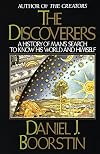
At 684 densely printed pages, plus a further sixty for the author's notes and index, this is neither a light nor an easy read - but very well worthwhile. It was not till I'd finished that I read on to discover, inside the back cover, that Boorstin had been Librarian of Congress the last time I was able to visit that wondeful place, back in the 1980s. Plans to visit this Spring have been dashed by some pandemic - next year perhaps (2022).
Although the general thrust of 'discovery' (the long show more evolution of man's understanding of our world and ourselves) may be well known to most prospective readers, don't let this put you off - I defy anyone to read almost and chapter without discovering some new personality or some new insight.
And don't be so foolish as to assume that, published in 1983, the book is dated, Yes, of course, we've continued to learn many things about distant black holes, the inner space of atoms and the inner space of our own minds, but this book is about the journey - a journey that will never end. show less
Although the general thrust of 'discovery' (the long show more evolution of man's understanding of our world and ourselves) may be well known to most prospective readers, don't let this put you off - I defy anyone to read almost and chapter without discovering some new personality or some new insight.
And don't be so foolish as to assume that, published in 1983, the book is dated, Yes, of course, we've continued to learn many things about distant black holes, the inner space of atoms and the inner space of our own minds, but this book is about the journey - a journey that will never end. show less
The Discoverers is a genial, readable, welcome overview of some of the major scientific discoveries in human history, linked together by theme, and a good candidate for "best book that should have been one of my textbooks in high school but inexplicably wasn't". Boorstin is apparently a generally strong historian, having written several other acclaimed works like the 1974 History Pulitzer winner The Americans, and if that one was anything like this it should be a great read. The Discoverers show more takes a strongly narrative approach to its scope of inquiry, which endeared it to me. It's divided into four main sections: Time, which discusses the inventions of the calendar and clock; The Earth and Seas, which recounts the refinement of mapping, geography, and exploration; Nature, which covers astronomy, medicine, and physics; and Society, which wraps up the modern era as an age where people have studied themselves and their works in unprecedented detail. These general topics are related to the reader through the stories of the explorers and scientists who uncovered new lands and new knowledge, and Boorstin's smooth writing style and talent for both panoramic surveys and detailed explanations should make the content stick in the mind a bit better than the somewhat disjointed style of most textbooks.
I like the way that he treats the "story of progress" as the stories of people, both because he's a great humanist, sensitive to the struggles of people to shrug off constraints of ignorance and see a little farther, and also because that way he's better able to impart just how difficult those struggles were. The overall lesson is that progress is very difficult: people's prejudices - be they the spontaneous generation, geocentrism, the threefold world map - are almost always seemingly reasonable and justifiable by simple inspection, and it takes a lot of deep thinking and hard work to advance the frontiers of knowledge. Boorstin is able to incite both sympathy for the inhabitants of the old worlds and admiration for the pioneers of the new worlds, while returning again and again to a sentiment we would all do well to remember: "I have observed that the world has suffered far less from ignorance than from pretensions to knowledge. It is not skeptics or explorers but fanatics and ideologues who menace decency and progress. No agnostic ever burned anyone at the stake or tortured a pagan, a heretic, or an unbeliever." Well said. Here's hoping that more people read this book, both to celebrate the great scientists and adventurers of the past, and keep in mind that spirit of discovery. show less
I like the way that he treats the "story of progress" as the stories of people, both because he's a great humanist, sensitive to the struggles of people to shrug off constraints of ignorance and see a little farther, and also because that way he's better able to impart just how difficult those struggles were. The overall lesson is that progress is very difficult: people's prejudices - be they the spontaneous generation, geocentrism, the threefold world map - are almost always seemingly reasonable and justifiable by simple inspection, and it takes a lot of deep thinking and hard work to advance the frontiers of knowledge. Boorstin is able to incite both sympathy for the inhabitants of the old worlds and admiration for the pioneers of the new worlds, while returning again and again to a sentiment we would all do well to remember: "I have observed that the world has suffered far less from ignorance than from pretensions to knowledge. It is not skeptics or explorers but fanatics and ideologues who menace decency and progress. No agnostic ever burned anyone at the stake or tortured a pagan, a heretic, or an unbeliever." Well said. Here's hoping that more people read this book, both to celebrate the great scientists and adventurers of the past, and keep in mind that spirit of discovery. show less

Naše predstave o svetu u kome živimo i koje smo često skloni da bez rezerve prihvatimo, imaju svoju dugu i neretko burnu predistoriju. Zbog čega je taj svet kakav jeste, koji su to stavovi, dogme, izumi, otkrića, koje su istine ili zablude učinile da on za nas poprimi upravo onakav oblik, i da ga upravo na ovakav način opažamo i shvatamo, pitanja su na koja Borstinova knjiga pokušava najpre da nas navede, a zatim i da nam ponudi odgovore.
Uz živopisnu pozadinu koju čine biografije show more istraživača iz različitih epoha, upoznajemo se ne samo sa velikim i važnim otkrićima, već i sa tim kako je do njih došlo. Imena Kolumba, Balboe, Magelana i Kuka, Paracelzusa, Galena, Verzalija i Harvija nisu samo simboli za najznačajnija otkrića u istoriji sveta; oni na stranicama Borstinove knjige oživljavaju sa svim svojim vrlinama ali i manama, težnjama i strepnjama zbog kojih zauvek ostaju to što jesu. show less
Uz živopisnu pozadinu koju čine biografije show more istraživača iz različitih epoha, upoznajemo se ne samo sa velikim i važnim otkrićima, već i sa tim kako je do njih došlo. Imena Kolumba, Balboe, Magelana i Kuka, Paracelzusa, Galena, Verzalija i Harvija nisu samo simboli za najznačajnija otkrića u istoriji sveta; oni na stranicama Borstinove knjige oživljavaju sa svim svojim vrlinama ali i manama, težnjama i strepnjama zbog kojih zauvek ostaju to što jesu. show less
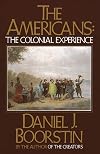
This is a remarkable book about colonial life in America, presented in a fashion quite unlike most history books provide. Boorstin looks at various aspects of life - religion, literacy and literature, the press, the military - and examines them in turn, and paints a picture of life in the colonies as reflected in the activities of the colonists. It is an excellent way into the beginnings of American history, from a fresh and innovative perspective.
Lists
Awards


You May Also Like


Associated Authors
Statistics
- Works
- 88
- Also by
- 22
- Members
- 16,393
- Popularity
- #1,383
- Rating
- 4.0
- Reviews
- 130
- ISBNs
- 252
- Languages
- 16
- Favorited
- 23

