
Jacques Barzun (1907–2012)
Author of From Dawn to Decadence: 1500 to the Present: 500 Years of Western Cultural Life
About the Author
Jacques Barzun was born in Créteil, France on November 30, 1907. He came to the United States in 1920 and graduated magna cum laude from Columbia University in 1927. Following graduation, he joined Columbia's faculty as an instructor while continuing his studies in graduate school there, receiving show more a master's degree in 1928 and a doctorate in French history in 1932. He became a full professor in 1945, was dean of graduate faculties from 1955 to 1958, and dean of faculties from 1958 to 1967. He retired from Columbia University in 1975. He was a historian and cultural critic. The core of his work was the importance of studying history to understand the present and a fundamental respect for intellect. Although he wrote on subjects as diverse as detective fiction and baseball, he was especially known for his many books on music, nineteenth-century romanticism and education. His works include Darwin, Marx and Wagner: Critique of a Heritage; Romanticism and the Modern Ego; The House of Intellect; Race: A Study in Superstition; Simple and Direct: A Rhetoric for Writers; A Stroll with William James; The Culture We Deserve; and From Dawn to Decadence. He died on October 25, 2012 at the age of 104. (Bowker Author Biography) show less
Image credit: "With Light from a New Dawn", painting by Eric Robert Morse, 2005, depicting Jacques Barzun in profile at around the age of 40
Works by Jacques Barzun
From Dawn to Decadence: 1500 to the Present: 500 Years of Western Cultural Life (2000) — Author — 4,076 copies, 41 reviews
A Company of Readers : Uncollected Writings of W. H. Auden, Jacques Barzun, and Lionel Trilling from the Reader's Subscr (2001) 139 copies, 1 review
Critical Questions: On Music and Letters, Culture and Biography, 1940-1980 (1982) 27 copies, 1 review
Bibliophile of the Future: His Complaints About the Twentieth Century (Maury A. Bromsen lecture in humanistic bibliography) (1976) 4 copies
The Selected Letters of Lord Byron 3 copies
Visual outline of English history 2 copies
Is Democratic Theory for Export (Morgenthau Memorial Leture on Ethics and Foreign Policy, No. 6) (1986) 2 copies
The French Race: Theories of Its Oriigins and Their Social and Political Implications, Prior to the Revolution (1966) 2 copies
Berlioz: Requiem 1 copy
Lincoln's philosophic vision 1 copy
Associated Works
Dictionary of Received Ideas (1913) — Translation, introduction, and notes, some editions; Translator — 588 copies, 5 reviews
For the Love of Books: 115 Celebrated Writers on the Books They Love Most (1999) — Contributor — 478 copies, 4 reviews
The Game Is Afoot: Parodies, Pastiches, and Ponderings of Sherlock Holmes (1994) — Contributor — 216 copies, 2 reviews
The Lincoln Anthology: Great Writers on His Life and Legacy from 1860 to Now (2008) — Contributor — 171 copies, 1 review
Physics and Politics: Or, Thoughts on the Application of the Principles of Natural Selection and Inheritance to Political Society (1999) — Introduction, some editions — 94 copies, 2 reviews
Phaedra and Figaro: Racine's Phèdre (1972) — Translator, some editions; Translator, some editions; Translator, some editions — 13 copies, 1 review
The Later Ego 6 copies
Tagged
Common Knowledge
- Canonical name
- Barzun, Jacques
- Legal name
- Barzun, Jacques Martin
- Birthdate
- 1907-11-30
- Date of death
- 2012-10-25
- Gender
- male
- Education
- Columbia University (BA | 1927 | valedictorian | MA | 1928 | PhD | 1932)
- Occupations
- historian
professor
cultural critic - Organizations
- Columbia University
Philolexian Society (president)
Charles Scribner's Sons - Awards and honors
- Presidential Medal of Freedom (2003)
Chevalier de l'Ordre National de la Legion d'Honneur
National Humanities Medal (2010)
Gold Medal, American Academy of Arts and Letters
American Philosophical Society (1984)
American Academy of Arts and Letters (Literature, 1952) (show all 12)
American Academy of Arts and Sciences (1954)
Edgar Award (1972)
St. Louis Literary Award (1968)
Melville Cane Poetry Award (1993)
Philolexian Award for Distinguished Literary Achievement (2011)
Académie Delphinale - Relationships
- Lowell, Mariana (wife)
Davenport, Marguerite Lee (wife) - Short biography
- Jacques Barzun was born in France in 1907. He grew up in Paris and, at twelve years old, was sent by his father to the United States to receive an American university education. In 1923 he entered Columbia College and graduated four years later at the top of his class, having been a prize-winning president of the prestigious Philolexian Society. He went on to lecture at Columbia, where he earned his Ph.D in 1932, became a full professor in 1945, and later became Dean of the Graduate School, Dean of Faculties, and Provost. In 1967 he resigned from his administrative duties to focus on teaching and writing until his retirement in 1975. Over seven decades, Barzun had written and edited more than forty books touching on an unusually broad range of subjects, including science and medicine; psychiatry from Robert Burton through William James to modern methods; art; and classical music - he was one of the all-time authorities on Hector Berlioz. After a period of poor health, he was advised that he had several years of life ahead, and this encouraged him to complete his last and largest book, From Dawn to Decadence: 500 Years of Western Cultural Life, 1500 to the Present (2000), which became an unexpected bestseller and critically acclaimed success. Dr. Barzun was widely known in America and in Europe as a trenchant critic of modern trends in education, music and the arts, and he is also a specialist in musical history. Among his many commendations, he had been featured on the cover of Time magazine (1956); he was awarded the Gold Medal for Criticism from the American Academy of Arts and Letters, to which society he was elected in 1952 and twice served as its president; and he was awarded the Presidential Medal of Freedom in 2003 and he was awarded the 2010 National Humanities Medal by President Obama. Jacques Barzun died October 25, 2012, at the age of 104 in San Antonio, Texas.
- Nationality
- France (birth)
USA (naturalized 1933) - Birthplace
- Créteil, France
- Places of residence
- Créteil, France
Paris, Île-de-France, France
New York, New York, USA
San Antonio, Texas, USA
Grenoble, France - Place of death
- San Antonio, Texas, USA
- Associated Place (for map)
- France
Members
Discussions
Daniel Boorstin and Jacques Barzun in Ancient History (April 2011)
Reviews
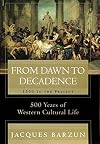
This book is a long read on the cultural history of the west, requiring nearly as much time to think about what the author says as to read it. It is one of the most insightful and thought-provoking books I've ever read. I had post-it flags throughout marking passages whose ideas I wanted to discuss with my husband. It is not a book I could read with distractions or when tired, and so it took me a while to finish, what with all the kids and all the work making me almost always distracted, show more tired, or both. After finishing, I'm actually a little sad to part from Jacques Barzun and his sharp mind and sharp tongue. Despite my long to-read list and the length and density of this book and the challenge of finding the time and mental energy for it, I fully expect to return to it, to reread parts or the whole, when I want to spend some time sitting around with a great mind with no patience for muddled thinking and intellectual laziness. show less

Summary: A discussion of the decline of the intellect and its causes.
It is fashionable in higher educational circles these days to decry the decline of intellectual life. Jacques Barzun, a patrician educator, professor of history and Dean at Columbia was doing that in 1959. What was striking to me was the continuity between what he wrote and our situation over sixty years later.
Barzun would define intellect as the basics of communication from the alphabet to the conventions of the clear show more articulation and argumentation of idea, disciplinary ideas and habits and more. He explains his idea of intellect as follows:
“That part of the world I call the House of the Intellect embraces at least three groups of subjects: the persons who consciously and methodically employ the mind; the forms and habits governing the activities in which the mind is so employed; and the conditions under which these people and activities exist. “
He goes on to explain the “house” metaphor:
“I would speak of the realm of the mind–limited and untamed–but I say the House of the Intellect, because it is an establishment, requiring appurtenances and prescribing conventions.”
He begins by contending that there are three enemies facing the intellect. When artistic sensibilities intrude into intellectual life, aesthetic sense obscures the discursive character of intellectual articulation. When the language of science intrudes, its precision and specificity intrudes into the unity of knowledge. Philanthropy as he uses it is opens education to a wide audience, regardless of fitness (which comes off as elitist, one of my problems with this part of his argument).
He describes the pseudo-intellectualism of public discourse and our polite, cultured conventions of conversation that prevent serious discussions of ideas (although some polite conventions and manners might be needed in our own day). He describes education as without instruction, observing the use of television for instruction (if only he knew) and instruction without authority. He is one of the earliest to recognize the conversion of education into business and college leadership into bureaucracies. And he points out how intellectual pedantry has influenced every discipline, and far beyond–even President Eisenhower declaims, “Marshal Zhukov and I operated together very closely” rather than saying “worked.”
Barzun makes an argument for power and pretension intruding into the work of the intellect. What is concerning is that he also sweeps up the broadening of American education into his critique. I was one of those who benefited by that “broadening,” or as he would call it, “philanthropy.” I would not naturally have enjoyed access to these opportunities, growing up in a lower middle, working class neighborhood. In another era, I might have been excluded from “the house of the Intellect.”
Nevertheless, Barzun poses some important questions. Today, it is the hegemony of STEM fields over those disciplines that classically taught clarity of thought and expression. He guts the jargon-laden discourse of many academic disciplines. He questions the academic fads that often substitute for the instruction that cultivates the intellect. He exposes the conventions of public and personal conversation that thwart intellectual life (I’d love to see what he would do with social media).
Barzun is an educator from another era, and while I cannot endorse some of his ideas, he also holds up a mirror to contemporary educational practice, asking, “why are we doing this?” He was a kind of educational prophet. If you can find a used copy of this online, and care about education, I think you will find this a thought-provoking read. show less
It is fashionable in higher educational circles these days to decry the decline of intellectual life. Jacques Barzun, a patrician educator, professor of history and Dean at Columbia was doing that in 1959. What was striking to me was the continuity between what he wrote and our situation over sixty years later.
Barzun would define intellect as the basics of communication from the alphabet to the conventions of the clear show more articulation and argumentation of idea, disciplinary ideas and habits and more. He explains his idea of intellect as follows:
“That part of the world I call the House of the Intellect embraces at least three groups of subjects: the persons who consciously and methodically employ the mind; the forms and habits governing the activities in which the mind is so employed; and the conditions under which these people and activities exist. “
He goes on to explain the “house” metaphor:
“I would speak of the realm of the mind–limited and untamed–but I say the House of the Intellect, because it is an establishment, requiring appurtenances and prescribing conventions.”
He begins by contending that there are three enemies facing the intellect. When artistic sensibilities intrude into intellectual life, aesthetic sense obscures the discursive character of intellectual articulation. When the language of science intrudes, its precision and specificity intrudes into the unity of knowledge. Philanthropy as he uses it is opens education to a wide audience, regardless of fitness (which comes off as elitist, one of my problems with this part of his argument).
He describes the pseudo-intellectualism of public discourse and our polite, cultured conventions of conversation that prevent serious discussions of ideas (although some polite conventions and manners might be needed in our own day). He describes education as without instruction, observing the use of television for instruction (if only he knew) and instruction without authority. He is one of the earliest to recognize the conversion of education into business and college leadership into bureaucracies. And he points out how intellectual pedantry has influenced every discipline, and far beyond–even President Eisenhower declaims, “Marshal Zhukov and I operated together very closely” rather than saying “worked.”
Barzun makes an argument for power and pretension intruding into the work of the intellect. What is concerning is that he also sweeps up the broadening of American education into his critique. I was one of those who benefited by that “broadening,” or as he would call it, “philanthropy.” I would not naturally have enjoyed access to these opportunities, growing up in a lower middle, working class neighborhood. In another era, I might have been excluded from “the house of the Intellect.”
Nevertheless, Barzun poses some important questions. Today, it is the hegemony of STEM fields over those disciplines that classically taught clarity of thought and expression. He guts the jargon-laden discourse of many academic disciplines. He questions the academic fads that often substitute for the instruction that cultivates the intellect. He exposes the conventions of public and personal conversation that thwart intellectual life (I’d love to see what he would do with social media).
Barzun is an educator from another era, and while I cannot endorse some of his ideas, he also holds up a mirror to contemporary educational practice, asking, “why are we doing this?” He was a kind of educational prophet. If you can find a used copy of this online, and care about education, I think you will find this a thought-provoking read. show less
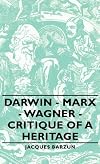
An interesting, and often illuminating, argument about how materialism, or rather, popular perceptions of it, might have helped bring about the worst episodes of the twentieth century. I'm going to have to disagree with HadriantheBlind's assessment. Barzun's focus, or, rather, target, here isn't Darwin's science per se, it's how his age jumped at the chance to make Darwinism into a general principle, usually with terrible results. The point is that Darwin himself -- who wasn't he most show more forceful personalities -- was almost immediately obscured by his interpreters. Barzun also pauses to consider other evolutionary theories that predated Darwin and to consider some of and exactly what separated Darwin from these, which is pretty instructive for anyone concerned with the history of ideas.
"Critique of a Heritiage" is, in a sense, broad-strokes intellectual history, an attempt to figure out how a few great ideas shaped a century's worth of history, and a reminder that even great ideas have their limits and misuses. Barzun, in effect, wants to identify the ideological, often ignored intellectual bulwark that supported materialism and, by doing so, traces the fanaticism and intellectual dogmatism that many people rightly identify with the twentieth century to a few works in the nineteenth. He can be hard on what he considers error -- the elder Huxley, Spencer, Marxists of various stripes, and Marx and Wagner themselves are treated very roughly, on both a personal and intellectual level. But "Critique of a Heritage," though it doesn't mention Freud too often, can be weirdly holistic and psychological, even hopeful. Maybe because this was written in the midst of the Second World War, Barzun seems to want to impress upon his readers these theories' inevitable overreach and their failure to account for every part of man's being. The phrase "the return of the repressed" seems to loom over this entire book. The last few chapters are an impassioned plea for intellectual moderation, the importance of ideas and human consciousness, and general empathy. Now that Marxism's no longer a really viable political force in much of the world and has even lost some cachet in academia, some readers might find it a bit dated. Still, it's nice to find those ideas expressed so succinctly and sincerely. The three individuals mentioned in the title have inspired a library worth of books, but this one is still worth reading. I'd recommend "Critique of a Heritage" for no other reason that it lets readers spend time with a truly educated and organized mind, and that's always a pleasure. show less
"Critique of a Heritiage" is, in a sense, broad-strokes intellectual history, an attempt to figure out how a few great ideas shaped a century's worth of history, and a reminder that even great ideas have their limits and misuses. Barzun, in effect, wants to identify the ideological, often ignored intellectual bulwark that supported materialism and, by doing so, traces the fanaticism and intellectual dogmatism that many people rightly identify with the twentieth century to a few works in the nineteenth. He can be hard on what he considers error -- the elder Huxley, Spencer, Marxists of various stripes, and Marx and Wagner themselves are treated very roughly, on both a personal and intellectual level. But "Critique of a Heritage," though it doesn't mention Freud too often, can be weirdly holistic and psychological, even hopeful. Maybe because this was written in the midst of the Second World War, Barzun seems to want to impress upon his readers these theories' inevitable overreach and their failure to account for every part of man's being. The phrase "the return of the repressed" seems to loom over this entire book. The last few chapters are an impassioned plea for intellectual moderation, the importance of ideas and human consciousness, and general empathy. Now that Marxism's no longer a really viable political force in much of the world and has even lost some cachet in academia, some readers might find it a bit dated. Still, it's nice to find those ideas expressed so succinctly and sincerely. The three individuals mentioned in the title have inspired a library worth of books, but this one is still worth reading. I'd recommend "Critique of a Heritage" for no other reason that it lets readers spend time with a truly educated and organized mind, and that's always a pleasure. show less
This part goes from 1500 to the late 18th Century, circa 1789. This is a vast, encompassing history as saga - a cultural history that is focused on philosophy, the arts, and technological innovation and largely skips over such usual history fodder as battles and bold explorers. There are two elements I really like about this presentation: in-place recommendations to further reading rather than a detached bibliography (including what to skim or what to read in-depth) and similarly at-hand show more immediate glossing for important facts of etymology and shades of meaning.
I thought I was alone in being peeved by the vacuous pronouncements of social niceties. I was glad to see here quoted support that Samuel Johnson agrees:
Johnson. "My dear friend, clear your mind of cant. You may talk as other people do: you may say to a man, 'Sir, I am your most humble servant. You are not his most humble servant. You may say, 'These are sad times; it is a melancholy thing to be reserved to such times." You don't mind the times. You tell a man, "I am sorry you had such bad weather the last day of your journey, and were so much wet." You don't care six-pence whether he was wet or dry. You may talk in this manner; it is a mode of talking in Society; but don't think foolishly."
- Life of Johnson, Vol 1 show less
I thought I was alone in being peeved by the vacuous pronouncements of social niceties. I was glad to see here quoted support that Samuel Johnson agrees:
Johnson. "My dear friend, clear your mind of cant. You may talk as other people do: you may say to a man, 'Sir, I am your most humble servant. You are not his most humble servant. You may say, 'These are sad times; it is a melancholy thing to be reserved to such times." You don't mind the times. You tell a man, "I am sorry you had such bad weather the last day of your journey, and were so much wet." You don't care six-pence whether he was wet or dry. You may talk in this manner; it is a mode of talking in Society; but don't think foolishly."
- Life of Johnson, Vol 1 show less
Lists
Awards


You May Also Like


Associated Authors
Statistics
- Works
- 74
- Also by
- 32
- Members
- 9,606
- Popularity
- #2,496
- Rating
- 4.0
- Reviews
- 86
- ISBNs
- 128
- Languages
- 5
- Favorited
- 23
