
Joseph J. Ellis
Author of Founding Brothers: The Revolutionary Generation
About the Author
Joseph J. Ellis was born in Washington, D.C. on July 18, 1943. He received a B.A. from the College of William and Mary in 1965 and a M.A., M.Phil., and Ph.D. from Yale University. He was an instructor in the department of American studies at Yale University from 1968 to 1969 and an assistant show more professor in the department of history and social studies at the U.S. Military Academy at West Point from 1969 to 1972. He began his career at Mount Holyoke College as assistant professor in the department of history in 1972 and was made professor in 1979. Ellis was dean of the faculty at Mount Holyoke from 1980 to 1990. He retired from his position as the Ford Foundation Professor of History at Mount Holyoke College. He is the author of numerous books including After the Revolution: Profiles of Early American Culture, His Excellency: George Washington, American Creation: Triumphs and Tragedies at the Founding of the Republic, First Family: Abigail and John Adams, Revolutionary Summer: The Birth of American Independence, and The Quartet: Orchestrating the Second American Revolution, 1783-1789. He has received the National Book Award in Nonfiction for American Sphinx in 1997 and the Pulitzer Prize for History for Founding Brothers: The Revolutionary Generation in 2001. (Bowker Author Biography) show less
Works by Joseph J. Ellis
American Creation: Triumphs and Tragedies at the Founding of the Republic (2007) 1,918 copies, 31 reviews
The Quartet: Orchestrating the Second American Revolution, 1783-1789 (2015) 1,034 copies, 26 reviews
Brotherhood of the Revolution How America’s Founders Forged a New Nation (2004) 28 copies, 4 reviews
Associated Works
I Wish I'd Been There: Twenty Historians Bring to Life Dramatic Events That Changed America (2006) — Contributor — 302 copies, 3 reviews
Something That Will Surprise the World: The Essential Writings of the Founding Fathers (2006) — Foreword — 52 copies, 1 review
Tagged
Common Knowledge
- Canonical name
- Ellis, Joseph J.
- Legal name
- Ellis, Joseph John-Michael, III
- Birthdate
- 1943-07-18
- Gender
- male
- Education
- College of William and Mary (BA|1965)
Yale University (M.A.|MFA|Ph.D|1969) - Occupations
- college professor
historian - Organizations
- Mount Holyoke College
U.S. Military Academy
United States Army - Awards and honors
- Pulitzer Prize (History, 2001)
National Book Award (1997) - Agent
- Gerald McCauley
- Nationality
- USA
- Birthplace
- Alexandria, Virginia, USA
- Places of residence
- Amherst, Massachusetts, USA
Vermont, USA - Associated Place (for map)
- USA
Members
Reviews
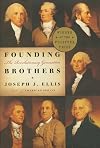
These are not the founding fathers of The Federalist Papers or from you gilt-edged, aura-infused history books. This is the more complicated version, and it doesn't require hundreds or thousands of pages to get to the core of these complicated men. Ellis has written those books, but he wanted something reduced down for easier swallowing. There's coverage of the duel between Burr and Hamilton - honestly, can't think a a worse person to focus a musical puff piece on than Hamilton - and show more coverage of Jefferson and Adams' friendship - and the decade or more virulent rift between them. But the best section covers the issue of slavery, put on the table in 1790 by a petition from Quakers to abolish it. These guys throw up their hands at the problem, identifying it as a union-busting insoluble issue. If they'd only foreseen how right they were about the union-busting part, but they were wrong about the insoluble piece. It's just that they didn't have any will left after mounting a revolution and would rather rest on the laurels of their accomplishment than to focus the revolutionary impetus on the very people who needed it the most.
5 bones!!!!!
Highly Recommended show less
5 bones!!!!!
Highly Recommended show less
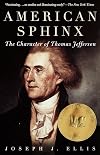
Thomas Jefferson was probably the most complex and conflicted of those individuals who played a significant role in the founding of the United States of America. The title of Joseph Ellis’s book examining this figure is well-chosen. The combination of Jefferson’s romantic political vision, an unwillingness to let reality change that vision, his mixed success at implementing his vision into reality, his reliance on self-delusion, and the deception of others, to avoid facing his many show more contradictions and to achieve his political and personal ends -- all contribute to Jefferson being an enigmatic figure.
Ellis seeks to unearth Jefferson’s true character through examination of both his strengths and flaws as manifested in several key periods in his life. Rather than give us a traditional biography, Ellis makes deep dives into the significance of his actions/thoughts in those key episodes and fills in as necessary any gaps in the biography that remain. The result is a masterful portrait of a complex man - - as well as a cautionary tale on the challenges of the historian’s task in connection with Ellis’s attempt to size up the evidence on Jefferson’s relationship with Sally Hemings, as discussed below.
The book ranges from Jefferson’s writings on the causes and goals of the American Revolution as exemplified in the Declaration of Independence through his term as Ambassador to France, his time in Monticello between serving as Washington’s Secretary of State and becoming President, the eight years of his Presidency and ending with his final years at Monticello, his correspondence with John Adams and founding of the University of Virginia. Ellis concludes that Jefferson held a central core of convictions his entire life, even though they were contradictory and became increasingly hysterical in his retirement. Jefferson combined great depth with great shallowness, massive learning with great naïveté and great insights into others combined with self-deception. Perhaps the greatest enigma concerning this aristocratic landowner was that his core legacy for his country was a radical democratic and egalitarian ethos combined with a continual distrust of government and sympathy with those who rebel against it.
Highlights of the book are set forth below.
Jefferson’s Political Vision. Jefferson’s basic vision was set forth in his writings supporting the American Revolution, including his Summary View of the Rights of British America, the Declaration of Causes, and the Declaration of Independence. He asserted a mythical and untrue description of the colonial past - - for example, that the colonies were independent from their foundation. He declared that Parliament and the King had no authority over the colonies. He ascribed to the Whig vision which saw government as corrupt and opposed to liberty. Ellis sees the Declaration of Independence as derived from many influences in Jefferson’s mind: his own previous writings, the Virginia Constitution which had recently been drafted by George Mason (perhaps the most important source), the egalitarian thinking of the Scottish thinker Francis Hutcheson, John Locke’s principle of the sovereignty of the people (but in a more radical form), the Whig theory of British constitutional history and even the model of government among the Native Americans, as well as the vision which Jefferson had himself developed. His vision of America was an agrarian ideal in which those who worked the earth were the chosen people of God. (In his own life, overwhelmed by debt, he was unable to live this ideal and indeed neither could most farmers in the nineteenth century, given the harsh realities of weather and markets.) In Ellis’s words: “Jefferson was not a profound political thinker. He was, however, an utterly brilliant political rhetorician and visionary. The genius of his vision is to articulate that our deepest yearnings for personal freedom are in fact attainable. The genius of his rhetoric is to articulate irreconcilable human urges at a sufficiently abstract level to mask their mutual exclusiveness. Jefferson guards the American Creed, at this inspirational level, which is inherently immune to scholarly skepticism and a place where ordinary Americans can congregate to speak the magic words together.” (p. 11).
The Constitution. Jefferson was in Paris while the Constitution was drafted and ratified by the states. Madison had kept him in touch from afar and largely succeeded in obtaining Jefferson’s consent, although Jefferson wanted a bill of rights and limits on presidential power. Nevertheless, many aspects of the Constitution were contrary to Jefferson’s own republican vision and in later years he did not hesitate to criticize or even oppose the operation of the constitutional scheme. Examples include his strong opposition to judicial review and to the need for federal courts in the first place (as exemplified by his opposition to John Marshall), his belief that no American generation could bind its successors, meaning that each generation could redo the Constitution (Madison pointed out to Jefferson that this was unrealistic) and his opposition to a strong president. He strongly supported freedom of speech (despite his slipping back when President). He also invariably sympathized with rebellions against government including Shay’s Rebellion and the Whiskey Rebellion. His vision of political society was one made up of individuals acting responsibly; he opposed institutional arrangements and checks and balances of the kind embedded in the Constitution as all too much government limiting liberty.
Jefferson’s Presidency. Alexander Hamilton supported Jefferson over Aaron Burr when the tie in the electoral college in the election of 1800 brought the election into the House of Representatives for decision by the states. Despite Jefferson’s strong anti-Federalist views, Hamilton thought that in the end Jefferson was too pragmatic to disassemble the federal government and persuaded the New York delegation to vote for Jefferson over the unprincipled Aaron Burr. Nevertheless, Jefferson signaled in his inaugural address (next to the Declaration of Independence the most important and eloquent document he wrote), that he intended to return the country to the “pure republicanism” of the American Revolution, which entailed rolling back the federal government and its nationalist policies. In the end, Hamilton was correct; Jefferson did not dismantle the central government. However, he did accomplish several measures to pare back the structure created by the Federalists and indeed counted as one of his achievements the destruction of Federalists. Thanks to the peace secured by John Adams in the “quasi-war” with France and Great Britain, Jefferson was able to cut back the navy and the army. Treasury Secretary Gallatin’s plan to pay off the national debt was also a great success, fueled by a strong economy which generated high tax revenues. Finally, Jefferson had success in cutting the number of federal government employees, especially those who were Federalists. However, in other respects, and despite having strong majorities in both the House and the Senate, he did not achieve his republican ideals. While the Judiciary Act of 1801 that created Federal Circuit judges was repealed, Jefferson was unable to weaken the Supreme Court, led by his enemy the Federalist John Marshall, or its assertion of the power of judicial review over the Constitution. He feared federal courts would contribute to the “consolidation” of central governmental power. In addition, when the opportunity to acquire Louisiana from Napoleon appeared, Jefferson asserted broad executive power to take control of the new territory without clear constitutional authority to do so, thus acting as a strong president despite his general objections to presidential power. And his luck began to run out in his second term. He initiated the disastrous embargo against imports from Great Britain which hurt the United States much more than it did Great Britain.
Slavery. Like many in that era, his views on slavery evolved over time. In the abstract, he always opposed slavery. In his Notes on Virginia, written for the French while he was ambassador in Paris, he stated that slavery was incompatible with the ideals of the American Revolution and predicted that planters would emancipate slaves. He dreaded God’s judgment. He also believed that blacks and whites would be unable to live together in harmony so that racial war and extermination were likely outcomes of emancipation. Whites might well have to emigrate from the South. Later he gave up on freeing the slaves in his time and left the task to the next generation -- basically slavery would disappear over time. He combined condemnation with procrastination. As he got older, he became more aware of his own dependence on slavery. The debate over slavery in Missouri brought things to a head. The North including his friend John Adams thought slavery should be prohibited in Missouri, with the understanding that the Constitution had represented a compromise between North and South in which the North deferred to the South on the timing and process for ending slavery in the South. Now the South had shifted to wanting to expand slavery rather than end it as people like Adams expected. This all occurred after Jefferson’s retirement when he had become more isolated from people outside of Virginia and more hysterical in his defense of his beliefs. In an argument that shocked Adams (who saw slavery as a cancer), he maintained that permitting slavery to “diffuse” to the territories of the expanding United States would eventually lead to its disappearance via a kind of dilution (akin to the thinking of Federalist Number 10 that factions would be less likely to gain a foothold in a large republic). And he argued that the proposal to exclude slavery from Missouri was a pretext for banning it in the South altogether. This was an exercise of the “consolidation” of central governmental power, which for him was contrary to the republicanism of the American Revolution. Secession was preferable to consolidation. “It was the old Whig rhetoric but now harnessed to the most provincial interests of Virginia politics.” (p. 326.) Unlike Washington, he did not free his slaves upon his death, except for some household slaves.
Native Americans. In his political vision, Jefferson idealized Native American societies. However, as a politician, he viewed Native Americans as doomed unless they assimilated with the dominant Anglo-Saxon culture. In this regard, he had no hesitancy as president in laying the groundwork for deporting Native Americans, including pushing them beyond the Mississippi. By the same token, he saw expansion into the West as the future of the country. Interests of Native Americans could not be permitted to interfere.
Religion. Jefferson was a strong believer in the separation of church and state and opposed any governmental interference with a person’s religious beliefs. Writing in the 1990’s, Ellis notes that Jefferson would be dismayed that the branch of government he hated the most, the Supreme Court, would be the chief defender of separation. In 2022, given the changes in the Supreme Court, Ellis’s observation has lost its force. In terms of his own religious beliefs, Jefferson defended himself against charges that he was an atheist or at least not a Christian by describing himself as a disciple of the doctrines of Jesus and of primitive Christianity. He rejected the “corruptions” of the organized church and attacked denominations, Protestant and Catholic, for making the simple teachings of Christianity incomprehensible. If he had put aside the need to assert his Christianity to beat off the criticism of political foes, Ellis remarks that “he would have described himself as a deist who admired the ethical teachings of Jesus as a man rather than as the son of God.” (p. 310). The University of Virginia, founded by Jefferson, had no religious affiliation, and Jefferson went so far as to prohibit teaching of theology altogether.
Adams-Jefferson Correspondence. Adams and Jefferson worked together during the revolution, with Jefferson being deferential to the older Adams, but became enemies with the split between Federalists and Republicans that occurred after the ratification of the Constitution. Benjamin Rush of Philadelphia encouraged John Adams to reengage with Jefferson, and they started a correspondence in 1812 which lasted fourteen years. Ellis describes their correspondence as a literary monument to the meaning of the revolution. Adams was a realist and empiricist and criticized Jefferson’s idealism and unshakable belief in reason. Jefferson saw history as a clash between the popular majority and despotic elites, and thought the ideals of the American and French Revolutions would spread throughout the world. Adams believed in popular sovereignty but also saw the majority as a danger. He thought there would always be elites and that social equality was an illusion. In his view, the government would have to step in to reduce inequality. Jefferson saw the American Revolution as a clean break with the past, betrayed by the Federalists with the establishment of a strong central government in the Constitution. Adams, sensitive to his own place in history, downplayed the importance of the Declaration of Independence and argued that the short resolution on May 5, 1976 declaring independence was the key step in the revolution. Jefferson, also becoming sensitive to his legacy and aware of the fact that the Declaration of Independence had become an important part of it, naturally pushed back. “If the American Revolution had become a national hymn, [Adams and Jefferson] were its words and music. The ironies abound, since the self-made son of a New England farmer and shoemaker was insisting that neither individual freedom nor social equality was ever a goal of the revolutionary generation, while the Virginia aristocrat with an inherited plantation of lands and slaves was insisting that both were.” (p. 299).
Sally Hemings. The book contains an appendix on the Sally Hemings “scandals” in which Ellis weighs carefully the evidence pro and con that Jefferson was the father of Heming’s children. (The appendix was written prior to DNA testing that occurred after publication of the book.) He cites among other things testimony of Sally’s descendants asserting Jefferson was the father, accusations of the same in the press by his enemies during Jefferson’s lifetime (sourced to his former associate and later enemy, James Callender), the fact that Jefferson’s father-in-law had fathered Sally, the fact that Jefferson, who was often away from Monticello, was always there nine months before Sally gave birth and the general practice of many slaveowners to have sexual relationships with their slaves. Sally’s children were very light in appearance (making it obvious their father was white), and Jefferson emancipated the children before his death. (Jefferson freed few of his other slaves.) He also cites factors that count against the conclusion that there was a sexual relationship. The alternative theory, put forth by Jefferson’s white descendants and others who deny Jefferson’s parentage, was that Jefferson's nephew, Peter Carr, was the father. Despite acknowledging a difficulty in reaching a clear conclusion in light of the quality of the evidence as he sees it, and claiming that the evidence would be inadequate in a court of law for either position, Ellis engages in what he calls “reasonable speculation” and reaches a conclusion that Jefferson’s having a sexual relationship with Hemings was “remote.” Ironically, he seems to come down most strongly on the argument that such a relationship was inconsistent with Jefferson’s character. Specifically, Ellis claims that his immersion in the historical evidence has persuaded him that “for most of his adult life, [Jefferson] lacked the capacity for the direct and physical expression of his sexual energies.” Putting aside that Annette Gordon-Reed’s work and DNA testing has now shifted the consensus to the conclusion that Jefferson is indeed the father of Sally’s children, it is difficult to see how Ellis could reach such a conclusion given the character of Jefferson that he has presented in his book – a character full of inconsistencies, self-deception and deception of others. Why shouldn’t these characteristics come into play in Jefferson’s relationship with Sally, especially when the powerful force of physical love was present? We can easily imagine Jefferson’s mind appealing to considerations such as by not marrying Sally, he remained true to his promise to his deceased wife never to remarry, and because Sally was the daughter of his father-in-law (and half-sister of his wife) the liaison was okay despite Jefferson’s general objections to miscegenation. There the matter might have been left if it had not been for Annette Gordon-Reed’s work and the input of DNA testing, which caused Ellis to change his view and agree with the growing consensus that Jefferson was indeed the father of Sally’s children. But it is hard to avoid the conclusion that in the appendix Ellis had let his own wishful thinking influence his “reasonable speculation.” Not surprisingly, historians also have human flaws.
Personal Style. Jefferson was a lawyer but a poor speaker. His initial writings in favor of the colonies’ position against Great Britain helped him secure the task of writing the Declaration of Independence. During his presidency, he avoided speeches as well as political debate. Cabinet meetings were to approve actions previously agreed upon, not debate policy issues. Discussion of political actions took the form of written drafts that would be circulated and commented upon by Jefferson and members of his cabinet. Accordingly, there is a strong written record of his presidency. He was a refined scholar who thrived in solitary study. He took all criticism personally, including edits to his draft of the Declaration of Independence. Jefferson loved his personal library. Because of his financial difficulties, he was forced to sell it to the US government and it became the core collection of the Library of Congress. He prepared a list of all his books - - if he were to return today he would love LibraryThing and indeed his legacy library is on LT. Jefferson was a horseback rider all his life: He rode back to Monticello when his Presidency ended. And in a scene that could have come out of Cat Ballou, Ellis describes how his horse Eagle would lean against the house to make it easier for the aging Jefferson to mount.
Legacy. In many respects, Jefferson’s vision of America was not borne out by subsequent American history: The Civil War destroyed the doctrine that states were sovereign agents in the federal compact, the country shifted from a predominantly rural agrarian society to an urban industrialized one and both domestic and foreign challenges led to stronger central government. However, as Ellis points out “[t]he entire history of liberal reform in America can be written as a process of discovery, within Jefferson’s words, of a spiritually sanctioned mandate for ending slavery, providing the rights of citizenship to blacks and women, justifying welfare programs for the poor and expanding individual freedom.” (p. 63). And the tradition of distrust in government is with us strongly today. show less
Ellis seeks to unearth Jefferson’s true character through examination of both his strengths and flaws as manifested in several key periods in his life. Rather than give us a traditional biography, Ellis makes deep dives into the significance of his actions/thoughts in those key episodes and fills in as necessary any gaps in the biography that remain. The result is a masterful portrait of a complex man - - as well as a cautionary tale on the challenges of the historian’s task in connection with Ellis’s attempt to size up the evidence on Jefferson’s relationship with Sally Hemings, as discussed below.
The book ranges from Jefferson’s writings on the causes and goals of the American Revolution as exemplified in the Declaration of Independence through his term as Ambassador to France, his time in Monticello between serving as Washington’s Secretary of State and becoming President, the eight years of his Presidency and ending with his final years at Monticello, his correspondence with John Adams and founding of the University of Virginia. Ellis concludes that Jefferson held a central core of convictions his entire life, even though they were contradictory and became increasingly hysterical in his retirement. Jefferson combined great depth with great shallowness, massive learning with great naïveté and great insights into others combined with self-deception. Perhaps the greatest enigma concerning this aristocratic landowner was that his core legacy for his country was a radical democratic and egalitarian ethos combined with a continual distrust of government and sympathy with those who rebel against it.
Highlights of the book are set forth below.
Jefferson’s Political Vision. Jefferson’s basic vision was set forth in his writings supporting the American Revolution, including his Summary View of the Rights of British America, the Declaration of Causes, and the Declaration of Independence. He asserted a mythical and untrue description of the colonial past - - for example, that the colonies were independent from their foundation. He declared that Parliament and the King had no authority over the colonies. He ascribed to the Whig vision which saw government as corrupt and opposed to liberty. Ellis sees the Declaration of Independence as derived from many influences in Jefferson’s mind: his own previous writings, the Virginia Constitution which had recently been drafted by George Mason (perhaps the most important source), the egalitarian thinking of the Scottish thinker Francis Hutcheson, John Locke’s principle of the sovereignty of the people (but in a more radical form), the Whig theory of British constitutional history and even the model of government among the Native Americans, as well as the vision which Jefferson had himself developed. His vision of America was an agrarian ideal in which those who worked the earth were the chosen people of God. (In his own life, overwhelmed by debt, he was unable to live this ideal and indeed neither could most farmers in the nineteenth century, given the harsh realities of weather and markets.) In Ellis’s words: “Jefferson was not a profound political thinker. He was, however, an utterly brilliant political rhetorician and visionary. The genius of his vision is to articulate that our deepest yearnings for personal freedom are in fact attainable. The genius of his rhetoric is to articulate irreconcilable human urges at a sufficiently abstract level to mask their mutual exclusiveness. Jefferson guards the American Creed, at this inspirational level, which is inherently immune to scholarly skepticism and a place where ordinary Americans can congregate to speak the magic words together.” (p. 11).
The Constitution. Jefferson was in Paris while the Constitution was drafted and ratified by the states. Madison had kept him in touch from afar and largely succeeded in obtaining Jefferson’s consent, although Jefferson wanted a bill of rights and limits on presidential power. Nevertheless, many aspects of the Constitution were contrary to Jefferson’s own republican vision and in later years he did not hesitate to criticize or even oppose the operation of the constitutional scheme. Examples include his strong opposition to judicial review and to the need for federal courts in the first place (as exemplified by his opposition to John Marshall), his belief that no American generation could bind its successors, meaning that each generation could redo the Constitution (Madison pointed out to Jefferson that this was unrealistic) and his opposition to a strong president. He strongly supported freedom of speech (despite his slipping back when President). He also invariably sympathized with rebellions against government including Shay’s Rebellion and the Whiskey Rebellion. His vision of political society was one made up of individuals acting responsibly; he opposed institutional arrangements and checks and balances of the kind embedded in the Constitution as all too much government limiting liberty.
Jefferson’s Presidency. Alexander Hamilton supported Jefferson over Aaron Burr when the tie in the electoral college in the election of 1800 brought the election into the House of Representatives for decision by the states. Despite Jefferson’s strong anti-Federalist views, Hamilton thought that in the end Jefferson was too pragmatic to disassemble the federal government and persuaded the New York delegation to vote for Jefferson over the unprincipled Aaron Burr. Nevertheless, Jefferson signaled in his inaugural address (next to the Declaration of Independence the most important and eloquent document he wrote), that he intended to return the country to the “pure republicanism” of the American Revolution, which entailed rolling back the federal government and its nationalist policies. In the end, Hamilton was correct; Jefferson did not dismantle the central government. However, he did accomplish several measures to pare back the structure created by the Federalists and indeed counted as one of his achievements the destruction of Federalists. Thanks to the peace secured by John Adams in the “quasi-war” with France and Great Britain, Jefferson was able to cut back the navy and the army. Treasury Secretary Gallatin’s plan to pay off the national debt was also a great success, fueled by a strong economy which generated high tax revenues. Finally, Jefferson had success in cutting the number of federal government employees, especially those who were Federalists. However, in other respects, and despite having strong majorities in both the House and the Senate, he did not achieve his republican ideals. While the Judiciary Act of 1801 that created Federal Circuit judges was repealed, Jefferson was unable to weaken the Supreme Court, led by his enemy the Federalist John Marshall, or its assertion of the power of judicial review over the Constitution. He feared federal courts would contribute to the “consolidation” of central governmental power. In addition, when the opportunity to acquire Louisiana from Napoleon appeared, Jefferson asserted broad executive power to take control of the new territory without clear constitutional authority to do so, thus acting as a strong president despite his general objections to presidential power. And his luck began to run out in his second term. He initiated the disastrous embargo against imports from Great Britain which hurt the United States much more than it did Great Britain.
Slavery. Like many in that era, his views on slavery evolved over time. In the abstract, he always opposed slavery. In his Notes on Virginia, written for the French while he was ambassador in Paris, he stated that slavery was incompatible with the ideals of the American Revolution and predicted that planters would emancipate slaves. He dreaded God’s judgment. He also believed that blacks and whites would be unable to live together in harmony so that racial war and extermination were likely outcomes of emancipation. Whites might well have to emigrate from the South. Later he gave up on freeing the slaves in his time and left the task to the next generation -- basically slavery would disappear over time. He combined condemnation with procrastination. As he got older, he became more aware of his own dependence on slavery. The debate over slavery in Missouri brought things to a head. The North including his friend John Adams thought slavery should be prohibited in Missouri, with the understanding that the Constitution had represented a compromise between North and South in which the North deferred to the South on the timing and process for ending slavery in the South. Now the South had shifted to wanting to expand slavery rather than end it as people like Adams expected. This all occurred after Jefferson’s retirement when he had become more isolated from people outside of Virginia and more hysterical in his defense of his beliefs. In an argument that shocked Adams (who saw slavery as a cancer), he maintained that permitting slavery to “diffuse” to the territories of the expanding United States would eventually lead to its disappearance via a kind of dilution (akin to the thinking of Federalist Number 10 that factions would be less likely to gain a foothold in a large republic). And he argued that the proposal to exclude slavery from Missouri was a pretext for banning it in the South altogether. This was an exercise of the “consolidation” of central governmental power, which for him was contrary to the republicanism of the American Revolution. Secession was preferable to consolidation. “It was the old Whig rhetoric but now harnessed to the most provincial interests of Virginia politics.” (p. 326.) Unlike Washington, he did not free his slaves upon his death, except for some household slaves.
Native Americans. In his political vision, Jefferson idealized Native American societies. However, as a politician, he viewed Native Americans as doomed unless they assimilated with the dominant Anglo-Saxon culture. In this regard, he had no hesitancy as president in laying the groundwork for deporting Native Americans, including pushing them beyond the Mississippi. By the same token, he saw expansion into the West as the future of the country. Interests of Native Americans could not be permitted to interfere.
Religion. Jefferson was a strong believer in the separation of church and state and opposed any governmental interference with a person’s religious beliefs. Writing in the 1990’s, Ellis notes that Jefferson would be dismayed that the branch of government he hated the most, the Supreme Court, would be the chief defender of separation. In 2022, given the changes in the Supreme Court, Ellis’s observation has lost its force. In terms of his own religious beliefs, Jefferson defended himself against charges that he was an atheist or at least not a Christian by describing himself as a disciple of the doctrines of Jesus and of primitive Christianity. He rejected the “corruptions” of the organized church and attacked denominations, Protestant and Catholic, for making the simple teachings of Christianity incomprehensible. If he had put aside the need to assert his Christianity to beat off the criticism of political foes, Ellis remarks that “he would have described himself as a deist who admired the ethical teachings of Jesus as a man rather than as the son of God.” (p. 310). The University of Virginia, founded by Jefferson, had no religious affiliation, and Jefferson went so far as to prohibit teaching of theology altogether.
Adams-Jefferson Correspondence. Adams and Jefferson worked together during the revolution, with Jefferson being deferential to the older Adams, but became enemies with the split between Federalists and Republicans that occurred after the ratification of the Constitution. Benjamin Rush of Philadelphia encouraged John Adams to reengage with Jefferson, and they started a correspondence in 1812 which lasted fourteen years. Ellis describes their correspondence as a literary monument to the meaning of the revolution. Adams was a realist and empiricist and criticized Jefferson’s idealism and unshakable belief in reason. Jefferson saw history as a clash between the popular majority and despotic elites, and thought the ideals of the American and French Revolutions would spread throughout the world. Adams believed in popular sovereignty but also saw the majority as a danger. He thought there would always be elites and that social equality was an illusion. In his view, the government would have to step in to reduce inequality. Jefferson saw the American Revolution as a clean break with the past, betrayed by the Federalists with the establishment of a strong central government in the Constitution. Adams, sensitive to his own place in history, downplayed the importance of the Declaration of Independence and argued that the short resolution on May 5, 1976 declaring independence was the key step in the revolution. Jefferson, also becoming sensitive to his legacy and aware of the fact that the Declaration of Independence had become an important part of it, naturally pushed back. “If the American Revolution had become a national hymn, [Adams and Jefferson] were its words and music. The ironies abound, since the self-made son of a New England farmer and shoemaker was insisting that neither individual freedom nor social equality was ever a goal of the revolutionary generation, while the Virginia aristocrat with an inherited plantation of lands and slaves was insisting that both were.” (p. 299).
Sally Hemings. The book contains an appendix on the Sally Hemings “scandals” in which Ellis weighs carefully the evidence pro and con that Jefferson was the father of Heming’s children. (The appendix was written prior to DNA testing that occurred after publication of the book.) He cites among other things testimony of Sally’s descendants asserting Jefferson was the father, accusations of the same in the press by his enemies during Jefferson’s lifetime (sourced to his former associate and later enemy, James Callender), the fact that Jefferson’s father-in-law had fathered Sally, the fact that Jefferson, who was often away from Monticello, was always there nine months before Sally gave birth and the general practice of many slaveowners to have sexual relationships with their slaves. Sally’s children were very light in appearance (making it obvious their father was white), and Jefferson emancipated the children before his death. (Jefferson freed few of his other slaves.) He also cites factors that count against the conclusion that there was a sexual relationship. The alternative theory, put forth by Jefferson’s white descendants and others who deny Jefferson’s parentage, was that Jefferson's nephew, Peter Carr, was the father. Despite acknowledging a difficulty in reaching a clear conclusion in light of the quality of the evidence as he sees it, and claiming that the evidence would be inadequate in a court of law for either position, Ellis engages in what he calls “reasonable speculation” and reaches a conclusion that Jefferson’s having a sexual relationship with Hemings was “remote.” Ironically, he seems to come down most strongly on the argument that such a relationship was inconsistent with Jefferson’s character. Specifically, Ellis claims that his immersion in the historical evidence has persuaded him that “for most of his adult life, [Jefferson] lacked the capacity for the direct and physical expression of his sexual energies.” Putting aside that Annette Gordon-Reed’s work and DNA testing has now shifted the consensus to the conclusion that Jefferson is indeed the father of Sally’s children, it is difficult to see how Ellis could reach such a conclusion given the character of Jefferson that he has presented in his book – a character full of inconsistencies, self-deception and deception of others. Why shouldn’t these characteristics come into play in Jefferson’s relationship with Sally, especially when the powerful force of physical love was present? We can easily imagine Jefferson’s mind appealing to considerations such as by not marrying Sally, he remained true to his promise to his deceased wife never to remarry, and because Sally was the daughter of his father-in-law (and half-sister of his wife) the liaison was okay despite Jefferson’s general objections to miscegenation. There the matter might have been left if it had not been for Annette Gordon-Reed’s work and the input of DNA testing, which caused Ellis to change his view and agree with the growing consensus that Jefferson was indeed the father of Sally’s children. But it is hard to avoid the conclusion that in the appendix Ellis had let his own wishful thinking influence his “reasonable speculation.” Not surprisingly, historians also have human flaws.
Personal Style. Jefferson was a lawyer but a poor speaker. His initial writings in favor of the colonies’ position against Great Britain helped him secure the task of writing the Declaration of Independence. During his presidency, he avoided speeches as well as political debate. Cabinet meetings were to approve actions previously agreed upon, not debate policy issues. Discussion of political actions took the form of written drafts that would be circulated and commented upon by Jefferson and members of his cabinet. Accordingly, there is a strong written record of his presidency. He was a refined scholar who thrived in solitary study. He took all criticism personally, including edits to his draft of the Declaration of Independence. Jefferson loved his personal library. Because of his financial difficulties, he was forced to sell it to the US government and it became the core collection of the Library of Congress. He prepared a list of all his books - - if he were to return today he would love LibraryThing and indeed his legacy library is on LT. Jefferson was a horseback rider all his life: He rode back to Monticello when his Presidency ended. And in a scene that could have come out of Cat Ballou, Ellis describes how his horse Eagle would lean against the house to make it easier for the aging Jefferson to mount.
Legacy. In many respects, Jefferson’s vision of America was not borne out by subsequent American history: The Civil War destroyed the doctrine that states were sovereign agents in the federal compact, the country shifted from a predominantly rural agrarian society to an urban industrialized one and both domestic and foreign challenges led to stronger central government. However, as Ellis points out “[t]he entire history of liberal reform in America can be written as a process of discovery, within Jefferson’s words, of a spiritually sanctioned mandate for ending slavery, providing the rights of citizenship to blacks and women, justifying welfare programs for the poor and expanding individual freedom.” (p. 63). And the tradition of distrust in government is with us strongly today. show less
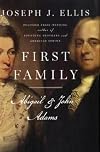
In a similar vein to Ellis’s other books on the nation’s founders (First Brothers, Revolutionary Summer, Thomas Jefferson: American Sphinx) Ellis gives us a close look at two who are among the most notable of the pantheon: John and Abigail Adams. The couple left volumes of personal letters that let us peer into the political issues of their times, their personalities and their deep marital relationship. The letters provide the basis for greater understand of the tumultuous times and show more events. We see the successes as well as the failures and frustrations that the founders experienced without, valuably, the rose-colored glasses (or politically motivated distortion) too often seen today.
John Adams was one of the most skillful instigators of the political decisions that led the colonies to strike for independence from Britain. Clearly no founder deserves more credit for maneuvering the disparate and conflicting ideas and factions into the unity that severed the colonial ties with England. As a man, Adams was highly ambitious and decidedly vain; he was constantly motivated by his craving to be remembered and venerated by future generations. He was impulsive and often agitated, traits that Abigail worked hard to help him keep under control. Adams picked up the reputation in the years of and following his presidency of being a closet monarchist. This was undeserved, but Adams did hold a large measure of skepticism about wisdom of the masses that were apt to be swayed by demagoguery and passions of the moment. Adams was a staunch believer in the powers of the central government and he aligned with the federalist faction, although he and Hamilton became bitter enemies. His views were quite contrary to those of Jefferson who tended to support the primacy of the states over a central authority. He and Jefferson, once on the friendliest terms, became estranged during Washington’s administration. Jefferson became Adams’s vice-president due to the flaw in the constitutional method of presidential elections that resulted in the runner-up taking the vice-presidency (soon fixed by the twelfth amendment). As Adams’s subordinate Jefferson is shown to be devious and disloyal to an extreme degree. His manipulations played a part in Adams’s failure to be elected to a second term. In the late years of both men’s lives they reconciled and exchanged a remarkable correspondence. (In one of history’s most poignant coincidences, these two giants died on July 4, 1826 within hours of each other.)
Adams often made decisions from perspectives that ran counter to popular views; he believed that his contrary views supported their correctness. As president he held firm to the unpopular decision to remain neutral in France’s conflict with Britain when opposing factions either favored war with France or unfettered support for revolutionary France. He is long forgotten as the father of the US Navy, built at his insistence to thwart any ambitions of the Europeans with their powerful naval forces. He is often remembered for his most egregious decision to advocate for and sign the Alien and Sedition Act, a law aimed at silencing critics of his administration. What is too little recognized today is his belief in the separation of powers among the executive, legislature and judiciary, a concept he introduced with his authorship of the Massachusetts Commonwealth’s constitution. His “midnight” appointment of John Marshall as chief justice, much resented by successor Jefferson, turned out to have profound impact securing the role of the court in our democracy.
Abigail Adams was a remarkable woman for her times, perhaps for any time. Without formal education and in a society that expected women to eschew political opinions, she was deeply knowledgeable of the political issues that her husband and the country faced. Her advice to him was cogent and sophisticated and he relied heavily on her guidance in reaching his judgments. She was attuned to his weaknesses – his vanity and impulsiveness – and could mitigate the consequences of these traits through her advice to him. John and Abigail were a perfect balance for each other and both had not only deep affection but also complete mutual respect. Ellis points out that we owe to John’s frequent absences from home at Congress or abroad the presence of the volumes of correspondence they shared. Although certainly a hindsight perspective, Abigail can be said to be a forerunner of feminism and notions of gender equality – her complaints about the subordinate status of women in politics and the law are seen in her letters.
The book tells us much about the Adams’s family. John Quincy was the favored son and his parents’ high expectations and demands for his success as an adult were realized. The other Adams’s offspring did not fare so well. Charles became and alcoholic and died an early death. Thomas floundered in his legal profession and took to drink. Nabby had a bad marriage and succumbed to breast cancer while still young.
Ellis would claim that John and Abigail remain the foremost political couple that our nation has seen. One must agree. Franklin and Eleanor were powerful players on the nation’s stage, but her influence seemed to run parallel to his, not conjoined. Bill and Hillary? While effective political partners, one suspects that ambition undergirds the relationship, not affection as was the case of the Adams.
One aside about letters. The qualities of the correspondence shared between the Adams – introspective, thoughtful, expository, lengthy, etc. – are not features of today’s electronic media. One can’t imagine the richness of the Adams’s letters surviving the world of tweeting, instagram and Facebook. show less
John Adams was one of the most skillful instigators of the political decisions that led the colonies to strike for independence from Britain. Clearly no founder deserves more credit for maneuvering the disparate and conflicting ideas and factions into the unity that severed the colonial ties with England. As a man, Adams was highly ambitious and decidedly vain; he was constantly motivated by his craving to be remembered and venerated by future generations. He was impulsive and often agitated, traits that Abigail worked hard to help him keep under control. Adams picked up the reputation in the years of and following his presidency of being a closet monarchist. This was undeserved, but Adams did hold a large measure of skepticism about wisdom of the masses that were apt to be swayed by demagoguery and passions of the moment. Adams was a staunch believer in the powers of the central government and he aligned with the federalist faction, although he and Hamilton became bitter enemies. His views were quite contrary to those of Jefferson who tended to support the primacy of the states over a central authority. He and Jefferson, once on the friendliest terms, became estranged during Washington’s administration. Jefferson became Adams’s vice-president due to the flaw in the constitutional method of presidential elections that resulted in the runner-up taking the vice-presidency (soon fixed by the twelfth amendment). As Adams’s subordinate Jefferson is shown to be devious and disloyal to an extreme degree. His manipulations played a part in Adams’s failure to be elected to a second term. In the late years of both men’s lives they reconciled and exchanged a remarkable correspondence. (In one of history’s most poignant coincidences, these two giants died on July 4, 1826 within hours of each other.)
Adams often made decisions from perspectives that ran counter to popular views; he believed that his contrary views supported their correctness. As president he held firm to the unpopular decision to remain neutral in France’s conflict with Britain when opposing factions either favored war with France or unfettered support for revolutionary France. He is long forgotten as the father of the US Navy, built at his insistence to thwart any ambitions of the Europeans with their powerful naval forces. He is often remembered for his most egregious decision to advocate for and sign the Alien and Sedition Act, a law aimed at silencing critics of his administration. What is too little recognized today is his belief in the separation of powers among the executive, legislature and judiciary, a concept he introduced with his authorship of the Massachusetts Commonwealth’s constitution. His “midnight” appointment of John Marshall as chief justice, much resented by successor Jefferson, turned out to have profound impact securing the role of the court in our democracy.
Abigail Adams was a remarkable woman for her times, perhaps for any time. Without formal education and in a society that expected women to eschew political opinions, she was deeply knowledgeable of the political issues that her husband and the country faced. Her advice to him was cogent and sophisticated and he relied heavily on her guidance in reaching his judgments. She was attuned to his weaknesses – his vanity and impulsiveness – and could mitigate the consequences of these traits through her advice to him. John and Abigail were a perfect balance for each other and both had not only deep affection but also complete mutual respect. Ellis points out that we owe to John’s frequent absences from home at Congress or abroad the presence of the volumes of correspondence they shared. Although certainly a hindsight perspective, Abigail can be said to be a forerunner of feminism and notions of gender equality – her complaints about the subordinate status of women in politics and the law are seen in her letters.
The book tells us much about the Adams’s family. John Quincy was the favored son and his parents’ high expectations and demands for his success as an adult were realized. The other Adams’s offspring did not fare so well. Charles became and alcoholic and died an early death. Thomas floundered in his legal profession and took to drink. Nabby had a bad marriage and succumbed to breast cancer while still young.
Ellis would claim that John and Abigail remain the foremost political couple that our nation has seen. One must agree. Franklin and Eleanor were powerful players on the nation’s stage, but her influence seemed to run parallel to his, not conjoined. Bill and Hillary? While effective political partners, one suspects that ambition undergirds the relationship, not affection as was the case of the Adams.
One aside about letters. The qualities of the correspondence shared between the Adams – introspective, thoughtful, expository, lengthy, etc. – are not features of today’s electronic media. One can’t imagine the richness of the Adams’s letters surviving the world of tweeting, instagram and Facebook. show less

Ellis' thesis in this book is that 1776 is the key year in the story of the American Revolution, but that historians have tended to tell the story in separate accounts, focusing on either the political story in Philadelphia with the Continental Congress, or the military events in New York. But Ellis argues that they were two sides of a single story that cannot truly be understood unless they are told together. These events were happening at the same time, and what happened in one place show more influenced outcomes in the other. He proceeds to give us the story, with details of what was happening on both fronts. He provides descriptive portraits of Washington, Jefferson, Adams, and Franklin, as well as some of the leading figures on the English side. His descriptions of the political and military situations are clear and revealing.
The events surrounding the American Revolution are familiar, and we think we know what happened, but he provides details that I did not know. For one thing, we know all the stories about the deprivations that the Continental Army faced throughout the war. One of the problems being that enlistments were normally for just a year, so recruits were leaving at the time they had finally been trained, and they had to start over with new recruits. They were also usually woefully short of supplies. But Ellis points out that this was inevitable, because Americans at that time feared a standing army, and saw it as an embodiment of centralized military power, which was the very thing they were fighting against. Individual states were more interested in supplying their local militias than the Continental Army. And the Army was intended to be transitory, expanding as needed to fight battles, supplemented by the militias. This is a point I had never thought of before, and don't remember it being pointed out by any other historian. In describing the military campaign in New York, he makes it clear that the English forces had several opportunities to crush the Continental Army, but allowed it to escape to fight another day. Another surprise to me was that both General William Howe and his brother Admiral Richard Howe, leaders of the English army and navy, still actually hoped to broker a diplomatic solution and end the fighting. They hoped the superior show of force would cause the Americans to rethink their position. However, by the time they arrived, it was too late, and the Continental Congress could not be turned.
I found the book to be extremely well-written, clear and easy to read, with wit with an occasional touch of irony. show less
The events surrounding the American Revolution are familiar, and we think we know what happened, but he provides details that I did not know. For one thing, we know all the stories about the deprivations that the Continental Army faced throughout the war. One of the problems being that enlistments were normally for just a year, so recruits were leaving at the time they had finally been trained, and they had to start over with new recruits. They were also usually woefully short of supplies. But Ellis points out that this was inevitable, because Americans at that time feared a standing army, and saw it as an embodiment of centralized military power, which was the very thing they were fighting against. Individual states were more interested in supplying their local militias than the Continental Army. And the Army was intended to be transitory, expanding as needed to fight battles, supplemented by the militias. This is a point I had never thought of before, and don't remember it being pointed out by any other historian. In describing the military campaign in New York, he makes it clear that the English forces had several opportunities to crush the Continental Army, but allowed it to escape to fight another day. Another surprise to me was that both General William Howe and his brother Admiral Richard Howe, leaders of the English army and navy, still actually hoped to broker a diplomatic solution and end the fighting. They hoped the superior show of force would cause the Americans to rethink their position. However, by the time they arrived, it was too late, and the Continental Congress could not be turned.
I found the book to be extremely well-written, clear and easy to read, with wit with an occasional touch of irony. show less
Lists
Awards


You May Also Like


Associated Authors
Statistics
- Works
- 20
- Also by
- 6
- Members
- 21,403
- Popularity
- #1,012
- Rating
- 4.0
- Reviews
- 308
- ISBNs
- 163
- Languages
- 4
- Favorited
- 48


