
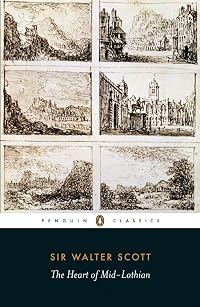
The Heart of Mid-Lothian
by Sir Walter Scott
Tales of My Landlord (Book 2), Waverley Novels, publication (1818), Waverley Novels (1736)
On This Page
Description
This novel, which has always been regarded as one of Scott's finest, opens with the Edinburgh riots of 1736. The people of the city have been infuriated by the actions of John Porteous, Captain of the Guard, and when they hear that his death has been reprieved by the distant monarch theyignore the Queen and resolve to take their own revenge. At the cente of the story is Edinburgh's forbidding Tolbooth prison, known by all as the Heart of Midlothian.Tags
Recommendations



















Member Recommendations

charlie68 Similar setting although different time periods.
Member Reviews
After an introductory chapter serving to maintain the fiction of an anonymous author, Scott starts what many consider to be his masterpiece with a historic event from 1736: the storming of the Tolbooth to kidnap and lynch Captain John Porteous, captain of the City Guard, an officer whose execution had just been delayed by London, allowing him an appeal, one the mob felt was sure to be successful. The mob was incensed with Porteous for his treatment of a popular condemned prisoner at that prisoner's execution. Scott's account has the mob led by a man in women's clothing, a man they called Wildfire.
After breaking down the gate of the Tolbooth, Wildfire took time to encourage a young female prisoner, Effie Deans, to make her escape in all show more the confusion. The girl refused to leave. Effie was awaiting trial under a 1690 statute, An Act Anent Murthering of Children, intended to cut down on the rising number of dead infants and children. This harsh act presumed a woman to be guilty of murder if three conditions were met:
1. the woman concealed her pregnancy for the entire term, and
2. she did not request assistance during labour, and
3. the child was dead or missing
Since all three conditions appeared to hold true in this case, it appeared Effie was sure to be sentenced to death by hanging.
There was one faint hope. If Effie's half sister Jeanie Deans could be persuaded to testify that she had been aware of the pregnancy, Effie would be saved. Here we get into one of the great themes of Scottish history, the role of religious conflicts and beliefs in everyday life. Jeanie had been raised by a veteran of the horrific religious wars of the seventeenth century. David Deans, father to both Jeanie and Effie, was "a staunch presbyterian, of the most rigid and unbending adherence to what he conceived to be the only possible straight line." Could Jeanie violate the commandment not to bear false witness in order to save her sister? If she did, could her father forgive such a transgression? Father and daughter had a wrenching conversation on the eve of Effie's trial; a conversation where neither would address the difficulties head on, and each mistook the other's intent. In the end, Jeanie refused to lie and her sister was condemned to hang, with an interval of six weeks in which to appeal.
The trial scene is gripping in true nineteenth century literary fashion. Scott excels in this particular scene, whose influence on Dickens, Eliot and Hardy is evident. In typically direct Scots fashion, the judge told Effie,
I cannot afford to you, in the present circumstances of the country, the slightest hope that your life will be prolonged beyond the period assigned for the execution of your sentence. Forsaking, therefore, the thoughts of this world, let your mind be prepared by repentance for those of more awful moment --- for death, judgement and eternity.
He then called on the Doomster to read the sentence. The Doomster was the common executioner, who in Effie's time also read out capital sentences, ending with the chilling "And this I pronounce for Doom."
Faced with the worst, Jeanie, a simple country dairy maid, now made the astounding decision to walk to London to plead with the King for Effie's life. At the time the novel was set, only thirty years had elapsed since the Act of Union, and Jeanie knew nothing of England or the court. In her mind, she would appeal to the Duke of Argyll, the most powerful Scottish presence at Court. She had no way of knowing he was having his own political difficulties at Court and so had to ration any acts of generosity or pleas for favours. Jeanie's knowledge of the world was so scant she thought a minister of the Crown was a member of the clergy.
The second part of the novel concerns itself with Jeanie's trip to London and its aftermath. She used clan and religious connections in her efforts to obtain an audience with the Duke. There is a change in tone here. In the earlier sections set in Scotland, life was more harsh, events were more dramatic. Westminster and the Act of Union were seen as unnecessary and unwanted complications, coming as they did with new taxes, the assertion of state power over church matters, the loss of economic benefits with the removal of the Court and a parliament now centred in London, and the increasing disparity between Lowland and Highland living standards. Jeanie's trip to London was by no means uneventful, but life got easier the further south she went. Scott, the old Tory, treats the Duke of Argyll as if Scott himself was one of his retainers.
Stylistically, The Heart of Mid-Lothian falls between the romantic novels of the eighteenth century and those of the later nineteenth century Victorian canon. It is narrative in style and tightly plotted. Scott used an impressive array of sources, from ballads to Greek tragedies, as epigraphs and references. He was one of the first to write historical novels, influencing later writers like Dumas and Hugo. Given the time in which he wrote, the reader expects a happy or at least improving ending, and this is the case here. There is one horrific incident for Jeanie on her return trip home, but one with a significant outcome for her. There was a bit too much of the Duke, but it is difficult to overestimate from this remove Argyll's influence in his home territory, where he owned five hundred square miles and exerted feudal rights over three thousand more. He was indeed capable of extending the aid he offered Jeanie, but this section with its softer feel was not as impressive as the first half. Overall though, this was a great story. show less
After breaking down the gate of the Tolbooth, Wildfire took time to encourage a young female prisoner, Effie Deans, to make her escape in all show more the confusion. The girl refused to leave. Effie was awaiting trial under a 1690 statute, An Act Anent Murthering of Children, intended to cut down on the rising number of dead infants and children. This harsh act presumed a woman to be guilty of murder if three conditions were met:
1. the woman concealed her pregnancy for the entire term, and
2. she did not request assistance during labour, and
3. the child was dead or missing
Since all three conditions appeared to hold true in this case, it appeared Effie was sure to be sentenced to death by hanging.
There was one faint hope. If Effie's half sister Jeanie Deans could be persuaded to testify that she had been aware of the pregnancy, Effie would be saved. Here we get into one of the great themes of Scottish history, the role of religious conflicts and beliefs in everyday life. Jeanie had been raised by a veteran of the horrific religious wars of the seventeenth century. David Deans, father to both Jeanie and Effie, was "a staunch presbyterian, of the most rigid and unbending adherence to what he conceived to be the only possible straight line." Could Jeanie violate the commandment not to bear false witness in order to save her sister? If she did, could her father forgive such a transgression? Father and daughter had a wrenching conversation on the eve of Effie's trial; a conversation where neither would address the difficulties head on, and each mistook the other's intent. In the end, Jeanie refused to lie and her sister was condemned to hang, with an interval of six weeks in which to appeal.
The trial scene is gripping in true nineteenth century literary fashion. Scott excels in this particular scene, whose influence on Dickens, Eliot and Hardy is evident. In typically direct Scots fashion, the judge told Effie,
I cannot afford to you, in the present circumstances of the country, the slightest hope that your life will be prolonged beyond the period assigned for the execution of your sentence. Forsaking, therefore, the thoughts of this world, let your mind be prepared by repentance for those of more awful moment --- for death, judgement and eternity.
He then called on the Doomster to read the sentence. The Doomster was the common executioner, who in Effie's time also read out capital sentences, ending with the chilling "And this I pronounce for Doom."
Faced with the worst, Jeanie, a simple country dairy maid, now made the astounding decision to walk to London to plead with the King for Effie's life. At the time the novel was set, only thirty years had elapsed since the Act of Union, and Jeanie knew nothing of England or the court. In her mind, she would appeal to the Duke of Argyll, the most powerful Scottish presence at Court. She had no way of knowing he was having his own political difficulties at Court and so had to ration any acts of generosity or pleas for favours. Jeanie's knowledge of the world was so scant she thought a minister of the Crown was a member of the clergy.
The second part of the novel concerns itself with Jeanie's trip to London and its aftermath. She used clan and religious connections in her efforts to obtain an audience with the Duke. There is a change in tone here. In the earlier sections set in Scotland, life was more harsh, events were more dramatic. Westminster and the Act of Union were seen as unnecessary and unwanted complications, coming as they did with new taxes, the assertion of state power over church matters, the loss of economic benefits with the removal of the Court and a parliament now centred in London, and the increasing disparity between Lowland and Highland living standards. Jeanie's trip to London was by no means uneventful, but life got easier the further south she went. Scott, the old Tory, treats the Duke of Argyll as if Scott himself was one of his retainers.
Stylistically, The Heart of Mid-Lothian falls between the romantic novels of the eighteenth century and those of the later nineteenth century Victorian canon. It is narrative in style and tightly plotted. Scott used an impressive array of sources, from ballads to Greek tragedies, as epigraphs and references. He was one of the first to write historical novels, influencing later writers like Dumas and Hugo. Given the time in which he wrote, the reader expects a happy or at least improving ending, and this is the case here. There is one horrific incident for Jeanie on her return trip home, but one with a significant outcome for her. There was a bit too much of the Duke, but it is difficult to overestimate from this remove Argyll's influence in his home territory, where he owned five hundred square miles and exerted feudal rights over three thousand more. He was indeed capable of extending the aid he offered Jeanie, but this section with its softer feel was not as impressive as the first half. Overall though, this was a great story. show less
All sorts of critics describe this as Scott's masterpiece: I wouldn't argue with that. By taking a working class woman as his central character, he avoids the "vacuum at the centre" we get in more conventional adventure stories. The Scottish criminal law and the city of Edinburgh put Scott on his favourite ground; 1735, with the cement of the Act of Union still setting and the religious struggles of the last century still in living memory, is also pretty much the ideal historical moment for him.
Of course, there is much a modern reader would quibble with: although the story gets going much faster than some of his others, we do have to put up with a certain amount of slow-moving (but vital) back-story in the early chapters, and the ending show more takes far longer to tie up all the threads than it might (and there's a shade too much poetic justice handed out). The Duke of Argyle and the sinister gypsy woman make rather one-dimensional good and bad fairy godmothers. Scott being Scott, the characters do occasionally forget themselves and start talking like books. We can put up with the little imperfections, though, because there is so much treasure in between. Jeanie and her old Covenanter father are simply wonderful characters; there are a couple of splendid comic lairds of the best sort; Scott guides us though the complicated legal and religious problems that drive the plot with unobtrusive expert knowledge.
Reflecting on the book with hindsight, the really clever thing Scott has done is to tell the story mostly from Jeanie's point of view, sidelining Effie and her lover, who might have been the obvious central characters in a romantic adventure story. They have a passionate love affair, rob, murder, make thrilling clandestine journeys, disguise their identities, etc. - and it all happens offstage. We see their whole romantic career though the eyes of the people who have to clear up the mess. When Jeanie embarks on her epic journey to London, Scott makes us see that what is remarkable about her is the absolute conviction that she is doing the right thing and will succeed. We may think her naive; another writer might have treated the whole affair with a bit more irony and thrown more obstacles in her way; but Scott accomplishes the difficult task of making a wholly virtuous character three dimensional and interesting enough to carry a whole book without becoming either nauseating or tedious. Not a lot of people can do that. show less
Of course, there is much a modern reader would quibble with: although the story gets going much faster than some of his others, we do have to put up with a certain amount of slow-moving (but vital) back-story in the early chapters, and the ending show more takes far longer to tie up all the threads than it might (and there's a shade too much poetic justice handed out). The Duke of Argyle and the sinister gypsy woman make rather one-dimensional good and bad fairy godmothers. Scott being Scott, the characters do occasionally forget themselves and start talking like books. We can put up with the little imperfections, though, because there is so much treasure in between. Jeanie and her old Covenanter father are simply wonderful characters; there are a couple of splendid comic lairds of the best sort; Scott guides us though the complicated legal and religious problems that drive the plot with unobtrusive expert knowledge.
Reflecting on the book with hindsight, the really clever thing Scott has done is to tell the story mostly from Jeanie's point of view, sidelining Effie and her lover, who might have been the obvious central characters in a romantic adventure story. They have a passionate love affair, rob, murder, make thrilling clandestine journeys, disguise their identities, etc. - and it all happens offstage. We see their whole romantic career though the eyes of the people who have to clear up the mess. When Jeanie embarks on her epic journey to London, Scott makes us see that what is remarkable about her is the absolute conviction that she is doing the right thing and will succeed. We may think her naive; another writer might have treated the whole affair with a bit more irony and thrown more obstacles in her way; but Scott accomplishes the difficult task of making a wholly virtuous character three dimensional and interesting enough to carry a whole book without becoming either nauseating or tedious. Not a lot of people can do that. show less
This is one of Scott's most famous novels, named after the Tolbooth prison in the heart of Edinburgh. The basic plotline concerns Effie Deans, who gives birth to a child who disappears and who as a consequence is arrested and tried for its murder on the basis of a harsh Scots law in force at the time which gives a presumption of guilt to a mother in these circumstances. Her sister Jean makes a solo trip to London to beg mercy from the King and Queen. This plot is well and dramatically told, as are the rebellious events around the death of Captain Porteous, but much of the story's effect was marred for me by the heavy use of Scots vernacular for the speech of many of the characters, and the doings of rigid and unbending members of the show more Scottish kirk. I know it is not the point for the style of novels written two centuries ago, but this could have been a better read if around 30% shorter. That said, this is a good novel and rightly regarded as one of Scott's best novels. show less
The seventh of Walter Scott's historical novels, and one that he was especially proud of - not an opinion that I share.
The book is uneven. The first half seems to lack narrative progress, and the history, such a good backdrop to his earlier novels, seems here to be too prominent and dry. Fortunately, the second half picks up the pace and is more in line with Scott at his best.
The plot is based on actual events - a woman accused of child murder, and the actions of her sister. Scott adds some familiar features - a strong, slightly crazy woman, and a lost heir, giving the book a formulaic feel.
Worth reading, but not my favourite.
The book is uneven. The first half seems to lack narrative progress, and the history, such a good backdrop to his earlier novels, seems here to be too prominent and dry. Fortunately, the second half picks up the pace and is more in line with Scott at his best.
The plot is based on actual events - a woman accused of child murder, and the actions of her sister. Scott adds some familiar features - a strong, slightly crazy woman, and a lost heir, giving the book a formulaic feel.
Worth reading, but not my favourite.
Definitely above average for Scott. A gripping tale of crime, miscarriage of justice, heroism, madness, and memorable characters, all with a satisfying conclusion. Could perhaps have cut a hundred pages or so without losing its effect however.
I liked much of this, particular when the heroine appeals to George II's mistress for a pardon for her sister, accused of infanticide under a law that if a woman known to be pregnant could not show the baby, she was presumed to have killed it. However, I felt the ending set up the possibility of a neatly
perfect happy ending and then deliberately spoiled because Scott felt some of his characters did not deserve happiness.
perfect happy ending and then deliberately spoiled because Scott felt some of his characters did not deserve happiness.
I enjoyed this more than Ivanhoe, even tho it was set in Scottland in the 1800’s. A woman is trying to save her sister from being hung. The thing that turned me off tho, was the use of the scottish dialect. It was nigh impossible to understand. Thankfully there was a glossary in the back. But how am I supposed to know that “I dinna ken muckle aboot dukes, fools and wee bairns” is supposed to mean “I don’t know much about ducks, fowls and little children”? I don’t like that dialect.
Members
- Recently Added By
Published Reviews
ThingScore 75
The criticism that Scott cannot draw a heroine has to be modified after we have read The Heart of Midlothian. To judge by this book Scott could not draw a hero. For neither the pious, pettifogging Butler nor the wicked George Staunton can be called human beings of anything but conventional interest. Effie and Jeanie Deans are quite another matter. They are peasants and Scott condescends to show more them with the gentlemanliness of his time, but they are alive as his peasants always are...
The greatness of The Heart of Midlothian arises, first of all, in the scope that the problem of conscience gave to Scott’s imagination. He was not arguing in a void. His argument was creating real people and attracting real people to it. He made the story of Effie’s murdered baby a national story. And then how wide his range is! The scenes in theTolbooth are remarkable, and especially those that are built about the figure of Ratcliffe when the governor is working to turn him into an informer. Scott had the eighteenth-century taste for rogues, and their talk is straight from nature... Scott has looked it all up, but his own version is so alive, so effortless, so fast moving. Every detail tells; the very pedantry of it is pedantry washed down by the rough wine of life. show less
The greatness of The Heart of Midlothian arises, first of all, in the scope that the problem of conscience gave to Scott’s imagination. He was not arguing in a void. His argument was creating real people and attracting real people to it. He made the story of Effie’s murdered baby a national story. And then how wide his range is! The scenes in theTolbooth are remarkable, and especially those that are built about the figure of Ratcliffe when the governor is working to turn him into an informer. Scott had the eighteenth-century taste for rogues, and their talk is straight from nature... Scott has looked it all up, but his own version is so alive, so effortless, so fast moving. Every detail tells; the very pedantry of it is pedantry washed down by the rough wine of life. show less
added by SnootyBaronet
Lists

Best Historical Fiction
620 works; 261 members

Favourite 19th century fiction
257 works; 62 members

Best of British Literature
226 works; 41 members

Recommend the 20 best books you've read in the last five years
2,168 works; 606 members

Favourite Books
1,817 works; 316 members

Women's Stories
88 works; 13 members

Best of Scottish Literature
35 works; 6 members

Lamont's Hundred Best Novels (1947)
100 works; 4 members

Fifty Representative Historical Novels
50 works; 2 members

1810s
11 works; 2 members
Harold Bloom - The Western Canon: C. The Democratic Age
336 works; 15 members
Trinity College Booklist (1951): Class Ten, English Literature
358 works; 5 members
F. B. Perkins' List of 100 Best Fiction
100 works; 5 members
150 Best Novels Selected by Brander Matthews (1883)
150 works; 7 members
Talk Discussions
Past Discussions
The Heart Of Midlothian - souloftherose and lyzard read Walter Scott in 75 Books Challenge for 2012 (February 2012)
Author Information

1,004+ Works 40,649 Members
Some Editions
Awards and Honors
Series

Tales of My Landlord
7 works (Book 2)

Waverley Novels, publication
31 works (1818)

Waverley Novels
31 works (1736)
Belongs to Publisher Series
Work Relationships
Is contained in
Contains
Has the adaptation
Inspired
Has as a student's study guide
Common Knowledge
- Canonical title
- The Heart of Mid-Lothian
- Original title
- The Heart of Mid-Lothian
- Original publication date
- 1818
- People/Characters
- Jeanie Deans; Effie Deans (Euphemia); Euphemia Deans (Effie); Captain Porteus; David Deans; Laird of Dumbiedykes (show all 29); Magdalen Murdockson (Madge Wildfire); Madge Wildfire (Magdalen Murdockson); Reuben Butler; Meg Murdockson; Bartolini Saddletree; Sir Edmund Staunton; George Staunton (Robertson); Robertson (George Staunton); Jock Porteous; Sharpitlaw; Jim Ratcliffe; King's Advocate; Andrew Wilson; Mr Fairbrother; Caroline of Ansbach, Queen Consort of Great Britain and Ireland; Mrs Bickerston; Mrs Glass; MacCallum More, Duke of Argyle; Duke of Argyle (MacCallum More); Mr Archibald; Mrs Dutton; Duncan Knock; Donocha Dhu
- Important places
- Edinburgh, Scotland, UK; Dumbartonshire, Scotland, UK (historic county); Midlands, England, UK; London, England, UK
- Important events
- Porteous Riots (1736)
- Related movies
- The Heart of Midlothian (1914 | IMDb); The Heart of Midlothian (1966 | IMDb)
- First words
- The times have changed nothing more (we follow as we were wont the manuscript of Peter Pattieson) than an in the rapid communication of intelligence and communication between one part of Scotland and another.
- Last words
- (Click to show. Warning: May contain spoilers.)Meanwhile, happy in each other, in the prosperity of their family, and the love and honour of all who knew them, this simple pair lived beloved, and died lamented.
- Blurbers*
- Buchan, John
*Some information comes from Common Knowledge in other languages. Click "Edit" for more information.
Classifications
Statistics
- Members
- 1,226
- Popularity
- 20,107
- Reviews
- 18
- Rating
- (3.61)
- Languages
- 12 — Czech, Danish, Dutch, English, Finnish, French, German, Hungarian, Norwegian (Bokmål), Russian, Spanish, Swedish
- Media
- Paper, Audiobook, Ebook
- ISBNs
- 73
- ASINs
- 91