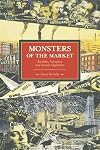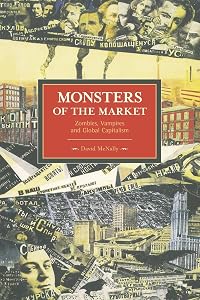
Monsters of the Market: Zombies, Vampires, and Global Capitalism
by David McNally
On This Page
Description
Winner of the 2012 Isaac and Tamara Deutscher Memorial Prize. Monsters of the Market investigates the rise of capitalism through the prism of the body-panics it arouses. Drawing on folklore, literature and popular culture, the book links tales of monstrosity from early-modern England, including Mary Shelley ?s Frankenstein , to a spate of recent vampire- and zombie-fables from sub-Saharan Africa, and it connects these to Marx ?s persistent use of monster-metaphors in his descriptions of show more capitalism. Reading across these tales of the grotesque, Monsters of the Market offers a novel account of the cultural and corporeal economy of a global market-system. The book thus makes original contributions to political economy, cultural theory, commodification-studies and ?body-theory ?. show lessTags
Recommendations












Member Reviews
so basically vampires are capitalists, the undead are workers, stripped of their individuality etc by capitalism and becoming pure labour power. stories of monsters and magic help defetishise capitalism by exposing the unnaturalness of it. talk of monsters has been used by the working class to show how unnatural it is and by the ruling class to mark off workers. stuff about dismemberment and anatomy dissections as ruling class punishment on the poor and also symbolic of what workers became (ie capital can control the worker, hands become alienated from worker and are controlled by capital/machinery). there's a lot to it it's interesting. like the idea of the monstrous common person in the 17thish century as something "without bounds", show more the horror of the commons as a concept as opposed to good capitalist enclosures represented in the fear of the monstrous boundless mob. the analysis of okri's writing at the end is very good. you could maybe write a critique of orientalism type stuff in this - he talks a lot about "africa" in general although he's v good with specifics about the places and circumstances the occult ideas he's talking about come from.
the book acts also as a kind of whirlwind tour of 3 periods of capitalism - "primitive accumulation" in europe, development of industrial capitalism, neocolonialism in africa (probably most notably original colonialism is missing from this - seems the monstrous being connected with race would be a meaningful study but i dunno). i liked the history stuff a lot it was good even when the symbolic analysis was a bit tenuous (eg the connection between paintings of corpse anatomy and ruling class understandings of their own power seemed v benefit of hindsight)
the history stuff is good to read but the cultural analysis type stuff can be really tough to get through because of the language. sometimes i had trouble making it through because the actual descriptions of the horrors of capitalism felt too raw while the development of the themes of monsters sometimes felt too remote from the realities of capitalism. which is unfair on the latter because he closely ties the symbolism to the horrors but the language used can be bleh. it's a good book and if the subject sounds interesting then i recommend it
there's a LOT of analysis and interesting stuff to pore over in this book but i'm not in a good place to summarise but if the concept's interesting and you're prepared to tackle some tough language sometimes then it's good show less
the book acts also as a kind of whirlwind tour of 3 periods of capitalism - "primitive accumulation" in europe, development of industrial capitalism, neocolonialism in africa (probably most notably original colonialism is missing from this - seems the monstrous being connected with race would be a meaningful study but i dunno). i liked the history stuff a lot it was good even when the symbolic analysis was a bit tenuous (eg the connection between paintings of corpse anatomy and ruling class understandings of their own power seemed v benefit of hindsight)
the history stuff is good to read but the cultural analysis type stuff can be really tough to get through because of the language. sometimes i had trouble making it through because the actual descriptions of the horrors of capitalism felt too raw while the development of the themes of monsters sometimes felt too remote from the realities of capitalism. which is unfair on the latter because he closely ties the symbolism to the horrors but the language used can be bleh. it's a good book and if the subject sounds interesting then i recommend it
there's a LOT of analysis and interesting stuff to pore over in this book but i'm not in a good place to summarise but if the concept's interesting and you're prepared to tackle some tough language sometimes then it's good show less
Fascinating, challenging, and exciting. Full of geniune YES! moments. This is a book that has helped me understand Marx, capitalism, philosophy, and modern society better.
Ratings
Members
- Recently Added By
Lists

Top Five Books of 2021
604 works; 181 members

Mythical Monsters of the World
199 works; 79 members
Author Information

11+ Works 421 Members
David McNally is the Cullen Distinguished Professor of History and Business at the University of Houston and director of the Center for the Study of Capitalism. McNally is the author of seven books including Global Slump.
Some Editions
Awards and Honors
Awards
Series
Belongs to Publisher Series
Common Knowledge
- Canonical title
- Monsters of the Market: Zombies, Vampires, and Global Capitalism
- Original publication date
- 2011
- People/Characters
- Mary Shelley; Karl Marx; Ben Okri
- Dedication
- For Liam
- First words
- We live in an age of monsters and of the body-panics
they excite. - Quotations
- The mythology of power propagated by the rich can
only survive, he intimates, if it is sustained by the dreams of the poor.
The demobilisation of poor women, the refashioning of their
movement by women of the dominant classes, once again leaves the people
treading the endless road of their dreams. The famished road of freedom can
be satia... (show all)ted, hints Okri, only through the means envisioned by Blake in 1793
The extent to which the European working classes were ‘racialised’ in the
discourse of emergent industrial capitalism is rarely appreciated today. Yet,
during the epoch in which scientific racism emerged in order to... (show all) rationalise the
oppression of Africans and colonised peoples, its categories were sufficiently
pliable to racialise the labouring poor of Europe as well. Granier de Cassagnac,
for instance, in his Histoire des classes ouvrières et des classes bourgeoises
(1838) asserted that proletarians were a subhuman race formed through the
interbreeding of prostitutes and thieves. In a similar register, Henry Mayhew’s
London Labour and the London Poor (1861) divided humanity into two distinct
races: the civilised and the wanderers. The latter, including the labouring poor
of Britain, were defined by their ostensible incapacity to transcend the body
and its desires.
Marx saw the key to unions and workers’
organisation not in their strictly material achievements but, rather, in the spirit
of opposition they cultivated. Without struggle, resistance and international
organisation... (show all), he argued, workers risked becoming ‘apathetic, thoughtless,
more or less well-fed instruments of production - Last words
- (Click to show. Warning: May contain spoilers.)It is those magic hands that possess the power to slay the monsters of the
market. Until such time, the endless toilers of the earth will continue to
nurture monstrous desires for utopia as they walk ‘the endless dream of
their roads’.
Classifications
Statistics
- Members
- 83
- Popularity
- 384,117
- Reviews
- 2
- Rating
- (4.17)
- Languages
- English, Spanish
- Media
- Paper, Ebook
- ISBNs
- 6