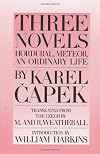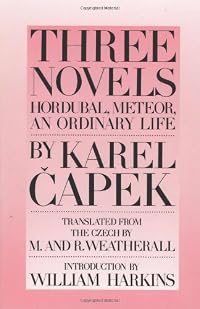
Hordubal / Meteor / An Ordinary Life
by Karel Čapek
On This Page
Description
This trilogy of novels was the culmination of Karel Capek's career. The novels share neither characters nor events; instead, they approach the problem of knowing people--of mutual understanding--in a variety of ways. Detectives faced with a murder reconstruct the crime, but not the character of the man who was murdered. Three people tell stories about a dying pilot they know almost nothing about; each story is as full of truth as it is devoid of facts. And one man looks back on his life and show more discovers all the people he might have been. Together, these three short novels form a readable philosophical novel unique in world literature. show lessTags
Recommendations



















Member Reviews
Hordubal:
The only thing I’d read of his before was R.U.R. This is a straightforward story about Hordubal who returns home to his small rural village after spending eight years as a miner in the United States. A devoted and loyal husband, he comes home to a wife who is less than happy to see him. She has been “carrying on” with the hired hand and they plan to do away with Hordubal and take his money. The story is largely about the personalities and the customs and mores of a small rural village. Well done and I look forward tackling the next in the series. Although this is the first volume of his Noetic trilogy, the other stories are unrelated, although each book deals with that part of the intellect or the mind that helps one show more understand what is true or real. Recommended. show less
The only thing I’d read of his before was R.U.R. This is a straightforward story about Hordubal who returns home to his small rural village after spending eight years as a miner in the United States. A devoted and loyal husband, he comes home to a wife who is less than happy to see him. She has been “carrying on” with the hired hand and they plan to do away with Hordubal and take his money. The story is largely about the personalities and the customs and mores of a small rural village. Well done and I look forward tackling the next in the series. Although this is the first volume of his Noetic trilogy, the other stories are unrelated, although each book deals with that part of the intellect or the mind that helps one show more understand what is true or real. Recommended. show less
Proslulá, tzv. noetická trilogie Karla Čapka patří v vrcholům jeho umění. Tři prózy, které byly původně samostatné. Baladický příběh zakarpatského sedláka Hordubala, postupná identifikace neznámého pilota povětroně a sledování mnohosti v „obyčejném životě“ – mají společné východisko: nahlédnout skutečnost z různých úhlů
Oct 29, 2024Czech
Ratings
Members
- Recently Added By
Author Information

Karel Capek is best known abroad for his plays, but at home he is also revered as an accomplished novelist, short-story writer, essayist, and writer of political articles. His bitingly satirical novel The War with the Newts (1936) reveals his understanding of the possible consequences of scientific advance. The novel Krakatit (1924), about an show more explosive that could destroy the world, foreshadows the feared potential of a nuclear disaster. In his numerous short stories he depicts the problems of modern life and common people in a humorous and whimsically philosophical fashion. The plays of Karel Capek presage the Theater of the Absurd. R.U.R. (Rossum's Universal Robots) (1921) was a satire on the machine age. He created the word robot from the Czech noun robota, meaning "work" for the human-made automatons who in that play took over the world, leaving only one human being alive. The Insect Comedy (1921), whose characters are insects, is an ironic fantasy on human weakness. The Makropoulos Secret (1923), later used as the basis for Leos Janacek's opera, was an experimental piece that questioned whether immortality is really desirable. All the plays have been produced successfully in New York. Most deal satirically with the modern machine age or with war. Underlying all his work, though, is a faith in humanity, truth, justice, and democracy, which has made him one of the most beloved of all Czech writers. (Bowker Author Biography) show less
Awards and Honors
Awards
Series
Belongs to Publisher Series
Work Relationships
Contains
Common Knowledge
- Canonical title
- Hordubal / Meteor / An Ordinary Life
- Original title
- Hordubal / Povetron / Obycejný zivot
- Original publication date
- 1933-1934
- First words*
- Het is de tweede vanaf het raam, die in het gekreukelde pak: zou je daar nu van zeggen dat het een Amerikaan is?
- Last words*
- (Click to show. Warning: May contain spoilers.)Het hart van Juraj Hordubal is ergens verloren gegaan en is nooit begraven.
- Publisher's editor
- Grozdanovicova, Doris
- Original language*
- Tsjechisch
*Some information comes from Common Knowledge in other languages. Click "Edit" for more information.
Classifications
- Genres
- Fiction and Literature, General Fiction
- DDC/MDS
- 891.8635 — Literature & rhetoric Asian Literature East Indo-European and Celtic literatures West and South Slavic languages (Bulgarian, Slovene, Polish, Czech, Slovak, Serbo-Croatian, and Macedonian) Czech Czech fiction 1900–1989
- LCC
- PG5038 .C3 .A28 — Language and Literature Slavic languages and literatures. Baltic languages. Albanian language Slavic. Baltic. Albanian Slavic Czech
- BISAC
Statistics
- Members
- 232
- Popularity
- 139,240
- Reviews
- 2
- Rating
- (4.00)
- Languages
- 7 — Czech, Dutch, English, Estonian, French, German, Polish
- Media
- Paper, Ebook
- ISBNs
- 10
- ASINs
- 5