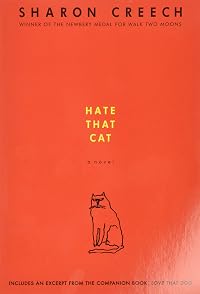
Hate That Cat
by Sharon Creech
On This Page
Description
Jack is studying poetry again in school, and he continues to write poems reflecting his understanding of famous poems and how they relate to his life.Tags
Recommendations










Member Reviews
Following R's Summer Reading (1 of 3): assigned for the Summer before 4th Grade, she liked it despite expectations and A and I also thought it was great fun. It plunges the reader in without any preamble, and figuring out what's going on is half the pleasure. Apparently it is clearer to those having read the first book, but I liked that I hadn't.
The verse is inspired by influential poems, challenging but not ridiculous, and the actual verse stands up well even without knowing its inspiration well enough to see the borrowings. Some crucial stanzas are reprinted at the end, perhaps the author's intention for it to be used to capture the interest of grade school children.
In addition to the good use of poetry, the bit about Jack's mom show more being deaf is subtly done and adds another layer of appreciation for words and sounds. Probably worth seeking out Love that Dog. show less
The verse is inspired by influential poems, challenging but not ridiculous, and the actual verse stands up well even without knowing its inspiration well enough to see the borrowings. Some crucial stanzas are reprinted at the end, perhaps the author's intention for it to be used to capture the interest of grade school children.
In addition to the good use of poetry, the bit about Jack's mom show more being deaf is subtly done and adds another layer of appreciation for words and sounds. Probably worth seeking out Love that Dog. show less
When last we saw Jack he had learned to love the poet Walter Dean Myers and to accept that his dead dog was gone. Now it’s an entirely new school year and Surprise! Miss Stretchberry is unexpectedly his teacher again. Of course, she’s not too pleased with the series of anti-cat poems he’s been writing lately. Lately a fat black cat has been terrorizing Jack at his bus stop and he is in a full-on anti-feline mode as a result. But there may be some surprises for Jack coming up. Miss Stretchberry is introducing him to concepts like onomatopoeia and synonyms. Though his Uncle Bill (a college prof) is pooh-poohing what constitutes a "real" poem, Jack is able to use his poetry to discuss everything from his mother's deafness to an show more unexpected Christmas present and an even more unexpected friend. show less
It’s a new school year and Jack is unexpectedly back in Miss Stretchberry’s class, again studying poetry. Miss Stretchberry has introduced the class to new poets (Poe, Williams, and Eliot, among others) and students are to write in their poetry journals once more.
Jack writes a series of nasty poetry about cats, a reaction to a horrible black cat who terrorizes him at the bus stop. Cats, according to Jack, are also “not dogs” and therefore bad. Concerned, his teacher and his parents conspire to get him a kitten for Christmas, which takes him about .01 second to fall in love with. He names her Skitter McKitter, after her “skitter, kittery” personality.
Jack disagrees with his Uncle Bill, a stuffy professor of poetry, who show more doesn’t seem to think much of free verse. Jack clearly has his own thoughts on the matter and records them in his poetry journal, citing his dad when he says about his uncle, “sometimes I envy your mom not being able to hear” and “if uncle Bill is allergic to cats maybe he won’t be able to visit us anymore.” To this, Jack writes, “hahaha.”
Creech is incredibly creative in the way she weaves poetry lessons into the storyline, demonstrating poetic terms in the process. Hate that Cat is quite short and easy to access. The poetry is written in a way that doesn’t seem like poetry, so that younger teens can access it. Hate that Cat is wonderfully charming; I laughed, became scared, and on at least one occasion cried; all this in a 125 page book! show less
Jack writes a series of nasty poetry about cats, a reaction to a horrible black cat who terrorizes him at the bus stop. Cats, according to Jack, are also “not dogs” and therefore bad. Concerned, his teacher and his parents conspire to get him a kitten for Christmas, which takes him about .01 second to fall in love with. He names her Skitter McKitter, after her “skitter, kittery” personality.
Jack disagrees with his Uncle Bill, a stuffy professor of poetry, who show more doesn’t seem to think much of free verse. Jack clearly has his own thoughts on the matter and records them in his poetry journal, citing his dad when he says about his uncle, “sometimes I envy your mom not being able to hear” and “if uncle Bill is allergic to cats maybe he won’t be able to visit us anymore.” To this, Jack writes, “hahaha.”
Creech is incredibly creative in the way she weaves poetry lessons into the storyline, demonstrating poetic terms in the process. Hate that Cat is quite short and easy to access. The poetry is written in a way that doesn’t seem like poetry, so that younger teens can access it. Hate that Cat is wonderfully charming; I laughed, became scared, and on at least one occasion cried; all this in a 125 page book! show less
Just as good as the last one. I love Jack's voice and how he expresses himself through poetry. I love getting little glimpses into his life. I loved reading Jack's musings about hearing and deafness and how we experience poetry and life in more than just sound. I didn't love that Jack was interpreting for his mom at the poetry recital. If the teacher wanted to be inclusive she should have hired an interpreter.
This book was a joy to read! Like many novels in verse, it is a quick and easy read, with a lot of white space to help the story move along. Jack, the main character, tells the story of his hate for cats through poetry. There is no way a cat can compare with a pet dog, who met in the prequel to this, Love That Dog. We learn how that hatred turns to love when he receives a kitten from his parents. Jack's initial dislike for poetry lessens as we witness his incredible talent at writing a poem, often imitating famous poets in the process. The book will make you laugh and smile. Highly recommended, especially for reluctant readers.
A "mean, fat, black, cat" sounds like my own life! From the owner of one to another...I feel those words! Jack is entering another year of school with Miss Stretchberry as his teacher. Her love of poetry and teaching the children in her class to love and write poetry is evident in the way Jack shares his own feelings. Throughout the book, we see Jack work through his emotions, fears, and worries in his prose. He grows an appreciation for famous poets such as Poe and Tennyson. And he eventually grows to appreciate that fat, mean black cat. This is a lovely book that gives us a glimpse inside the mind of a young boy who is inspired by a passionate teacher who encourages creativity and exploration within poetry. The end of the book shares show more the poems that Jack mentions throughout the book, so we can experience them for ourselves. show less
Sequel to "Love That Dog" -- Jack one year on still writing poems for Miss Stretchberry in Room 204. Same format - poetry diary with poems he has to read at the back of the book. Discusses rhyme, rhythm, images, symbols, metaphors, onomatopoeia, alliteration, assonance, and consonance. The nominal query of the book is about cats, e.g., vs. dogs in life. The deep question of the book is, can you feel sounds instead of hear them? Like tapping out the rhythm of a poem. Because the book is a long love poem not only to his cat, but to Jack's mother, who is deaf and in the end when parents are invited to school for a poetry evening, Jack volunteers to do sign translation for his mother.
Members
- Recently Added By
Lists

Cats in Fiction
209 works; 9 members

Books Read in 2017
4,249 works; 130 members

GCS 6th grade summer reading list
171 works; 4 members
Author Information

51+ Works 46,374 Members
Sharon Creech was on born July 29, 1945 in South Euclid, Ohio, a suburb of Cleveland. She was in college when she took literature and writing courses and became intrigued by story-telling. Later, she was a teacher (high school English and writing) in England and in Switzerland. Her novel Walk Two Moons received in 1995 Newbery Medal; The Wanderer show more was a 2001 Newbery Honor book and Ruby Holler received the 2002 Carnegie Medal. In 2007, Heartbeat was a finalist in the Junior Division (4th to 6th grades) of the Young Reader's Choice Awards, sponsored by the Pacific Northwest Library Association. She has written over 15 fiction novels for young readers. She is married to Lyle Rigg, who is the headmaster of The Pennington School in Pennington, New Jersey, and have two grown children, Rob and Karin. (Bowker Author Biography) show less
Awards and Honors
Work Relationships
Is contained in
Common Knowledge
- Canonical title
- Hate That Cat
- Original title
- Hate That Cat
- Original publication date
- 2008
- People/Characters
- Jack; Miss Stretchberry
- First words
- Jack
Room 204—Miss Stretchberry
September 12
I hate that cat
like a dog hates a rat
I said I hate that cat
like a dog hates a rat
Hate to see it in the morning
hate to see that
F A... (show all) T black cat. - Original language
- English US
Classifications
- Genres
- Poetry, Kids, Fiction and Literature, Children's Books
- DDC/MDS
- 813.54 — Literature & rhetoric American literature in English American fiction in English 1900-1999 1945-1999
- LCC
- PZ7.5 .C74 .H — Language and Literature Fiction and juvenile belles lettres Fiction and juvenile belles lettres Juvenile belles lettres
- BISAC
Statistics
- Members
- 2,013
- Popularity
- 10,476
- Reviews
- 82
- Rating
- (4.09)
- Languages
- Dutch, English
- Media
- Paper, Audiobook, Ebook
- ISBNs
- 20
- ASINs
- 11