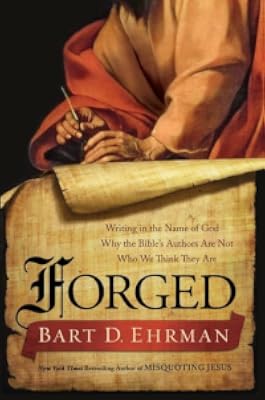
Forged: Writing in the Name of God — Why the Bible's Authors Are Not Who We Think They Are
by Bart D. Ehrman
On This Page
Description
Bart D. Ehrman, the New York Times bestselling author of Jesus, Interrupted and God's Problem reveals which books in the Bible's New Testament were not passed down by Jesus's disciples, but were instead forged by other hands-and why this centuries-hidden scandal is far more significant than many scholars are willing to admit. A controversial work of historical reporting in the tradition of Elaine Pagels, Marcus Borg, and John Dominic Crossan, Ehrman's Forged delivers a stunning explication show more of one of the most substantial-yet least discussed-problems confronting the world of biblical scholarship. show lessTags
Recommendations



Member Recommendations

Member Reviews
Once again, Ehrman demolishes any excuse anyone has for believing in the veracity of the bible. He shows conclusively that many of the books are not written by who they claim to be written by--and the evidence is plain to see, such as direct contradictions between books supposed to be written by the same person. Not to mention that textual analysis shows it was a different author, and so on. Folks with various agenda throughout the last two millennia have forged religious texts, and some were accepted into the New Testament. Ehrman also tells interesting stories about the four gospels--most notably that they weren't even called Matthew, Mark, Luke, and John until decades after they were first written and circulated. Those names were show more applied to tie them to the apostles and give them more authority. I could go on, but I don't want to emulate Ehrman too much, since his worst habit, in his attempt to explain everything as clearly as possible, is to go on a bit too long. I will say that the audiobook is well read by Walter Dixon. show less
Bart D. Ehrman is an accomplished and eminent scholar of biblical criticism. He is one of those "liberal" thinkers who has been able to get past the fiction that Jesus was a god, but not the contrivance that he was a man. In Forged Ehrman treats the subject of authorial mendacity in early Christian literature, not excepting the New Testament canon. As he demonstrates, there are scores of ancient Christian texts whose authors willfully misrepresent their identities, and are thus forgeries. He does carefully distinguish such forgery from false or merely erroneous attributions, all of which have been lumped customarily into the category of "pseudepigraphal" writings.
Ehrman importantly addresses the widespread misconceptions that the show more ancient world somehow possessed a more benign view of literary forgery, falsification, and plagiarism. As he shows, there are ancient writings which remonstrate against these practices. Just like modern readers, those of antiquity expected authors to represent themselves accurately in their texts.
In the final chapter of the book, Ehrman even jumps forward to the modern period with three examples of Christian pseudepigrapha from the 19th century, to demonstrate that the behavior we see in writings from early Christianity isn't alien to the sort of forgeries that have been created in later ages.
Forgery holds out as an "irony" the contrast between the stated ideal of Christianity in communicating divinely-ordained truth and the actual literary practices of the authors of Christian scripture. In his recurring discussions of motive, Ehrman tends to gloss over the obvious possibility that many, perhaps most, of these writers were in fact not sincere as they tampered with the facts in order to promote their preferred sects and doctrines.
While informed by extensive research and supplying references for further study, Forged is itself a popularizing rather than a scholarly book. It is a fast read and a valuable orientation to the realities of biblical authorship in the Christian world. show less
Ehrman importantly addresses the widespread misconceptions that the show more ancient world somehow possessed a more benign view of literary forgery, falsification, and plagiarism. As he shows, there are ancient writings which remonstrate against these practices. Just like modern readers, those of antiquity expected authors to represent themselves accurately in their texts.
In the final chapter of the book, Ehrman even jumps forward to the modern period with three examples of Christian pseudepigrapha from the 19th century, to demonstrate that the behavior we see in writings from early Christianity isn't alien to the sort of forgeries that have been created in later ages.
Forgery holds out as an "irony" the contrast between the stated ideal of Christianity in communicating divinely-ordained truth and the actual literary practices of the authors of Christian scripture. In his recurring discussions of motive, Ehrman tends to gloss over the obvious possibility that many, perhaps most, of these writers were in fact not sincere as they tampered with the facts in order to promote their preferred sects and doctrines.
While informed by extensive research and supplying references for further study, Forged is itself a popularizing rather than a scholarly book. It is a fast read and a valuable orientation to the realities of biblical authorship in the Christian world. show less
Like candy, if you happen (like me) to find New Testament scholarship sweet. This is a welcome exploration of something that I was taught in theological school: it was common practice in the earliest Christian times for people to write under assumed names of someone more famous or authoritative. REALLY?? Not likely, says Ehrman. In fact, such practices were condemned by some of the early Christian apologists. How could they not be? It's dishonest, at best. And if it was "common practice" and people knew that this was not the real author, why would writers do it in the first place? Fascinating, as always...and it opens up the New Testament, as well as writings that did not make it into the New Testament, in a whole new way. Ehrman is one show more of my favorites. When is the next book? show less
Like candy, if you happen (like me) to find New Testament scholarship sweet. This is a welcome exploration of something that I was taught in theological school: it was common practice in the earliest Christian times for people to write under assumed names of someone more famous or authoritative. REALLY?? Not likely, says Ehrman. In fact, such practices were condemned by some of the early Christian apologists. How could they not be? It's dishonest, at best. And if it was "common practice" and people knew that this was not the real author, why would writers do it in the first place? Fascinating, as always...and it opens up the New Testament, as well as writings that did not make it into the New Testament, in a whole new way. Ehrman is one show more of my favorites. When is the next book? show less
I second what's been previously said - that I was a bit hesitant to pick up this book at first. I've read [b:Misquoting Jesus|51364|Misquoting Jesus The Story Behind Who Changed the Bible & Why|Bart D. Ehrman|http://photo.goodreads.com/books/1170379100s/51364.jpg|50128] and [b:Jesus Interrupted|6101996|Jesus, Interrupted Revealing the Hidden Contradictions in the Bible & Why We Don't Know About Them|Bart D. Ehrman|http://photo.goodreads.com/books/1255645385s/6101996.jpg|6279259] and was a bit concerned that this book would just be rehashing the old information. Fortunately, I was very wrong.
I'm a great fan of Ehrman's style regardless of what he's writing. I find him to be far more respectful in his discourse than some of the better show more known atheistic authors (Hitchens, Dawkins, etc.) and he tends to be more focused upon bringing this information to light than outright saying that Christian's are wrong. He's about knowledge, and I can respect that.
The book deals with how forgery was viewed in the ancient world, and whether or not it is correct to call some of the New Testament books (and Old Testament books, actually) forgeries. He goes into the different definitions of forgeries, misattributions, fabrications, and the like as well as acknowledging both ancient and modern forged 'biblical' texts. Only at the very end does he summarize what has been previously stated by him in other books.
All in all, a very informative, very well researched book. Highly recommended. show less
I'm a great fan of Ehrman's style regardless of what he's writing. I find him to be far more respectful in his discourse than some of the better show more known atheistic authors (Hitchens, Dawkins, etc.) and he tends to be more focused upon bringing this information to light than outright saying that Christian's are wrong. He's about knowledge, and I can respect that.
The book deals with how forgery was viewed in the ancient world, and whether or not it is correct to call some of the New Testament books (and Old Testament books, actually) forgeries. He goes into the different definitions of forgeries, misattributions, fabrications, and the like as well as acknowledging both ancient and modern forged 'biblical' texts. Only at the very end does he summarize what has been previously stated by him in other books.
All in all, a very informative, very well researched book. Highly recommended. show less
Note: I am not a scholar of the New Testament or early Christianity. Nor am I in any way invested in the "truth" of the Gospel. This review is written from the perspective of an interested amateur.
Ehrman, in Forged, argues that the Gospels, among other New Testament and ancient Christian texts, are forgeries. Simply put, the Gospels were not written by Matthew, Mark, Luke and John; nor were certain of the epistles attributed to Paul really authored by the apostle. Rather, these texts were written by other Christians using the names of their more famous counterparts in order to "prove" the "truth" of their historical or theological beliefs.
I don't take issue with Ehrman's claims; I think it unlikely that the Gospels were written by the show more disciples/apostles (I am not an expert with the terminology) to whom they're attributed. Jesus' earliest followers, after all, were socioeconomically similar to himself: Illiterate Jewish peasants. They lacked the knowledge necessary to produce sophisticated texts in Greek. (Ehrman notes that the Gospels themselves were at first anonymous, but attributes that to the fact that the authors were known to the communities for which they were writing. Thus, when other names were falsely attributed to the Gospels, it was for the purpose of deception: To lend further authority to the viewpoints espoused by them.)
What is problematic for me is Ehrman's methodology. Ehrman's argument is based almost exclusively on textual analysis. (As are most works in the social sciences and humanities.) That in and of itself is not a problem. When Ehrman points out that a text couldn't have been written by an author because that author was almost certainly dead by the time it was written, I accept that. Likewise with the argument regarding the illiteracy of their supposed authors. I have trouble accepting Ehrman's other arguments: Evidence that texts are forged is to be found in their style and viewpoints.
I have no knowledge of Greek, but I am leery of his use of "style" of evidence of forgery. Certainly in can be done. But arguing that a particular book is a forgery because it doesn't match the style of other books known to be by an author (e.g., Paul), or part of a book, a few verses, for instance, are forged because they don't match the style of the rest of the book, is more difficult for me to accept. People are inconsistent. Styles change. An author writing one text now and another ten years from now might appear to be a different author. Or, as Ehrman himself notes, scribes sometimes altered texts. Is it not possible that the copies of the texts we have are so altered? That they added bits and pieces and their own flourishes to the texts with which they worked?
Ehrman repeatedly states that forgery was frowned upon in the ancient world. He bases that on the statements of elite ancient authors. Presumably they spoke so vociferously against forging because it happened all the time. Who did most of the writing? Scribes. Is it possible, then, that the people doing the copying had a different view of their interaction with the text? What was the intellectual and moral world of the scribe? It is impossible to know.
Ehrman cites a study that concluded one of Paul's epistles was forged based on a word-for-word statistical comparison of all of the letters known to be by Paul. The conclusion: So many words are different in this one letter that it almost certainly wasn't written by the apostle. I find this an intriguing method, and the findings are compelling. (More compelling, to me, than readers saying styles don't match.) But what is the degree of difference among texts by other known authors? Have similar studies been done on Cicero or other ancients for whom we have a sizable corpus of written work? Such a task should be easy enough with the help of a computer. If no similar studies have been done, then we are taking this argument out of context, and without that context, how can we be confident in it?
Ehrman likewise cites the inconsistency of theological viewpoints in certain of Paul's letters in order to demonstrate that they are inauthentic. This makes a certain sort of sense: Surely a leader in the community wouldn't express contradictory beliefs. Except that they do. All the time. It's called politics. And surely Paul must have been a politician (to and among his particular constituency) as he was a spiritual leader. Even putting aside Paul's need to minister to a fractious polity, we must admit that people are by nature inconsistent; they frequently contradict themselves, sometimes baldly. And beliefs develop and evolve over time. This must have been so among early Christianity, which was not yet an established intellectual and religious tradition.
Ehrman is either unaware of or indifferent to such concerns. (Or, as a scholar, realizes that my objections are so silly that they needn't be addressed.) His style is so ardent that other possibilities are immediately dismissed when raised. That, and his need to limit the scope of his argument for the sake of brevity, reduce the effectiveness of Forged, which reads more like an article or essay stretched to the length of a book. show less
Ehrman, in Forged, argues that the Gospels, among other New Testament and ancient Christian texts, are forgeries. Simply put, the Gospels were not written by Matthew, Mark, Luke and John; nor were certain of the epistles attributed to Paul really authored by the apostle. Rather, these texts were written by other Christians using the names of their more famous counterparts in order to "prove" the "truth" of their historical or theological beliefs.
I don't take issue with Ehrman's claims; I think it unlikely that the Gospels were written by the show more disciples/apostles (I am not an expert with the terminology) to whom they're attributed. Jesus' earliest followers, after all, were socioeconomically similar to himself: Illiterate Jewish peasants. They lacked the knowledge necessary to produce sophisticated texts in Greek. (Ehrman notes that the Gospels themselves were at first anonymous, but attributes that to the fact that the authors were known to the communities for which they were writing. Thus, when other names were falsely attributed to the Gospels, it was for the purpose of deception: To lend further authority to the viewpoints espoused by them.)
What is problematic for me is Ehrman's methodology. Ehrman's argument is based almost exclusively on textual analysis. (As are most works in the social sciences and humanities.) That in and of itself is not a problem. When Ehrman points out that a text couldn't have been written by an author because that author was almost certainly dead by the time it was written, I accept that. Likewise with the argument regarding the illiteracy of their supposed authors. I have trouble accepting Ehrman's other arguments: Evidence that texts are forged is to be found in their style and viewpoints.
I have no knowledge of Greek, but I am leery of his use of "style" of evidence of forgery. Certainly in can be done. But arguing that a particular book is a forgery because it doesn't match the style of other books known to be by an author (e.g., Paul), or part of a book, a few verses, for instance, are forged because they don't match the style of the rest of the book, is more difficult for me to accept. People are inconsistent. Styles change. An author writing one text now and another ten years from now might appear to be a different author. Or, as Ehrman himself notes, scribes sometimes altered texts. Is it not possible that the copies of the texts we have are so altered? That they added bits and pieces and their own flourishes to the texts with which they worked?
Ehrman repeatedly states that forgery was frowned upon in the ancient world. He bases that on the statements of elite ancient authors. Presumably they spoke so vociferously against forging because it happened all the time. Who did most of the writing? Scribes. Is it possible, then, that the people doing the copying had a different view of their interaction with the text? What was the intellectual and moral world of the scribe? It is impossible to know.
Ehrman cites a study that concluded one of Paul's epistles was forged based on a word-for-word statistical comparison of all of the letters known to be by Paul. The conclusion: So many words are different in this one letter that it almost certainly wasn't written by the apostle. I find this an intriguing method, and the findings are compelling. (More compelling, to me, than readers saying styles don't match.) But what is the degree of difference among texts by other known authors? Have similar studies been done on Cicero or other ancients for whom we have a sizable corpus of written work? Such a task should be easy enough with the help of a computer. If no similar studies have been done, then we are taking this argument out of context, and without that context, how can we be confident in it?
Ehrman likewise cites the inconsistency of theological viewpoints in certain of Paul's letters in order to demonstrate that they are inauthentic. This makes a certain sort of sense: Surely a leader in the community wouldn't express contradictory beliefs. Except that they do. All the time. It's called politics. And surely Paul must have been a politician (to and among his particular constituency) as he was a spiritual leader. Even putting aside Paul's need to minister to a fractious polity, we must admit that people are by nature inconsistent; they frequently contradict themselves, sometimes baldly. And beliefs develop and evolve over time. This must have been so among early Christianity, which was not yet an established intellectual and religious tradition.
Ehrman is either unaware of or indifferent to such concerns. (Or, as a scholar, realizes that my objections are so silly that they needn't be addressed.) His style is so ardent that other possibilities are immediately dismissed when raised. That, and his need to limit the scope of his argument for the sake of brevity, reduce the effectiveness of Forged, which reads more like an article or essay stretched to the length of a book. show less
I found this a fascinating book and really loved it. Much of it was new to me when I started, but for some reason, I set it aside for awhile while I read other books. And some of these other books went on to assert some of the same things I found Ehrman referring to when I later picked up the book to finish. That doesn't diminish the research or quality of the material, but it does mean some of it isn't as "original" as I had previously thought, which is the reason I've knocked it down from five stars to four. Still, if you want to learn the "real" story of many of the books of the Bible, particularly the New Testament, when they were actually written, who did and did not actually author so many of the books, this is an excellent show more source. Definitely recommended. show less
Members
- Recently Added By
Author Information

137+ Works 22,187 Members
New Testament scholar Bart D. Ehrman grew up in Lawrence, Kansas and graduated from Wheaton College in 1978. He earned his Masters of Divinity and PhD from Princeton Theological Seminary and has taught at Rutgers University and the University of North Carolina at Chapel Hill, where he is the James A. Gray Distinguished Professor. He has published show more more than 20 scholarly and popular books, including three New York Times bestsellers, plus numerous articles and book reviews. (Bowker Author Biography) show less
Common Knowledge
- Canonical title
- Forged: Writing in the Name of God — Why the Bible's Authors Are Not Who We Think They Are
- Original publication date
- 2011
- People/Characters
- Konrad Kujau; Hugh Trevor-Roper; Dionysius the Renegade; Cerinthus, ca. 100; Salvian; Onomacritus (show all 27); Wolfgang Speyer; Mason Locke Weems; Eusebius; Josephus, Flavius, 37-c. 100; Justus of Tiberius; Paul; Thecla; Tertullian, Quintus Septimius Florens, ca. 155-ca. 220; Marcion of Sinope, c. 85–c. 160; Schleiermacher, Friedrich Daniel Ernst, 1768-1834; Egeria; Minucius Felix; Justin Martyr; Athenagoras of Athens; Origen, ca. 185-ca. 254; Irenaeus, c. 130-202; Epiphanius, of Salamis, c. 310/320-403; Judas Didymus Thomas; Pontius Pilate; Nicolas Notovitch; Morton Smith
- Dedication
- To Sierra, granddaughter extraordinaire
- First words
- Whenever I teach about forgery, I think back to my first lecture on the subject, twenty-five years ago now, at Rutgers University.
- Last words
- (Click to show. Warning: May contain spoilers.)If so, it would certainly explain why so many of the writings of the New Testament claim to have been written by apostles, when it fact they were not.
- Blurbers
- Fish, Stanley
Classifications
Statistics
- Members
- 721
- Popularity
- 39,440
- Reviews
- 18
- Rating
- (3.92)
- Languages
- English, Italian, Polish, Portuguese
- Media
- Paper, Audiobook, Ebook
- ISBNs
- 10
- ASINs
- 7