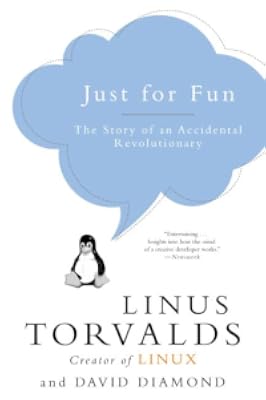
Just For Fun
by Linus Torvalds (Author), David Diamond (Author)
On This Page
Description
Examines the life of Linux creator Linus Torvalds, an "accidental" innovator who helped create the open source software movement, discussing his offbeat Finnish childhood, his interest in computers, and his success with Linux.Tags
Recommendations
Member Reviews
»And I have a wife to make the decisions that complete my wardrobe, to pick out things like sandals and socks. So I never have to worry about it again.«
Those who know me a little better know that I fell in love with Linux some 27 years ago. In March 1995 IBM OS/2 Warp was replaced by (I think) DLD - the Deutsche Linux-Distribution - and I was… free.
»As I read and started to understand Unix, I got a big enthusiastic jolt. Frankly, it’s never subsided. (I hope you can say the same about something.)«
How could I not admire the person who started it all - Linus Torvalds. Torvalds is just a few years older than me and I was delighted and highly amused to find him very relatable in the first half of the book:
Be it then…
»It probably show more won’t surprise anyone that some of my earliest and happiest memories involve playing with my grandfather’s old electronic calculator.«
(In my case, it was a programmable calculator which I got from Joseph who was never shy to help with my computer needs!)
… or be it now…
»When I’m sitting in front of the computer, I get really upset and irritable if somebody disturbs me. Tove could elaborate on this point.«
… my wife also would have a lot to tell you about disturbing me while at my computer.
The entire first half in which Linus remembers his childhood and youth is amusing, engagingly written (despite Linus clearly not being an author) and - to me - highly enjoyable.
I had some issues with David Diamond’s parts: Diamond is a journalist who increasingly writes from the perspective of a friend. He gets too close to his subject and his parts are weak. They emphasise Diamond’s lack of distance to Torvalds and show that closeness doesn’t necessarily lead to better results.
Nevertheless, Torvald’s parts were so good I thought I had a five-star read in front of me after a string of ok’ish books.
Sadly, the brilliant first half was followed by a woefully outdated (the book was first published in 2001, my edition is from 2002) and slightly preachy second half: While Linus Torvalds is undoubtedly brilliant at what he does, he’s neither a great writer nor a great philosopher. (At least not in my book.)
Nokia is still the biggest thing in cell phones, the Palm Pilot is the next big thing and Linus talks about the meaning of life (“Survive, socialise, have fun!”). Quite a few times entire sentences get repeated (“shoulders of giants”, anyone?) and Linus drones on and on about the merits and demerits of people in open source and intellectual property (an entire chapter…).
At times, Linus becomes preachy and acknowledges it (»Okay. You’re right, I should stop preaching.«) instead of fixing it.
On the other hand, years before Android (2008) Linus had the right idea:
»And where is Linux itself, and open source generally, in all this? You won’t even know. It will be inside those Sony machines. You’ll never see it, you’ll never know it, but it’s there, making it all run. It will be in that cell phone, which is at the same time acting as your very own personal communications hub for the rest of your electronic widgets when you’re away from your wireless local area network.
You’ll see. It’s only a matter of time. And money.«
So when Torvalds talks about his profession, he’s just as one might imagine him to be. It’s massively felt that this book has remained for 20 years in relative obscurity and has never been updated to the developments of the last two decades - an age or two in information technology.
And yet: If you read this without expectation and “Just for Fun”, you might at least enjoy part of this amazing ride.
I’m looking forward to one day reading Walter Isaacson’s take on Linus Torvalds.
Till then I’ll leave with three star out of five and this final piece of wisdom by Linus:
»Linux has instead brought people both the entertainment of an intellectual challenge and the social motivations associated with being part of creating it all. We may not have seen each other face-to-face very much, but email was much more than just a dry exchange of information. Bonds of friendship and other social ties can form over email.
This probably also means that if and when we ever meet another intelligent life form in this universe, their first words are not likely to be “Take me to our leader.” They’re more likely to say “Party on, dude!”
Of course, I might be wrong.«
Blog | Facebook | Twitter | Instagram | Pinterest | Medium | Matrix | Tumblr | Plurk
Ceterum censeo Putin esse delendam show less
Those who know me a little better know that I fell in love with Linux some 27 years ago. In March 1995 IBM OS/2 Warp was replaced by (I think) DLD - the Deutsche Linux-Distribution - and I was… free.
»As I read and started to understand Unix, I got a big enthusiastic jolt. Frankly, it’s never subsided. (I hope you can say the same about something.)«
How could I not admire the person who started it all - Linus Torvalds. Torvalds is just a few years older than me and I was delighted and highly amused to find him very relatable in the first half of the book:
Be it then…
»It probably show more won’t surprise anyone that some of my earliest and happiest memories involve playing with my grandfather’s old electronic calculator.«
(In my case, it was a programmable calculator which I got from Joseph who was never shy to help with my computer needs!)
… or be it now…
»When I’m sitting in front of the computer, I get really upset and irritable if somebody disturbs me. Tove could elaborate on this point.«
… my wife also would have a lot to tell you about disturbing me while at my computer.
The entire first half in which Linus remembers his childhood and youth is amusing, engagingly written (despite Linus clearly not being an author) and - to me - highly enjoyable.
I had some issues with David Diamond’s parts: Diamond is a journalist who increasingly writes from the perspective of a friend. He gets too close to his subject and his parts are weak. They emphasise Diamond’s lack of distance to Torvalds and show that closeness doesn’t necessarily lead to better results.
Nevertheless, Torvald’s parts were so good I thought I had a five-star read in front of me after a string of ok’ish books.
Sadly, the brilliant first half was followed by a woefully outdated (the book was first published in 2001, my edition is from 2002) and slightly preachy second half: While Linus Torvalds is undoubtedly brilliant at what he does, he’s neither a great writer nor a great philosopher. (At least not in my book.)
Nokia is still the biggest thing in cell phones, the Palm Pilot is the next big thing and Linus talks about the meaning of life (“Survive, socialise, have fun!”). Quite a few times entire sentences get repeated (“shoulders of giants”, anyone?) and Linus drones on and on about the merits and demerits of people in open source and intellectual property (an entire chapter…).
At times, Linus becomes preachy and acknowledges it (»Okay. You’re right, I should stop preaching.«) instead of fixing it.
On the other hand, years before Android (2008) Linus had the right idea:
»And where is Linux itself, and open source generally, in all this? You won’t even know. It will be inside those Sony machines. You’ll never see it, you’ll never know it, but it’s there, making it all run. It will be in that cell phone, which is at the same time acting as your very own personal communications hub for the rest of your electronic widgets when you’re away from your wireless local area network.
You’ll see. It’s only a matter of time. And money.«
So when Torvalds talks about his profession, he’s just as one might imagine him to be. It’s massively felt that this book has remained for 20 years in relative obscurity and has never been updated to the developments of the last two decades - an age or two in information technology.
And yet: If you read this without expectation and “Just for Fun”, you might at least enjoy part of this amazing ride.
I’m looking forward to one day reading Walter Isaacson’s take on Linus Torvalds.
Till then I’ll leave with three star out of five and this final piece of wisdom by Linus:
»Linux has instead brought people both the entertainment of an intellectual challenge and the social motivations associated with being part of creating it all. We may not have seen each other face-to-face very much, but email was much more than just a dry exchange of information. Bonds of friendship and other social ties can form over email.
This probably also means that if and when we ever meet another intelligent life form in this universe, their first words are not likely to be “Take me to our leader.” They’re more likely to say “Party on, dude!”
Of course, I might be wrong.«
Blog | Facebook | Twitter | Instagram | Pinterest | Medium | Matrix | Tumblr | Plurk
Ceterum censeo Putin esse delendam show less
Fun book/biography of the story around the birth of a new operating system (well a derivative operating system) that was critical to the history of computer software.
The most important impact of the Linux story is the potential productivity of a motivated decentralised force that have a shared objective under an open software development mind set. The socioeconomic impact of this success is still playing out today and will continue to do so with all sorts of opportunities and contradictory failures.
Google would have never existed if it wasn’t for this predecessor example of impact from open technology. And yet this is somehow paradoxical because it flies in the face of what the free software movement has tried to achieve.
Paraphrasing show more Brand:
- Free information wants to be owned.
- Owned information wants to be free.
Abd these two sides wrap around eachother... show less
The most important impact of the Linux story is the potential productivity of a motivated decentralised force that have a shared objective under an open software development mind set. The socioeconomic impact of this success is still playing out today and will continue to do so with all sorts of opportunities and contradictory failures.
Google would have never existed if it wasn’t for this predecessor example of impact from open technology. And yet this is somehow paradoxical because it flies in the face of what the free software movement has tried to achieve.
Paraphrasing show more Brand:
- Free information wants to be owned.
- Owned information wants to be free.
Abd these two sides wrap around eachother... show less
Though now dated, this was fun to read maybe because I lived through many of the events. Surprisingly entertaining, with a few behind the scenes revelations.
The story of Linus Torvalds, the creator of the Linux Operating System.
Obviously the main problem with a book like this is how to make a nerds life sound interesting? The book manages this to an extent, but I feel that the non-nerd community of the world might find this book boring at times. Linus might do something else that's up there with Linux one day and after that the part about Linux can be condensed making it much easier to read.
This is a must-read for people interested in Linux or computers in general. For others this does offer an insight into the mind of one of the great nerds of today. It gives an insight of what the people who have created the computer revolution are and what makes them tick. But as far as biographies go, show more there are better available. show less
Obviously the main problem with a book like this is how to make a nerds life sound interesting? The book manages this to an extent, but I feel that the non-nerd community of the world might find this book boring at times. Linus might do something else that's up there with Linux one day and after that the part about Linux can be condensed making it much easier to read.
This is a must-read for people interested in Linux or computers in general. For others this does offer an insight into the mind of one of the great nerds of today. It gives an insight of what the people who have created the computer revolution are and what makes them tick. But as far as biographies go, show more there are better available. show less
a fascinating memoir about the creation and evolution of the Linux operating system, one of the most important and influential open-source software projects in history. Torvalds provides an engaging and candid account of his personal and professional journey, from his childhood in Finland to his unexpected role as the leader of a global community of developers. He also shares insights into the unique culture and values of the open-source movement, and the challenges and rewards of building a collaborative, decentralized software ecosystem. This book is a must-read for anyone interested in technology, innovation, and the power of community-driven development.
It was fun reading about the history of Linux from the point of view of its creator. Torvalds gives the impression of being an average person who inadvertently walked into fame. His apathetic approach to the whole situation conveyed a striking difference to all the other names that come to mind when thinking of the 'open source' movement.
As a bit of a disclaimer, this book was written through the language and style of a Linux hacker, not a writer. Those expecting a well written essay be forewarned that the timeline wanders and backtracks constantly. For my own reading experience it did not detract from his story, but for many it could.
As a bit of a disclaimer, this book was written through the language and style of a Linux hacker, not a writer. Those expecting a well written essay be forewarned that the timeline wanders and backtracks constantly. For my own reading experience it did not detract from his story, but for many it could.
I read this 250 page book in a day.
Linus seems like a very accessible guy.
Although he says that enjoys money and isn't a "monk", it seems weird that he's so careful about circumstances that could get him some easy money.
I wonder if questioning his (not) taking (seemingly) easy money says more about him or more about me...
Linus seems like a very accessible guy.
Although he says that enjoys money and isn't a "monk", it seems weird that he's so careful about circumstances that could get him some easy money.
I wonder if questioning his (not) taking (seemingly) easy money says more about him or more about me...
Members
- Recently Added By
Lists

Books Read in 2019
4,052 works; 110 members
Author Information

Some Editions
Common Knowledge
- Canonical title
- Just For Fun
- Original title
- Just for Fun
- Original publication date
- 2001
- People/Characters
- Linus Torvalds
- Important places
- Helsinki, Finland; San Francisco, California, USA
- Dedication
- To Tove and Patricia, Daniela, and Celeste. I always wanted to be surrounded by young women, and you made it so.
To Tia and Kaley. Boy do I feel blessed. - First words
- During the euphoria of the final years of the twentieth century, a revolution was happening among all the other revolutions.
- Last words
- (Click to show. Warning: May contain spoilers.)Of course, I might be wrong.
- Original language*
- Amerikanisch
*Some information comes from Common Knowledge in other languages. Click "Edit" for more information.
Classifications
- Genres
- Technology, Biography & Memoir, Nonfiction, General Nonfiction, History
- DDC/MDS
- 005.1092 — Computer science, information & general works Computer science, knowledge & systems Artificial Intelligence/Virtual Reality Software development modified standard subdivisions History, geographic treatment, biography Biography
- LCC
- QA76.2 .T67 .T67 — Science Mathematics Mathematics Instruments and machines Calculating machines
- BISAC
Statistics
- Members
- 1,119
- Popularity
- 22,671
- Reviews
- 14
- Rating
- (3.67)
- Languages
- 12 — Chinese, Danish, Dutch, English, Finnish, French, German, Italian, Korean, Portuguese, Swedish, Turkish
- Media
- Paper, Audiobook, Ebook
- ISBNs
- 24
- ASINs
- 2
