On This Page
Description
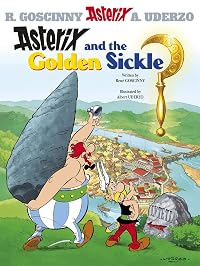
It's a disaster - the druid Getafix has broken his golden sickle. Asterix and Obelix go to Lutetia (now Paris) to buy him a new one. Soon they are tangling with the criminal underworld of the big city - can they outwit Navishtrix, Clovogarlix and the sickle-trafficking gang? Will Getafix ever be able to brew magic potion again?Tags
Recommendations











Member Reviews
This review is written with a GPL 4.0 license and the rights contained therein shall supersede all TOS by any and all websites in regards to copying and sharing without proper authorization and permissions. Crossposted at WordPress, Blogspot, & Librarything by Bookstooge’s Exalted Permission
Title: Asterix and the Golden Sickle
Series: Asterix #2
Authors: Goscinny & Uderzo
Translators: Bell & Hockridge
Rating: 3.5 of 5 Stars
Genre: Comics
Pages: 51
Words: 3K
Synopsis:
From Wikipedia.org
Disaster strikes the Gaulish village when Getafix the druid breaks his golden sickle, as without one, he cannot attend the annual conference of druids, or cut mistletoe for the magic potion which keeps the Roman army at bay. Asterix and Obelix set out for Lutetia show more (present-day Paris) to buy a new sickle from Obelix's distant cousin, the sicklesmith Metallurgix.
On the way there, they encounter bandits, but easily defeat them, and learn from a fellow-traveller that "sickles are in short supply in Lutetia". In the city, they find Metallurgix missing and make inquiries at a local inn, but the landlord professes to know nothing. He later gives a description of Asterix and Obelix to the devious Clovogarlix, who in turn directs them to his superior Navishtrix, who tries to sell them a sickle at an exorbitant price. They refuse, and defeat Navishtrix and his followers, only to be arrested by a Roman patrol. They are released by the Prefect of Lutetia, Surplus Dairyprodus, and learn from a Centurion that Metallurgix may have been kidnapped by sickle traffickers.
From a drunkard imprisoned by Dairyprodus, they learn Navishtrix has a hideout at a portal dolmen in the Boulogne forest. In Navishtrix's underground store-room, Asterix and Obelix find a hoard of golden sickles, but are attacked by Clovogarlix, Navishtrix and their minions. Upon defeat, Navishtrix escapes, and Asterix and Obelix follow him to Surplus Dairyprodus, who – in front of the Centurion – freely confesses to having sponsored the illegal sickle monopoly for his own amusement. The Centurion releases Metallurgix and imprisons Dairyprodus and Navishtrix; whereafter Metallurgix gratefully gives Asterix and Obelix the best of his sickles. With this, they return to their village and celebrate their achievement.
My Thoughts:
As fun as this was, I am realizing that it truly is meant for a younger audience. I think that for me to appreciate it to its fullest I'd have to read these just one a year instead of one a month. However, that just isn't going to happen.
There is a formula to these books that goes something like this: There is a Problem that somehow involves the Gaulish village. Asterix and Obelix get roped into Solving the Problem. Violence and Jokes Ensue, Repeat as Necessary until Solution(s) are reached. Everyone has a Feast at the Village to celebrate. The End.
That formula works and it works well. You simply cannot beat (pun intended) Asterix drinking the magic potion and kerpow'ing scads of roman legionnaires with one punch. And don't forget the random stranger who gets a swig of the stuff and adds to the chaos. And the banter, don't forget the banter. It is like combining the Three Stooges with Laurel & Hardy. The problem with a formula is that at some point a reader (ie, me) expects something new and the older you are and the longer you've read, the harder it is to find new things. And formula's aren't well known for coming up with new things but with successfully re-using items that have worked before.
Of course, it might just be that I'm an old grump (get off my concrete lawn, you stupid kids!) and I want to complain about something and poor little Asterix “won” the lottery. I'll leave it up to you to decide.
★★★✬☆ show less
Title: Asterix and the Golden Sickle
Series: Asterix #2
Authors: Goscinny & Uderzo
Translators: Bell & Hockridge
Rating: 3.5 of 5 Stars
Genre: Comics
Pages: 51
Words: 3K
Synopsis:
From Wikipedia.org
Disaster strikes the Gaulish village when Getafix the druid breaks his golden sickle, as without one, he cannot attend the annual conference of druids, or cut mistletoe for the magic potion which keeps the Roman army at bay. Asterix and Obelix set out for Lutetia show more (present-day Paris) to buy a new sickle from Obelix's distant cousin, the sicklesmith Metallurgix.
On the way there, they encounter bandits, but easily defeat them, and learn from a fellow-traveller that "sickles are in short supply in Lutetia". In the city, they find Metallurgix missing and make inquiries at a local inn, but the landlord professes to know nothing. He later gives a description of Asterix and Obelix to the devious Clovogarlix, who in turn directs them to his superior Navishtrix, who tries to sell them a sickle at an exorbitant price. They refuse, and defeat Navishtrix and his followers, only to be arrested by a Roman patrol. They are released by the Prefect of Lutetia, Surplus Dairyprodus, and learn from a Centurion that Metallurgix may have been kidnapped by sickle traffickers.
From a drunkard imprisoned by Dairyprodus, they learn Navishtrix has a hideout at a portal dolmen in the Boulogne forest. In Navishtrix's underground store-room, Asterix and Obelix find a hoard of golden sickles, but are attacked by Clovogarlix, Navishtrix and their minions. Upon defeat, Navishtrix escapes, and Asterix and Obelix follow him to Surplus Dairyprodus, who – in front of the Centurion – freely confesses to having sponsored the illegal sickle monopoly for his own amusement. The Centurion releases Metallurgix and imprisons Dairyprodus and Navishtrix; whereafter Metallurgix gratefully gives Asterix and Obelix the best of his sickles. With this, they return to their village and celebrate their achievement.
My Thoughts:
As fun as this was, I am realizing that it truly is meant for a younger audience. I think that for me to appreciate it to its fullest I'd have to read these just one a year instead of one a month. However, that just isn't going to happen.
There is a formula to these books that goes something like this: There is a Problem that somehow involves the Gaulish village. Asterix and Obelix get roped into Solving the Problem. Violence and Jokes Ensue, Repeat as Necessary until Solution(s) are reached. Everyone has a Feast at the Village to celebrate. The End.
That formula works and it works well. You simply cannot beat (pun intended) Asterix drinking the magic potion and kerpow'ing scads of roman legionnaires with one punch. And don't forget the random stranger who gets a swig of the stuff and adds to the chaos. And the banter, don't forget the banter. It is like combining the Three Stooges with Laurel & Hardy. The problem with a formula is that at some point a reader (ie, me) expects something new and the older you are and the longer you've read, the harder it is to find new things. And formula's aren't well known for coming up with new things but with successfully re-using items that have worked before.
Of course, it might just be that I'm an old grump (get off my concrete lawn, you stupid kids!) and I want to complain about something and poor little Asterix “won” the lottery. I'll leave it up to you to decide.
★★★✬☆ show less
Clasicazo de Goscinny y Uderzo. No llega a las alturas que alcanzaría la serie más adelante pero ya aparecen muchos de los elementos característicos (Incluyendo el coprotagonismo de Obélix) y algunos momentos brillantes (Como los protagonizados por el prefecto)
Well, it turns out that the second Asterix book is actually really entertaining. It is a little difficult to compare them to Tintin though, especially since the first Tintin books appeared in the 1930s while it was not until the 1960s that the Asterix books began to appear. However, while it took a few albums for Herge to begin to set Tintin on the path that he was going to go, it appears that Asterix reached that position pretty quickly. However, and I will have to revisit this statement a bit later when I have read a lot more of them, the Asterix books seem to become a little ho-hum down the track.
Anyway, this story involves Getafix breaking his golden sickle, and he needs it not only to make the magic potion, but to also go to the show more Druid's conference in the forest of Carnutes. Therefore Asterix and Obelix set out to travel to Lutetia (Ancient Paris) to attempt to get a new sickle. However, when they get there they discover that Obelix's cousin, Metalurgix the sickle maker, has gone missing and nobody wants to talk to them about it.
We begin to see the subtle humour that is being drawn into these comics, where they begin to treat the Roman civilisation as akin to our own, with all of the bureaucracy and the infrastructure that we see around us. One scene has them walking past an aqueduct that is being built, and them commenting about all of the eyesores that are being put up. Then there is the Roman road they travel along with the slaves repairing the road and thus a slow sign being put up, and the chariot driver who speeds past and then is later pulled over by a Roman soldier and given a fine.
This was a lot better than the first one, probably because all of the introductions had been completed and it was time to send Asterix and Obelix on an adventure. However, this adventure has lots of little twists in it as they try to bust open a sickle smuggling racket, who's leadership goes right up to the top in Lutetia. Obviously we also see Obelix with his addiction to wild boar, though I note that Dogmatix, Obelix's dog, doesn't appear in these early albums (despite a write up at the front for him).
I guess I did really enjoy this one, especially since it seems to be a lot more over the top than Tintin. Tintin is comical but more of an adventure story, however while Asterix has its fair share of adventure, it is a lot more comical, and even to an extent farcical. It has been suggested that the writers are using Roman Gaul as a way to make critical comment on our society, however I am not convinced that there is necessarily a much social criticism in these albums as there was in Tintin. However, as I begin to read more of them, we will come to see whether or not that is the case. show less
Anyway, this story involves Getafix breaking his golden sickle, and he needs it not only to make the magic potion, but to also go to the show more Druid's conference in the forest of Carnutes. Therefore Asterix and Obelix set out to travel to Lutetia (Ancient Paris) to attempt to get a new sickle. However, when they get there they discover that Obelix's cousin, Metalurgix the sickle maker, has gone missing and nobody wants to talk to them about it.
We begin to see the subtle humour that is being drawn into these comics, where they begin to treat the Roman civilisation as akin to our own, with all of the bureaucracy and the infrastructure that we see around us. One scene has them walking past an aqueduct that is being built, and them commenting about all of the eyesores that are being put up. Then there is the Roman road they travel along with the slaves repairing the road and thus a slow sign being put up, and the chariot driver who speeds past and then is later pulled over by a Roman soldier and given a fine.
This was a lot better than the first one, probably because all of the introductions had been completed and it was time to send Asterix and Obelix on an adventure. However, this adventure has lots of little twists in it as they try to bust open a sickle smuggling racket, who's leadership goes right up to the top in Lutetia. Obviously we also see Obelix with his addiction to wild boar, though I note that Dogmatix, Obelix's dog, doesn't appear in these early albums (despite a write up at the front for him).
I guess I did really enjoy this one, especially since it seems to be a lot more over the top than Tintin. Tintin is comical but more of an adventure story, however while Asterix has its fair share of adventure, it is a lot more comical, and even to an extent farcical. It has been suggested that the writers are using Roman Gaul as a way to make critical comment on our society, however I am not convinced that there is necessarily a much social criticism in these albums as there was in Tintin. However, as I begin to read more of them, we will come to see whether or not that is the case. show less
A little light relief in these days of social distancing and anxiety!
Goscinny's character names were again hilarious - Clovogarlicus and Navishtrix and the Roman Surplus Dairiprodus! Uderzo's artwork is excellent and the ebook I borrowed from the Open Library had preserved it well in its digital edition.
Goscinny's character names were again hilarious - Clovogarlicus and Navishtrix and the Roman Surplus Dairiprodus! Uderzo's artwork is excellent and the ebook I borrowed from the Open Library had preserved it well in its digital edition.
Boring, repetitive. Not funny, not entertaining at all. In this second adventure, Asterix and Obelix go out to find their village druid Getafix (Get A Fix) a new golden sickle as the druid breaks his old one and without the golden sickle the druid can't make the magic potion that gives Asterix superhuman strength. During the adventure, Asterix and Obelix kept coming across the same Roman legionaries who arrested them again and again to bring them before the Roman prefect. The prefect is too liberal and kind. Every time the protagonists are brought before him, he releases them as each time they showed great bravery by demolishing his own Roman soldiers with their bare hands. The gluttony of Obelix and his craving for wild boars every now show more and then are meant to be funny but they couldn't bring in much humour. Like the first issue, the villains here are very honest. They confess their sins once they are asked and after confessing, their drive to go to the jail is 'exemplary'. It's really amazing to have such friendly enemies!
Bad storyline with great illustrations. I found it 'it was okay' and hence, according to the Goodreads rating system, two stars. show less
Bad storyline with great illustrations. I found it 'it was okay' and hence, according to the Goodreads rating system, two stars. show less
A little light relief in these days of social distancing and anxiety!
Goscinny's character names were again hilarious - Clovogarlicus and Navishtrix and the Roman Surplus Dairiprodus! Uderzo's artwork is excellent and the ebook I borrowed from the Open Library had preserved it well in its digital edition.
Goscinny's character names were again hilarious - Clovogarlicus and Navishtrix and the Roman Surplus Dairiprodus! Uderzo's artwork is excellent and the ebook I borrowed from the Open Library had preserved it well in its digital edition.
Another classic tale by Goscinny & Uderzo.
2nd volume, released 1962I was given a little tour of my eldest's classroom the other day and saw this book on their bookshelf and asked her to bring it home for me as I hadn't read this one. Another good'un by our Frenchie mates depicting the struggle against the odds of a small Gaulish village against the tyranny of Caesar and the Romans.
The Druid, Getafix, has busted his golden sickle which is required for its source of power to the 'formula' so Asterix and Obelix take what we know as a road trip to buy him another. Of course they come across baddies in the form of thugs and scores of Roman Legionnaires with predictable results.
While some of the story is lame and filling in gaps, which show more actually occurs in almost all episodes, at the end of the day it is a cartoon with hidden jokes all the way through, most lost on the reader if their Latin is not up to scratch. But for me, it has been the names, and here are some of my picks from this book;
Cacofonix, the Bard
Metallurgix, the sickle maker
Clovogarlix
Surplus Dairiprodus, the Prefect
The main antagonists from the village
For the trivia-minded;
it is the first time Cacofonix is tied up in the banquet scene
the Prefect is a caricature of actor Charles Laughton show less
2nd volume, released 1962I was given a little tour of my eldest's classroom the other day and saw this book on their bookshelf and asked her to bring it home for me as I hadn't read this one. Another good'un by our Frenchie mates depicting the struggle against the odds of a small Gaulish village against the tyranny of Caesar and the Romans.
The Druid, Getafix, has busted his golden sickle which is required for its source of power to the 'formula' so Asterix and Obelix take what we know as a road trip to buy him another. Of course they come across baddies in the form of thugs and scores of Roman Legionnaires with predictable results.
While some of the story is lame and filling in gaps, which show more actually occurs in almost all episodes, at the end of the day it is a cartoon with hidden jokes all the way through, most lost on the reader if their Latin is not up to scratch. But for me, it has been the names, and here are some of my picks from this book;
Cacofonix, the Bard
Metallurgix, the sickle maker
Clovogarlix
Surplus Dairiprodus, the Prefect
The main antagonists from the village
For the trivia-minded;
it is the first time Cacofonix is tied up in the banquet scene
the Prefect is a caricature of actor Charles Laughton show less
Members
- Recently Added By
Lists

Recommended Comics / Graphic Novels
595 works; 122 members

1960s, Best books published therein
254 works; 22 members

Paris, City of Lights
103 works; 17 members

The Books I've Read 2018
143 works; 1 member

Books Read in 2018
4,360 works; 110 members

Books Read in 2021
5,361 works; 113 members

ClubLeabhar: Leabhar na Míosa
121 works; 1 member
Author Information


Albert Uderzo was born on April 25, 1927 in Fismes, France as Alberto Aleondro Uderzo. In 1940, when he was just 13, he worked for Paris Publishing Society where he learned the basics for his profession - designing text and letters and editing photos. During World War II he worked on a farm and later as a furniture maker with his father. His show more drawing skills were put aside until 1945 when he entered a comic strip competition and later worked on a cartoon film titled Clic Clac. In the mean time he moved to Paris and worked on the magazine O.K. where he created several comics such as Arys Buck and Belloy. It was then that he met Rene Goscinny and the two worked on new comic book characters like Ompah-pah, Jehan Pistolet and Luc Junior. In 1959 they started a magazine called Pilote aimed at older children. It was the first issue that introduced the character Asterix and it was a big hit. By 1967 the comic became so popular that they decided to devote all their time to the series. Albert Uderzo was the illustator of all thirty Asterix adventures and the writer of the last eight adventures. show less
Some Editions
Series

Belongs to Publisher Series
Asterix [Dalen] (9)
Work Relationships
Is contained in
Asterix Omnibus 01: Asterix the Gaul #1, Asterix and the Golden Sickle #2, Asterix and the Goths #3 by René Goscinny
De avonturen van Asterix de Galliër. [1]: De Galliër ; Het gouden snoeimes ; De Gothen ; De gladiatoren by René Goscinny
Asterix collectie I: 1 de Galliër, 2 het gouden snoeimes, 3 en de Gothen, 4 en de gladiatoren, 5 en de ronde van Gallia, 6 en Cleopatra by Albert Uderzo
Asterix bind 3: Asterix og goterne : Asterix og styrkedråpene : Asterix som gladiator : Asterix - Gallia rundt by Goscinny
Has the adaptation
Common Knowledge
- Canonical title
- Asterix and the Golden Sickle
- Original title
- La Serpe d'Or
- Alternate titles*
- Asterix: Die goldene Sichel
- Original publication date
- 1962
- People/Characters
- Astérix; Obélix; Assurancetourix; Abraracourcix; Idéfix
- Important places*
- Lutetia, Gallien
- Important events
- Roman Empire
- First words*
- In Asterix' kleinem, uns wohlbekannten gallischen Dorf, das fest entschlossen ist, unabhängig zu bleiben, herrscht tiefer Frieden ...
- Last words*
- (Click to show. Warning: May contain spoilers.)Komisch! Troubadix, der Barde, gibt heute gar nichts zum besten!
- Original language
- French
*Some information comes from Common Knowledge in other languages. Click "Edit" for more information.
Classifications
- Genre
- Graphic Novels & Comics
- DDC/MDS
- 741.5 — Arts & recreation Drawing & decorative arts Drawing Comic books, graphic novels, fotonovelas, cartoons, caricatures, comic strips
- LCC
- PN6747 — Language and Literature Literature (General) Literature (General) Collections of general literature Comic books, strips, etc.
- BISAC
Statistics
- Members
- 2,024
- Popularity
- 10,318
- Reviews
- 21
- Rating
- (3.97)
- Languages
- 33 — Afrikaans, Arabic, Bable, Bengali, Catalan, Czech, Danish, Dutch, English, Finnish, French, Frisian, German, Scottish Gaelic, Irish, Galician, Greek, Hungarian, Italian, Latin, Norwegian (Bokmål), Norwegian, Farsi/Persian, Polish, Russian, Scots, Croatian, Slovak, Spanish, Swedish, Turkish, Welsh, Portuguese (Brazil)
- Media
- Paper, Ebook
- ISBNs
- 109
- ASINs
- 26