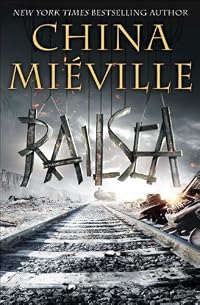
Railsea
by China Miéville
On This Page
Description
"On board the moletrain Medes, Sham Yes ap Soorap watches in awe as he witnesses his first moldywarpe hunt: the giant mole bursting from the earth, the harpoonists targeting their prey, the battle resulting in one's death & the other's glory. But no matter how spectacular it is, Sham can't shake the sense that there is more to life than traveling the endless rails of the railsea--even if his captain can think only of the hunt for the ivory-colored mole she's been chasing since it took her show more arm all those years ago. When they come across a wrecked train, at first it's a welcome distraction. But what Sham finds in the derelict--a kind of treasure map indicating a mythical place untouched by iron rails--leads to considerably more than he'd bargained for. Soon he's hunted on all sides, by pirates, trainsfolk, monsters, & salvage-scrabblers. & it might not be just Sham's life that's about to change. It could be the whole of the railsea. Here is a novel for readers of all ages, a gripping & brilliantly imagined take on Herman Melville's Moby-Dick that confirms China Mieville's status as "the most original & talented voice to appear in several years" (Science Fiction Chronicle)"--Provided by publisher. show lessTags
Recommendations








Member Recommendations
Member Reviews
Okay, so this is Moby Dick but trains instead of ships. Also, it's set is some AU, post apocalyptic future where there are weird corrupted monsters living underground and a giant "railsea" left over from some forgotten capitalistic war. So. When I say "railsea" I'm talking about some nonsensically dense cobweb of railroad ties tangling forever. Humanity has retreated onto mountains, which cannot be burrowed through thus protecting them from the terrible earth which is just chock-ablock with huge, flesh eating moles, insects, owls, etc. Seriously, like one footfall on the dirt and they'll come for you. Why they won't come for the trains themselves is never explained. All these animals have legs and do just fine above ground, but they show more don't just jump out of the ground, climb onto a train and eat the helpless humans aboard. Nope, these beasts respect the rules of "the ground is lava". As long as no one is making direct contact with the ground, you're safe. Apparently, you're even safe to just walk along the wooded ties, just don't touch the dirt!
Also, I really can't tell you how annoyed I was by the terminology in this book. It's the steampunk version of that classic scifi trope of just slapping "space" onto normal words. As in, "Pass me my spaceshoes, I'm about to get on my spacebike and go to my spacejob." Except, the author feels the need to tack on awkward train or sailing words to normal words. Also, the author has created the most offensively stupid fake future swear word I've ever heard. Stonefaces. That's three syllables, people. And characters, multiple times say, "Oh my Stonefaces" in dire situations. Not only is that a fucking mouthful, it sounds dumb and makes no sense. I almost put the book down after the first chapter these annoying portmanteaus pulled me out of the narrative so much.
The character names are also really bad. So many are introduced with full names that just sound like word salad with the result being that I have no idea who anyone is and the train just seems to be full of faceless, completely undeveloped cardboard cutouts. Later, the author seems to just give up with this name nonsense and names two siblings basically the SAME NAME. One is Caldera and the other is Caldero. Like... why would you even do that ever? Immediately, the two characters tell us to just call them Cal and Dero. Like... you could have just named them that? Why make us hate their absent parents for being stupid?
The plot is just so dumb and makes no sense at all. The characters motivations are constantly shifting sands. The protagonist is an apprentice doctor on a mole hunting ship, but he really wishes he could be a member of a salvage crew. It's not clear why this dream couldn't just very very easily happen. But anyway, he stops caring about salvage pretty quickly and decides he wants to explore the far reaches of the railsea and find the end. He decides this is what he wants after he sees a photograph of strange places on the edge.
I guess, in this world people just believe that the railsea goes on forever? Literally, they believe that this man-made thing never ends. The end of the rails is part of a legend but no one believes its really true. The end of the railsea is like Atlantis. But the protagonist manages to convince an entire train to abandon their mole hunt and just try to find the end of the world. The captain's obsession with a certain special mole is established from almost the first page of the book. She travels all over to find special tech to track the beast. But, very late in the book, we find out that her silly steampunk prosthetic arm is just a fake. She actually has all her limbs and is just obsessed with the mole for no reason. As far as we know, she's never actually had any sort of run-in with the monster for which she requires revenge. So like... why is this whole book a thing?
More than that, this book was plagued by constant problems that were basically cryptonite for my suspension of disbelief. I just kept wondering who owns these trains and why are they okay with mad obsession from their captains. Literally, the mole hunt that opens the book is the only molehunt IN THE WHOLE BOOK. The kill one mole and then the rest of the time they are just toodling around the railsea just doing whatever seems best to them. I kept wondering where they were getting fuel. I mean, the only reason the whaling industry worked was because the ships were powered by the wind. Diesel engines driving on circuitous and extremely dangerous routes in hopes of catching large moles seems like an unsustainable industry. It wasn't clear to me why mole meat was even that important a resource.
I just. The ending of this book is too stupid to write down. It's bad. Really bad and makes no sense and isn't very well explained either. Super bad from page one. And I really think there was no chance that it could have been good. There was nothing redeemable in the whole thing. I've enjoyed other books by Mieville, so I really don't know what went wrong here. show less
Also, I really can't tell you how annoyed I was by the terminology in this book. It's the steampunk version of that classic scifi trope of just slapping "space" onto normal words. As in, "Pass me my spaceshoes, I'm about to get on my spacebike and go to my spacejob." Except, the author feels the need to tack on awkward train or sailing words to normal words. Also, the author has created the most offensively stupid fake future swear word I've ever heard. Stonefaces. That's three syllables, people. And characters, multiple times say, "Oh my Stonefaces" in dire situations. Not only is that a fucking mouthful, it sounds dumb and makes no sense. I almost put the book down after the first chapter these annoying portmanteaus pulled me out of the narrative so much.
The character names are also really bad. So many are introduced with full names that just sound like word salad with the result being that I have no idea who anyone is and the train just seems to be full of faceless, completely undeveloped cardboard cutouts. Later, the author seems to just give up with this name nonsense and names two siblings basically the SAME NAME. One is Caldera and the other is Caldero. Like... why would you even do that ever? Immediately, the two characters tell us to just call them Cal and Dero. Like... you could have just named them that? Why make us hate their absent parents for being stupid?
The plot is just so dumb and makes no sense at all. The characters motivations are constantly shifting sands. The protagonist is an apprentice doctor on a mole hunting ship, but he really wishes he could be a member of a salvage crew. It's not clear why this dream couldn't just very very easily happen. But anyway, he stops caring about salvage pretty quickly and decides he wants to explore the far reaches of the railsea and find the end. He decides this is what he wants after he sees a photograph of strange places on the edge.
I guess, in this world people just believe that the railsea goes on forever? Literally, they believe that this man-made thing never ends. The end of the rails is part of a legend but no one believes its really true. The end of the railsea is like Atlantis. But the protagonist manages to convince an entire train to abandon their mole hunt and just try to find the end of the world. The captain's obsession with a certain special mole is established from almost the first page of the book. She travels all over to find special tech to track the beast. But, very late in the book, we find out that her silly steampunk prosthetic arm is just a fake. She actually has all her limbs and is just obsessed with the mole for no reason. As far as we know, she's never actually had any sort of run-in with the monster for which she requires revenge. So like... why is this whole book a thing?
More than that, this book was plagued by constant problems that were basically cryptonite for my suspension of disbelief. I just kept wondering who owns these trains and why are they okay with mad obsession from their captains. Literally, the mole hunt that opens the book is the only molehunt IN THE WHOLE BOOK. The kill one mole and then the rest of the time they are just toodling around the railsea just doing whatever seems best to them. I kept wondering where they were getting fuel. I mean, the only reason the whaling industry worked was because the ships were powered by the wind. Diesel engines driving on circuitous and extremely dangerous routes in hopes of catching large moles seems like an unsustainable industry. It wasn't clear to me why mole meat was even that important a resource.
I just. The ending of this book is too stupid to write down. It's bad. Really bad and makes no sense and isn't very well explained either. Super bad from page one. And I really think there was no chance that it could have been good. There was nothing redeemable in the whole thing. I've enjoyed other books by Mieville, so I really don't know what went wrong here. show less
Railsea is set in a world -- I want to say "a post-apocalyptic world," but maybe that's not quite right. Maybe it's just a very old world in which a lot of stuff has happened. Anyway, it's set in a world where the oceans are railroads. Literally. Instead of water, there are miles and miles of train tracks, splitting and joining and looping in on themselves everywhere. And people take to these rails, among other things, to hunt giant moles. Whale-sized giant moles.
Basically, it's a sea story, but with trains. Which is a ridiculous, insane idea and should not work, but Miéville is an absolute master of taking surreal ideas like this and shaping them, somehow, into detailed, real-feeling worlds, and this one is no exception. The bizarre, show more fascinating setting isn't the only selling point here, either. The plot is full of exciting, suspenseful adventure. The narration has a clever, self-aware quality to it that could, in lesser hands, have seemed painfully arch, but instead works beautifully. Also, it riffs on Moby-Dick in some thoughtful, playful ways that I found utterly delightful (although, lest you get the wrong idea, the novel is by no means a Melville pastiche). Miéville slyly sneaks in a few other entertaining literary references, too, from the obvious to the obscure. And the ending... the ending was nothing I expected at all.
I've enjoyed all the Miéville novels that I've read (which includes the Bas-Lag trilogy, The City & the City, and Kraken), but I think this one may be my new favorite. What a ride! show less
Basically, it's a sea story, but with trains. Which is a ridiculous, insane idea and should not work, but Miéville is an absolute master of taking surreal ideas like this and shaping them, somehow, into detailed, real-feeling worlds, and this one is no exception. The bizarre, show more fascinating setting isn't the only selling point here, either. The plot is full of exciting, suspenseful adventure. The narration has a clever, self-aware quality to it that could, in lesser hands, have seemed painfully arch, but instead works beautifully. Also, it riffs on Moby-Dick in some thoughtful, playful ways that I found utterly delightful (although, lest you get the wrong idea, the novel is by no means a Melville pastiche). Miéville slyly sneaks in a few other entertaining literary references, too, from the obvious to the obscure. And the ending... the ending was nothing I expected at all.
I've enjoyed all the Miéville novels that I've read (which includes the Bas-Lag trilogy, The City & the City, and Kraken), but I think this one may be my new favorite. What a ride! show less
Wow. Just wow.
This is a book with subterranean labyrinths of depth, barely detectable via literary allusions both obscure and overt. This is also an adventure story, written to entertain children. Somehow, it is both of these things at once.
What I'm getting at, here, is that it's a story which works flawlessly. It's eminently approachable, but never panders- instead it broadens, it winks, it encourages and cajoles. "See what I just did there?" It asks. "Look closer. There's more."
A good friend recommended this book to me, with (I paraphrase blurry recollection) the statement "If all YA fiction was like this, we wouldn't need to worry about the future. The work would be done."
I thought I recognized that at the time as hyperbole. Now I show more realize the exaggeration was not so great- not, in fact, so far from literal truth.
This is a book which invites the reader to grow. To think. To correlate and cross reference culture until it becomes understanding.
It's an open invitation and introductory tutorial to the kind of critical thinking that defines the best of humanity. It's not the whole course, which is a life's work. But it's a seed, a beginning, a station from which journeys begin.
Wow. show less
This is a book with subterranean labyrinths of depth, barely detectable via literary allusions both obscure and overt. This is also an adventure story, written to entertain children. Somehow, it is both of these things at once.
What I'm getting at, here, is that it's a story which works flawlessly. It's eminently approachable, but never panders- instead it broadens, it winks, it encourages and cajoles. "See what I just did there?" It asks. "Look closer. There's more."
A good friend recommended this book to me, with (I paraphrase blurry recollection) the statement "If all YA fiction was like this, we wouldn't need to worry about the future. The work would be done."
I thought I recognized that at the time as hyperbole. Now I show more realize the exaggeration was not so great- not, in fact, so far from literal truth.
This is a book which invites the reader to grow. To think. To correlate and cross reference culture until it becomes understanding.
It's an open invitation and introductory tutorial to the kind of critical thinking that defines the best of humanity. It's not the whole course, which is a life's work. But it's a seed, a beginning, a station from which journeys begin.
Wow. show less
I'll admit that when I saw this book was 'for all ages', it worried me. That worry was unfounded, however. 'Railsea' isn't as viscerally disturbing as 'Perdido Street Station' or 'The Scar' (which are absolutely fantastic, amongst the best fantasy I've ever read). Nonetheless, it's a thrilling, strange, and brilliant adventure. I loved the world of trains meandering about the tangle of rails, spanning a continent or more. As well as pirates, wreckers, salvagers, and merchants, there can be found hunters and the navy. The elements parodying 'Moby Dick' are especially entertaining - captains of hunting trains tend to acquire a 'philosophy', in other words a particular identifiable creature they pursue avidly. In the case of Captain Naphi, show more the fixation takes the form of a gargantuan albino mole called Mocker-Jack. The little detail that there's a magazine for philosopher-captains, for which they write pieces about their nemeses, is especially amusing. The narration of the book is also entertainingly self-aware and darts periodically across the fourth wall.
This is the kind of book in which you become absorbed and read more than 300 pages in an afternoon. It's an easier read than other Miéville novels, with a breakneck plot. The main point of view character, Sham, remains relatively undeveloped, but that seems fair enough as he's a teenager (16, 17-ish as I recall) who doesn't know what to do with his life. His sense of wonder about the new weirdnesses he encounters is great, as the reader also marvels at their strangeness.
Whilst reading, I did wonder if 'Railsea' existed in Bas-Lag, the same universe (planet?) as 'Perdido Street Station' etc. It seems not, although it felt compatible until some way through. Rather, 'Railsea' seems to be set in Earth a few hundred, maybe a thousand, years hence. The world-building reminded me, actually, of the 'Greatwinter' series by Sean McMullen, possibly because sail-trains were also a feature of that future. (I highly recommend the 'Greatwinter' books if you enjoy Miéville's work, by the by.)
In summary, 'Railsea' is delightful and I enjoyed it a lot. China Miéville is one of my favourite writers, gifted with incredible ability, versatility, and imagination. I strongly recommend reading everything that he has written (...except perhaps 'Kraken'). show less
This is the kind of book in which you become absorbed and read more than 300 pages in an afternoon. It's an easier read than other Miéville novels, with a breakneck plot. The main point of view character, Sham, remains relatively undeveloped, but that seems fair enough as he's a teenager (16, 17-ish as I recall) who doesn't know what to do with his life. His sense of wonder about the new weirdnesses he encounters is great, as the reader also marvels at their strangeness.
Whilst reading, I did wonder if 'Railsea' existed in Bas-Lag, the same universe (planet?) as 'Perdido Street Station' etc. It seems not, although it felt compatible until some way through. Rather, 'Railsea' seems to be set in Earth a few hundred, maybe a thousand, years hence. The world-building reminded me, actually, of the 'Greatwinter' series by Sean McMullen, possibly because sail-trains were also a feature of that future. (I highly recommend the 'Greatwinter' books if you enjoy Miéville's work, by the by.)
In summary, 'Railsea' is delightful and I enjoyed it a lot. China Miéville is one of my favourite writers, gifted with incredible ability, versatility, and imagination. I strongly recommend reading everything that he has written (...except perhaps 'Kraken'). show less
Last year I discovered a very, very strange film and fell completely in love with it. Richard Lester's film adaptation of Spike Milligan's and John Antrobus' post-apocalyptic farce The Bed-Sitting Room is one of the most bizarre things I've ever seen, and I'm a David Lynch/Peter Greenaway/Spike Jonze fan.
The film, like so many I take to my heart, tanked at the box office, but it had a few fans nonetheless.
I am 100% not surprised that China Mieville is one of them.
Railsea is a book I've had sitting on my ereader for many, many months. Mieville is one of my very favorite writers; I love his daring, his baroque and slightly deranged prose style, and most of all, his imagination. He is therefore an author on the very short list of "writers show more whose books I automatically buy sight unseen just because of who wrote them" as they come out (also on the list: Tim Powers, Michael Chabon, Alastair Reynolds... China's in mighty interesting company, there). He's only disappointed me once, so far (Kraken). But this time, this time I hesitated. Because the first thing I heard about it (beyond that it had to do with trains, duh) was that it was China Mieville's take on Herman Melville's (hee) Moby-Dick. Which I did not love, you guys, not one little bit.
But sooner or later, my love for China Mieville was gonna win out over my hate for his pseudo-namesake (or at least, for his big bloated hipster-before-there-were-hipsters-that-makes-it-even-more-hipster opus). And here we are.
What, you may be asking, has any of this to do with The Bed Sitting Room? Well, just hold on a moment, I'll get to that.* Because first, a sketch of the world China has taken us to, which is, as ever, fascinating. For one thing, it is covered in railroad tracks. Covered. There's never just one set.** And where there is not track, there is either "hard ground" where Mad Max-esque towns and other facilities, built largely out of materials salvaged from the ruins of the world you and I know, are set (and regarded as continents or islands), or regular ground, which is the domain of a host of monstrous soil dwellers -- giant earthworms with girths comparable to human arms, burrowing owls the size of rocs (they can carry off train cars when they bother to fly), antlions as big as a person (or bigger), huge swarms of naked mole rats, and moles ranging from the size we know in garden and farm to those of sperm whales. And like whales, these giant moles are hunted by humans, who chase them down in great mole-trains from which they dispatch jolly-carts (like jolly boats from an ocean whaler) full of harpooneers and other specialists in killing and butchering the giant mole when one surfaces.
And yes, there is an albino giant, called Mocker-Jack. And yes, Mocker-Jack has an obsessed captain hunting it, one Ms. Abacat Naphi (anagram for Captain Ahab***), who sports a crazy semi-cybernetic arm made of metal and mole-bone ivory.
But this is not just a retelling of Moby-Dick with moles and trains****, though yes, we have an Ishmael-esque point of view character, Sham Yes ap Soorpan (but thank god, he's not a mole-ing fanboy who oppresses us chapter after chapter with his knowledge of and enthusiasm for the profession; indeed, he's rather reluctant to be a moler; he'd rather be a salvager, an Indiana Jones fantasy of finding treasure in the train wrecks out on the railsea). There is a lot more going on. Because this is some kind of post-apocalypse, though it's hard to determine in what way our civilization devolved and deranged itself into this one.
Which brings me to The Bed Sitting Room. To which there are at least two in-your-ribs references and lots of more subtle ones. I was already thinking vaguely of this film as I read, but treating the experience as one of those idiosyncratic brain-twitches I sometimes get when I make a connection that probably doesn't really exist. But then, wait, ho! Two of these characters are the children of a mother named Ethel Shroake (in TBS, Shroake is the charwoman to the Queen of England and, upon surviving the "nuclear misunderstanding" that touches off the film/play, is regarded as the closest thing the shattered realm has left to royalty), and they live in a compound dominated by a great archway made of washing machines, a visual echo of the archway under which we meet Ethel Shroak in TBS. I died, you guys.
Another delight to be had in Railsea is an ongoing game Mieville plays with the reader, a coy sort of teasing in which he pretends, in his little trainsplaining interludes between narrative chapters, to be giving us a look at the workings backstage, as it were. He pretends to show us his inner processes, his wrestling with the story, or stories, for he claims there is a story he wants to tell and a story that wants to be told, and they are not precisely the same story. Thus once the story breaks into three narrative possibilities (like a train coming to a switchyard where three tracks present themselves as options), we could follow Sham's adventures, or Naphi's, or the Shroakes', and our narrator appears to struggle with the tension between what he pretends to think his readers expect and what he knows is actually the most interesting bit going on. It's all very droll.
The book is also illustrated by Mieville himself, with drawings of many of the monsters of the railsea appearing between sections of the story. The artwork is admirable and charming, even in e-ink, and leads me to wonder if there is anything this guy can't do. I'd hate him if I didn't love him so.
*You who have read Railsea, you see what I did there?
**No indeed. There are LOTS of sets, sometimes running in parallel, often criss-crossing and looping back and all over the place, like an ampersand (which is, Mieville explains in one of his trainsplaining interludes, is why this world never spells out the word "and" but always uses the ampersand, and why he has chosen to as well. Surprisingly, this is not annoying). Thus the switcher crews on any train are kept very busy indeed.
***I found at least one other anagram, the god called That Apt Omh, which unscrambles to, of course, Topham Hatt, of Thomas the Tank Engine fame. I suspect there are many, many more. But I suck at anagrams. You should be very impressed that I found these two.
****Indeed, the Moby-Dick plot takes a backseat most of the novel, except in that it seems to have informed a whole culture: the railsea is full of train-captains who are obsessively hunting monsters of various species, for various reasons. Each captain has created a metaphor-burdened narrative that is really just an elaborate excuse for taking on the role of obsessive hunter, which they call "having a philosophy." Thus various monsters are stand-ins for various high-falutin' concepts like doubt and remorse and, yes, vengeance, but really, everybody just wants to play Ahab. Which is hilarious. show less
The film, like so many I take to my heart, tanked at the box office, but it had a few fans nonetheless.
I am 100% not surprised that China Mieville is one of them.
Railsea is a book I've had sitting on my ereader for many, many months. Mieville is one of my very favorite writers; I love his daring, his baroque and slightly deranged prose style, and most of all, his imagination. He is therefore an author on the very short list of "writers show more whose books I automatically buy sight unseen just because of who wrote them" as they come out (also on the list: Tim Powers, Michael Chabon, Alastair Reynolds... China's in mighty interesting company, there). He's only disappointed me once, so far (Kraken). But this time, this time I hesitated. Because the first thing I heard about it (beyond that it had to do with trains, duh) was that it was China Mieville's take on Herman Melville's (hee) Moby-Dick. Which I did not love, you guys, not one little bit.
But sooner or later, my love for China Mieville was gonna win out over my hate for his pseudo-namesake (or at least, for his big bloated hipster-before-there-were-hipsters-that-makes-it-even-more-hipster opus). And here we are.
What, you may be asking, has any of this to do with The Bed Sitting Room? Well, just hold on a moment, I'll get to that.* Because first, a sketch of the world China has taken us to, which is, as ever, fascinating. For one thing, it is covered in railroad tracks. Covered. There's never just one set.** And where there is not track, there is either "hard ground" where Mad Max-esque towns and other facilities, built largely out of materials salvaged from the ruins of the world you and I know, are set (and regarded as continents or islands), or regular ground, which is the domain of a host of monstrous soil dwellers -- giant earthworms with girths comparable to human arms, burrowing owls the size of rocs (they can carry off train cars when they bother to fly), antlions as big as a person (or bigger), huge swarms of naked mole rats, and moles ranging from the size we know in garden and farm to those of sperm whales. And like whales, these giant moles are hunted by humans, who chase them down in great mole-trains from which they dispatch jolly-carts (like jolly boats from an ocean whaler) full of harpooneers and other specialists in killing and butchering the giant mole when one surfaces.
And yes, there is an albino giant, called Mocker-Jack. And yes, Mocker-Jack has an obsessed captain hunting it, one Ms. Abacat Naphi (anagram for Captain Ahab***), who sports a crazy semi-cybernetic arm made of metal and mole-bone ivory.
But this is not just a retelling of Moby-Dick with moles and trains****, though yes, we have an Ishmael-esque point of view character, Sham Yes ap Soorpan (but thank god, he's not a mole-ing fanboy who oppresses us chapter after chapter with his knowledge of and enthusiasm for the profession; indeed, he's rather reluctant to be a moler; he'd rather be a salvager, an Indiana Jones fantasy of finding treasure in the train wrecks out on the railsea). There is a lot more going on. Because this is some kind of post-apocalypse, though it's hard to determine in what way our civilization devolved and deranged itself into this one.
Which brings me to The Bed Sitting Room. To which there are at least two in-your-ribs references and lots of more subtle ones. I was already thinking vaguely of this film as I read, but treating the experience as one of those idiosyncratic brain-twitches I sometimes get when I make a connection that probably doesn't really exist. But then, wait, ho! Two of these characters are the children of a mother named Ethel Shroake (in TBS, Shroake is the charwoman to the Queen of England and, upon surviving the "nuclear misunderstanding" that touches off the film/play, is regarded as the closest thing the shattered realm has left to royalty), and they live in a compound dominated by a great archway made of washing machines, a visual echo of the archway under which we meet Ethel Shroak in TBS. I died, you guys.
Another delight to be had in Railsea is an ongoing game Mieville plays with the reader, a coy sort of teasing in which he pretends, in his little trainsplaining interludes between narrative chapters, to be giving us a look at the workings backstage, as it were. He pretends to show us his inner processes, his wrestling with the story, or stories, for he claims there is a story he wants to tell and a story that wants to be told, and they are not precisely the same story. Thus once the story breaks into three narrative possibilities (like a train coming to a switchyard where three tracks present themselves as options), we could follow Sham's adventures, or Naphi's, or the Shroakes', and our narrator appears to struggle with the tension between what he pretends to think his readers expect and what he knows is actually the most interesting bit going on. It's all very droll.
The book is also illustrated by Mieville himself, with drawings of many of the monsters of the railsea appearing between sections of the story. The artwork is admirable and charming, even in e-ink, and leads me to wonder if there is anything this guy can't do. I'd hate him if I didn't love him so.
*You who have read Railsea, you see what I did there?
**No indeed. There are LOTS of sets, sometimes running in parallel, often criss-crossing and looping back and all over the place, like an ampersand (which is, Mieville explains in one of his trainsplaining interludes, is why this world never spells out the word "and" but always uses the ampersand, and why he has chosen to as well. Surprisingly, this is not annoying). Thus the switcher crews on any train are kept very busy indeed.
***I found at least one other anagram, the god called That Apt Omh, which unscrambles to, of course, Topham Hatt, of Thomas the Tank Engine fame. I suspect there are many, many more. But I suck at anagrams. You should be very impressed that I found these two.
****Indeed, the Moby-Dick plot takes a backseat most of the novel, except in that it seems to have informed a whole culture: the railsea is full of train-captains who are obsessively hunting monsters of various species, for various reasons. Each captain has created a metaphor-burdened narrative that is really just an elaborate excuse for taking on the role of obsessive hunter, which they call "having a philosophy." Thus various monsters are stand-ins for various high-falutin' concepts like doubt and remorse and, yes, vengeance, but really, everybody just wants to play Ahab. Which is hilarious. show less
This is a Young Adult novel by Miéville (whose adult works I have yet to read, but must). It has a completely whacky premise: a world in which there are no oceans, and where in their place is the endless ‘railsea’: a vast tangle of railroad tracks over which trains hurtle between islands of higher land, throwing switches on the run to change direction.
"This is the story of a bloodstained boy."
Thus we are introduced to Sham ap Soorap, a young man on board the moletrain Medes, whose captain is driven by an obsession to catch and kill a great white mole which has in the past severed her arm. Well, you get the idea. If the trick was only this recasting of Moby-Dick then there wouldn’t be much to the book. But Miéville spins out a show more much more interesting and complex story, full of sly references to books like Kidnapped, Robinson Crusoe and Gulliver’s Travels.
I do like the way Miéville keeps breaking the ‘fourth wall’ and discussing what is going to happen with the reader. (Since I’ve just finished reading Barchester Chronicles, this reminds me a lot of Anthony Trollope doing the same thing). There’s a typographical quirk to the text too. Each and every instance of the word ‘and’ is replaced by the ampersand ‘&’. At first this annoyed me, but then I got used to it, and it does give an interesting feel to the story.
Lots of exciting adventure and interest. And in the end, there’s almost (stress almost) a justification revealed for the existence of the railsea. I really liked it. show less
"This is the story of a bloodstained boy."
Thus we are introduced to Sham ap Soorap, a young man on board the moletrain Medes, whose captain is driven by an obsession to catch and kill a great white mole which has in the past severed her arm. Well, you get the idea. If the trick was only this recasting of Moby-Dick then there wouldn’t be much to the book. But Miéville spins out a show more much more interesting and complex story, full of sly references to books like Kidnapped, Robinson Crusoe and Gulliver’s Travels.
I do like the way Miéville keeps breaking the ‘fourth wall’ and discussing what is going to happen with the reader. (Since I’ve just finished reading Barchester Chronicles, this reminds me a lot of Anthony Trollope doing the same thing). There’s a typographical quirk to the text too. Each and every instance of the word ‘and’ is replaced by the ampersand ‘&’. At first this annoyed me, but then I got used to it, and it does give an interesting feel to the story.
Lots of exciting adventure and interest. And in the end, there’s almost (stress almost) a justification revealed for the existence of the railsea. I really liked it. show less
I go to China Miéville when I need mental healing from bad sci fi & fantasy. He's a Pulitzer level writer that chose to write weird stuff. Miéville only writes books that restructure my perception of literature or society. Everything starts from ground zero, as if no rules were created to define genre.
This less famous book equals any of his others in world building and has one of the best endings, a punchline 500 pages to set up.
I have to wonder if this Moby Dick inspired tale also contains an epic meta pun of his name sounding like Melville.
This less famous book equals any of his others in world building and has one of the best endings, a punchline 500 pages to set up.
I have to wonder if this Moby Dick inspired tale also contains an epic meta pun of his name sounding like Melville.
Members
- Recently Added By
Lists

Best Science Fiction Novels
816 works; 426 members

Top Five Books of 2013
1,562 works; 721 members

Most-anticipated future releases
40 works; 25 members

IMPAC Dublin Literary Award 2014 longlist
150 works; 3 members

Books Read in 2015
3,299 works; 126 members

Best public-transport fiction
72 works; 13 members

Book Worlds We'd Like To Visit
322 works; 158 members
Author Information

111+ Works 50,767 Members
China Miéville was born in Norwich, England on September 6, 1972. He received a B.A. in social anthropology from the University of Cambridge in 1994, and a Masters' degree with distinction and Ph.D in international relations from the London School of Economics, the latter in 2001. He has also held a Frank Knox fellowship at Harvard University. show more His first novel, King Rat, was nominated for both an International Horror Guild and a Bram Stoker award. His other works include Perdido Street Station, The Scar, Iron Council, Un Lun Dun, The City and the City, Embassytown, and Three Moments of an Explosion: Stories. He has won numerous awards for his works including three Arthur C. Clarke Awards, two British Fantasy Awards, the British Science Fiction Award, and the 2008 Locus Award for Best Young Adult Book. He also published a book on Marxism and international law called Between Equal Rights: A Marxist Theory of International Law. He teaches creative writing at Warwick University. (Bowker Author Biography) show less
Some Editions
Awards and Honors
Awards
Distinctions
Notable Lists
Series
Belongs to Publisher Series
Pocket (7236)
Work Relationships
Was inspired by
Common Knowledge
- Canonical title*
- Merfer
- Original title
- Railsea
- Original publication date
- 2012-05
- People/Characters
- Shamus Yes ap Soorap; Sunder Nabby; Abacat Naphi; Lish Fremlo; Rye Shossunder; Boyza Go Mbenday (show all 31); Zaro Gunst; Hob Vurinam; Kiragabo Luck; Danjamin Benightly; Voam ya Soorap; Troose yu Verba; Yaksham Worli; Valtis Lind; Gansiffer Brownall; Unkus Stone; Jens Thorn; Cecilie Klimy; Ebba Shappy; That Apt Ohm; Travisande Strocco; Robalson; Caldero Shroake; Caldera Shroake; Byro Shroake; Bozlateen Quex; Juddamore; Mary Ann the Digger; Railhater Beeching; Shedni ap Yes; Zhed the Yimmer
- Important places
- Railsea
- Dedication
- To Indigo.
- First words
- This is the story of a bloodstained boy.
- Quotations
- Our minds we salvage from history's rubbish, & they are machines to make chaos into story.
Angels, unremittingly & absolutely sane, cannot but seem to poor humanity relentlessly & madly murderous. - Last words
- (Click to show. Warning: May contain spoilers.)Sham smiles.
- Original language
- English
*Some information comes from Common Knowledge in other languages. Click "Edit" for more information.
Classifications
Statistics
- Members
- 1,857
- Popularity
- 11,560
- Reviews
- 106
- Rating
- (3.84)
- Languages
- 8 — Bulgarian, Czech, English, French, German, Polish, Spanish, Turkish
- Media
- Paper, Audiobook, Ebook
- ISBNs
- 27
- ASINs
- 20