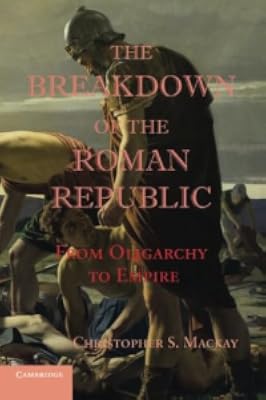
The Breakdown of the Roman Republic: From Oligarchy to Empire
by Christopher S. Mackay
On This Page
Description
In this book, Christopher S. Mackay recounts the last century of the Roman Republic in a readable narrative treatment. Within this narrative he analyzes the breakdown of the traditional Republican form of government as a result of the administrative and political crises brought about by the Roman conquest of the Mediterranean basin in the Middle Republic. He also shows how the many reforms instituted by Augustus, which effectively created the new imperial form of government, were a reaction show more to the failings of the Republic. Illustrated with an extensive collection of coin images that document the changes in contemporary political ideology, this volume also focuses on the political significance of the key personalities, including Marius, Sulla and Caesar, who played a large role in the events that led to the demise of the Roman Republic. show lessTags
Recommendations





Member Recommendations
Member Reviews
This book is a very informative and intelligent overview of the end of the Roman Republic, a pivotal moment in western history. It approaches the subject from the perspective of basic governmental problems: how did the republican oligarchy try to control its provinces, its citizens and the military power it had at its disposal? As it turned out, they could not strike the right balance and Rome descended into protracted civil war. How it all came about is a long story which the author tells with great clarity. His account focuses on individuals, their policies and motives, but also on economic and social constraints. He also discusses the uncertainties of the historical evidence, especially from the time before Caesar. I don’t know any show more other book which would provide this much explanatory background on the transition from republic to empire.
Many chapters deal with the civil war where politics was kept in abeyance, but the last chapter on the Augustan settlement is a very insightful analysis of imperial political problems and their only solution: rule by one man. The first emperor did not intend to found an autocracy, but a return to oligarchical government was impossible. This chapter alone makes this book worth reading, but the preceding ones also contribute a lot. The book seems to be intended mainly for laymen, but it’s not light reading by any means. I highly recommend it to readers interested in Roman political history, both republican and imperial. show less
Many chapters deal with the civil war where politics was kept in abeyance, but the last chapter on the Augustan settlement is a very insightful analysis of imperial political problems and their only solution: rule by one man. The first emperor did not intend to found an autocracy, but a return to oligarchical government was impossible. This chapter alone makes this book worth reading, but the preceding ones also contribute a lot. The book seems to be intended mainly for laymen, but it’s not light reading by any means. I highly recommend it to readers interested in Roman political history, both republican and imperial. show less
Ratings
Members
- Recently Added By
Author Information
6+ Works 182 Members
Classifications
- Genres
- History, Nonfiction, General Nonfiction, Politics and Government
- DDC/MDS
- 937.05 — History & geography History of ancient world (to ca. 499) Italian Peninsula to 476 and adjacent territories to 476 Period of civil strife, 146-31 B.C.
- LCC
- DG254 .M25 — History of Europe, Asia, Africa and Oceania City History of Italy Ancient Italy. Rome to 476 History By period Kings and Republic, 753-27 B.C. Republic, 509-27 Fall of the Republic and establishment
- BISAC
Statistics
- Members
- 34
- Popularity
- 836,989
- Reviews
- 1
- Rating
- (3.50)
- Languages
- English, Spanish
- Media
- Paper
- ISBNs
- 3