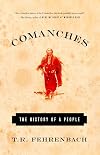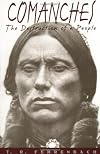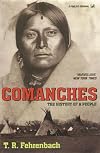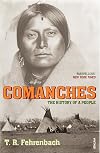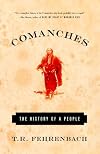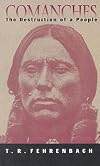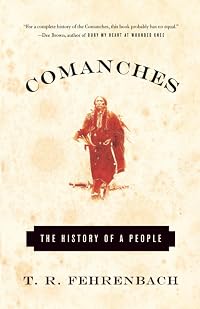
Comanches: The History of a People
by T. R. Fehrenbach
On This Page
Description
Authoritative and immediate, this is the classic account of the most powerful of the American Indian tribes. T. R. Fehrenbach traces the Comanches' rise to power, from their prehistoric origins to their domination of the high plains for more than a century until their demise in the face of Anglo-American expansion. Master horseback riders who lived in teepees and hunted bison, the Comanches were stunning orators, disciplined warriors, and the finest makers of arrows. They lived by a strict show more legal code and worshipped within a cosmology of magic. As he portrays the Comanche lifestyle, Fehrenbach recreates their doomed battle against European encroachment. While they destroyed the Spanish dream of colonizing North America and blocked the French advance into the Southwest, the Comanches ultimately fell before the Texas Rangers and the U.S. Army in the great raids and battles of the mid-nineteenth century. This is a classic American story, vividly and poignantly told. show lessTags
Recommendations























Member Reviews
This is superb history - dispassionate though not without judgment, informative with a clear narrative and capable both of changing prejudices and assumptions and suggesting analogies with today.
Fehrenbach wrote this book forty years ago as a sympathetic historian of Texas and Mexico who was filling in the natural sovereign gap in the history of the South West - the 'savage' Comancheria.
Because it was written so long ago, it was also written before 'political correctness' obliged us to accept an entirely false view of the benignity of savagery because of our fear of what Hobbes claimed.
In fact, Fehrenbach (who does have a bias towards 'civilisation' that might be unwarranted) treats the southern plains Amerindians with more respect and show more less sentimentality than East Coast liberals.
He takes them for what they were and not what deeply idiotic Quaker Indian agents would like them to have been - the book presents a standing argument for keeping religion and ideology out of empire.
There are two overwhelming truths about the dreadful experience of the Comanche: the official state machines of Texas and the USA were never in control of the situation; and the Indians were vicious.
The first point is one of demography and not actually of superiority. Indeed, the white settlers were held back, even pushed back by Comanche determination, for many decades.
Driving the white population forward was the simple fact that they were breeding like rabbits and surviving, sending waves of dour Baptists and then desperate migrants eastwards.
Ironically, the West is now besieged by the opposite - excitable pentecostalists and islamists and desperate migrants moving northwards with the same sort of sentimentalist evading the consequences.
The native Amerindians were numbered in tens of thousands, not millions, and were defeated ultimately first by disease and second by a market-driven, not calculated, destruction of the bison herds.
The United States in particular, but also the Republic of Texas, were not sophisticated hierarchical empires with the ability to enforce assimilation or treaties but polities trying to keep a lid on things.
The British in Canada preserved Indian culture by enforcing deals against settlers but the sheer scale of European migration and the weakness of the state meant that this was not possible in the US.
Hence the much written about tragedy of long and violent border wars and brutal and intermittent guerrilla actions leading to the utterly self-destructive tactics of the tribes and their final destruction.
Fehrenbach plausibly argues, using the Navajo example and alluding to Canada, that the best strategy for the Indians would have been a decisive military defeat and enforceable treaty-making.
It is at this point that he may be too kind to the populist federal republics that emerged in Texas and which made up the rather nasty Jacksonian democracy that drove agrarian indians ever westward.
The plains indians were not fools but simply ignorant and Jacksonian democracy as a political model had lies and faithlessness built into it - Texas was a mere extension of Christian Southern arrogance.
The point was that the Indians could never possibly resist the surge from the East because it was many and they were few but their culture and experience failed them in organising adequately to deal with this.
A diferent sort of Indian culture might have followed the classic barbarian model of creating a single Comanche proto-state that could create its own settler patterns but this was not to be.
Had it had the intellectual and organisational resources to do this, it would have followed the Slav pattern, created a sovereign war chief ('king'), adopted Protestant Christianity and become the Comanche Republic as a state within the Union or independent.
This could either have happened naturally (which no plains indian seemed able to achieve) or as a result of a defeat in effective collaboration with a sympathetic federal enemy (as in Canada).
This latter is not as absurd as it sounds since the military were professional not racist and there was a strong body of Eastern opinion sympathetic, overly so, to the Amerindians.
Unfortunately, the classic problem of American democracy - populist hysteria and inter-agency conflict constantly evaded a decisive handling of the problem.
When the military were finally permitted a free hand, the war of attrition between millions of whites and thousands of Comanche was a brutal walk over that destroyed a culture that had no room to adapt.
The Comanche, by their blunders and brutality, also sped up the end for their northern plains counterparts but that is another story.
So far, my account of the book sounds rather one-sided but that is because I have missed out the essential truth of the conflict - that the Comanches and other southern plains tribes really were savage.
The small-minded Baptists and racists were no less unappealing to modern tastes and many whites were thugs of the first order but the plains indian culture was inherently violent.
What we are dealing with here are not the romantic noble figures with waving feather headdresses who speak of great spirits and environmental responsibility but torturing half-beasts.
These were stone age people engaged in permanent internecine warfare of consummate brutality, engaging in the vilest form of torture and destruction for a form of 'honour'.
Horses and then iron simply upgraded the methodology of terror to include the plains and competition with other tribes. This moved on to brutal raids against vulnerable Mexican villagers for loot.
Given the culture, its misogynistic kin-orientated brutalities would naturally be applied to the very different tejanos even if they were initially restrained with the americanos.
Be in no doubt, the horrors perpetrated by the Amerindians on their own kind and the settlers - systematic rape, mutilation, kidnapping, enslavement, murder and wanton destruction - were 'normal'.
Any excuse that they were responding to the invasion of their territory does not hold water. They were raiding because it was profitable and that is what their young men did to get 'honour'.
Fehrenbach's book is good not only in clarifying this but in giving important context for each stage of the Comanche's evolution so that we learn a lot about the history of the whole American South West.
As he points out, what was 'normal' to Amerindians became normalised as barbarities amongst the besieged 'tejanos' although the Texans and Americans certainly did not rape, mutilate and torture as a 'norm'.
These were two incommensurate borderlands cultures and, as we know from European history, borderlands are the liminal areas where any cultural restraints will collapse under pressure.
Fehrenbach points out the differential in 'organisation' (not intelligence or technology) and the effects of demography and market capitalism as decisive in the final American victory.
But, as we note above, this victory took an inordinately long time a-coming and only emerged when the American Civil War had permitted the federal state the ability to organise itself for modernity.
The story is a tragedy. There are many capable people in it and some heroes - the disastrous rule of the Quaker Indian agents must not be included here. Most people here are muddling through on tram-lines.
Perhaps that is the lesson for today - populist democracies can never seem to get a grip on what needs to be done and there is, as a result, far more suffering than is necessary.
For all their brutalities and short lives, the plains indians deserve the respect that Fehrenbach and the best of the soldiery gave to them.
They deserved an early defeat in battle with honour and a treaty imposed by a superior force that enforced its provisions with the same sense of honour and professionalism as was found in Canada.
(Although we should be careful of claiming too much British Imperial decency. Once those missionaries got their teeth into the tribes, the decency started to disappear pretty quickly)
Instead, the Comanche faced a weak state whose lies and incompetencies derived from sentimentalism and religion. These did far more harm to them than any number of honest military defeats could have done.
The soft sentimental liberal and faith-based mind simply cannot understand this - that progress comes from direct brutal struggle between strong forces succeeded by magnanimity and the rule of law.
The final form of the American Federal State, before it degenerated again into ideology and religiosity, got this perfectly right in 1945 after another existential struggle.
It is probable that the USA will never be great again until it learns the lessons of the Indian wars - use power effectively, decisively and sparingly and be generous to the defeated.
The treatment of the Amerindians after their defeat, despite their brutal 'norms', is a lasting stain on American democracy, indeed on the normative claims of the West in general.
I recommend this highly readable book to anyone who wants to understand our own species better, what differential power really means and why sentiment and faith are appalling guides to policy. show less
Fehrenbach wrote this book forty years ago as a sympathetic historian of Texas and Mexico who was filling in the natural sovereign gap in the history of the South West - the 'savage' Comancheria.
Because it was written so long ago, it was also written before 'political correctness' obliged us to accept an entirely false view of the benignity of savagery because of our fear of what Hobbes claimed.
In fact, Fehrenbach (who does have a bias towards 'civilisation' that might be unwarranted) treats the southern plains Amerindians with more respect and show more less sentimentality than East Coast liberals.
He takes them for what they were and not what deeply idiotic Quaker Indian agents would like them to have been - the book presents a standing argument for keeping religion and ideology out of empire.
There are two overwhelming truths about the dreadful experience of the Comanche: the official state machines of Texas and the USA were never in control of the situation; and the Indians were vicious.
The first point is one of demography and not actually of superiority. Indeed, the white settlers were held back, even pushed back by Comanche determination, for many decades.
Driving the white population forward was the simple fact that they were breeding like rabbits and surviving, sending waves of dour Baptists and then desperate migrants eastwards.
Ironically, the West is now besieged by the opposite - excitable pentecostalists and islamists and desperate migrants moving northwards with the same sort of sentimentalist evading the consequences.
The native Amerindians were numbered in tens of thousands, not millions, and were defeated ultimately first by disease and second by a market-driven, not calculated, destruction of the bison herds.
The United States in particular, but also the Republic of Texas, were not sophisticated hierarchical empires with the ability to enforce assimilation or treaties but polities trying to keep a lid on things.
The British in Canada preserved Indian culture by enforcing deals against settlers but the sheer scale of European migration and the weakness of the state meant that this was not possible in the US.
Hence the much written about tragedy of long and violent border wars and brutal and intermittent guerrilla actions leading to the utterly self-destructive tactics of the tribes and their final destruction.
Fehrenbach plausibly argues, using the Navajo example and alluding to Canada, that the best strategy for the Indians would have been a decisive military defeat and enforceable treaty-making.
It is at this point that he may be too kind to the populist federal republics that emerged in Texas and which made up the rather nasty Jacksonian democracy that drove agrarian indians ever westward.
The plains indians were not fools but simply ignorant and Jacksonian democracy as a political model had lies and faithlessness built into it - Texas was a mere extension of Christian Southern arrogance.
The point was that the Indians could never possibly resist the surge from the East because it was many and they were few but their culture and experience failed them in organising adequately to deal with this.
A diferent sort of Indian culture might have followed the classic barbarian model of creating a single Comanche proto-state that could create its own settler patterns but this was not to be.
Had it had the intellectual and organisational resources to do this, it would have followed the Slav pattern, created a sovereign war chief ('king'), adopted Protestant Christianity and become the Comanche Republic as a state within the Union or independent.
This could either have happened naturally (which no plains indian seemed able to achieve) or as a result of a defeat in effective collaboration with a sympathetic federal enemy (as in Canada).
This latter is not as absurd as it sounds since the military were professional not racist and there was a strong body of Eastern opinion sympathetic, overly so, to the Amerindians.
Unfortunately, the classic problem of American democracy - populist hysteria and inter-agency conflict constantly evaded a decisive handling of the problem.
When the military were finally permitted a free hand, the war of attrition between millions of whites and thousands of Comanche was a brutal walk over that destroyed a culture that had no room to adapt.
The Comanche, by their blunders and brutality, also sped up the end for their northern plains counterparts but that is another story.
So far, my account of the book sounds rather one-sided but that is because I have missed out the essential truth of the conflict - that the Comanches and other southern plains tribes really were savage.
The small-minded Baptists and racists were no less unappealing to modern tastes and many whites were thugs of the first order but the plains indian culture was inherently violent.
What we are dealing with here are not the romantic noble figures with waving feather headdresses who speak of great spirits and environmental responsibility but torturing half-beasts.
These were stone age people engaged in permanent internecine warfare of consummate brutality, engaging in the vilest form of torture and destruction for a form of 'honour'.
Horses and then iron simply upgraded the methodology of terror to include the plains and competition with other tribes. This moved on to brutal raids against vulnerable Mexican villagers for loot.
Given the culture, its misogynistic kin-orientated brutalities would naturally be applied to the very different tejanos even if they were initially restrained with the americanos.
Be in no doubt, the horrors perpetrated by the Amerindians on their own kind and the settlers - systematic rape, mutilation, kidnapping, enslavement, murder and wanton destruction - were 'normal'.
Any excuse that they were responding to the invasion of their territory does not hold water. They were raiding because it was profitable and that is what their young men did to get 'honour'.
Fehrenbach's book is good not only in clarifying this but in giving important context for each stage of the Comanche's evolution so that we learn a lot about the history of the whole American South West.
As he points out, what was 'normal' to Amerindians became normalised as barbarities amongst the besieged 'tejanos' although the Texans and Americans certainly did not rape, mutilate and torture as a 'norm'.
These were two incommensurate borderlands cultures and, as we know from European history, borderlands are the liminal areas where any cultural restraints will collapse under pressure.
Fehrenbach points out the differential in 'organisation' (not intelligence or technology) and the effects of demography and market capitalism as decisive in the final American victory.
But, as we note above, this victory took an inordinately long time a-coming and only emerged when the American Civil War had permitted the federal state the ability to organise itself for modernity.
The story is a tragedy. There are many capable people in it and some heroes - the disastrous rule of the Quaker Indian agents must not be included here. Most people here are muddling through on tram-lines.
Perhaps that is the lesson for today - populist democracies can never seem to get a grip on what needs to be done and there is, as a result, far more suffering than is necessary.
For all their brutalities and short lives, the plains indians deserve the respect that Fehrenbach and the best of the soldiery gave to them.
They deserved an early defeat in battle with honour and a treaty imposed by a superior force that enforced its provisions with the same sense of honour and professionalism as was found in Canada.
(Although we should be careful of claiming too much British Imperial decency. Once those missionaries got their teeth into the tribes, the decency started to disappear pretty quickly)
Instead, the Comanche faced a weak state whose lies and incompetencies derived from sentimentalism and religion. These did far more harm to them than any number of honest military defeats could have done.
The soft sentimental liberal and faith-based mind simply cannot understand this - that progress comes from direct brutal struggle between strong forces succeeded by magnanimity and the rule of law.
The final form of the American Federal State, before it degenerated again into ideology and religiosity, got this perfectly right in 1945 after another existential struggle.
It is probable that the USA will never be great again until it learns the lessons of the Indian wars - use power effectively, decisively and sparingly and be generous to the defeated.
The treatment of the Amerindians after their defeat, despite their brutal 'norms', is a lasting stain on American democracy, indeed on the normative claims of the West in general.
I recommend this highly readable book to anyone who wants to understand our own species better, what differential power really means and why sentiment and faith are appalling guides to policy. show less
This highly recommended, very readable book tells of the greatness and the tragedy of the Comanche people. Known by themselves as the Nemernuh (the “People”), the term Comanche derives from the Ute word “Those who are our enemies.” The author gives as broad a context as possible, starting with the migration from Asia into the Western Hemisphere and then discussing the development of Indian civilizations and the conquest by the Europeans. Originally a Shoshone tribe, the Comanches come down from the mountains into the plains upon the appearance of the horse, and they become the dominant tribe on the High Plains because they adjusted more quickly and completely to the horse than any other tribe of AmerIndians. They wiped out the show more presence of the Apaches on the southern plains, and developed the tradition of raiding hundreds of miles into Mexico (travelling by the full, or "Comanche" moon). They thrived until the coming of the Texans and then the Anglo-Americans began to constrain and eventually destroy them.
Because the Comanche themselves had no written records and no real history of their own, their history can only be pieced together from the observations of those on the outside, primarily Spanish, French and American explorers, frontiersmen and soldiers. So there is an odd feeling that while the Comanches are the main subject of the book, to a large extent they are being seen from the outside, as demonstrated by their name. show less
Because the Comanche themselves had no written records and no real history of their own, their history can only be pieced together from the observations of those on the outside, primarily Spanish, French and American explorers, frontiersmen and soldiers. So there is an odd feeling that while the Comanches are the main subject of the book, to a large extent they are being seen from the outside, as demonstrated by their name. show less
Excellent information but a bit slow and tedious read.
Ratings
Members
- Recently Added By
Author Information

21+ Works 2,197 Members
Classifications
Statistics
- Members
- 293
- Popularity
- 109,252
- Reviews
- 3
- Rating
- (4.25)
- Languages
- English
- Media
- Paper, Audiobook, Ebook
- ISBNs
- 10
- ASINs
- 3