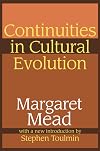
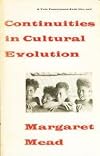
Continuities in Cultural Evolution
by Margaret Mead
On This Page
Description
Margaret Mead once said, "I have spent most of my life studying the lives of other peoples--faraway peoples--so that Americans might better understand themselves." Continuities in Cultural Evolution is evidence of this devotion. All of Mead's efforts were intended to help others learn about themselves and work toward a more humane and socially responsible society. Scientist, writer, explorer, and teacher, Mead brought the serious work of anthropology into the public consciousness. This show more volume began as the Terry Lectures, given at Yale in 1957 and was not published until 1964, after extensive reworking. The time she spent on revision is evidence of the importance Mead attached to the subject: the need to develop a truly evolutionary vision of human culture and society. This was desirable in her eyes both in order to reinforce the historical dimension in our ideas about human culture, and to preserve the relevance of historical and cultural diversity to social, economic, and political action. Given the present state of academic and public discourse alike, this volume speaks to us in a language we badly need to recover. show lessTags
Recommendations

































Member Recommendations
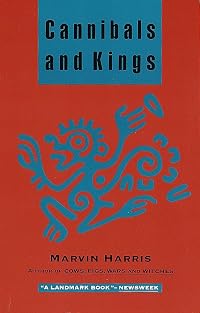
shieldwolf Popular and easier to read/understand than the Mead Book but 25 years later with many good references to much of the same information, ideas new advancements in the subject.
Member Reviews
One of my Earlier Introductions to Anthropology/Ethnology, a subject I eventually majored at University. It was People Like Ms. Mead and this particular volume from a lecture Series that started me thinking about the subject seriously. In order to do that and make that type of paradigm shift in my thinking; it had to be pretty good. Mead's writing on culture, biology, and evolution demonstrates that contrary to claims of others, Mead favored an evolutionary approach throughout her career. Moreover, while Mead's book was a popular text and a bestseller, it was not a sacred text among anthropologists. The volume is a scientific book on what, in later years, Authors like Joseph Campbell would popularize with the lay media.
Members
- Recently Added By
Author Information

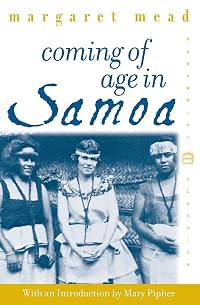
Margaret Mead, an American anthropologist, was for most of her life the most illustrious curator at the American Museum of Natural History in New York. She was famed not only as an anthropologist but also as a public figure, a popularizer of the social sciences, and an analyst of American society. While at Columbia University, she was a student of show more Franz Boas, whose teaching assistant, Ruth Benedict, became one of Mead's closest colleagues and friends; after Benedict's death, Mead became her first biographer and the custodian of her field notes and papers. Mead's early research in Samoa led to her best selling book, "Coming of Age in Samoa" (1928); it also led, after her death, to a well-publicized attack on her work by the Australian anthropologist Derek Freeman. Her importance was not damaged by his book; in fact, there is probably a greater awareness today of the important role that she played in twentieth-century intellectual history as an advocate of tolerance, education, civil liberties, world peace, and the worldwide ecumenical movement within Christianity. She was an active and devout Episcopalian throughout her life. On January 6, 1979, she was posthumously awarded the Presidential Medal of Freedom, the nation's highest civilian honor. (Bowker Author Biography) Margaret Mead was born on December 16, 1901 in Philadelphia. Her family moved a great deal during her childhood and encouraged her to pursue an education. She graduated from Barnard College in 1923 and earned a Ph.D. in Anthropology from Columbia University in 1929. The 1928 publication of her first book, "Coming of Age in Samoa," was based on her study of the sexual patterns of Samoan adolescent girls. It became a best-seller and changed American anthropology; it also established Mead as one of the leaders in American anthropology, a position she retained for 50 years. Mead was active in education most of her life and taught and lectured at many prominent schools, including Columbia University, Vassar College, Fordham University, and New York University. She was appointed assistant curator at the American Museum of Natural History in 1926, becoming successively associate curator in 1942, curator in 1964 and emeritus curator in 1969. In all, Mead wrote 23 widely read books. Some other titles include "Growing Up in New Guinea," "Sex and Temperament in Three Primitive Societies," and "Keep Your Powder Dry: An Anthropologist Looks at America." Margaret Mead died of cancer in New York City in 1978. (Bowker Author Biography) show less
Some Editions
Series
Belongs to Publisher Series
Terry Lectures (1957-1958)
Common Knowledge
- Original title
- Continuities in Cultural Evolution
- Original publication date
- 1964 (Originally published: New Haven, Conn. : Yale University Press) (Originally published: New Haven, Conn. : Yale University Press)
- Original language
- English
- Disambiguation notice
- Two Separate books (editions) with different information - Please do not Combine
Continuities in cultural evolution / Margaret Mead ; with a new introduction by Stephen Toulmin.Published/Created: New Brunswic... (show all)k, N.J. : Transaction Publishers, c1999.Binding: Paperback (1999)ISBN 10: 0765806045ISBN 13: 9780765806048LC Classification: HM101 .M37 1999 Dewey Class No.: 303.4 21
Continuities in cultural evolution. Published/Created: New Haven, Yale University Press, 1964. LC Classification: HM101 .M37 Dewey Class No.: 301.23 NO ISBN Pre 1970 ISBN Classification
Classifications
Statistics
- Members
- 37
- Popularity
- 782,309
- Reviews
- 1
- Rating
- (5.00)
- Languages
- English
- Media
- Paper, Ebook
- ISBNs
- 7
- ASINs
- 2