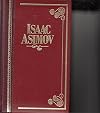
Isaac Asimov [Masters Library, Amaranth Press]
by Isaac Asimov
On This Page
Description
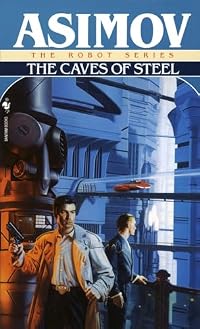
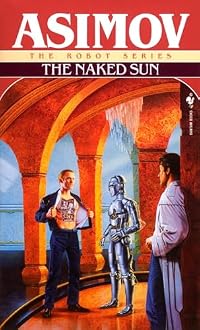
"Foundation"--The fledgling Foundation finds itself at the mercy of corrupt warlords rising in the wake of the receding Empire. "Foundation and Empire"--The Foundation and the Galactic Empire civilizations are battling for mastery of the Universe. No one could have predicted the birth of the creature called the Mule, a power that could turn the strongest-willed human into an obedient slave. "Second Foundation"--After years of struggle, the Foundation lay in ruins, destroyed by the Mule. show more However, it was rumored that there was a Second Foundation somewhere at the end of the Galaxy. "The Naked Sun"--Detective Elijah Baley is sent from the streets of New York with his positronic partner, the robot R. Daneel Olivaw, to solve an incredible murder. A reclusive Solarian was killed by one of his robots, unthinkable under the Laws of Robotics. show lessTags
Recommendations














Member Reviews
The trilogy of books Foundation, Foundation and Empire and Second Foundation are among the best Asimov ever wrote among his science-fiction novels and among his most influential. I've read it was based on Gibbon's Rise and Fall of the Roman Empire. Only this empire spans the galaxy. Hari Seldon predicts through "psychohistory" the empire will fall within 300 years and establishes a foundation to manipulate history to shorten the dark ages that will follow. The fascination is seeing how all that plays out, especially in the first book. Foundation and Empire is less episodic than the first and features one of Asimov's most complex and compelling characters, "the Mule," as well as a strong female character, Bayta, and a clever twist. show more Second Foundation also features a strong female character--Arkady Darell. The first three books in the series were written in the early 1950s, and at times it shows. Asimov considered himself a feminist and created strong female characters (especially Susan Calvin in his Robot stories) but even so there are blindspots and occasional gender fail, because class? This was the fifties! The trilogy is dated in other ways--technological and social advances Asimov didn't foresee, but for all that I think this is still a fantastic read rich in ideas.
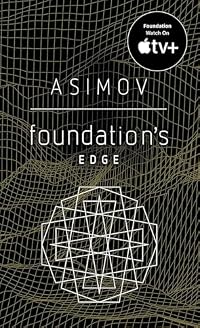
Asimov returned to the Foundation Series in the 80s with Foundation's Edge and other sequels and prequels, merging aspects of the Robot series with it--represented in this volume by Naked Sun and I, Robot, both strong, classic sci-fi. But though I find those novels entertaining, I don't find them quite as thought-provoking as the first three Foundation novels. And The Stars Like Dust, only his second novel, Asimov himself called his least favorite. I can't say it's a keeper. A clunker, really, very pulp fiction. However, I do think Asimov's most amazing works can be found in his short stories, not his novels. I'd recommend getting a book collecting his shorts. His "The Ugly Little Boy," "The Dead Past," "Nightfall" among others are amazing stories. show less
Asimov returned to the Foundation Series in the 80s with Foundation's Edge and other sequels and prequels, merging aspects of the Robot series with it--represented in this volume by Naked Sun and I, Robot, both strong, classic sci-fi. But though I find those novels entertaining, I don't find them quite as thought-provoking as the first three Foundation novels. And The Stars Like Dust, only his second novel, Asimov himself called his least favorite. I can't say it's a keeper. A clunker, really, very pulp fiction. However, I do think Asimov's most amazing works can be found in his short stories, not his novels. I'd recommend getting a book collecting his shorts. His "The Ugly Little Boy," "The Dead Past," "Nightfall" among others are amazing stories. show less
Foundation was written in 1951, Foundation and Empire 1952, and Second Foundation, not surprisingly 1953. I jotted down technology that disappointed me: micro-film, encyclopedia, paper, film-books, communication takes years, newspapers, ticking watches, atomic (not nuclear), navigation by manually aligning stars, transcribing device that printed results on paper, and tubes. Even with that many things that I think should not have been in the book, the writing and story was enjoyable - well done. 8,608 members; 4.01 average rating; 7/19/2017
A good introduction to Isaac Asimov. Before this, I had already read I, Robot, but nothing else.
Ratings
Members
- Recently Added By
Author Information

2,404+ Works 292,076 Members
Isaac Asimov was born in Petrovichi, Russia, on January 2, 1920. His family emigrated to the United States in 1923 and settled in Brooklyn, New York, where they owned and operated a candy store. Asimov became a naturalized U.S. citizen at the age of eight. As a youngster he discovered his talent for writing, producing his first original fiction at show more the age of eleven. He went on to become one of the world's most prolific writers, publishing nearly 500 books in his lifetime. Asimov was not only a writer; he also was a biochemist and an educator. He studied chemistry at Columbia University, earning a B.S., M.A. and Ph.D. In 1951, Asimov accepted a position as an instructor of biochemistry at Boston University's School of Medicine even though he had no practical experience in the field. His exceptional intelligence enabled him to master new systems rapidly, and he soon became a successful and distinguished professor at Columbia and even co-authored a biochemistry textbook within a few years. Asimov won numerous awards and honors for his books and stories, and he is considered to be a leading writer of the Golden Age of science fiction. While he did not invent science fiction, he helped to legitimize it by adding the narrative structure that had been missing from the traditional science fiction books of the period. He also introduced several innovative concepts, including the thematic concern for technological progress and its impact on humanity. Asimov is probably best known for his Foundation series, which includes Foundation, Foundation and Empire, and Second Foundation. In 1966, this trilogy won the Hugo award for best all-time science fiction series. In 1983, Asimov wrote an additional Foundation novel, Foundation's Edge, which won the Hugo for best novel of that year. Asimov also wrote a series of robot books that included I, Robot, and eventually he tied the two series together. He won three additional Hugos, including one awarded posthumously for the best non-fiction book of 1995, I. Asimov. "Nightfall" was chosen the best science fiction story of all time by the Science Fiction Writers of America. In 1979, Asimov wrote his autobiography, In Memory Yet Green. He continued writing until just a few years before his death from heart and kidney failure on April 6, 1992. (Bowker Author Biography) show less
Work Relationships
Contains
Common Knowledge
- Canonical title
- Isaac Asimov [Masters Library, Amaranth Press]
- Original title
- Isaac Asimov [Masters Library, Amaranth Press]
- Original publication date
- 1984
- Disambiguation notice
- This edition contains The Foundation Trilogy plus three other non-Foundation novels in one omnibus. Do not combine any other edition that contains a different set of stories.
Classifications
Statistics
- Members
- 649
- Popularity
- 44,326
- Reviews
- 4
- Rating
- (4.19)
- Languages
- English, German
- Media
- Paper
- ISBNs
- 6
- ASINs
- 6