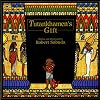
Tutankhamen's Gift
by Robert Sabuda
On This Page
Description
A brief biography of Tutankhamen, who became the pharaoh of Egypt at the age of ten.Tags
Recommendations




Member Reviews
Tutankhamen is perhaps the best known of the pharaohs of Ancient Egypt, largely because of the discovery of his intact tomb by Howard Carter in 1922. In this beautiful picture book, writer and illustrator Robert Sabuda attempts to reconstruct the boyhood of the frail boy king who came to power at the age of nine in the mid 1300s BC, ruled for ten years, and then died at age nineteen.
Sabuda’s book provides some information about how the young prince may have been schooled. The author also imagines the sights young Tut may have seen, including the building and then destruction of temples. The previous pharaoh, Akhenaten (also known as Amenhotep IV) turned Egypt away from the traditional pantheon to monotheism, the worship of a single show more god, Aten (the sun disk).
There’s a huge problem with Sabuda’s book, however. I consulted multiple sources—The British Museum, National Geographic, and PBS, to name a few—and all of them make clear that Tutankhamen was the son of the iconoclastic pharaoh Akhenaten (Amenhotep IV), who systematically destroyed traditional religious institutions, art, and imagery. Tut’s parentage was apparently known in 1994 when Sabuda’s book was first published, yet the author-illustrator incorrectly identifies him as the son of Amenhotep III (who was, in fact, his grandfather) and the brother of Akhenaten. He also represents the young ruler as a heroic figure whose gift to the Egyptians was the return to them of their traditional religion.
Based on my reading, Tut is considered a relatively minor pharaoh. There is speculation that he may have been under the control of powerful figures in the kingdom. Additionally, while the book does highlight Tut’s physical vulnerability, he had more significant health issues than Sabuda intimates. The boy king had an inherited bone disease, along with other genetic disorders. His contracting malaria certainly didn’t help matters. Tut’s parents were almost certainly siblings. (The purity of the royal line had to be preserved, thought the Egyptians.)
To be clear: one would not expect a children’s picture book to venture into the territory of inbreeding. At the same time, it is regrettable that Sabuda’s beautiful book is factually unreliable. I can’t imagine using it in a classroom.
The only real positive here is the artwork. It’s unfortunate that Sabuda didn’t leave the writing to someone more knowledgeable. show less
Sabuda’s book provides some information about how the young prince may have been schooled. The author also imagines the sights young Tut may have seen, including the building and then destruction of temples. The previous pharaoh, Akhenaten (also known as Amenhotep IV) turned Egypt away from the traditional pantheon to monotheism, the worship of a single show more god, Aten (the sun disk).
There’s a huge problem with Sabuda’s book, however. I consulted multiple sources—The British Museum, National Geographic, and PBS, to name a few—and all of them make clear that Tutankhamen was the son of the iconoclastic pharaoh Akhenaten (Amenhotep IV), who systematically destroyed traditional religious institutions, art, and imagery. Tut’s parentage was apparently known in 1994 when Sabuda’s book was first published, yet the author-illustrator incorrectly identifies him as the son of Amenhotep III (who was, in fact, his grandfather) and the brother of Akhenaten. He also represents the young ruler as a heroic figure whose gift to the Egyptians was the return to them of their traditional religion.
Based on my reading, Tut is considered a relatively minor pharaoh. There is speculation that he may have been under the control of powerful figures in the kingdom. Additionally, while the book does highlight Tut’s physical vulnerability, he had more significant health issues than Sabuda intimates. The boy king had an inherited bone disease, along with other genetic disorders. His contracting malaria certainly didn’t help matters. Tut’s parents were almost certainly siblings. (The purity of the royal line had to be preserved, thought the Egyptians.)
To be clear: one would not expect a children’s picture book to venture into the territory of inbreeding. At the same time, it is regrettable that Sabuda’s beautiful book is factually unreliable. I can’t imagine using it in a classroom.
The only real positive here is the artwork. It’s unfortunate that Sabuda didn’t leave the writing to someone more knowledgeable. show less
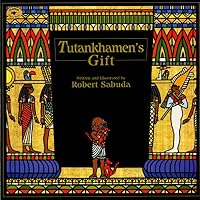
The illustrations in TUTANKHAMEN'S GIFT are simply beautiful and reminiscent of the art of ancient Egypt. The story follows Tutankhamen's life from birth to being crowned as Pharaoh and summarizes his achievement as Pharaoh of Egypt. I found it to be an interesting depiction/opinion of society in general- seeing that the people of Egypt after his father's death utilized the weakened state of the monarchy and used it as an opportunity to rebel and rip Egypt apart. Consequently, I learned that the reason Tutankhamen is so famous is that he is remembered for restoring Egypt. It was a new lesson for me. I knew of him, for the most part, just as one of the intact mummies and "great pharaohs" discovered by anthropologists in the last few show more decades. I think this book would serve as a great supplement and read aloud for a SS lesson on Egypt. show less
Focuses on the childhood of Tutankhamen: his temperament and experiences of watching the religious transition between his grandfather as pharaoh and his father as pharaoh. Shows how those experiences influenced his decision to bring Egypt back to polytheism. The narrative is simple as it’s from the perspective of a child but touches on significant ideas in ancient Egypt. The illustrations are captivating and inspired by the style of ancient Egyptian artwork.
Focuses on the childhood of Tutankhamen: his temperament and experiences of watching the religious transition between his grandfather as pharaoh and his father as pharaoh. Shows how those experiences influenced his decision to bring Egypt back to polytheism. The narrative is simple as it’s from the perspective of a child but touches on significant ideas in ancient Egypt. The illustrations are captivating and inspired by the style of ancient Egyptian artwork.
A simple, somewhat fictionalized narrative introduction to the life of King Tut with beautiful illustrations and an author's note. This would pair well with "Tutankhamun" by Demi for further detail and context on Tutankhamun's life.
With pretty illustrations on simulated papyrus paper, this simplified story of King Tut's childhood and rise to power may be a fun way to introduce the culture of ancient Egypt to very young readers. It is a very simplified story and does not offer any biographical notes or references. I would only use as a fun read for young children. I did use it as an example to my 5th graders on how they could write their own stories about an ancient culture.
With astonishing artwork created from cut paper and inks on papyrus, this simply written account of one of Egypt's most fabled kings follows Tutankhamen from his frail childhood through his brief but magnificent reign. A New York Times Notable Children's Book. Full color.
Members
- Recently Added By
Lists

The Story of the World: History for the Classical Child: Activity Book One
291 works; 3 members
Author Information

70+ Works 10,807 Members
Sabuda was born in Pinckney, Michigan on March 8, 1965. He was skilled as an artist from a very young age, and he attended the Pratt Institute in New York City. His specific interest in 3-D paper engineering---pop-up books---was sparked by a book he received as a gift. Since 1994 Sabuda has published at least one pop-up book annually. These books show more are typically childrens' classics like The Twelve Days of Christmas, Mother Goose, The Wizard of Oz, Alice's Adventures in Wonderland, The Night Before Christmas and, most recently, Beauty and the Beast. Sabuda works from his studio in New York City. His 2010 title Beauty and The Beast made The New York Times BestSeller List for 2010. (Bowker Author Biography) show less
Awards and Honors
Common Knowledge
- People/Characters
- Tutankhamun
Classifications
Statistics
- Members
- 536
- Popularity
- 55,398
- Reviews
- 7
- Rating
- (3.72)
- Languages
- English
- Media
- Paper
- ISBNs
- 7
- ASINs
- 3