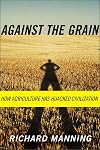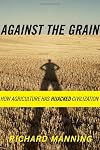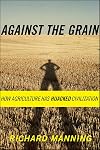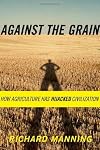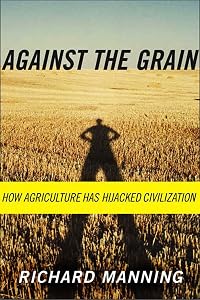
Against the Grain: How Agriculture Has Hijacked Civilization
by Richard Manning
On This Page
Description
In this provocative, wide-ranging book,Against the Grain, Richard Manning offers a dramatically revisionist view of recent human evolution, beginning with the vast increase in brain size that set us apart from our primate relatives and brought an accompanying increase in our need for nourishment. For 290,000 years, we managed to meet that need as hunter-gatherers, a state in which Manning believes we were at our most human: at our smartest, strongest, most sensually alive. But our reliance show more on food made a secure supply deeply attractive, and eventually we embarked upon the agricultural experiment that has been the history of our past 10,000 years. The evolutionary road is littered with failed experiments, however, and Manning suggests that agriculture as we have practiced it runs against both our grain and nature's. Drawing on the work of anthropologists, biologists, archaeologists, and philosophers, along with his own travels, he argues that not only our ecological ills-overpopulation, erosion, pollution-but our social and emotional malaise are rooted in the devil's bargain we made in our not-so-distant past. And he offers personal, achievable ways we might re-contour the path we have taken to resurrect what is most sustainable and sustaining in our own nature and the planet's. show lessTags
Recommendations


Member Reviews
"Against the Grain: How Agriculture Has Hijacked Civilization" provides a historical outline of the socio-economic effects that agriculture has had on civilization, from the hunter-gatherer society to commercial industrial commodities agriculture. The book is a combination of documented history, anecdotes and the author's personal observations, written in a clear and easily understood style. I found this book rather interesting, especially the details on grain growing and hybridization, and how grain for food eventually became grain for "stuff" (aka commodities).
Themes: food, culture, agriculture and farming, evolution, sociology, poverty, family, human nature
This one sure didn't impress me at first - see message 76 - but it was ultimately worth reading. Manning ranged far and wide in his condemnation of agriculture. From mankind's origin as hunter-gatherers, to the widespread problem of poverty and malnutrition, to modern agribusiness and how it is ruining the ecology of the earth as a whole, he gave me a lot to think about. I really knew almost nothing about the history of farm policy in the United States, so I found that part informative and even startling. Overall, it was a rather depressing look at how our planet is doomed. I did resolve to try harder to eat locally grown and produced show more food. 3 stars. show less
This one sure didn't impress me at first - see message 76 - but it was ultimately worth reading. Manning ranged far and wide in his condemnation of agriculture. From mankind's origin as hunter-gatherers, to the widespread problem of poverty and malnutrition, to modern agribusiness and how it is ruining the ecology of the earth as a whole, he gave me a lot to think about. I really knew almost nothing about the history of farm policy in the United States, so I found that part informative and even startling. Overall, it was a rather depressing look at how our planet is doomed. I did resolve to try harder to eat locally grown and produced show more food. 3 stars. show less
Manning tells us agriculture and especially corn is bad. Using ten thousand different methods. Looking at the entire course of history.
Honestly, it was a relatively interesting book -- but I also think a lot of what I found interesting was derivative. I recognized maybe a half dozen books that I've read that he referenced (including a laudatory reference to "philosopher Robert Pirsig", ha ha ha! how random in an agriculture book, and how quaint!). Much of the book read like he was rebutting or reiterating everyone else who has ever written about agriculture, or the agricultural machinery. As a result, it probably isn't worth reading for anyone who is familiar with a lot of the pop literature on these issues.
In truth, I found his show more connections between money and reality one of the strongest parts of the book, starting from very early on when he notes that picking up the check at business dinners is a way of proving that "I Am Better Than You". He has a fascinating approach to the role of money in the world (most of which is indeed tied more closely to agriculture). However, I can't recommend reading Against the Grain on the basis of his commentary on the role of money in forming society, either, since it's distributed throughout the book and not a focus.
So, all told, not much new to be found in this book if you've already read a bit on the subject of our horrible modern agricultural complex. show less
Honestly, it was a relatively interesting book -- but I also think a lot of what I found interesting was derivative. I recognized maybe a half dozen books that I've read that he referenced (including a laudatory reference to "philosopher Robert Pirsig", ha ha ha! how random in an agriculture book, and how quaint!). Much of the book read like he was rebutting or reiterating everyone else who has ever written about agriculture, or the agricultural machinery. As a result, it probably isn't worth reading for anyone who is familiar with a lot of the pop literature on these issues.
In truth, I found his show more connections between money and reality one of the strongest parts of the book, starting from very early on when he notes that picking up the check at business dinners is a way of proving that "I Am Better Than You". He has a fascinating approach to the role of money in the world (most of which is indeed tied more closely to agriculture). However, I can't recommend reading Against the Grain on the basis of his commentary on the role of money in forming society, either, since it's distributed throughout the book and not a focus.
So, all told, not much new to be found in this book if you've already read a bit on the subject of our horrible modern agricultural complex. show less
though provoking rant about how maize and wheat are really running the world for their own benefit, and we are just their pawns. Corn syruo bad, heirloom veggies (and sex, and venison, and vintage guitars) good. The author is clearly a nut-case of the kind that are fun to sit aruond and get drunk with every now and then.
Cut this one off early. There were at least two or three scientific errors and at least one sexist reference in the first two chapters. Did not deem it worth going on, though I do agree in general with the overall thesis (though I suspect he overstates it, I can't judge since I did not finish the book).
His essay "The Oil We Eat" is an outstanding summary see http://bachlab.balbach.net/coolreading/TheOilWeEat.txt
Ratings
Members
- Recently Added By
Lists

Best Environmental Books
32 works; 2 members

The Great Courses: Earth at the Crossroads
48 works; 1 member
Author Information

21+ Works 752 Members
Richard Manning is the author of Last Stand, A Good House, Grassland, and One Round River. He lives in Montana. (Bowker Author Biography)
Classifications
Statistics
- Members
- 223
- Popularity
- 146,327
- Reviews
- 6
- Rating
- (3.72)
- Languages
- English
- Media
- Paper, Ebook
- ISBNs
- 3
- ASINs
- 3