
Jeremy Rifkin
Author of The End of Work: The Decline of the Global Labor Force and the Dawn of the Post-Market Era
About the Author
Jeremy Rifkin is president of the Foundation on Economic Trends and the author of 19 bestselling books that have been translated into, more than 35 languages. Rifkin serves as an adviser to the European Union and to heads of state around the world. He is chairman of the Third Industrial Revolution show more Global CEO Business Roundtable, which includes many of the world's leading Fortune 500 companies. Rifkin is also a senior lecturer at the Wharton Schools Executive Education Program at the University or Pennsylvania. show less
Works by Jeremy Rifkin
The End of Work: The Decline of the Global Labor Force and the Dawn of the Post-Market Era (1995) 652 copies, 7 reviews
The European Dream: How Europe's Vision of the Future Is Quietly Eclipsing the American Dream (2004) 476 copies, 4 reviews
The Empathic Civilization: The Race to Global Consciousness in a World in Crisis (2009) 402 copies, 4 reviews
The Age of Access: The New Culture of Hypercapitalism, Where all of Life is a Paid-For Experience (2000) 400 copies, 5 reviews
The Hydrogen Economy: The Creation of the World-Wide Energy Web and the Redistribution of Power on Earth (2002) 333 copies, 4 reviews
The Zero Marginal Cost Society: The Internet of Things, the Collaborative Commons, and the Eclipse of Capitalism (2014) 307 copies, 6 reviews
The Third Industrial Revolution: How Lateral Power Is Transforming Energy, the Economy, and the World (2011) 292 copies, 9 reviews
The Green New Deal: Why the Fossil Fuel Civilization Will Collapse by 2028, and the Bold Economic Plan to Save Life on Earth (2019) — Author — 99 copies, 2 reviews
Who should play God? : the artificial creation of life and what it means for the future of the human race (1977) 38 copies
Voting Green: Your Complete Environmental Guide to Making Political Choices in the 90s (1992) 21 copies
Euroopa unistus : kuidas Euroopa tulevikunägemus varjutab vaikselt Ameerika unistuse (2007) 2 copies
A Terceira Revolução Industrial Como o poder lateral está a inspirar uma geração e a transformar o mundo (2014) 1 copy
The Third Industrial Revolution: How Lateral Power is Transforming Energy, the Economy, and the World . (1800) 1 copy
Tiempos (post) modernos 1 copy
Bienvenido, Mr. Rifkin 1 copy
The Green New Deal: Why the Fossil Fuel Civilization Will Collapse by 2028 and the Bold Economic Plan to Save Life on Earth (2019) 1 copy
Green Lifestyle Handbook 1 copy
エントロピーの法則:21世紀文明観の基礎=ENTROPY 1 copy
Associated Works
On the Firing Line: The Public Life of Our Public Figures (1989) — Contributor — 128 copies, 1 review
Tagged
Common Knowledge
- Other names
- RIFKIN, Jeremy
- Birthdate
- 1943-01-26
- Gender
- male
- Education
- Wharton School (economics)
Tufts University (international affairs) - Occupations
- economist
public speaker - Organizations
- Foundation on Economic Trends (founder | president)
- Nationality
- USA
- Birthplace
- Denver, Colorado, USA
- Places of residence
- Denver, Colorado, USA
Bethesda, Maryland, USA - Map Location
- USA
Members
Reviews
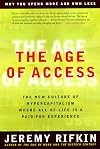
A disturbing bit of prescience - this was published at the turn of the last century, and correctly pegs the effect of the information age on the economics of capitalism. Markets are secondary now to networks, property is mostly an intangible "experience" and access has replaced ownership. About the only things missed here are the overwhelming rise of online shopping and the contributions of online social networks to the destruction of culture, but other than that, this book could have been show more written earlier this year. Unfortunately there are no real solutions proposed here, but I suspect that's because the author was secretly hoping his speculations were wrong. Read it and weep, then worry. show less
The Green New Deal: Why the Fossil Fuel Civilization Will Collapse by 2028, and the Bold Economic Plan to Save Life on Earth by Jeremy Rifkin
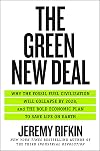
Some interesting and hopeful ideas around financing projects with e.g. pension money bogged down by the entire rest of the book which is a collection of half-truths, mistakes, naivete, bad math, self-promotion, and ignorance.
Which shouldn't be a surprise. This is Rifkin's schtick, this is his game. He was wrong e.g. 20 years ago on fuel cells (which, given another 20 years, will probably be ready for widespread usage.) He got smacked down in the 80's by, amongst others, no less than Stephen show more Gould for his ignorance on evolution and genetics. He's at it again, wildly promoting plans and ideas supported by little more than conjecture and promises, with a handful of cherry-picked evidence.
We need to deal with fossil fuels and carbon. We need to prepare for climate change as already baked in. We need something like a "green new deal." But with friends like these, who needs enemies? show less
Which shouldn't be a surprise. This is Rifkin's schtick, this is his game. He was wrong e.g. 20 years ago on fuel cells (which, given another 20 years, will probably be ready for widespread usage.) He got smacked down in the 80's by, amongst others, no less than Stephen show more Gould for his ignorance on evolution and genetics. He's at it again, wildly promoting plans and ideas supported by little more than conjecture and promises, with a handful of cherry-picked evidence.
We need to deal with fossil fuels and carbon. We need to prepare for climate change as already baked in. We need something like a "green new deal." But with friends like these, who needs enemies? show less
The End of Work: the Decline of the Global Labor Force and the Dawn of the Post-Market Era by Jeremy Rifkin
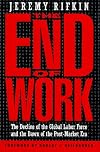
A more intelligent argument than most I have heard for something other than a market economy (for which I remain an advocate). Rifkin argues that the advances in technology are quickly taking us to a state in which few workers are needed. The resulting unemployment and free time should lead to increased participation in the third sector of volunteerism and community service. He also makes a decent case for a negative income tax for certain low incomes, which in my opinion, beats the show more alternatives he and others propose. The history he provides around the basis of the New Deal (moving the 65+ crowd out to avoid having idle youth) and the trends of the 50's and 60's is very interesting. show less
***.5
Mostly good stuff, but it's all over the place, with way too many seemingly random asides to unrelated topics. The author also has some disturbing opinions about cities, religion, politics, technology, education, children, psychology, and nature. He throws around many references and statistics, but they are often only vaguely related to the point he's making at the time.
Which is a shame, because it detracts from the main thesis of the book, which is that we need to transition from show more viewing "progress" and efficiency as paramount to a more resilient, forgiving, and adaptive society and economy. show less
Mostly good stuff, but it's all over the place, with way too many seemingly random asides to unrelated topics. The author also has some disturbing opinions about cities, religion, politics, technology, education, children, psychology, and nature. He throws around many references and statistics, but they are often only vaguely related to the point he's making at the time.
Which is a shame, because it detracts from the main thesis of the book, which is that we need to transition from show more viewing "progress" and efficiency as paramount to a more resilient, forgiving, and adaptive society and economy. show less
Lists
Awards


You May Also Like


Associated Authors
Statistics
- Works
- 51
- Also by
- 3
- Members
- 4,482
- Popularity
- #5,590
- Rating
- 3.4
- Reviews
- 52
- ISBNs
- 243
- Languages
- 16
- Favorited
- 4

