
Lester R. Brown
Author of Plan B 2.0: Rescuing a Planet Under Stress and a Civilization in Trouble
About the Author
The son of farmers, Lester Brown was born in New Jersey in 1934 and attended Rutgers University, receiving a B.S. in agricultural science in 1955. He earned an M.S. in agricultural economics from the University of Maryland in 1959 and an M.P.A. from Harvard University in 1962. He worked as adviser show more on foreign agricultural policy for the secretary of the U.S. Department of Agriculture, served as administrator of the International Agricultural Development Service, and helped establish the Overseas Development Council. In 1974, Brown founded the Worldwatch Institute, a private, nonprofit, environmental think tank designed to act as a global early warning system and to study overpopulation, famine, and other world problems. Located in Washington, D.C., the institute publishes the Worldwatch Papers series, Worldwatch Magazine, and the annual State of the World report. Although sometimes criticized for his emphasis on population control, this author of more than a dozen books and the recipient of a MacArthur Foundation fellowship has been highly praised for his understanding of the threats to the ecology of our planet. (Bowker Author Biography) Lester R. Brown, founder & now chairman of the Worldwatch Institute in Washington, D.C., is a MacArthur Fellow. He is a senior author of "State of the World". (Bowker Author Biography) show less
Series
Works by Lester R. Brown
Plan B 2.0: Rescuing a Planet Under Stress and a Civilization in Trouble (2006) 315 copies, 4 reviews
Outgrowing the Earth: The Food Security Challenge in an Age of Falling Water Tables and Rising Temperatures (2004) 70 copies
The Great Transition: Shifting from Fossil Fuels to Solar and Wind Energy (2015) 68 copies, 1 review
State of the World 1993: A Worldwatch Institute Report on Progress Toward a Sustainable Society (1993) 45 copies, 2 reviews
State of the World 1997: A Worldwatch Institute Report on Progress Toward a Sustainable Society (1997) 43 copies
State of the World 1987: A Worldwatch Institute Report on Progress Toward a Sustainable Society (1987) 42 copies
State of the World 1986: A Worldwatch Institute Report on Progress Toward a Sustainable Society (1986) 17 copies
State of the World 1984: A Worldwatch Institute Report on Progress Toward a Sustainable Society (1984) 13 copies
State of the World 1985: A Worldwatch Institute Report on Progress Toward a Sustainable Society (1985) 11 copies
Agricultural Link: How Environmental Deterioation Could Disrupt Economic Progress (Worldwatch Paper #136) (1997) 9 copies
The future of urbanization : facing the ecological and economic constraints (1987) 5 copies, 1 review
Il 29° giorno 3 copies
The world watch reader 1991 2 copies
Man, land & food: looking ahead at world food needs (Foreign Agricultural Economic Report No. 11, USDA) (1976) 2 copies
L'État de la Planète 1990 1 copy
Our Daily Bread 1 copy
La Situación en el mundo ... un informe del Worldwatch Institute sobre desarrollo y medio ambiente (2002) 1 copy
State of the world 1985 : A worldwatch institute report on progress toward a sustainable society 1 copy
L'ETAT DE LA PLANETE. 1 copy
L'Estat del món 1997 : informe de Worldwatch Institute sobre els avenços cap a una societat sostenible (1997) 1 copy, 1 review
The world watch reader 2002 1 copy
Associated Works
American priorities in a new world era — Contributor — 1 copy
Tagged
Common Knowledge
- Other names
- BROWN, Lester Russel
BROWN, Lester R. - Birthdate
- 1934-03-28
- Gender
- male
- Education
- Rutgers University (BS|agricultural science|1955)
University of Maryland (MS|agricultural economics|1959)
Harvard University (MPA|public administration|1964) - Occupations
- US Government beaurocrat
Overseas Development Council, co-founder
Worldwatch Institute, founder (1974)
Earth Policy Institute, founder (2001) - Awards and honors
- Humanist of the Year (1991)
World Wide Fund for Nature Gold Medal (1989)
Blue Planet Prize (1994)
National Library of China book Award
Charles A. and Anne Morrow Lindbergh Award (2009)
Members
Reviews
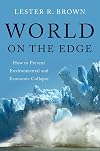
This book was published in 2011 so it was a bit dated. However, it still covered all the current issues, and its solutions (the second half of the book, Plan B) reflect more hope than many of us have now.
A few excerpts:
Page 7: “…it would take 1.5 Earths to sustain our current consumption. Environmentally, the world is in overshoot mode. … the global decline of the economy’s natural support system … is well underway.”
Page 16: “…Plan B has four components: a massive 80 percent show more cut in global carbon emissions by 2020 and the stabilization of the world population at no more than 8 billion by 2040.”
My comment: Since the book’s publication in 2011 (except for a temporary dip in 2020 likely due to Covid), global emissions have only increased and are now at an all-time high at 37 billion tons per year. And our population already reached 8 billion in 2023, well before the author’s hopeful projection of 2040.
Page 23: “There are two sources of irrigation water: underground water and surface water. Most underground water comes from aquifers that are regularly replenished with rainfall … But a distinct minority of aquifers are fossil aquifers—containing water put down eons ago. Since these do not recharge, irrigation ends when they are pumped dry. Among the more prominent fossil aquifers are the Ogallala underlying the U.S. Great Plains, the Saudi one … and the deep aquifer under the North China Plain.”
Page 30: “In Mexico, … in the agricultural state of Guanajuato, the water table is falling by 6 feet or more a year. In the northwestern wheat-growing state of Sonora, farmers once pumped water from the Hermosillo aquifer at a depth of 40 feet. Today, they pump from over 400 feet. … Mexico’s food bubble may soon burst.”
My comment: Rechargeable aquifers in the U.S. are also being overpumped, as are fossil aquifers that will run dry, such as the Ogallala.
Page 114: “Manufacturing the nearly 28 billion plastic bottles used each year to package water in the United States alone requires the equivalent of 17 million barrels of oil. This—combined with the energy used to refrigerate and haul the bottled water in trucks, sometimes over hundreds of miles—means the U.S. bottled water industry consumes roughly 50 million barrels of oil per year, equal to 13 percent of U.S. oil imports from Saudi Arabia.”
Page 178: “An American living high on the food chain with a diet heavy in grain-intensive livestock products, including red meat, consumes twice as much grain as the average Italian and nearly four times as much as the average Indian. Adopting a Mediterranean diet can cut the grain footprint of Americans roughly in half, reducing carbon emissions accordingly.”
Page 193: “If we cannot mobilize to save the Greenland ice sheet, we probably cannot save civilization as we know it.”
This was a thought-provoking book full of statistics and data but still engaging and readable. I sometimes rolled my eyes at his optimism (like, yeah, we’re going to suddenly reduce our emissions by 80%). He listed a thousand things to be optimistic about, all the projects for alternative energy and fuel efficiency. And sure, they’re all great. But, apparently, they’re not lowering our CO2 emissions as they continue to climb, as does our population.
So I don’t share his optimism. I envy the hope he had in 2011 when he and other authors could say, “There’s still time!” This morning, I watched the sun rise as a deep orange ball, likely due to the fires in California – no smoke here, fortunately, at least for now. But the big Park Fire north of us may be affecting the hue of the sun. I’m keeping track of the fire and some smaller ones on the CalFire website.
Regardless of my pessimism, I do my part in 100 ways with my lifestyle, my diet, and my politics, and the organizations I continue to fund. Because, well … what else can I do?
Despite my cynicism, or maybe because of it, I highly recommend this book. show less
A few excerpts:
Page 7: “…it would take 1.5 Earths to sustain our current consumption. Environmentally, the world is in overshoot mode. … the global decline of the economy’s natural support system … is well underway.”
Page 16: “…Plan B has four components: a massive 80 percent show more cut in global carbon emissions by 2020 and the stabilization of the world population at no more than 8 billion by 2040.”
My comment: Since the book’s publication in 2011 (except for a temporary dip in 2020 likely due to Covid), global emissions have only increased and are now at an all-time high at 37 billion tons per year. And our population already reached 8 billion in 2023, well before the author’s hopeful projection of 2040.
Page 23: “There are two sources of irrigation water: underground water and surface water. Most underground water comes from aquifers that are regularly replenished with rainfall … But a distinct minority of aquifers are fossil aquifers—containing water put down eons ago. Since these do not recharge, irrigation ends when they are pumped dry. Among the more prominent fossil aquifers are the Ogallala underlying the U.S. Great Plains, the Saudi one … and the deep aquifer under the North China Plain.”
Page 30: “In Mexico, … in the agricultural state of Guanajuato, the water table is falling by 6 feet or more a year. In the northwestern wheat-growing state of Sonora, farmers once pumped water from the Hermosillo aquifer at a depth of 40 feet. Today, they pump from over 400 feet. … Mexico’s food bubble may soon burst.”
My comment: Rechargeable aquifers in the U.S. are also being overpumped, as are fossil aquifers that will run dry, such as the Ogallala.
Page 114: “Manufacturing the nearly 28 billion plastic bottles used each year to package water in the United States alone requires the equivalent of 17 million barrels of oil. This—combined with the energy used to refrigerate and haul the bottled water in trucks, sometimes over hundreds of miles—means the U.S. bottled water industry consumes roughly 50 million barrels of oil per year, equal to 13 percent of U.S. oil imports from Saudi Arabia.”
Page 178: “An American living high on the food chain with a diet heavy in grain-intensive livestock products, including red meat, consumes twice as much grain as the average Italian and nearly four times as much as the average Indian. Adopting a Mediterranean diet can cut the grain footprint of Americans roughly in half, reducing carbon emissions accordingly.”
Page 193: “If we cannot mobilize to save the Greenland ice sheet, we probably cannot save civilization as we know it.”
This was a thought-provoking book full of statistics and data but still engaging and readable. I sometimes rolled my eyes at his optimism (like, yeah, we’re going to suddenly reduce our emissions by 80%). He listed a thousand things to be optimistic about, all the projects for alternative energy and fuel efficiency. And sure, they’re all great. But, apparently, they’re not lowering our CO2 emissions as they continue to climb, as does our population.
So I don’t share his optimism. I envy the hope he had in 2011 when he and other authors could say, “There’s still time!” This morning, I watched the sun rise as a deep orange ball, likely due to the fires in California – no smoke here, fortunately, at least for now. But the big Park Fire north of us may be affecting the hue of the sun. I’m keeping track of the fire and some smaller ones on the CalFire website.
Regardless of my pessimism, I do my part in 100 ways with my lifestyle, my diet, and my politics, and the organizations I continue to fund. Because, well … what else can I do?
Despite my cynicism, or maybe because of it, I highly recommend this book. show less
So while I would recommend this to anyone interested in a global perspective on water/energy/climate problems, I have serious feasibility issues around the plan to fix them. I think that, even with such a high level plan as this, it should be possible to do better allocation of who is paying (I don’t think the security argument will fly with the vast majority of voters), and I don’t know how useful the energy plan is. Showing that the potential for wind and solar exceeds global demand by show more a lot is not very interesting (we know this) - showing where you’d tap it, how you’d handle extra powerlines, and how we’d deal with reliability and variability issues would be. This might lead to some unrealistic optimism from folks who read this - but the background and general outline is good enough that they should do it anyway. show less
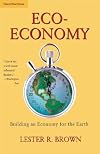
One of the earlier works on transitioning to a sustainable economy by taking the environmental crisis as opportunities for a new way of doing business. Crisp, powerful writing, with profuse examples and specific recommendations. By an agricultural expert who contributed in large measure to India's fight with famine and food shortages.
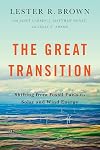
Because this book is a year old, and since it's based on lots of current facts and percentages, I desperately want an update. It discusses a breadth of topics for an energy transition away from fossil fuels and all of the current (or then current) plans for achieving this around the world. With some attention to improving energy efficiency, it primarily has sections on oil, coal (including a bit on natural gas), nuclear, solar, wind, geothermal, and hydro solutions. These seem fair in show more describing the benefits and disadvantages of each, but concentrate more on where the world stands and efforts to +/- each of these. While it's a small book, it's a good overview - that could have been helped with a few charts and graphs - but whose topics could have taken a full bookshelf. Still a very worthwhile read... especially for recognizing how much more our country could be doing now. show less
Lists
Awards


You May Also Like


Associated Authors
Statistics
- Works
- 109
- Also by
- 3
- Members
- 3,438
- Popularity
- #7,396
- Rating
- 3.8
- Reviews
- 31
- ISBNs
- 274
- Languages
- 13
- Favorited
- 1