
Rachel Carson (1907–1964)
Author of Silent Spring
About the Author
Rachel Carson was for many years a marine biologist and then editor-in-chief of the United States Fish and Wildlife Service's publications. She was also the author of Silent Spring, Under the Sea-Wind, and At the Edge of the Sea. She died in 1964. Sylvia Earle is a marine biologist, oceanographer, show more and National Geographic Society Explorer in Residence. Her books include Blue Hope: Exploring and Caring for Earth's Magnificent Ocean and Ocean An Illustrated Atlas. show less
Image credit: from Wikipedia
Series
Works by Rachel Carson
The Sea Trilogy: Under the Sea-Wind, The Sea Around Us, The Edge of the Sea (2021) 163 copies, 2 reviews
Always, Rachel: The Letters of Rachel Carson and Dorothy Freeman, 1952-1964, The Story of a Remarkable Friendship (1995) 111 copies
Carson, Rachel Archive 1 copy
Rachel Carson papers 1 copy
Associated Works
Sisters of the Earth: Women's Prose and Poetry About Nature (1991) — Contributor — 443 copies, 5 reviews
On a Farther Shore: The Life and Legacy of Rachel Carson, Author of Silent Spring (2012) — Quotations — 238 copies, 6 reviews
The Glorious American Essay: One Hundred Essays from Colonial Times to the Present (2020) — Contributor — 119 copies
The Sweet Breathing of Plants: Women Writing on the Green World (2001) — Contributor — 101 copies, 1 review
Shaking the Foundations: 200 Years of Investigative Journalism in America (Nation Books) (2003) — Contributor — 45 copies
Animal Machines: The New Factory Farming Industry (1964) — Foreword, some editions — 35 copies, 2 reviews
DDT, Silent Spring, and the Rise of Environmentalism: Classic Texts (2008) — Contributor — 19 copies
Tagged
Common Knowledge
- Legal name
- Carson, Rachel Louise
- Birthdate
- 1907-05-27
- Date of death
- 1964-04-14
- Gender
- female
- Education
- Chatham University (BS|1929)
Johns Hopkins University (MS|1932) - Occupations
- marine biologist
conservationist
nature writer - Organizations
- U.S. Fish and Wildlife Service
U.S. Bureau of Fisheries - Awards and honors
- Presidential Medal of Freedom (1980)
The Schweitzer Medal (1962)
American Academy of Arts and Letters (1953)
Constance Lindsay Skinner Award (1963)
Great Americans series postage stamp issued (1981)
Birthplace added to National Register of Historic Places (Rachel Carson Homestead) (show all 24)
Colesville, Maryland home designated National Historic Landmark (1991)
Rachel Carson Trail (Alleghany County ∙ PA)
Rachel Carson Bridge (Pittsburgh ∙ PA ∙ USA)
Rachel Carson State Office Building (Harrisburg ∙ PA ∙ USA)
Rachel Carson Elementary School (Gaithersburg ∙ Montgomery County ∙ Maryland ∙ USA)
Rachel Carson Middle School (Herndon ∙ VA ∙ USA)
Rachel Carson Elementary (Sammamish ∙ WA ∙ USA)
Rachel Carson Elementary School (San Jose ∙ CA ∙ USA)
Rachel Carson Environmental Middle School (Beaverton ∙ OR ∙ USA)
Rachel Carson High School for Coastal Studies (Brooklyn ∙ NY ∙ USA)
Rachel Carson Conservation Park (Montgomery County ∙ MD ∙ USA)
Rachel Carson room at Ariel Rios Building
Rachel Carson National Wildlife Refuge (Maine ∙ USA)
Rachel Carson Coastal Reserve (Carteret County ∙ NC ∙ USA)
Rachel Carson Prize named for her (Stavanger ∙ Norway)
Rachel Carson Prize named for her (Society for Social Studies of Science)
Rachel Carson Greenway (Montgomery County ∙ MD ∙ USA)
National Women's Hall of Fame (1973) - Agent
- Marie Rodell
- Short biography
- Rachel Carson was a marine biologist and vocal conservationist. Her book, Silent Spring, is often credited with being the spark for the modern environmental movements. Carson's work led directly to changes in pesticide and other environmental policies in the United States and helped lead to the creation of the U.S. Environmental Protection Agency.
- Cause of death
- cancer (breast)
heart attack - Nationality
- USA
- Birthplace
- Springdale, Pennsylvania, USA
- Places of residence
- Springdale, Pennsylvania, USA
Southport Island, Maine, USA
Silver Spring, Maryland, USA - Place of death
- Silver Spring, Maryland, USA
- Burial location
- Parklawn Memorial Park, Rockville, Maryland, USA
- Map Location
- USA
Members
Discussions
Undersea - Nawakum press in Fine Press Forum (April 2023)
Reviews
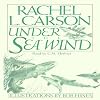
18. Under the Sea Wind by Rachel Carson
reader: C. M. Hébert
published: 1941
format: 5:46 audible audio* (~137 pages of original paperback)
acquired: March 5 listened: Mar 5-14
rating: 4
genre/style: Nature theme: random audio
locations: Atlantic Coast
about the author: 1907 –1964, born on a family farm near Springdale, Pennsylvania. Carson was an American marine biologist, writer, and conservationist whose influential book Silent Spring (1962) and other writings are credited with advancing the show more global environmental movement.
*The audiobook length is 6:38, but the glossary started with 52 minutes left and I stopped there. The original paperback is 157 pages.
Another classic, but one again completely different.
I didn't know what to expect here in Rachel Carson's first book, from 1941, published shortly before the bombing of Pearl Harbor. I learned in the [The Book of Eels] by Patrick Svensson that Carson wrote an essay as a contribution for a book on coastal animals and was told that what she wrote wasn't a good fit for the book, but that she might try the Atlantic Monthly. She did, it got published and she expanded it into this book. I didn't know what that meant. Svensson has really nice things to say about Carson, and that's why I picked this up.
So, unprepared, I started, and an elegant-paced reader read to me:
Carson tells her natural stories without introduction, explanation, purpose, or any authorial intervention. No commentary, no authorial side notes and presence. She just begins to tell us, and she never pauses to talk to the reader about what she's doing or where her information comes from, or what her message is; she stops only to change location for the next chapter. Each coastal environment is captured by a string of striking prose on natural experience and sensations - the sights, sounds, feelings, sensations present and absent, animal awareness, its limitations. There is a sense of these animals' fragile existence.
Each chapter centers on a named animal. So, everything is personified.
Striking prose and simple format. Carson imagines the experiences of her birds fish, etc. using the information of her time, 1941, which was a lot of information. No purpose is presented, but the reader should understand they are learning something. And the reader can't but help notice the poetic sense of experience. If you happen to drift, the narrative forgives, and experience maintained by that voice. I can't promise I diligently captured the full story details, but I'm glad I stopped here. It's a curious audio experience, with an exceptionally good reader (C. M. Hébert) who joyfully, after the briefest pause for affect, calls out all the distinct bird sounds.
2023
https://www.librarything.com/topic/348551#8097670 show less
reader: C. M. Hébert
published: 1941
format: 5:46 audible audio* (~137 pages of original paperback)
acquired: March 5 listened: Mar 5-14
rating: 4
genre/style: Nature theme: random audio
locations: Atlantic Coast
about the author: 1907 –1964, born on a family farm near Springdale, Pennsylvania. Carson was an American marine biologist, writer, and conservationist whose influential book Silent Spring (1962) and other writings are credited with advancing the show more global environmental movement.
*The audiobook length is 6:38, but the glossary started with 52 minutes left and I stopped there. The original paperback is 157 pages.
Another classic, but one again completely different.
I didn't know what to expect here in Rachel Carson's first book, from 1941, published shortly before the bombing of Pearl Harbor. I learned in the [The Book of Eels] by Patrick Svensson that Carson wrote an essay as a contribution for a book on coastal animals and was told that what she wrote wasn't a good fit for the book, but that she might try the Atlantic Monthly. She did, it got published and she expanded it into this book. I didn't know what that meant. Svensson has really nice things to say about Carson, and that's why I picked this up.
So, unprepared, I started, and an elegant-paced reader read to me:
The island lay in shadows only a little deeper than those that were swiftly stealing across the sound from the east. On its western shore the wet sand of the narrow beach caught the same reflection of palely gleaming sky that laid a bright path across the water from island beach to horizon. Both water and sand were the color of steel overlaid with the sheen of silver, so that it was hard to say where water ended and land began.
Carson tells her natural stories without introduction, explanation, purpose, or any authorial intervention. No commentary, no authorial side notes and presence. She just begins to tell us, and she never pauses to talk to the reader about what she's doing or where her information comes from, or what her message is; she stops only to change location for the next chapter. Each coastal environment is captured by a string of striking prose on natural experience and sensations - the sights, sounds, feelings, sensations present and absent, animal awareness, its limitations. There is a sense of these animals' fragile existence.
Each chapter centers on a named animal. So, everything is personified.
On the south beach of the island, where water no deeper than a man’s hand ran over gently ribbed bottom, Rynchops began to wheel and quarter over the shallows. He flew with a curious, lilting motion, lifting his wings high after the downstroke. His head was bent sharply so that the long lower bill, shaped like a scissor blade, might cut the water.
The blade or cutwater plowed a miniature furrow over the placid sheet of the sound, setting up wavelets of its own and sending vibrations thudding down through the water to rebound from the sandy bottom. The wave messages were received by the blennies and killifish that were roving the shallows on the alert for food. In the fish world many things are told by sound waves. Sometimes the vibrations tell of food animals like small shrimps or oar-footed crustaceans moving in swarms overhead. And so at the passing of the skimmer the small fishes came nosing at the surface, curious and hungry. Rynchops, wheeling about, returned along the way he had come and snapped up three of the fishes by the rapid opening and closing of his short upper bill.
Striking prose and simple format. Carson imagines the experiences of her birds fish, etc. using the information of her time, 1941, which was a lot of information. No purpose is presented, but the reader should understand they are learning something. And the reader can't but help notice the poetic sense of experience. If you happen to drift, the narrative forgives, and experience maintained by that voice. I can't promise I diligently captured the full story details, but I'm glad I stopped here. It's a curious audio experience, with an exceptionally good reader (C. M. Hébert) who joyfully, after the briefest pause for affect, calls out all the distinct bird sounds.
Ah-h-h-h, called the black skimmer. Ha-a-a-a! Ha-a-a-a!
2023
https://www.librarything.com/topic/348551#8097670 show less
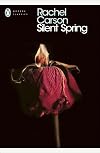
I can't believe I took so long to read this amazing, accurate and accessible warning about man's war on nature - or how unbelievably angry Rachel Carson's research made me! The original book was published in 1962, and the author sadly died in 1964, but a quick Google tells me that nothing has changed, and in fact the use of pesticides and other 'chemical warfare' has increased; the infamous DDT (referenced by Joni Mitchell - 'hey farmer, farmer, put away your DDT now/Give me spots on my show more apples, but leave me the birds and the bees' - which came on the radio while I was reading) was banned in some countries, but other, stronger chemicals have taken its place.
Rachel Carson presents her arguments against spraying chemicals to combat insignificant little problems - ants, gnats, tree fungus - in clear and powerful language. The dependence on chemicals, instead of natural or biological control of pests, came about after WW2, as a derivative of nerve gas - and was promoted by the Department of Agriculture and the mercenary manufacturers of DDT and the like, especially in the good old USA. The air, soil and waterways, and therefore the food chain, were all irrevocably polluted by spray-happy farmers and even suburbanites who blindly followed the 'science', which was motivated by money and lacked any research into the after effects:
The 'control of nature' is a phrase conceived in arrogance, born of the Neanderthal age of biology and philosophy, when it was supposed that nature exists for the convenience of man. ... It is our alarming misfortune that so primitive a science has armed itself with the most modern and terrible weapons, and that in turning them against the insects, it has also turned them against the earth.
You tell 'em, Rachel! I could almost picture the arrogant little 'experts' and chemical men while reading her words - impotent pen pushers who took pleasure in blasting the earth with the worst pollutants, watching birds and fish die rather than the target 'pests', which became immune to the pesticides and came back bigger and stronger anyway, and then refusing to listen to the complaints and the protests because men know best.(They also turned on Rachel for presenting the truth and spoiling their monopoly on death and destruction, calling her 'hysterical'.) I kind of wish the conservationists could have sprayed the manufacturers with their own chemicals. At the very least, I hope the (mutant) cockroaches win the war and eat us all.
An infuriating history of man's arrogance, but sadly still relevant - this book should be required reading at school. show less
Rachel Carson presents her arguments against spraying chemicals to combat insignificant little problems - ants, gnats, tree fungus - in clear and powerful language. The dependence on chemicals, instead of natural or biological control of pests, came about after WW2, as a derivative of nerve gas - and was promoted by the Department of Agriculture and the mercenary manufacturers of DDT and the like, especially in the good old USA. The air, soil and waterways, and therefore the food chain, were all irrevocably polluted by spray-happy farmers and even suburbanites who blindly followed the 'science', which was motivated by money and lacked any research into the after effects:
The 'control of nature' is a phrase conceived in arrogance, born of the Neanderthal age of biology and philosophy, when it was supposed that nature exists for the convenience of man. ... It is our alarming misfortune that so primitive a science has armed itself with the most modern and terrible weapons, and that in turning them against the insects, it has also turned them against the earth.
You tell 'em, Rachel! I could almost picture the arrogant little 'experts' and chemical men while reading her words - impotent pen pushers who took pleasure in blasting the earth with the worst pollutants, watching birds and fish die rather than the target 'pests', which became immune to the pesticides and came back bigger and stronger anyway, and then refusing to listen to the complaints and the protests because men know best.(They also turned on Rachel for presenting the truth and spoiling their monopoly on death and destruction, calling her 'hysterical'.) I kind of wish the conservationists could have sprayed the manufacturers with their own chemicals. At the very least, I hope the (mutant) cockroaches win the war and eat us all.
An infuriating history of man's arrogance, but sadly still relevant - this book should be required reading at school. show less
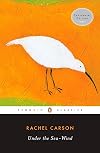
Was Rachel Carson a fish? A bird? A single-cell organism? If not, how could she have such incredible knowledge of Atlantic shore creatures, how they grow, how they interact, their co-dependencies, and their demises? In this treasure of naturalism, she describes the lifespans and times of exotic creatures such as amphipods, anguillas (eels), aurelia jellyfish, blennies (fish), brants (geese), conger eels, copepods, croakers, crowberries (plant), curlews (birds), desmids and diatoms show more (algae)...I could go on. She follows a few species and mentions many more. Carson's language is as lyrical as the underwater scenery. I only knew her as a naturalist and one who warned of climate and pollution disasters eighty five years ago. Here, she's a brilliant playwright. show less
Something About the Sky (Illustrated by Nikki McClure) [Reading age: 5 - 8 years & Grade level: Kindergarten - 3] by Rachel Carson
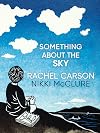
Cut-paper wizard Nikki McClure is a brilliant steward for the words of a pioneering environmentalist in this wondrous ode to clouds--and the scientific "language of the sky."
Rachel Carson once wrote, "It is not half so important to know as to feel." What do we know about clouds? There are three basic types: stratus, cumulus, and cirrus. Some are fleecy and fair-weathered while others portend storms. But clouds are more than pretty or ominous backdrops. They're the vehicle of water between show more sea and land, land and sea, in a cycle without end or beginning. They are the writing of the wind on the sky, a language all their own. An illustrator note explains the origins of Rachel Carson's shimmering essay--previously unpublished in its entirety--and the process of adapting it to picture book format, as well as how the author of Silent Spring forever changed the way we think about science and progress. Bringing the soft edges of clouds and the natural world to vivid life with a new, more fluid approach to her signature cut-paper technique, Nikki McClure inspires true emotional engagement with the world we all share. An antidote to "get your head out of the clouds," this art-meets-science tribute to curiosity and wonder is a gift for daydreamers and nature lovers of all ages. show less
Rachel Carson once wrote, "It is not half so important to know as to feel." What do we know about clouds? There are three basic types: stratus, cumulus, and cirrus. Some are fleecy and fair-weathered while others portend storms. But clouds are more than pretty or ominous backdrops. They're the vehicle of water between show more sea and land, land and sea, in a cycle without end or beginning. They are the writing of the wind on the sky, a language all their own. An illustrator note explains the origins of Rachel Carson's shimmering essay--previously unpublished in its entirety--and the process of adapting it to picture book format, as well as how the author of Silent Spring forever changed the way we think about science and progress. Bringing the soft edges of clouds and the natural world to vivid life with a new, more fluid approach to her signature cut-paper technique, Nikki McClure inspires true emotional engagement with the world we all share. An antidote to "get your head out of the clouds," this art-meets-science tribute to curiosity and wonder is a gift for daydreamers and nature lovers of all ages. show less
Lists
Awards


You May Also Like


Associated Authors
Statistics
- Works
- 29
- Also by
- 24
- Members
- 13,609
- Popularity
- #1,703
- Rating
- 4.0
- Reviews
- 185
- ISBNs
- 245
- Languages
- 14
- Favorited
- 15
