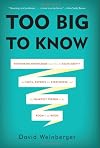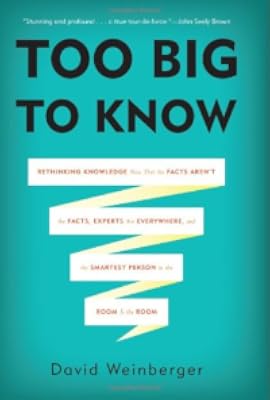
Too Big to Know: Rethinking Knowledge Now That the Facts Aren't the Facts, Experts Are Everywhere, and the Smartest Person in the Room Is the Room
by David Weinberger 
On This Page
Description
Technology. Nonfiction. HTML:We used to know how to know. We got our answers from books or experts. We’d nail down the facts and move on. But in the Internet age, knowledge has moved onto networks. There’s more knowledge than ever, of course, but it’s different. Topics have no boundaries, and nobody agrees on anything. Yet this is the greatest time in history to be a knowledge seeker . . . if you know how. In Too Big to Know, Internet philosopher David Weinberger shows how business, show more science, education, and the government are learning to use networked knowledge to understand more than ever and to make smarter decisions than they could when they had to rely on mere books and experts.This groundbreaking book shakes the foundations of our concept of knowledge—from the role of facts to the value of books and the authority of experts—providing a compelling vision of the future of knowledge in a connected world.
. show less
Tags
Recommendations






Member Reviews
Too Big to Know is a surprisingly small book (around 200 pages) that covers a lot of ground, touching on issues of interest to anyone who wonders where knowledge is headed and what shape it is taking in this unstable era. The long subtitle, in the elevator pitch style that is so popular with publishers these days, provides a hint of what's inside: Rethinking Knowledge Now That the Facts Aren't the Facts, Experts are Everywhere, and the Smartest Person in the Room is the Room. Weinberger was trained as a philosopher and is now a senior researcher at Harvard's Berkman Center for Internet and Society, which is where some of my favorite thinkers hang out. Previously he co-authored The Cluetrain Manifesto and wrote Small Pieces Loosely show more Joined and Everything is Miscellaneous, all of which looked at the ways the Internet not only works, but is changing the way we work and how we relate to one another and to ideas themselves as they are scattered throughout a new digital (dis)order.
Too Big to Know is an ambitious follow-up that looks at how we now handle (or try to handle) knowledge and how it has been affected by being networked. We now have access to more knowledge than ever, though anxiety about being overwhelmed is nothing new: Seneca and the Book of Ecclesiastes both fretted there were too many books being produced. But the abundance we face now is different by nature. It not only is abundant, it spills out of epistemological containers. As knowledge is networked, we lose our means of ordering it, or rather it can be ordered in many different ways at once. The internet, Weinberger writes, has no edges. "No edges means no shape. And no shape means that networked knowledge lacks what we have long taken to be essential to the structure of knowledge: a foundation" (17). He points out that our notion of a foundation has changed over time, and facts themselves became important only relatively recently as a building block for knowledge. Our idea of what makes someone an expert has changed in part because the network doesn't restrict speech to a limited number of experts and because speech online is itself networked and open to discussion, accreting further interpretations, disagreements, discursions, and detours. Negotiating the conduct of these discussions is examined in the book, including the problem of echo chambers and the need for diversity. In this section he lays out some observations:
All knowledge and experience is an interpretation.
Interpretations are social.
There is no privileged position.
Interpretations occur in discourses.
Within a discourse, some interpretations are privileged.
These, he is quick to point out, are not new - I first thought about these things when Gopher and WAIS were the hot new thing, when the World Wide Web was a gleam in Tim Berners-Lee's eye and I was getting familiar with composition theory. But these now-common ideas map well to the way the Internet works and how it sometimes doesn't work very well for advancing understanding. Weinberger says the Net can make us smarter - but only if we want to be.
Though some things about authority and discourse haven't really changed, the shape of how we display and share knowledge has in ways that destabilize both expertise and the way we construct a complex argument. When long-form arguments were shaped like books, they had firm stopping places and fewer temptations (though honestly, I have always found footnotes as distracting as hyperlinks. That one looks good! Better look it up right now, while I'm thinking of it!) Book-shaped arguments also had the impression of being fixed, finished - though of course, they weren't. The authors would tinker further with those ideas, and others would comment and extend or complicate them. It's much easier now, though, to see all of that happening in real time. In the next section, Weinberger looks at changes in science as knowledge is networked and says "the Net's rebooting of science" through the increase in data and our ability to store and share it "has revealed that the old ways were more broken than we'd thought. In a phrase: Science had been a type of publishing and now it's becoming a network . . . now that science is becoming a network, knowledge is not something that gets pumped out of the system as its product. The hyperlinking of science not only links knowledge back to its sources. It also links knowledge into the human contexts and processes that produced it and use it, debate it, and make sense of it" (152, 155). The product isn't bits of established stuff; it's the network itself. Again, part of me says "this isn't new. Science has always been a network that is in ferment." But it's more visible now, even as journal publishers assert the rights to the product.
Weinberger also looks at how the networking of knowledge changes our idea of leadership, decision-making, and creativity itself. The Net seems to have as basic attributes abundance, interconnectedness through links, lack of agreement or a sense of conclusion, and encourages use to think of what's online as public and available for reuse. All of these things, of course, are problematic in practice. The problem with the expectation that what's on the web should be "permission-free" is on my mind constantly; the more we are technically able to link, share, and repurpose, the more prohibitions and threats are imposed by industries that rely on payment for use. A few hours before I started to write this, for example, Penguin USA announced they will not allow libraries to have access to their ebooks. Period. End of story. They had no way to impose such restrictions before the era of networked knowledge. Weinberger addresses these tensions and concludes "Traditional institutions need to be fierce contributors to the Net if our new infrastructure is to move us toward knowledge and not dazed ignorance" (191). Weinberger also suggests we need more than ever to teach everyone how to find information, how to evaluate claims, and how to appreciate and learn from those who see things differently than we do. In many ways the optimal approach to the future he describes is the one academic librarians prepare for - but it is also one that we have to fight for every single day. The sharing we do has become suspect, and publishers are now in a position to cripple what we do as much as possible.
Weinberger covers a lot of ground, and when you cover so much, there are places where depth is sacrificed for breadth. There are also inevitable lacunae. For me, the missing piece that kept intruding on my thoughts but makes no appearance in the book is the problem of privacy and the way that so many of our platforms for networking and sharing knowledge are actually data-gathering and influence-hoarding devices. This, to me, is a fundamentally vexing problem with our current network infrastructure: our "free" access to networks is actually paid for through the constant leakage of personal information. Those platforms that invite the greatest volume of sharing are taking advantage of the hopes we have while retaining enormous power - not only over our lives through surveillance, but because they have become big enough and essential enough platforms that they control much of the network itself. Users create and freely share knowledge and expression, delivering it into the hands of those who have the power to alter our knowledge base and culture and history in ways unimaginable before. They can change it or make it disappear with the flick of a switch.
When GLBT books disappeared overnight from Amazon's websites worldwide, the books didn't all disappear in reality. Most of them were physical books, merely discovered and sold through Amazon's online store. But the disappearance was significant because Amazon has made its database a uniquely powerful one, one that has insinuated itself into many other databases, and the disappearance of information about thousands of books (which the company blamed on a metadata error - an employee apparently decided the subject was a subset of the class "obscenity" or "deviant sexuality," so should not appear on a family-friendly site) simply illustrates the dangers of networked knowledge when one company controls huge parts of it - and no, of course, owns the rights to much digital stuff. The Internet was designed to work around failures like this, but the tools we rely on to search the network and share our ideas are being designed by giant corporations to appear free while being centrally controlled. Weinberger touches on this when he discusses the limits of toll access publication, but the problem is much broader and deeper than that.
Still, what Weinberger has done in a relatively short, admirably readable book is take on a complex, shifting, destabilized, and boundary-free set of ideas and talk about them in a way that makes them connect in a way that gives them coherent shape. He has used the the edges provided by the format of the book to organize a lot of material into a series of linked observations, even as he prompts us to think "yes, but" and "of course, there's also..." and in the final analysis encourages us to think about the way knowledge behaves today and where it may lead us.
21
Read more: http://www.insidehighered.com/blogs/too-big-know-david-weinberger#ixzz1q4Nvkap4
Inside Higher Ed show less
Too Big to Know is an ambitious follow-up that looks at how we now handle (or try to handle) knowledge and how it has been affected by being networked. We now have access to more knowledge than ever, though anxiety about being overwhelmed is nothing new: Seneca and the Book of Ecclesiastes both fretted there were too many books being produced. But the abundance we face now is different by nature. It not only is abundant, it spills out of epistemological containers. As knowledge is networked, we lose our means of ordering it, or rather it can be ordered in many different ways at once. The internet, Weinberger writes, has no edges. "No edges means no shape. And no shape means that networked knowledge lacks what we have long taken to be essential to the structure of knowledge: a foundation" (17). He points out that our notion of a foundation has changed over time, and facts themselves became important only relatively recently as a building block for knowledge. Our idea of what makes someone an expert has changed in part because the network doesn't restrict speech to a limited number of experts and because speech online is itself networked and open to discussion, accreting further interpretations, disagreements, discursions, and detours. Negotiating the conduct of these discussions is examined in the book, including the problem of echo chambers and the need for diversity. In this section he lays out some observations:
All knowledge and experience is an interpretation.
Interpretations are social.
There is no privileged position.
Interpretations occur in discourses.
Within a discourse, some interpretations are privileged.
These, he is quick to point out, are not new - I first thought about these things when Gopher and WAIS were the hot new thing, when the World Wide Web was a gleam in Tim Berners-Lee's eye and I was getting familiar with composition theory. But these now-common ideas map well to the way the Internet works and how it sometimes doesn't work very well for advancing understanding. Weinberger says the Net can make us smarter - but only if we want to be.
Though some things about authority and discourse haven't really changed, the shape of how we display and share knowledge has in ways that destabilize both expertise and the way we construct a complex argument. When long-form arguments were shaped like books, they had firm stopping places and fewer temptations (though honestly, I have always found footnotes as distracting as hyperlinks. That one looks good! Better look it up right now, while I'm thinking of it!) Book-shaped arguments also had the impression of being fixed, finished - though of course, they weren't. The authors would tinker further with those ideas, and others would comment and extend or complicate them. It's much easier now, though, to see all of that happening in real time. In the next section, Weinberger looks at changes in science as knowledge is networked and says "the Net's rebooting of science" through the increase in data and our ability to store and share it "has revealed that the old ways were more broken than we'd thought. In a phrase: Science had been a type of publishing and now it's becoming a network . . . now that science is becoming a network, knowledge is not something that gets pumped out of the system as its product. The hyperlinking of science not only links knowledge back to its sources. It also links knowledge into the human contexts and processes that produced it and use it, debate it, and make sense of it" (152, 155). The product isn't bits of established stuff; it's the network itself. Again, part of me says "this isn't new. Science has always been a network that is in ferment." But it's more visible now, even as journal publishers assert the rights to the product.
Weinberger also looks at how the networking of knowledge changes our idea of leadership, decision-making, and creativity itself. The Net seems to have as basic attributes abundance, interconnectedness through links, lack of agreement or a sense of conclusion, and encourages use to think of what's online as public and available for reuse. All of these things, of course, are problematic in practice. The problem with the expectation that what's on the web should be "permission-free" is on my mind constantly; the more we are technically able to link, share, and repurpose, the more prohibitions and threats are imposed by industries that rely on payment for use. A few hours before I started to write this, for example, Penguin USA announced they will not allow libraries to have access to their ebooks. Period. End of story. They had no way to impose such restrictions before the era of networked knowledge. Weinberger addresses these tensions and concludes "Traditional institutions need to be fierce contributors to the Net if our new infrastructure is to move us toward knowledge and not dazed ignorance" (191). Weinberger also suggests we need more than ever to teach everyone how to find information, how to evaluate claims, and how to appreciate and learn from those who see things differently than we do. In many ways the optimal approach to the future he describes is the one academic librarians prepare for - but it is also one that we have to fight for every single day. The sharing we do has become suspect, and publishers are now in a position to cripple what we do as much as possible.
Weinberger covers a lot of ground, and when you cover so much, there are places where depth is sacrificed for breadth. There are also inevitable lacunae. For me, the missing piece that kept intruding on my thoughts but makes no appearance in the book is the problem of privacy and the way that so many of our platforms for networking and sharing knowledge are actually data-gathering and influence-hoarding devices. This, to me, is a fundamentally vexing problem with our current network infrastructure: our "free" access to networks is actually paid for through the constant leakage of personal information. Those platforms that invite the greatest volume of sharing are taking advantage of the hopes we have while retaining enormous power - not only over our lives through surveillance, but because they have become big enough and essential enough platforms that they control much of the network itself. Users create and freely share knowledge and expression, delivering it into the hands of those who have the power to alter our knowledge base and culture and history in ways unimaginable before. They can change it or make it disappear with the flick of a switch.
When GLBT books disappeared overnight from Amazon's websites worldwide, the books didn't all disappear in reality. Most of them were physical books, merely discovered and sold through Amazon's online store. But the disappearance was significant because Amazon has made its database a uniquely powerful one, one that has insinuated itself into many other databases, and the disappearance of information about thousands of books (which the company blamed on a metadata error - an employee apparently decided the subject was a subset of the class "obscenity" or "deviant sexuality," so should not appear on a family-friendly site) simply illustrates the dangers of networked knowledge when one company controls huge parts of it - and no, of course, owns the rights to much digital stuff. The Internet was designed to work around failures like this, but the tools we rely on to search the network and share our ideas are being designed by giant corporations to appear free while being centrally controlled. Weinberger touches on this when he discusses the limits of toll access publication, but the problem is much broader and deeper than that.
Still, what Weinberger has done in a relatively short, admirably readable book is take on a complex, shifting, destabilized, and boundary-free set of ideas and talk about them in a way that makes them connect in a way that gives them coherent shape. He has used the the edges provided by the format of the book to organize a lot of material into a series of linked observations, even as he prompts us to think "yes, but" and "of course, there's also..." and in the final analysis encourages us to think about the way knowledge behaves today and where it may lead us.
21
Read more: http://www.insidehighered.com/blogs/too-big-know-david-weinberger#ixzz1q4Nvkap4
Inside Higher Ed show less
David Weinberger’s "Too Big To Know" is everything we’ve come to expect from him: engaging, thought-provoking, introspective, and even gently self-effacing. We gain a lot through Weinberger's ruminations on the nature of knowledge at a time when knowledge is far from defined solely by what is between the covers of books or peer-reviewed journals. It "is becoming a property of the network, rather than of individuals who know things, of objects that contain knowledge, and of the traditional institutions that facilitate knowledge," he writes (p. 182). This is placing us in a "crisis of knowledge," he maintains. We have to face the fact that the "Internet simply doesn’t have what it takes to create a body of knowledge: No editors and show more curators who get to decide what is in or out. No agreed-upon walls to let us know that knowledge begins here, while outside uncertainty reigns--at least none that everyone accepts. There is little to none of the permanence, stability, and community fealty that a body of knowledge requires and implies. The Internet is what you get when everyone is a curator and everything is linked," (p. 45) yet that is where many of us currently turn for knowledge. But having read "Too Big to Know," we stand a little closer to a positive awareness of the problems and the strengths of our current relationship to a cohesive body of knowledge--for ourselves as well as for the learners so many of us work to serve. show less
I finished this on the plane heading into LA. I really, really enjoyed reading the book, but it is going to take me quite a bit of time to unpack it. I was surprised that its reviews were so mixed. It did not suffer from the flaws attributed to it, I thought. Instead, I think the reviewers were expecting it to put forward a particular kind of argument that Weinberger declined (wisely, IMHO) to engage in.
Epistemologically speaking, Weinberger just assumes that the critiques raised by continental thinkers such as Kierkegaard, Nietzsche, Heidegger, and Foucault have been shown to be justified. His critics seem to want him to rehash and re-argue these critiques. Instead of doing this, Weinberger points to new ways data is being stored and show more new ways that people are creating knowledge out of these data as examples of how these critiques do a better job of explaining knowledge in today's contexts than do uncritical correspondence theories of truth or the idea that science is a mirror of nature. (I can see how readers who do not share an enthusiasm for continental philosophy and Pragmatism might find this assumption abrupt, but I would have found yet another rehash of that argument tedious and unnecessary.)
I've too much to say to put into this Goodreads review, but I hope to have a more thorough one up at informationgames.info in the near future. show less
Epistemologically speaking, Weinberger just assumes that the critiques raised by continental thinkers such as Kierkegaard, Nietzsche, Heidegger, and Foucault have been shown to be justified. His critics seem to want him to rehash and re-argue these critiques. Instead of doing this, Weinberger points to new ways data is being stored and show more new ways that people are creating knowledge out of these data as examples of how these critiques do a better job of explaining knowledge in today's contexts than do uncritical correspondence theories of truth or the idea that science is a mirror of nature. (I can see how readers who do not share an enthusiasm for continental philosophy and Pragmatism might find this assumption abrupt, but I would have found yet another rehash of that argument tedious and unnecessary.)
I've too much to say to put into this Goodreads review, but I hope to have a more thorough one up at informationgames.info in the near future. show less
In this book, David Weinberger offers yet his staunchest critique on well established conceptual and theoretical foundations of knowledge including the DIKW pyramid that most computer science and library science have incorporated in their curriculum in their foundations course. Another concept he took aim is information overload. Popularised by the technology futurist Alvin Toffler, the phrase resonates in the minds of librarians who for so long have hinged their value proposition on solving the problem of having too-much-information. In Too Big To know, in what seems a disruptive argument, Weinberger tells that too much information is actually a good thing. To support his argument, he cites Clay Shirky, who argues that "it is not show more information overload. It is filter failure". By providing several examples and writing rather beautifully, Weinberger contrasts the long-form argument of the Age of Books with the loosely connected webs of the Age of Networks in which he argues, the long form argument is a constraint inherited from the medium of print. Our thought process, nonetheless, works not in a simplistic, linear and long form ways but in an intricate web of links and associations which is better reflected in the Age of Networks. Scientists work in private in the Age of Books, after-the-fact peer-review is the norm, but in the Age of Networks, he argues, the filtering process is immediate, open and on the cloud. In short, he argues the abundance of crap and good that is generated through the network gets filtered by the network itself.
Reading this book, one can surmise that Weinberger is for Open Access. He is for Open Internet. He is for Open Data. He is for Linked Data. Such an open ecology, Weinberger argues, provides a fertile ground for innovation and creativity. Weinberger seems to suggest that the influence of the Age of Books is fading and the time has come for the Age of Networks. Hence, he argues, knowledge is now residing in the network, not in any one genius skull. In many respects, Weinberger's Too Big To Know, is in agreement with arguments put forward by James Surowiecki's The Wisdom of Crowds and Clay Shirky's Here Comes Everybody. Perhaps a slight oversight in the book may be the notion of `information overload as good and inevitable' was first discussed by David Allen in his book Getting Things Done (2002).
The book is relevant to the field of library and information science in many ways. The discussion on the value of metadata, especially on metadata that is generated by users in terms of user tagging, ratings, reviews, filtering, and recommendations (pp.186) is crucial for librarians who are at the cross-roads of choosing between old and new metadata paradigms. This book illuminates new ideas on library collections and provides a glimpse of what the future of libraries would look like, albeit Weinberger's discussion is at a philosophical level. Metadata is ultimately one of the solutions to the filter failure in which he asserts "the solution to the information overload problem is to create more metadata". This is a notion, I believe, we in library and information science should develop further. show less
Reading this book, one can surmise that Weinberger is for Open Access. He is for Open Internet. He is for Open Data. He is for Linked Data. Such an open ecology, Weinberger argues, provides a fertile ground for innovation and creativity. Weinberger seems to suggest that the influence of the Age of Books is fading and the time has come for the Age of Networks. Hence, he argues, knowledge is now residing in the network, not in any one genius skull. In many respects, Weinberger's Too Big To Know, is in agreement with arguments put forward by James Surowiecki's The Wisdom of Crowds and Clay Shirky's Here Comes Everybody. Perhaps a slight oversight in the book may be the notion of `information overload as good and inevitable' was first discussed by David Allen in his book Getting Things Done (2002).
The book is relevant to the field of library and information science in many ways. The discussion on the value of metadata, especially on metadata that is generated by users in terms of user tagging, ratings, reviews, filtering, and recommendations (pp.186) is crucial for librarians who are at the cross-roads of choosing between old and new metadata paradigms. This book illuminates new ideas on library collections and provides a glimpse of what the future of libraries would look like, albeit Weinberger's discussion is at a philosophical level. Metadata is ultimately one of the solutions to the filter failure in which he asserts "the solution to the information overload problem is to create more metadata". This is a notion, I believe, we in library and information science should develop further. show less
An easy read about the new nature of knowing in the hyperlinked age, but none of the conclusions are very profound. I did like some of the examples and especially the advocacy of open access publishing and publishing unfiltered "rough drafts" in science.
No great discoveries here, but a consistently interesting look at the impact of the internet on knowledge.
I wasn't terribly impressed by this book, although it may have been due to the fact that I've read a number of books about information and knowledge over the past few years, many of which he cites.
Members
- Recently Added By
Lists

Books referenced in David Weinberger's Too Big to Know
65 works; 2 members
Author Information

13+ Works 4,589 Members
David Weinberger is the publisher of JOHO (Journal of the Hyperlinked Organization, He is a commentator on National Public Radio's All Things Considered and a columnist for Darwin Magazine, KMWorld and Intranet Design Magazine
David Weinberger is a LibraryThing Author, an author who lists their personal library on LibraryThing.
Awards and Honors
Work Relationships
Is abridged in
Common Knowledge
- First words
- In his 1988 presidential address to the International Society for General Systems Research, Russell Ackoff, a leading organizational theorist, sketched a pyramid that has probably been redrawn on a white board somewhere in th... (show all)e world every hour since.
- Quotations
- Among all the opinions spouted, the subset that counts as knowledge consists of the ones that not only are true but also are believed for justifiable reasons.
(ideas to ideas, people to ideas, people to people)
The Internet represents the ascension of yahoos, a victory lap for plagiarists, the end of culture, the beginning of a dark ages inhabited by glassy-eyed chronic masturbators who judge truth by the number of thumbs up, wisdom... (show all) by the number of views, and knowledge by whatever is the most fun to believe.
Classifications
- Genres
- Sociology, Technology, Nonfiction, General Nonfiction, Philosophy, Science & Nature
- DDC/MDS
- 303.48 — Society, government, & culture Social sciences, sociology & anthropology Social processes Social change Causes of change
- LCC
- HM851 .W4297 — Social sciences Sociology (General) Sociology Social change
- BISAC
Statistics
- Members
- 459
- Popularity
- 66,313
- Reviews
- 11
- Rating
- (3.62)
- Languages
- English, German, Italian
- Media
- Paper, Audiobook, Ebook
- ISBNs
- 6
- ASINs
- 6