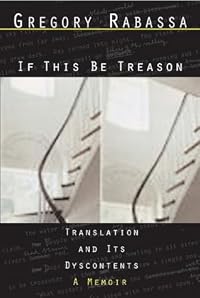
If This Be Treason: Translation and Its Dyscontents, A Memoir
by Gregory Rabassa
On This Page
Description
ALos Angeles Times Favorite Book of the Year for 2005. Gregory Rabassa's influence as a translator is tremendous. His translations of Gabriel Garcia Marquez'sOne Hundred Years of Solitude and Julio Cortazar'sHopscotch have helped make these some of the the most widely read and respected works in world literature. (Garcia Marquez was known to say that the English translation ofOne Hundred Years was better than the Spanish original.) InIf This Be Treason: Translation and Its Dyscontents, show more Rabassa offers a cool- headed and humorous defense of translation, laying out his views on the translator's art. Anecdotal and always illuminating, Rabassa traces his career from a boyhood on a New Hampshire farm, his school days "collecting" languages, the two and a half years he spent overseas during WWII, and his South American travels, until one day "I signed a contract to do my first translation of a long work [Cortazar'sHopscotch] for a commercial publisher." Additionally, Rabassa offers us his "rap sheet," a consideration of the various authors and the over 40 works he has translated. This long-awaited memoir is a joy to read, an instrumental guide to translating, and a look at the life of one of its great practitioners. show lessTags
Recommendations










Member Reviews
Translation is Treason, asserts an Italian cliché. Rabassa has translated from Portuguese and Spanish many of the the works with which those who follow literature in those languages are familiar. Although he states,"Throughout my disquisition I have savaged just about everyone eligible." his criteria for eligibility seems to be (over) analytic academics and political figures and he is quite loving to his authors, his students, and some of his fellows. Not that he is without points, as in pg. 117 "...so much writing that people want to call post-modern (I must consult my dog on this as he's an expert when it comes to posts)" and pg. 160 "..but it would be about as rewarding as the mental masturbation offered by crossword puzzles." I show more occasionally lost track of exactly which book he was discussing as sometimes he covers 3 of an author's works more in a chapter. show less
I enjoyed the introductory section, but the core of this book is Rabassa's descriptions of the various authors he has worked with and the books he has translated. Even without any knowledge of the books or of most of the authors, I found the various translation issues fascinating.
As someone who does translating, though not of literary texts, I found his thoughts both helpful and supportive in my own work. A mere theoretical study would not have been as good. Translation is mostly a matter of finding the next word and of weighing the difficulties when the languages just don't want to match up.
If this be treason, it is in the cause of the victim.
As someone who does translating, though not of literary texts, I found his thoughts both helpful and supportive in my own work. A mere theoretical study would not have been as good. Translation is mostly a matter of finding the next word and of weighing the difficulties when the languages just don't want to match up.
If this be treason, it is in the cause of the victim.
If This Be Treason is Gregory Rabassa's memoir about becoming and be a translator, and of the art of translating. Rabassa doesn't spend much time on his family or upbringing, but does, in hindsight, mention the things he experienced growing up as a child and as a young adult which seem to have contributed to his becoming a translator. He talks about the nicknames they were all given as children, his dabbling in languages in college, the cryptography he did during WWII. All of these stories laced with priceless bits about the art and occupation of translation. The second part of the book discusses each of the authors he has translated (he says 27, but I count 30 listed) and the fascinating challenges their particular work or works show more provided him. His first translation was Hopscotch by Julio Cortazar, which won the National Book Award (they once had a translation prize). I found the discussions of everything from word choice and style to the difficulty of translating slang and racial slurs all intriguing. While there are certainly some familiar authors here (e.g. Julio Cortazar, Gabriel Garcia Marguez and Antonio Lobo Atunes), there are certainly many I am not familiar with, including several women authors.
"A piece of writing cannot be cloned in another language, only imitated." --Gregory Rabassa
flag abuse show less
"A piece of writing cannot be cloned in another language, only imitated." --Gregory Rabassa
flag abuse show less
"Translation is always a treason", said Okakura Kakuzo in The Book of Tea (1906), "and as a Ming author observes, can at its best be only the reverse side of a brocade—all threads are there, but not the subtlety of colour or design."
Gregory Rabassa is one who sought to preserve the patterns of subtlety as best he could. His résumé speaks for itself. Each of his translations is discussed in his memoir If This Be Treason: Translation and Its Dyscontents (2005). His best known works are the much-loved translations of Julio Cortázar’s Hopscotch and Gabriel García Márquez’s One Hundred Years of Solitude.
Rabassa introduced his discussion of his translations in his memoir, under the section “The Bill of Particulars”:
Excluding show more shorter pieces I have done … the writers I have translated thus far number twenty-seven, with some awaiting publication …. The works are largely fiction, with one small poetry chapbook, a literary study, and a social history. This varying array of personalities, styles, languages (Portuguese and Spanish), and nationalities, all funneled into the work of one translator reveals how this last must in some way undergo a kind of controlled schizophrenia as he marshals his skills at immutability. My own experience in this matter has not been all that complex or worrisome. As I have said before, I follow the text, I let it lead me along, and a different and it is to be hoped proper style will emerge for each author. This bears out my thesis that a good translation is essentially a good reading; if we know how to read as we should we will be able to put down what we are reading in another language into our own. I might have said into our own words, but these, even in English, belong to the author who indirectly thought them up.
Rabassa’s memoir then went on to describe each of the books. His “rap sheet” mentions not only the nature of the books and his estimation of them, but also his relationship with the authors in question. It can be said that Rabassa not only produced a version of these works in English. In many creative ways, he also “co-authored” them. show less
Gregory Rabassa is one who sought to preserve the patterns of subtlety as best he could. His résumé speaks for itself. Each of his translations is discussed in his memoir If This Be Treason: Translation and Its Dyscontents (2005). His best known works are the much-loved translations of Julio Cortázar’s Hopscotch and Gabriel García Márquez’s One Hundred Years of Solitude.
Rabassa introduced his discussion of his translations in his memoir, under the section “The Bill of Particulars”:
Excluding show more shorter pieces I have done … the writers I have translated thus far number twenty-seven, with some awaiting publication …. The works are largely fiction, with one small poetry chapbook, a literary study, and a social history. This varying array of personalities, styles, languages (Portuguese and Spanish), and nationalities, all funneled into the work of one translator reveals how this last must in some way undergo a kind of controlled schizophrenia as he marshals his skills at immutability. My own experience in this matter has not been all that complex or worrisome. As I have said before, I follow the text, I let it lead me along, and a different and it is to be hoped proper style will emerge for each author. This bears out my thesis that a good translation is essentially a good reading; if we know how to read as we should we will be able to put down what we are reading in another language into our own. I might have said into our own words, but these, even in English, belong to the author who indirectly thought them up.
Rabassa’s memoir then went on to describe each of the books. His “rap sheet” mentions not only the nature of the books and his estimation of them, but also his relationship with the authors in question. It can be said that Rabassa not only produced a version of these works in English. In many creative ways, he also “co-authored” them. show less
Rather deceived by this book. Although I knew that it dealt with translations from Spanish and Portuguese into English, I didn’t expect only the first quarter of it to be a reflection on the author’s own experience in translation—which I was looking for—, while Rabassa details afterwards each translation of his, author by author. I found this second part rather lengthy because I knew none of them and none of their works. I guess someone more acquainted with Latin-American literature will find this main part of the book much more interesting. But Rabassa’s style is difficult to follow, and his vocabulary somewhat chosen.
From the many examples and anecdotes given by Rabassa, one gets the impression that the most difficult task show more in translating a book is to find the right title. I agree with him, also when he says that ‘translations have the strange progressive literary virtue of never being finished’, because this is precisely what I feel in my present first experience of translating a whole book.
It is very instructive to spend some time in a bookshop or a library, comparing different translations of the same book. I did it with the first page of Pride and Prejudice before finally buying the original English version—should I say that I hate reading translations…—, but I now understand better Rabassa when he says that ‘a translator is essentially a reader and we all read differently, except that a translator’s reading remains in unchanging print’.
One point of humour can be found in the last pages when Rabassa explains the difficulty to translate honorific titles such as ‘Doña Inés’ which he left as it was in English. (I would have done the same; I don’t see the point in mentioning it.) What follows is funnier: ‘This form of address has no equivalent in other languages, and attempts to translate the don in ‘Don Quixote’ have failed miserably. There is always a problem with students who think that his name must really be Donald and go along calling him Don.’ show less
From the many examples and anecdotes given by Rabassa, one gets the impression that the most difficult task show more in translating a book is to find the right title. I agree with him, also when he says that ‘translations have the strange progressive literary virtue of never being finished’, because this is precisely what I feel in my present first experience of translating a whole book.
It is very instructive to spend some time in a bookshop or a library, comparing different translations of the same book. I did it with the first page of Pride and Prejudice before finally buying the original English version—should I say that I hate reading translations…—, but I now understand better Rabassa when he says that ‘a translator is essentially a reader and we all read differently, except that a translator’s reading remains in unchanging print’.
One point of humour can be found in the last pages when Rabassa explains the difficulty to translate honorific titles such as ‘Doña Inés’ which he left as it was in English. (I would have done the same; I don’t see the point in mentioning it.) What follows is funnier: ‘This form of address has no equivalent in other languages, and attempts to translate the don in ‘Don Quixote’ have failed miserably. There is always a problem with students who think that his name must really be Donald and go along calling him Don.’ show less
This memoir was penned by 90-year-old Rabassa after a formidable career translating some of the great classics of Latin American writing, including the likes of Gabriel Garcia Marquez, Luisa Valenzuela, Julio Cortazar, Clarice Lispector, and more. Having lectured in translation, I imagine the book is aimed at students of translation, as it includes many constructive pointers about the translation process and its challenges. Rabassa is forthright, irreverent, and perhaps wry, but thoroughly enjoyable. I expected more of a memoir – because of the title – but it included only incidental bits about his life. Most of the book is dedicated to actual books and authors he has worked with, which made me realise how few Latin American show more authors/books I’ve read from these parts. He brings to light some very interesting points about translation and, on the whole, I found it a worthwhile read. show less
Liiberated me as a transistor and an editor.
Members
- Recently Added By
Author Information

3+ Works 135 Members
Gregory Rabassa was born in Yonkers, New York on March 9, 1922. He received a bachelor's degree in romance languages from Dartmouth College. During World War II, he served as a cryptographer. After the war, he received a doctorate from Columbia University and translated Spanish and Portuguese language works for the magazine Odyssey. He taught for show more over two decades at Columbia University before accepting a position at Queens College. He was a literary translator from Spanish and Portuguese to English. He would translate a book as he read it for the first time. He translated Gabriel Garcia Marquez's One Hundred Years of Solitude and The Autumn of the Patriarch, Mario Vargas Llosa's Conversation in the Cathedral, and Jorge Amado's Captains of the Sand. Rabassa received a National Book Award for Translation in 1967 for his version of Julio Cortázar's Hopscotch. In 2001, Rabassa received a lifetime achievement award from the PEN American Center for contributions to Hispanic literature. In 2006, he received a National Medal of Arts for translations which "continue to enhance our cultural understanding and enrich our lives." He wrote a memoir detailing his experiences as a translator entitled If This Be Treason: Translation and Its Dyscontents. He died after a brief illness on June 13, 2016 at the age of 94. (Bowker Author Biography) show less
Awards and Honors
Classifications
- Genres
- Nonfiction, Biography & Memoir, General Nonfiction, Literature Studies and Criticism
- DDC/MDS
- 418.02 — Language Linguistics Applied linguistics modified standard subdivisions and translating Translating
- LCC
- P306 .R33 — Language and Literature Philology. Linguistics Language. Linguistic theory. Comparative grammar Translating and interpreting
- BISAC
Statistics
- Members
- 130
- Popularity
- 250,511
- Reviews
- 7
- Rating
- (3.29)
- Languages
- English
- Media
- Paper
- ISBNs
- 2