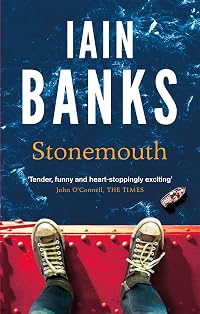
Stonemouth
by Iain Banks
On This Page
Description
Stewart Gilmour is back in Stonemouth. After five years in exile his presence is required at the funeral of patriarch Joe Murston, and even though the last time Stu saw the Murstons he was running for his life, staying away might be even more dangerous than turning up. An estuary town north of Aberdeen, Stonemouth, with its five mile beach, can be beautiful on a sunny day. On a bleak one it can seem to offer little more than seafog, gangsters, cheap drugs and a suspension bridge irresistible show more to suicides. And although there's supposed to be a temporary truce between Stewart and the town's biggest crime family, it's soon clear that only Stewart is taking this promise of peace seriously. Before long a quick drop into the cold grey Stoun begins to look like the soft option, and as he steps back into the minefield of his past to confront his guilt and all that it has lost him, Stu uncovers ever darker stories, and his homecoming takes a more lethal turn than even he had anticipated. Tough, funny, fast-paced and touching, Stonemouth cracks open adolescence, love, brotherhood and vengeance in a rite of passage novel like no other.. show less
Tags
Recommendations























Member Reviews
Stonemouth by Iain Banks (2012 Little, Brown, 356pp)
I enjoyed Stonemouth for many reasons. To begin with, while the location in the book was made up it came across as very real, as did the characters.
In addition, as someone who moved away from my hometown I could relate to Stewart (Stu) Gilmore’s feelings about returning home. (Not that I was run out of my hometown by gangsters.) Iain Banks caught the sense of returning home and finding oneself in familiar surroundings where things appear to have never changed, time never to have moved on, and yet you feel different.
I liked the way facts about Stu’s life in Stonemouth were revealed and Iain’s treatment of Stu’s interaction with old friends and companions wrung true. His show more treatment of Stu’s conflicting thoughts and internal reasoning about how his former girlfriend would react to him felt realistic.
The first half of the novel moved relatively slowly and I did wonder if I would have read it had it not been an Iain Banks novel. However, about halfway through it picked up the pace and I found myself not wanting to put it down. In fact, I had to force myself to put the book down at 1am on a midweek night so that I could get some sleep. (I only had twenty pages left at the time and so I finished it in Starbucks the following morning before going into work.)
Iain Banks always likes to take a shot at the establishment. The scene at the golf course presents him with this opportunity and his description of the gathering reminded me of all the recent coverage in the UK press about the “Chipping Norton Set” and the environment of collusion between politicians, agents of law and order, and those with a predilection for pursuits beyond those considered strictly legal, but all for the “better good”, of course. This scene could also be taken as a “hats off” salute to the film, “Hot Fuzz”, in which Bill Bailey’s two characters (Sergeants Turner) are seen to be reading Iain Banks and Iain M. Banks novels, and in which a similar approach to peace keeping can be observed.
It is the first book I’ve read in a long time in which the ending was not a foregone conclusion. Right up until the end it could have gone any number of ways and Iain Banks did a great job of laying any number of false trails that the reader could follow. As I approached the end of the book I had at least four possible endings in mind and I was kept guessing to the last few pages.
Many reviewers have considered this book to be a disappointment for a Banks novel. I do not agree with them. While “Stonemouth” is not “The Bridge”, “Walking on Glass”, “The Crow Road”, “Espedair Street”, “Complicity”, or “The Was Factory”, it is still a good read with a lot to offer and a novel that would have been acclaimed had it been written by someone else.
Thank you, Iain, for another enjoyable story. show less
I enjoyed Stonemouth for many reasons. To begin with, while the location in the book was made up it came across as very real, as did the characters.
In addition, as someone who moved away from my hometown I could relate to Stewart (Stu) Gilmore’s feelings about returning home. (Not that I was run out of my hometown by gangsters.) Iain Banks caught the sense of returning home and finding oneself in familiar surroundings where things appear to have never changed, time never to have moved on, and yet you feel different.
I liked the way facts about Stu’s life in Stonemouth were revealed and Iain’s treatment of Stu’s interaction with old friends and companions wrung true. His show more treatment of Stu’s conflicting thoughts and internal reasoning about how his former girlfriend would react to him felt realistic.
The first half of the novel moved relatively slowly and I did wonder if I would have read it had it not been an Iain Banks novel. However, about halfway through it picked up the pace and I found myself not wanting to put it down. In fact, I had to force myself to put the book down at 1am on a midweek night so that I could get some sleep. (I only had twenty pages left at the time and so I finished it in Starbucks the following morning before going into work.)
Iain Banks always likes to take a shot at the establishment. The scene at the golf course presents him with this opportunity and his description of the gathering reminded me of all the recent coverage in the UK press about the “Chipping Norton Set” and the environment of collusion between politicians, agents of law and order, and those with a predilection for pursuits beyond those considered strictly legal, but all for the “better good”, of course. This scene could also be taken as a “hats off” salute to the film, “Hot Fuzz”, in which Bill Bailey’s two characters (Sergeants Turner) are seen to be reading Iain Banks and Iain M. Banks novels, and in which a similar approach to peace keeping can be observed.
It is the first book I’ve read in a long time in which the ending was not a foregone conclusion. Right up until the end it could have gone any number of ways and Iain Banks did a great job of laying any number of false trails that the reader could follow. As I approached the end of the book I had at least four possible endings in mind and I was kept guessing to the last few pages.
Many reviewers have considered this book to be a disappointment for a Banks novel. I do not agree with them. While “Stonemouth” is not “The Bridge”, “Walking on Glass”, “The Crow Road”, “Espedair Street”, “Complicity”, or “The Was Factory”, it is still a good read with a lot to offer and a novel that would have been acclaimed had it been written by someone else.
Thank you, Iain, for another enjoyable story. show less
I suppose this marks a return to form of sorts for Iain Banks. With the thesis-undermining caveats that I haven't read Steep Approach To Garbadale and I bloody loved Transition, Banks' non-M books have been pretty lacking since Whit. Generally readable and fun - if you ignore Song Of Stone - but lacking in depth, perhaps, with his customary skill, narrative flair, formidable imagination and exquisite writing all more or less present and correct, but not quite gelling to produce more than the sum of their parts.
Stonemouth hearkens back to The Crow Road, Whit, and presumably Garbadale. It features family and friends in a small rain-battered Scottish location, ancient and not-so-ancient incidents rediscovered through the present, old show more secrets and tragedies and past mistakes, all subtly and profoundly shaping the here and now.
Stewart Gilmour returns to the town of Stonemouth which he left five years before under dramatic and unpleasant circumstances. Granted leave to attend the funeral of the patriarch of one of two crime families who run Stonemouth, Stewart visits old haunts, meets old friends, remembers episodes from his old life and pines guiltily for his lost love.
Despite the dramatic denouement, this isn't a thriller, nor is it full of terrible twists and appalling revelations - there's a bit of business involving cameras and such, but it's slight compared to, say, the central mystery of Crow Road. No, most of the things that we learn about in the past are flagged well ahead, and though that generates its own type of tension - the fate of Wee Malky and the incident in the hotel toilet are typically brilliant Banksian episodes of horror and hilarity - this is very much the story of a man who has everything going back to the town that threw him out in the forlorn hope of coming to terms with the frankly shitty thing he did.
And it's grand. A rattling story with real heft and weight. Perhaps it needed a Crow Road mystery or a Complicity-style revelation to boost it into the upper league, but it's a perfectly satisfying read with some lovely writing, and that brilliant thing Banks does over and over again in any genre, which is to create an utterly believable group of friends and show us their lives together and apart as they grow up, go their separate ways, and revisit the things that shaped their lives. show less
Stonemouth hearkens back to The Crow Road, Whit, and presumably Garbadale. It features family and friends in a small rain-battered Scottish location, ancient and not-so-ancient incidents rediscovered through the present, old show more secrets and tragedies and past mistakes, all subtly and profoundly shaping the here and now.
Stewart Gilmour returns to the town of Stonemouth which he left five years before under dramatic and unpleasant circumstances. Granted leave to attend the funeral of the patriarch of one of two crime families who run Stonemouth, Stewart visits old haunts, meets old friends, remembers episodes from his old life and pines guiltily for his lost love.
Despite the dramatic denouement, this isn't a thriller, nor is it full of terrible twists and appalling revelations - there's a bit of business involving cameras and such, but it's slight compared to, say, the central mystery of Crow Road. No, most of the things that we learn about in the past are flagged well ahead, and though that generates its own type of tension - the fate of Wee Malky and the incident in the hotel toilet are typically brilliant Banksian episodes of horror and hilarity - this is very much the story of a man who has everything going back to the town that threw him out in the forlorn hope of coming to terms with the frankly shitty thing he did.
And it's grand. A rattling story with real heft and weight. Perhaps it needed a Crow Road mystery or a Complicity-style revelation to boost it into the upper league, but it's a perfectly satisfying read with some lovely writing, and that brilliant thing Banks does over and over again in any genre, which is to create an utterly believable group of friends and show us their lives together and apart as they grow up, go their separate ways, and revisit the things that shaped their lives. show less
Stonemouth by Iain Banks is set in a small town in Scotland as Stewart Gilmour returns to attend a funeral. He has had to ask for special dispensation from the local crime boss to come home as 5 years ago he did something that changed the course of his life and caused the crime family to lose face. Although the father allows him to come, his sons are not quite so happy to see him.
This was a simple, darkly brooding story as Stewart comes back to face his past. The author delivers his story in a slightly acerbic style with an overabundance of profanity that at times was a little jarring but every so often there would be sections that were haunting and foreboding yet so beautifully written that I was totally drawn into this story. Each show more character was well drawn and complete. They each had their own motives for acting as they did although the author often took his time about revealing this. Through most of the book we learn about Ellie, Stewart’s lost love, through the words of other people but I found when she finally appeared she was well able to dominate the page.
A coming-of-age story, a crime thriller and a slightly strange romance story, Stonemouth was an interesting, atmospheric read delivered by an author who appears to be equally talented at portraying nostalgia and violence. I had previously read his novel The Wasp Factory so I was a little surprised that there wasn’t some shocking twist in Stonemouth, but the author played it straight and simply kept to his story of past and present relationships. show less
This was a simple, darkly brooding story as Stewart comes back to face his past. The author delivers his story in a slightly acerbic style with an overabundance of profanity that at times was a little jarring but every so often there would be sections that were haunting and foreboding yet so beautifully written that I was totally drawn into this story. Each show more character was well drawn and complete. They each had their own motives for acting as they did although the author often took his time about revealing this. Through most of the book we learn about Ellie, Stewart’s lost love, through the words of other people but I found when she finally appeared she was well able to dominate the page.
A coming-of-age story, a crime thriller and a slightly strange romance story, Stonemouth was an interesting, atmospheric read delivered by an author who appears to be equally talented at portraying nostalgia and violence. I had previously read his novel The Wasp Factory so I was a little surprised that there wasn’t some shocking twist in Stonemouth, but the author played it straight and simply kept to his story of past and present relationships. show less
Once more, we are in Iain Banks' Scotland, with a family reunion leading to an exploration of dark secrets. But unlike The Crow Road or The Steep Approach to Garbadale, this time the gloves are off and the knives are out - which as far as the protagonist Stewart Gilmour is concerned, is very much the problem. Five years before, he was run out of town after an indiscretion outraged the family of his soon-to-be-wife. Unfortunately for Stewart, that family is one of the two who run things in his home town, on the north-east coast of Scotland. And when matters don't meet with their approval, things can get broken. Only fingers, if you're lucky.
Now Stewart has come back for the funeral of the family patriarch. Old wounds may get reopened. show more New wounds may be inflicted. The problem for Stewart is how to emerge from the weekend of the funeral alive.
Unlike many other Iain Banks novels, this one is comparatively light on humour. The setting is described vividly; small-town Scotland has rarely been so well depicted. Banks grew up on the Scottish east coast but it rarely features in his novels. As we have come to expect, much of the story is told in flashback, following Stewart from his schooldays in the mid-1980s growing up alongside the powerful families of the town to the action of the novel at age 25.
The character painting is quite rich; Stewart's contemporaries in the town of Stonemouth are a realistic bunch, down to the cameo appearances; we mostly see Stewart, his best mate Fergus, and the Murston family who the story centres around; Joe the patriarch, his son Don and his four sons (the muscle behind the family firm) and his two daughters, Grier and Ellie, the wronged party in the family scandal. For a character of such importance, we see little of Ellie until the last third of the novel (and with good reason; Stewart has been given clear warnings about what might happen to him were he to think about trying to get too close to Ellie over the weekend). But once Ellie takes her own decisions about that, she becomes a major character despite what her family think she ought to do. That Ellie takes control of the situation only makes matters worse.
Stewart has spent his five years' exile from home building a career; Banks shows us very clearly how it feels to go back to a previous life after making a new life somewhere else. Stonemouth is probably one of the most realistic of Ian Banks' novels. show less
Now Stewart has come back for the funeral of the family patriarch. Old wounds may get reopened. show more New wounds may be inflicted. The problem for Stewart is how to emerge from the weekend of the funeral alive.
Unlike many other Iain Banks novels, this one is comparatively light on humour. The setting is described vividly; small-town Scotland has rarely been so well depicted. Banks grew up on the Scottish east coast but it rarely features in his novels. As we have come to expect, much of the story is told in flashback, following Stewart from his schooldays in the mid-1980s growing up alongside the powerful families of the town to the action of the novel at age 25.
The character painting is quite rich; Stewart's contemporaries in the town of Stonemouth are a realistic bunch, down to the cameo appearances; we mostly see Stewart, his best mate Fergus, and the Murston family who the story centres around; Joe the patriarch, his son Don and his four sons (the muscle behind the family firm) and his two daughters, Grier and Ellie, the wronged party in the family scandal. For a character of such importance, we see little of Ellie until the last third of the novel (and with good reason; Stewart has been given clear warnings about what might happen to him were he to think about trying to get too close to Ellie over the weekend). But once Ellie takes her own decisions about that, she becomes a major character despite what her family think she ought to do. That Ellie takes control of the situation only makes matters worse.
Stewart has spent his five years' exile from home building a career; Banks shows us very clearly how it feels to go back to a previous life after making a new life somewhere else. Stonemouth is probably one of the most realistic of Ian Banks' novels. show less
This is one of the best Iain Banks novels I've read. It's on a par with The Crow Road for plot and character realisation. Banks is very good at creating flawed but likeable characters. As with many of Banks' leading men, Stewart is a bit of an idiot, but not an annoying idiot. He's just human. The rest of the cast of characters could easily have been ciphers but Banks imbues them with enough humanity to make them matter as people as well as tools to move the plot along. The story itself is funny and sad and tragic and scary, set in a remote Scottish town run by rival criminal families who maintain a veneer of civility while using murder and violence as a means to control the population when their power is threatened. Stewart has had to show more leave town for a stupid mistake that offended one of the families and is now returning 5 years later for a funeral. He has to negotiate the politics of the town as though he's in a mediaeval court. As the book progresses, we find out what it is that Stewart did, and who else was involved. It's an ancient story that could have been a Greek tragedy or a play by Shakespeare but instead spans the first two decades of this century. show less
Stewart Gilmour. twenty-five, is returning to his hometown five years after being literally chased out by the Murstons, one of the local crime families. He is, in fact, returning to attend the funeral of Joe Murston, the old head of the family which is the only reason he is being allowed to return and, then, only for the weekend.
Stewart uses this time to reunite with old friends and avoid, although mostly unsuccessfully, old enemies. He also spends much of his time reminiscing about the past and indulging in 'what-ifs' especially about Ellie Murston, the girl he loved and lost and the reason for his exile.
Stonemouth gives a very violent and fascinating depiction of small-town Scotland, one immersed in drugs and drink and run by crime show more lords. Despite references to video games and iphones, the town seems largely untouched by the outside world. In the five years that Stewart has been away, very little has changed - the poker games continue in the same place, the watering holes are all populated by the same people, and the conversations seem to take up exactly where they left off when Stewart was so unceremoniously sent packing.
The only real change seems to be in Stewart himself. He has matured and is now able to recognize and accept his own role in past and present actions. In possibly the best depiction of maturity ever given in literature, Stewart says, "we all sort of secretly think our lives are like these very long movies with ourselves as the principal characters obviously. Only very occasionally does it occur to any one of us that all these supporting actors, cameo turns, bit players and extras around us might actually be in some sense real, just as real as we are and that each one of them thinks that the Big Movie is really all about them".
At its most basic, Stonemouth is a book about sin, guilt, and redemption, about maturing enough to overcome 'that core of childish greed within us'. The ending of Stonemouth could easily have descended into melodrama or, worse, falsity. However, it is Bank's ability to depict change within stasis which allows it to rise above and makes Stonemouth ultimately a very satisfying read. show less
Stewart uses this time to reunite with old friends and avoid, although mostly unsuccessfully, old enemies. He also spends much of his time reminiscing about the past and indulging in 'what-ifs' especially about Ellie Murston, the girl he loved and lost and the reason for his exile.
Stonemouth gives a very violent and fascinating depiction of small-town Scotland, one immersed in drugs and drink and run by crime show more lords. Despite references to video games and iphones, the town seems largely untouched by the outside world. In the five years that Stewart has been away, very little has changed - the poker games continue in the same place, the watering holes are all populated by the same people, and the conversations seem to take up exactly where they left off when Stewart was so unceremoniously sent packing.
The only real change seems to be in Stewart himself. He has matured and is now able to recognize and accept his own role in past and present actions. In possibly the best depiction of maturity ever given in literature, Stewart says, "we all sort of secretly think our lives are like these very long movies with ourselves as the principal characters obviously. Only very occasionally does it occur to any one of us that all these supporting actors, cameo turns, bit players and extras around us might actually be in some sense real, just as real as we are and that each one of them thinks that the Big Movie is really all about them".
At its most basic, Stonemouth is a book about sin, guilt, and redemption, about maturing enough to overcome 'that core of childish greed within us'. The ending of Stonemouth could easily have descended into melodrama or, worse, falsity. However, it is Bank's ability to depict change within stasis which allows it to rise above and makes Stonemouth ultimately a very satisfying read. show less
This is my first book by Banks and it was immediately obvious that he is a master storyteller. Returning to a hometown after an absence can be difficult under the best of circumstances but Stewart Gilmour's exit was under duress so now, five years later, he must face his demons. It certainly wasn't what I expected but the well-drawn characters and a superb portrayal of time and place ensured my appreciation.
Members
- Recently Added By
Lists

Top Five Books of 2013
1,562 works; 721 members

Books Read in 2015
3,299 works; 129 members

Favorite Books Published in 2012
57 works; 17 members
Author Information

25+ Works 31,796 Members
Some Editions
Work Relationships
Has the adaptation
Common Knowledge
- Original publication date
- 2012
- People/Characters
- Stewart Gilmour; Ellie Murston
- Important places
- Scotland, UK
- Related movies
- Stonemouth (2015 | IMDb)
- Dedication
- For My Family
- First words
- Clarity.
- Last words
- (Click to show. Warning: May contain spoilers.)Past those is the town itself, with its grey-brown clutter of buildings, spires and towers, edged by the bright flat plain of water with its tarnish marks of cloud shadows and ruffled fields of wind shear, and beyond that the road bridge, rising grey and tall and shimmering in the east, astride a silver glimpse of sea.
Classifications
Statistics
- Members
- 800
- Popularity
- 34,876
- Reviews
- 36
- Rating
- (3.85)
- Languages
- English, French
- Media
- Paper, Audiobook, Ebook
- ISBNs
- 25
- ASINs
- 13