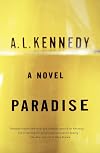
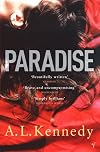
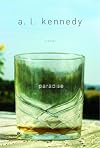
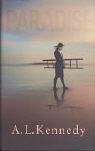
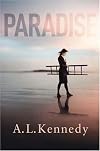
Paradise
by A. L. Kennedy
On This Page
Description
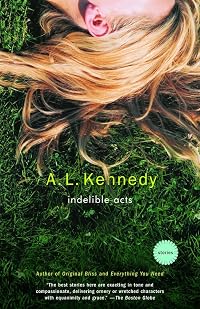
The breakthrough novel by Best-of-Young-British novelist Hannah Luckraft knows the taste of paradise. It's hidden in the peace of open country, it's sweet on her lover's skin, it flavours every drink she's ever taken, but it never seems to stay. Almost forty and with nothing to show for it, even Hannah is starting to notice that her lifestyle is not entirely sustainable: her subconscious is turning against her and it may be that her soul is a little unwell. Her family is wounded, her friends show more are frankly odd, her body is not as reliable as it once was. Robert, a dissolute dentist, appears to offer a love she can understand, but he may only be one more symptom of the problem she must cure. From the north-east of Scotland to Dublin, from London to Montreal, to Budapest and onwards, Hannah travels beyond her limits, beyond herself, in search of the ultimate altered state: the one where she can be happy - her paradise. Incapable of writing a dull sentence, or failing to balance the grim with the hilarious, the tender with the shocking, A.L. Kennedy has written an emotional and visceral tour-de-force. A compelling examination of failure that is also a comic triumph, a novel of dark extremes that is full of the most ravishing lyrical beauty, Paradise is the finest book yet by one of Britain's most extraordinarily gifted writers. Author Biography: A.L. Kennedy has published three previous novels, two books of non-fiction, and three collections of stories, most recently Indelible Acts in 2002. She lives in Glasgow. show lessTags
Recommendations











Member Reviews
"Paradise" by A. L. Kennedy had a profound effect on me in many ways. This is a somewhat difficult review to write because of my personal familiarity with alcoholism.
First of all I want to say that the writing is beautiful, poetic, original, sad, haunting, disturbing, and at times extremely funny. Kennedy will knock you down with such beautiful and devastating sentences as “If we were years ago and other people. If God allowed just anything.”
The depiction of alcoholism is real, honest, and brutal:
“I am delicate and the world is impossibly wrong, is unthinkable and I am not forewarned, forearmed, equipped. I cannot manage. If there was something useful I could do, I would – but there isn’t. So I drink.
So I drank.
And on all show more those other evenings, drink has trotted in and softened worries, charmed away internal repetitions of unpleasant facts and lifted my attitude those few vital degrees which prevent everybody from dragging their past behind them like a corpse, while bolting forward through a suicidal haze.”
I have felt this exactly but could not express it as accurately as Kennedy does here. She is unclean, uncomfortable, doesn’t understand, suicidal. And she compares this to how she was when she was a little girl, clean, happy, untainted, with her brother and parents, when there was love, health, beauty, and a future.
I normally do not give a book five stars. There have only been a few. But this one well deserves it. The writing is just phenomenal. I don’t know why this book is not as well known as Henry Miller’s "Tropic of Cancer". It is that good. It also reminds me a little of "The White Hotel" by D. M. Thomas, especially the surreal nightmarish train ride at the end with all of the sexual undertones – a train ride itself is a sexual innuendo, hills being the mounds of flesh, trees being pubic hairs, the train slicing through...
I almost didn’t mention this next part but I feel I should because it is important to me. The book also had a physical effect on me, I guess because I so strongly identified with it. I don’t drink coffee. I hate the taste. Always have. But in one scene, on the train, she is in a bar and the bartender gives her coffee and it is the best coffee she has ever had and with each new mug it tastes even better. That night I dreamed I made myself coffee and I remember tasting it and enjoying how good it tasted. I actually remember, can feel, the taste. This next part is extremely strange. In one point of the book she is walking with her father. She accidentally steps on a board with a nail and the nail punctures her foot. The next morning I woke up with a huge bruise on the bottom of my right foot. Fortunately it wasn’t cut but there was, and still is, a huge bruise. I have no memory of stepping on anything. I don’t know what this means. I should probably talk to a therapist about it… But as you can see, the book did have multiple effects on me.
It is a dangerous book to someone like myself; like looking in a mirror and seeing the real horror of life reflected back at me. Beautiful, astonishing, mad horror. show less
First of all I want to say that the writing is beautiful, poetic, original, sad, haunting, disturbing, and at times extremely funny. Kennedy will knock you down with such beautiful and devastating sentences as “If we were years ago and other people. If God allowed just anything.”
The depiction of alcoholism is real, honest, and brutal:
“I am delicate and the world is impossibly wrong, is unthinkable and I am not forewarned, forearmed, equipped. I cannot manage. If there was something useful I could do, I would – but there isn’t. So I drink.
So I drank.
And on all show more those other evenings, drink has trotted in and softened worries, charmed away internal repetitions of unpleasant facts and lifted my attitude those few vital degrees which prevent everybody from dragging their past behind them like a corpse, while bolting forward through a suicidal haze.”
I have felt this exactly but could not express it as accurately as Kennedy does here. She is unclean, uncomfortable, doesn’t understand, suicidal. And she compares this to how she was when she was a little girl, clean, happy, untainted, with her brother and parents, when there was love, health, beauty, and a future.
I normally do not give a book five stars. There have only been a few. But this one well deserves it. The writing is just phenomenal. I don’t know why this book is not as well known as Henry Miller’s "Tropic of Cancer". It is that good. It also reminds me a little of "The White Hotel" by D. M. Thomas, especially the surreal nightmarish train ride at the end with all of the sexual undertones – a train ride itself is a sexual innuendo, hills being the mounds of flesh, trees being pubic hairs, the train slicing through...
I almost didn’t mention this next part but I feel I should because it is important to me. The book also had a physical effect on me, I guess because I so strongly identified with it. I don’t drink coffee. I hate the taste. Always have. But in one scene, on the train, she is in a bar and the bartender gives her coffee and it is the best coffee she has ever had and with each new mug it tastes even better. That night I dreamed I made myself coffee and I remember tasting it and enjoying how good it tasted. I actually remember, can feel, the taste. This next part is extremely strange. In one point of the book she is walking with her father. She accidentally steps on a board with a nail and the nail punctures her foot. The next morning I woke up with a huge bruise on the bottom of my right foot. Fortunately it wasn’t cut but there was, and still is, a huge bruise. I have no memory of stepping on anything. I don’t know what this means. I should probably talk to a therapist about it… But as you can see, the book did have multiple effects on me.
It is a dangerous book to someone like myself; like looking in a mirror and seeing the real horror of life reflected back at me. Beautiful, astonishing, mad horror. show less
This book was horrible in a totally amazing way. Engrossing, felt entirely realistic. Yet describing a nightmarish existence of addiction that was painful to read, but impossible to look away from. I don't know how accurate this is to life, and after reading this book, I am very grateful to not know that.
Hannah is an intelligent, articulate woman in her late thirties who knows perfectly well that alcohol is destroying her career and her health, messing up her relations with her family, and generally sabotaging her life. But the “real life” she gets to experience during the periods when she’s sober just doesn’t seem to have enough to offer to persuade her that it’s worth sacrificing whatever it is alcohol does for her.
A painful, but often grimly funny, book that doesn’t take any prisoners. As someone else said here “horrible in a totally amazing way” (to put it another way: very Scottish). I didn’t much enjoy reading it, and I doubt whether it really adds anything tangible to an outsider’s view of alcohol addiction, show more but it certainly has some fine writing in it. show less
A painful, but often grimly funny, book that doesn’t take any prisoners. As someone else said here “horrible in a totally amazing way” (to put it another way: very Scottish). I didn’t much enjoy reading it, and I doubt whether it really adds anything tangible to an outsider’s view of alcohol addiction, show more but it certainly has some fine writing in it. show less
Some books should come with warning labels such as "Read At Your Own Risk", or "The Publisher Does Not Claim Responsibility for Your Reaction to this Book". Of course I'm being facetious, but you get the idea: not every book is meant for every person. Such is the case with Paradise by A. L. Kennedy.
In Paradise, Kennedy exposes the inner workings of an alcoholic through the story of Hannah Luckraft. Told in the first person, we first meet Hannah as she is emerging from an alcohol-induced blackout in a seedy hotel in an unknown city in possession of cash and a credit card that is not hers. We watch her slowly piece together her perception of the progression of events as seen through the bottom of an empty bottle. We learn about her show more family; in particular, her brother Simon with whom she shared a close relationship until her behavior came between them. We also see her relationship evolve with love-interest Robert, also an alcoholic. Even though they continually hurt each other, they have a mutual understanding of what drives them: searching for paradise while obliterating their day-to-day lives.
" 'Would you like a pie?' Robert returned and standing softly at my shoulder, the breath that carried this question still loitering in the cold and adding to the generally misty silver of the floodlit air. 'Or something'..." (pg. 41)
With brilliant prose that is at times breathtaking, Kennedy takes us, willingly or unwillingly, into the inner psyche of an alcoholic's mind. We witness first hand the reasoning used to justify the behavior and discover that no matter how much we want to, we cannot save them from themselves:
"Of course, my clothes and shoes have been hidden somewhere else, to stop me leaving. Which is very, very predictable. They always do this: your mother, your father, your brother, your worried partner: whoever it is doesn't matter, in the end they'll all develop the same symptoms. They will talk about you in the third person while you are there, as if you were an idiot, or a dog. They will examine your booze, as if you have no discipline. They will put you somewhere clean and unfamiliar, as if you have been living in a cave. They will take away your clothes and your belongings, as if you were a criminal, and they will lock you in. As if you were a werewolf, a monster, they will lock you in.
Oh, but it's not so awful. After the first time it happens, you realize - they can't keep it up forever, they have other concerns, they lose patience. Not one of them can wish you to be different as long and as hard as you can wish to stay the same." (pg. 120)
In spite of the story's difficult subject matter, I found that in Kennedy's hands it was superbly executed. I had the feeling of watching a train wreck that you know is about to happen, but there is nothing you can do to stop it. Her prose is excellent, and her portrayal of the mind of an addict is very convincing. show less
In Paradise, Kennedy exposes the inner workings of an alcoholic through the story of Hannah Luckraft. Told in the first person, we first meet Hannah as she is emerging from an alcohol-induced blackout in a seedy hotel in an unknown city in possession of cash and a credit card that is not hers. We watch her slowly piece together her perception of the progression of events as seen through the bottom of an empty bottle. We learn about her show more family; in particular, her brother Simon with whom she shared a close relationship until her behavior came between them. We also see her relationship evolve with love-interest Robert, also an alcoholic. Even though they continually hurt each other, they have a mutual understanding of what drives them: searching for paradise while obliterating their day-to-day lives.
" 'Would you like a pie?' Robert returned and standing softly at my shoulder, the breath that carried this question still loitering in the cold and adding to the generally misty silver of the floodlit air. 'Or something'..." (pg. 41)
With brilliant prose that is at times breathtaking, Kennedy takes us, willingly or unwillingly, into the inner psyche of an alcoholic's mind. We witness first hand the reasoning used to justify the behavior and discover that no matter how much we want to, we cannot save them from themselves:
"Of course, my clothes and shoes have been hidden somewhere else, to stop me leaving. Which is very, very predictable. They always do this: your mother, your father, your brother, your worried partner: whoever it is doesn't matter, in the end they'll all develop the same symptoms. They will talk about you in the third person while you are there, as if you were an idiot, or a dog. They will examine your booze, as if you have no discipline. They will put you somewhere clean and unfamiliar, as if you have been living in a cave. They will take away your clothes and your belongings, as if you were a criminal, and they will lock you in. As if you were a werewolf, a monster, they will lock you in.
Oh, but it's not so awful. After the first time it happens, you realize - they can't keep it up forever, they have other concerns, they lose patience. Not one of them can wish you to be different as long and as hard as you can wish to stay the same." (pg. 120)
In spite of the story's difficult subject matter, I found that in Kennedy's hands it was superbly executed. I had the feeling of watching a train wreck that you know is about to happen, but there is nothing you can do to stop it. Her prose is excellent, and her portrayal of the mind of an addict is very convincing. show less
On the confessional trauma scale, definitely a four-star book. Oh my God is this unpleasant. Smeary, spongy, oily, gritty: an inventory of the book's contents is like an inventory of a pool of fresh vomit.
I'm sorry, looking back on these sparse sentences a year later, that I did not write a longer review. This book, more than many others I've read in the last year, has really stayed with me. Its flaws run deep--is depends at every moment on outdoing other novelists in the pursuit of grime and the fine points of wallowing--but it is very strong.
I'm sorry, looking back on these sparse sentences a year later, that I did not write a longer review. This book, more than many others I've read in the last year, has really stayed with me. Its flaws run deep--is depends at every moment on outdoing other novelists in the pursuit of grime and the fine points of wallowing--but it is very strong.
I found this pretty heavy going with some lighter moments. It's a pretty grim read on the whole, and certainly an unromanticised view of alcoholism and what it can do to your life and sanity. I think it's well written, just not in a style I particularly got on with.
"Paradise" is by A.L. Kennedy, a younger Scottish novelist. It’s a good read, though difficult in places due to the harsh realities of its alcoholic narrator. Here’s the blurb from “The Seattle Times:” “A stunning depiction of alcoholism, as funny as it is sad, as ironic as it is romantic.” In this passage the narrator is standing in the doorway of a barn, soaking up the feeling of a Scottish summer, and remembering her childhood.
“Beyond the lintel’s shade, there is the sweetness of grain fields on the breeze, the bland dust of poor soil, baked to a yellowish crust: and salt, too: something of the high-tide line, bladderwrack and rock clefts dank with scrub and gorse: that slightly human, musty fug of heated gorse, the show more snap of its seeds, the blood drop in the yellow of each flower: which is to say, the smell and taste and everything of my being a child in summer, of running between the blue, narrow shore and the racing depths of barley with my brother until the sun had fallen and the sandy earth was cooled to match the temperature of skin.”
A beautiful evocation of place, strangely punctuated, and a delight to read aloud. As a matter of fact, you could chop it up randomly and call it poetry. The main problem with "Paradise", however, is its essential lack of plot. show less
“Beyond the lintel’s shade, there is the sweetness of grain fields on the breeze, the bland dust of poor soil, baked to a yellowish crust: and salt, too: something of the high-tide line, bladderwrack and rock clefts dank with scrub and gorse: that slightly human, musty fug of heated gorse, the show more snap of its seeds, the blood drop in the yellow of each flower: which is to say, the smell and taste and everything of my being a child in summer, of running between the blue, narrow shore and the racing depths of barley with my brother until the sun had fallen and the sandy earth was cooled to match the temperature of skin.”
A beautiful evocation of place, strangely punctuated, and a delight to read aloud. As a matter of fact, you could chop it up randomly and call it poetry. The main problem with "Paradise", however, is its essential lack of plot. show less
Members
- Recently Added By
Author Information

64+ Works 3,829 Members
A. L. Kennedy lives in Glasgow, Scotland. (Bowker Author Biography)
Some Editions
Awards and Honors
Common Knowledge
- Original title
- Paradise
- Original publication date
- 2004
- Original language
- English
Classifications
Statistics
- Members
- 365
- Popularity
- 88,165
- Reviews
- 10
- Rating
- (3.72)
- Languages
- 7 — Dutch, English, French, German, Greek, Lithuanian, Portuguese
- Media
- Paper, Ebook
- ISBNs
- 18
- ASINs
- 5