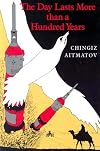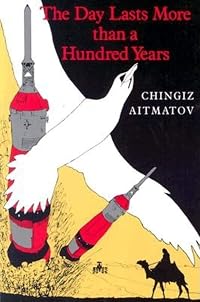
The day lasts more than a hundred years
by Chingiz Aitmatov
On This Page
Description
Set in the vast windswept Central Asian steppes and the infinite reaches of galactic space, this powerful novel offers a vivid view of the culture and values of the Soviet Union's Central Asian peoples.Tags
Recommendations





























Member Recommendations

Member Reviews
This is a novel of striking juxtapositions. The main plotline takes place over the course of a single day, and yet the past is ever present both in reflections and in legends. The focus is a tiny settlement at a railway intersection surrounded by the vastness of the Central Asian steppe, yet other nations and even aliens from outer space have a role. It is an example of socialist realism with its heroic railway worker, yet is subversive with its mankurts men who have been captured, tortured, and brainwashed into mindless slaves with no memory or identity. It is village prose and yet lauds the advances of technology. Finally, it is a novel written in Russian for a Russian or Russified audience, and yet seems to advocate for the retention show more of national identity and religion. And it is a novel by a Kyrgyz author set in Kazakhstan.
Yedigei was a soldier in WWII but suffered from shell shock and returned home early. Unable at first to perform the hard labor he is assigned, he finds a place in a remote settlement helping maintain the lines at a railroad junction. He and his wife are taken in by Kazangap, an older worker who is the lynchpin of the tiny community. The book opens with Yedigei learning that Kazangap has died, and the frame for the rest of the book is the journey Yedigei undertakes on his camel to take Kazangap to a cemetery for burial according to Muslim tradition. Along the way, Yedigei ruminates on his life, and especially on the fate of another family who joined their community for a time years ago.
A subplot involves the nearby (fictitious) cosmodrome, where rockets are launched after scientists from a join Soviet-US venture make contact with another intelligent species.
Despite its length (and the horribly damaged copy I was reading), I found this novel very compelling, as well as touching. I grew to care about Yedigei and his relationships with Kazangap and the members of the other family, as well as the troublesome, yet magnificent male camel, Karanar. It's a novel that would lend itself well to discussion, and I continue to think about aspects of the novel, especially after reading the introduction, which I did once I finished the book. I can see why the book is popular with readers of all stripes as it can be interpreted in a myriad of ways. show less
Yedigei was a soldier in WWII but suffered from shell shock and returned home early. Unable at first to perform the hard labor he is assigned, he finds a place in a remote settlement helping maintain the lines at a railroad junction. He and his wife are taken in by Kazangap, an older worker who is the lynchpin of the tiny community. The book opens with Yedigei learning that Kazangap has died, and the frame for the rest of the book is the journey Yedigei undertakes on his camel to take Kazangap to a cemetery for burial according to Muslim tradition. Along the way, Yedigei ruminates on his life, and especially on the fate of another family who joined their community for a time years ago.
A subplot involves the nearby (fictitious) cosmodrome, where rockets are launched after scientists from a join Soviet-US venture make contact with another intelligent species.
Despite its length (and the horribly damaged copy I was reading), I found this novel very compelling, as well as touching. I grew to care about Yedigei and his relationships with Kazangap and the members of the other family, as well as the troublesome, yet magnificent male camel, Karanar. It's a novel that would lend itself well to discussion, and I continue to think about aspects of the novel, especially after reading the introduction, which I did once I finished the book. I can see why the book is popular with readers of all stripes as it can be interpreted in a myriad of ways. show less
It's not uncommon for a book to take you somewhere which is completely removed from your personal reality. But I'm trying to think of another example of a book which has really conveyed a sense of life which is different from anything I've ever even read or heard about. Right now I can't think of one.
The setting of this book is a railway junction in the middle of the Central Asian steppe. Apart from the railway lines crossing each other, there is nothing for hundreds of miles around.
You must have the will to live on the Sarozek junctions—otherwise you perish. The steppe is vast and man is small. The steppe takes no sides; it doesn’t care if you are in trouble or if all is well with you; you have to take the steppe as it is. But a show more man cannot remain indifferent to the world around him; it worries him and torments him to think that he could be happier somewhere else, and that he is where he is simply through a mistake of fate. Because of this he wears himself out before the great, pitiless steppe and loses his will, just as that accumulator on Shaimerden’s three-wheel motor-bike loses its charge. The owner looks after it, but does not ride it or lend it to anyone else. So the machine stands idle—and that’s all there is to it—soon it won’t start up any more, its starting power is lost. It is the same with a man at a Sarozek junction: he fails to get on with his work, to put down roots in the steppe, to adjust to his surroundings; and then he finds he can’t settle down. Passengers look out from passing trains, shake their heads and ask: “God, how can people live here? Nothing but steppe and camels!” But people who have enough patience can live here. For three years, or four, with an effort. But then they pack up and get as far away as possible. Only two people really put down roots at Boranly-Burannyi—Kazangap and he, Burannyi Yedigei.
At the start of the novel, Yedigei is told that the old man Kazangap has died. Kazangap was already well established at the Sarozek junctions when Yedegei arrived in the 1950s, shattered by the experience of fighting in the war. Yedigei decides that, for all the Soviet teachings, Kazangap should be buried properly, in the old way, and so they set out by tractor and camel to take the body to the cemetery. The story of the journey is interleaved with the stories of Kazangap, Yedigei, and others who have stopped at the junction for a few years, as well as traditional Kazakh myths and legends. Through these, the book touches on the history of the steppe as well as the modern changes, including some of the brutality of Soviet politics (one character ends up in Sarozek because he fought for the Soviet Union in a way which later became seen as politically suspect: the scene in which the apparatchik interrogates Yedigei and twists his words into something incriminating is chilling).
It's not a perfect book. There is a science fiction-y subplot which contains some political critique which I don't think was needed - you get all that you need from the story of the steppe. And there's a love story which reads very differently to a female reader than I think the author intended. But regardless of these criticisms, it's a really interesting read, and one that I think will stay with me. show less
The setting of this book is a railway junction in the middle of the Central Asian steppe. Apart from the railway lines crossing each other, there is nothing for hundreds of miles around.
You must have the will to live on the Sarozek junctions—otherwise you perish. The steppe is vast and man is small. The steppe takes no sides; it doesn’t care if you are in trouble or if all is well with you; you have to take the steppe as it is. But a show more man cannot remain indifferent to the world around him; it worries him and torments him to think that he could be happier somewhere else, and that he is where he is simply through a mistake of fate. Because of this he wears himself out before the great, pitiless steppe and loses his will, just as that accumulator on Shaimerden’s three-wheel motor-bike loses its charge. The owner looks after it, but does not ride it or lend it to anyone else. So the machine stands idle—and that’s all there is to it—soon it won’t start up any more, its starting power is lost. It is the same with a man at a Sarozek junction: he fails to get on with his work, to put down roots in the steppe, to adjust to his surroundings; and then he finds he can’t settle down. Passengers look out from passing trains, shake their heads and ask: “God, how can people live here? Nothing but steppe and camels!” But people who have enough patience can live here. For three years, or four, with an effort. But then they pack up and get as far away as possible. Only two people really put down roots at Boranly-Burannyi—Kazangap and he, Burannyi Yedigei.
At the start of the novel, Yedigei is told that the old man Kazangap has died. Kazangap was already well established at the Sarozek junctions when Yedegei arrived in the 1950s, shattered by the experience of fighting in the war. Yedigei decides that, for all the Soviet teachings, Kazangap should be buried properly, in the old way, and so they set out by tractor and camel to take the body to the cemetery. The story of the journey is interleaved with the stories of Kazangap, Yedigei, and others who have stopped at the junction for a few years, as well as traditional Kazakh myths and legends. Through these, the book touches on the history of the steppe as well as the modern changes, including some of the brutality of Soviet politics (one character ends up in Sarozek because he fought for the Soviet Union in a way which later became seen as politically suspect: the scene in which the apparatchik interrogates Yedigei and twists his words into something incriminating is chilling).
It's not a perfect book. There is a science fiction-y subplot which contains some political critique which I don't think was needed - you get all that you need from the story of the steppe. And there's a love story which reads very differently to a female reader than I think the author intended. But regardless of these criticisms, it's a really interesting read, and one that I think will stay with me. show less
Aitmatov is a Kyrgyz writer who passed away this year. I have never heard of him or his books, but a friend recommended this book to me recently. As is usually the case with friends' recommendations, this book turned out to be a real gem.
The story takes place over the course of one day, and includes one major plot and one short sub-plot. Yedigei, a railroad worker in remote Kazakhstan, sets out to bury his old friend, Kazangap, in an old cemetery. Throughout the long journey to the cemetery, Yedigei recounts his personal history and that of the few other souls that live with him at the remote railroad station. The shorter sub-plot involves the discovery of extraterrestrial life by an American astronaut and a Soviet cosmonaut. The show more location of the Soviet launch site near Yedigei's station serves as the background for this science-fiction background story.
I will not go into the plot itself; it is far too elaborate and clever for me to try to summarise it in a few short paragraphs. Aitmatov paints an achingly beautiful picture of hardships of life in the remote steppes of central Asia under Soviet rule. He succeeds in describing the rich tradition and history of the local people and how their culture and practices are challenged by the laws of the Communist regime. The animal world plays a major role in the story, with Yedigei's camel, Karanar, being one of the main characters in the book. There is an ever-present criticism of the Soviet regime, but it is so subtle that the book does not become an anti-government manifest.
The sub-plot about the extraterrestrials seems, at first, to be entirely disconnected from the main story. However, as details about the discovery become more apparent, and especially the reaction of the leaders of the USA and the USSR to the discovery, it all comes together. Yedigei's earthly worries and dealings are interwoven with galactic events, to make a strong statement about the human condition. The past, present and future are interwoven in an intricately designed masterpiece.
It's hard to do justice to this book by attempting to review it. I learnt a lot about Kazakh culture and the hard-working rural inhabitants of the Sarozek desert. But mostly I learnt that one can tackle the big questions in life through a simple story. In two words, my recommendation is: read it. show less
The story takes place over the course of one day, and includes one major plot and one short sub-plot. Yedigei, a railroad worker in remote Kazakhstan, sets out to bury his old friend, Kazangap, in an old cemetery. Throughout the long journey to the cemetery, Yedigei recounts his personal history and that of the few other souls that live with him at the remote railroad station. The shorter sub-plot involves the discovery of extraterrestrial life by an American astronaut and a Soviet cosmonaut. The show more location of the Soviet launch site near Yedigei's station serves as the background for this science-fiction background story.
I will not go into the plot itself; it is far too elaborate and clever for me to try to summarise it in a few short paragraphs. Aitmatov paints an achingly beautiful picture of hardships of life in the remote steppes of central Asia under Soviet rule. He succeeds in describing the rich tradition and history of the local people and how their culture and practices are challenged by the laws of the Communist regime. The animal world plays a major role in the story, with Yedigei's camel, Karanar, being one of the main characters in the book. There is an ever-present criticism of the Soviet regime, but it is so subtle that the book does not become an anti-government manifest.
The sub-plot about the extraterrestrials seems, at first, to be entirely disconnected from the main story. However, as details about the discovery become more apparent, and especially the reaction of the leaders of the USA and the USSR to the discovery, it all comes together. Yedigei's earthly worries and dealings are interwoven with galactic events, to make a strong statement about the human condition. The past, present and future are interwoven in an intricately designed masterpiece.
It's hard to do justice to this book by attempting to review it. I learnt a lot about Kazakh culture and the hard-working rural inhabitants of the Sarozek desert. But mostly I learnt that one can tackle the big questions in life through a simple story. In two words, my recommendation is: read it. show less
It started off strong with the mix of desert folk on Terra and the aliens on Lesnaya Grud whisking away cosmonauts 1-2 & 2-1, but then eventually devolved into Aitmatov's obsession with old geriatric dudes trying to bang younger women. Ultimately, the protagonist of the story, Yedigei, was ready to abandon his beloved wife and 2 daughters so he could bang his dead comrade's widow. Fortunately, other shit distracted him enough, plus the widow gettin the fuck outta there before any of that dumb shit happened. Seems to be a common theme with Aitmatov's work though (ie The Red Apple and half of his other stories). He shoulda starred in some of Max Hardcore's films before he croaked. Still though, a solid 3/5 for change of pace from other show more literature blended with sci fi. show less
My entry for Around the World for a Good Book for Kyrgyzstan tells the story of Burannyi Yedigei, a man who works the railroads in a remote outpost of the Soviet Union, as he attempts to bring his old friend Kazangap's body to his peoples' traditional burial ground. While this main plot serves as a frame for the novel and is presumably set in the 1970's, much of the story takes place in the early 1950s and while I suspected the flashbacks would offer insight into Kazangap, he plays only a small - yet wise - part in the story. Instead Yedigei befriends an outcast family because the man in the family was captured during World War II. His friend is arrested by the Stalinist authorities and eventually dies in custody, and to add to the show more tragedy Yedigei falls in love with his widow, who moves away with her children without saying goodbye. This tragic story is interspersed with traditional folk tales that reflect on Yedigei's life and thoughts. A bizarre but interesting parallel story tells of a joint US-Soviet space station that makes contact with an advanced civilization on another planet. Cold War hysteria overrides this chance for peace and discovery, as the authorities abandon the cosmonauts and surround earth in a web of nuclear weapons. The two stories come together in a sense when Yedigei and his companions discover that their traditional burial ground is within the station where the rocket ships are launched, and after a confrontation with the authorities they are forced to bury Kazangap elsewhere. This book is well-written and interesting if a bit uneven, but artfully captures the desolation of the land and Yedigei's soul. show less
A fascinating journey through the Central Asian steppes. Centered on the life of a railway worker in a remote part of (today's) Kazakhstan, it is part-epic, part-metaphor for Soviet Russia, and a small part-science fiction. The science fiction is more fantasy than science, but it serves a metaphorical purpose as the (iron) curtain descends. Worth reading.
Burannyi Yedigei, the hero of Chingiz Amitiov's novel The Day Lasts More than a Hundred Years, has spent his entire adult life on the steppes of Central Asia in Soviet Kazakstan. The small village where he lives with his wife and children is made up of railway workers, there to maintain an important junction connecting the east with the west. Trains run past their small homes day and night, rarely ever stopping at all, and when they do not for long.
The novel opens with the death of Yedigei's life long friend Kazangap. Yedigei insists that Kazangap will have an honorable funeral in his ancestral cemetary a full days trip from their small village. He manages to get enough people and equipment released from work on the railway to give show more Kazangap the burial he deserves.
Yedigei leads the procession atop his prized camel, Karanar, which is fully adorned for a ceremonial parade. He is followed by a second villager who rides a tractor with a trailer carrying the body of Kazangap as well as Kazangap's son who has returned to the village from his life in the city to bury his estranged father. They are followed in turn by a final villager who drives an excavator which will be used to dig Kazangap's grave and by Kazangap's yellow dog who trots along refusing to leave the side of his master. This odd procession starts out one morning across the desert steppes of the Soviet Union.
Along the way, Yedigei recalls the major events of his own life-- friends he lost, women he loved, sons he might have raised. And here and there the narrative is interrupted by accounts of a Soviet/American space mission which has made contact with an intelligent race from another solar system. The rockets light up the night sky interrupting Yedigei's life at several key points because they are launched from bases hidden in the steppes of Kazakstan. show less
The novel opens with the death of Yedigei's life long friend Kazangap. Yedigei insists that Kazangap will have an honorable funeral in his ancestral cemetary a full days trip from their small village. He manages to get enough people and equipment released from work on the railway to give show more Kazangap the burial he deserves.
Yedigei leads the procession atop his prized camel, Karanar, which is fully adorned for a ceremonial parade. He is followed by a second villager who rides a tractor with a trailer carrying the body of Kazangap as well as Kazangap's son who has returned to the village from his life in the city to bury his estranged father. They are followed in turn by a final villager who drives an excavator which will be used to dig Kazangap's grave and by Kazangap's yellow dog who trots along refusing to leave the side of his master. This odd procession starts out one morning across the desert steppes of the Soviet Union.
Along the way, Yedigei recalls the major events of his own life-- friends he lost, women he loved, sons he might have raised. And here and there the narrative is interrupted by accounts of a Soviet/American space mission which has made contact with an intelligent race from another solar system. The rockets light up the night sky interrupting Yedigei's life at several key points because they are launched from bases hidden in the steppes of Kazakstan. show less
Members
- Recently Added By
Lists

Pleasant Surprises: Books That Exceeded Our Expectations
418 works; 142 members

Top Five Books of 2021
604 works; 181 members

Best public-transport fiction
72 works; 17 members

Top Five Books of 2017
5 works; 1 member

Speculative Fiction from around the World
610 works; 18 members

Best Science Fiction Originally Published in a Language Other Than English
449 works; 34 members

Central Asia
59 works; 2 members

Novels set over the course of a single day (or less)
72 works; 8 members

Books Read in 2021
5,361 works; 114 members

Books With the Most Memorable Titles
478 works; 158 members

Books We Discovered On LibraryThing
530 works; 130 members

1980 great books
63 works; 1 member
Author Information

229 Works 3,465 Members
Aitmatov became well known for his Russian-language prose describing the life of his own Kirghiz people. He was born in Kirghiza, in present-day Kyrgyzstan, in 1928. His writings include the novel The White Steamship; the novella Farewell, Gulsary!; and a daring play titled The Ascent of Mount Fuji. Although he was a member of the Communist party, show more his works did not follow the narrow canons of socialist realism. With depth and sensitivity, Aitmatov presented the Kirghiz in the throes of societal change, dealt very broadly with ethical problems, and took up topics that were generally avoided in official Soviet literature. With time his criticism of Russification and collectivization on traditional Kirghiz society increased. In 1963, Aitmatov received the Lenin Prize for Literature and Fine Arts. (Bowker Author Biography) show less
Some Editions
Awards and Honors
Awards
Notable Lists
Series
Belongs to Publisher Series
Work Relationships
Is contained in
Common Knowledge
- Canonical title
- The day lasts more than a hundred years
- Original title
- И дольше века длится день
- Alternate titles*
- Un día mas largo que un siglo
- Original publication date
- 1980
- Important places
- Kazakhstan
- First words
- The hungry vixen had to be patient as she searched for prey among the dried-out gullies and the bare ravines.
- Last words*
- (Click to show. Warning: May contain spoilers.)Ihr seid doch hier zu Hause, meine Kinder.
- Original language
- Russian
*Some information comes from Common Knowledge in other languages. Click "Edit" for more information.
Classifications
- Genres
- Fiction and Literature, Science Fiction, General Fiction
- DDC/MDS
- 891.73 — Literature & rhetoric Literatures of other languages East Indo-European and Celtic literatures Russian and East Slavic languages Russian fiction
- LCC
- PG3478 .I8 .D613 — Language and Literature Slavic languages and literatures. Baltic languages. Albanian language Slavic. Baltic. Albanian Russian literature Individual authors and works 1961-2000
- BISAC
Statistics
- Members
- 655
- Popularity
- 44,324
- Reviews
- 15
- Rating
- (4.11)
- Languages
- 15 — Czech, Dutch, English, Estonian, Finnish, French, German, Hebrew, Hungarian, Norwegian (Bokmål), Romanian, Russian, Spanish, Swedish, Turkish
- Media
- Paper, Ebook
- ISBNs
- 44
- ASINs
- 6