On This Page
Description
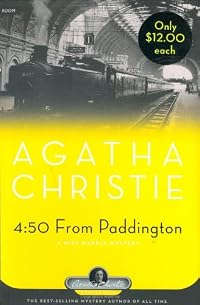
For an instant the two trains ran together, side by side. In that frozen moment, Elspeth witnessed a murder. Helplessly, she stared out of her carriage window as a man remorselessly tightened his grip around a woman's throat. The body crumpled. Then the other train drew away. But who, apart from Miss Marple, would take her story seriously? After all, there were no suspects, no other witnesses . . . and no corpse. This title was previously published as What Mrs. McGrillicuddy Saw!.Tags
Recommendations

















Member Reviews
First sentence: Mrs. McGillicuddy panted along the platform in the wake of the porter carrying her suitcase.
Premise/plot: Poor Mrs. McGillicuddy! She witnesses a crime when she's on a train--the crime takes place on a passing train--and NO ONE believes her. No one but Miss Marple that is! Miss Marple knows her friend did not imagine a man strangling a woman. Since the police aren't going to bother with an investigation, it's up to her and her friends. Miss Marple hires a woman--Lucy Eyelesbarrow--to do the job. Lucy gets hired on at an estate--the nearest estate to where Miss Marple thinks the body might have been thrown off the train--and in her spire time Lucy will hunt for the body. It doesn't take her long--not really, not all show more things considered. What takes time is identifying the woman. Who was she? What was she doing in England? Is she in any way connected to the family or the estate? Could Lucy be living with a murderer?
My thoughts: I love, love, love this murder mystery. The murder occurs BEFORE Christmas but most of the book occurs in January or thereabouts. Lucy is working for a very eccentric, quirky family. Some of these family members are quite memorable, almost delightful. Miss Marple is staying nearby and posing as Lucy's aunt.
This is a well-written mystery novel that is fun to read and reread. (Though to be honest you should let a few years go by so that the details get a bit fuzzy in between readings.)
Quotes:
"Well," she said, "it looks as though you were right." She produced her findings and gave the details of their discovery. "Perhaps one ought not to feel so," she said, "but it is rather gratifying to form a theory and get proof that it is correct!" (39)
"At a certain stage one is inclined to think everyone knows a little more than they are willing to tell you." (81)
"If you have not committed a murder, it naturally annoys you if it seems someone thinks that you have," said Inspector Craddock mildly. (129)
"The truth is people are an extraordinary mixture of heroism and cowardice." (144) show less
Premise/plot: Poor Mrs. McGillicuddy! She witnesses a crime when she's on a train--the crime takes place on a passing train--and NO ONE believes her. No one but Miss Marple that is! Miss Marple knows her friend did not imagine a man strangling a woman. Since the police aren't going to bother with an investigation, it's up to her and her friends. Miss Marple hires a woman--Lucy Eyelesbarrow--to do the job. Lucy gets hired on at an estate--the nearest estate to where Miss Marple thinks the body might have been thrown off the train--and in her spire time Lucy will hunt for the body. It doesn't take her long--not really, not all show more things considered. What takes time is identifying the woman. Who was she? What was she doing in England? Is she in any way connected to the family or the estate? Could Lucy be living with a murderer?
My thoughts: I love, love, love this murder mystery. The murder occurs BEFORE Christmas but most of the book occurs in January or thereabouts. Lucy is working for a very eccentric, quirky family. Some of these family members are quite memorable, almost delightful. Miss Marple is staying nearby and posing as Lucy's aunt.
This is a well-written mystery novel that is fun to read and reread. (Though to be honest you should let a few years go by so that the details get a bit fuzzy in between readings.)
Quotes:
"Well," she said, "it looks as though you were right." She produced her findings and gave the details of their discovery. "Perhaps one ought not to feel so," she said, "but it is rather gratifying to form a theory and get proof that it is correct!" (39)
"At a certain stage one is inclined to think everyone knows a little more than they are willing to tell you." (81)
"If you have not committed a murder, it naturally annoys you if it seems someone thinks that you have," said Inspector Craddock mildly. (129)
"The truth is people are an extraordinary mixture of heroism and cowardice." (144) show less
While traveling by train to visit an old friend, Mrs. McGillicuddy is distressed to witness the murder of a woman on a train traveling parallel to hers. The railway officials don’t seem to take her seriously, but her old friend, Miss Marple, does. In the absence of news reports of the discovery of a body, Miss Marple sets out on a hunt. She engages a young paragon, Lucy Eylesbarrow, to take a temporary domestic position in a household near the site where the body must have been dumped. But why hasn’t the murdered woman been reported missing? Who was she, and what is her connection to this place?
This is one of my favorite Christies. I love mysteries involving trains, and I love the plot twist of a witness to a murder with a missing show more corpse. I like that Christie doesn’t ask her readers to suspend their disbelief in Miss Marple’s stamina by bringing in the young and intelligent Lucy to do all the physical investigation while Miss Marple puts her brain to work. And the dramatic ending is just perfect. show less
This is one of my favorite Christies. I love mysteries involving trains, and I love the plot twist of a witness to a murder with a missing show more corpse. I like that Christie doesn’t ask her readers to suspend their disbelief in Miss Marple’s stamina by bringing in the young and intelligent Lucy to do all the physical investigation while Miss Marple puts her brain to work. And the dramatic ending is just perfect. show less
Ah Christie, you cunning minx you. I knew my earlier guess had low odds for being right, but I never saw that coming. I probably should have given the book a higher rating, but it started off slow and frankly, I don't feel confident yet that Christie didn't pull a rabbit out of her hat here. I need to let the story sit with me for awhile, and I may adjust the rating 1/2 star later.
I say it started off slow, but that's not really the case; it's much more about what happens when an original idea becomes over-used. Witnessing a murder taking place in a passing train was likely original - or at least fresh - when Christie used it, but 60 years later it feels trite. I'm also impatient with the idea of dismissing people because of their age.
show more
Once Lucy Eyelesbarrow arrived on the scene though, things started to pick up. From that point I was pretty well glued to the pages, getting lost in the setting and the characters. And apparently allowing myself to become completely seduced by Christie's red herring. For the record, I think my ending would have been much more twisted. show less
I say it started off slow, but that's not really the case; it's much more about what happens when an original idea becomes over-used. Witnessing a murder taking place in a passing train was likely original - or at least fresh - when Christie used it, but 60 years later it feels trite. I'm also impatient with the idea of dismissing people because of their age.
show more
Once Lucy Eyelesbarrow arrived on the scene though, things started to pick up. From that point I was pretty well glued to the pages, getting lost in the setting and the characters. And apparently allowing myself to become completely seduced by Christie's red herring. For the record, I think my ending would have been much more twisted. show less
When Mrs. Elspeth McGillicuddy takes the train from London to Brackhampton, her train briefly runs along another train going in the same direction and witnesses a murder. But when no body is found either on the train or on the tracks, everyone presumes that she must have imagined it. Everyone, of course, but Mrs. McGillicuddy's dear friend, Miss Jane Marple.
I really enjoyed this Miss Marple mystery. The character names are fabulous (seriously, Elspeth McGillicuddy is perfection as a name), the mystery is well-crafted, the red herrings expertly placed, and each of the characters fantastically well-drawn. I enjoyed the element of Miss Marple using a younger woman as her eyes and legs on the scene, particularly as Lucy Eyelesbarrow is a show more lovely character to spend time with. Definitely recommended. show less
I really enjoyed this Miss Marple mystery. The character names are fabulous (seriously, Elspeth McGillicuddy is perfection as a name), the mystery is well-crafted, the red herrings expertly placed, and each of the characters fantastically well-drawn. I enjoyed the element of Miss Marple using a younger woman as her eyes and legs on the scene, particularly as Lucy Eyelesbarrow is a show more lovely character to spend time with. Definitely recommended. show less
This is one of those Marple novels where she's almost a guest star. Fun, mainly because the entire premise is initially nightmarish enough to be a set up for a Hitchcock or Argento film. Obviously it doesn't go in that direction. Lots of leering, creepy, male characters interact with Marple's intrepid soldier in the field -Lucy Eyelesbarrow, as she searches for the body of a strangled woman. And she can cook too! Not in love with the punchline, but it's an engaging ride.
Brief Christie, with a unusually unsatisfying resolution. In general, I am tolerant of bank-shot plots to enable the surprise twist. Here, it felt implausible. I can imagine Raymond Chandler fuming in frustration...
When Mrs. McGillicuddy arrived at Jane Marple’s house for a visit, she has an extraordinary tale to tell – she witnessed a murder! During her trip, another train ran parallel to her own and when a window shade suddenly went up, she saw a man strangling a woman. She immediately reported events to the train personnel and to the police. The problem is, no body turns up in the next several days, nor is anyone reported missing. It’s up to Miss Marple to figure out what transpired.
I enjoyed this mystery because it showcased Miss Marple’s deductive reasoning more than other novels I’ve read. She doesn’t just have to account for human behavior, at which she is an admitted expert. She has to figure out where that body could have show more gone. After a couple trips via the same train, she deduces the body must be at Rutherford Hall. She enlists the help of Lucy Eyelesbarrow, a professional cook and housekeeper, to work at Rutherford Hall and find the body. Once found, the mystery turns toward possible suspects – all members of the Crackenthorpe family: 74-year-old Luther, his unsavory sons Harold, Cedric & Alfred, daughter Emma, dead daughter Edith’s husband Bryan. When one of the family ends up dead, Inspector Craddock suspects money as the motive. Luther is sitting on a fortune that he can’t touch and will pass to his children once he dies. But, what did the dead woman have to do with any of it?
Craddock is Marple’s godson, so their interactions added some personal connections to the story. I really liked Lucy as well and wouldn’t mind seeing her pop up in another story. The ultimate conclusion was satisfying. Another solid mystery from Christie. show less
I enjoyed this mystery because it showcased Miss Marple’s deductive reasoning more than other novels I’ve read. She doesn’t just have to account for human behavior, at which she is an admitted expert. She has to figure out where that body could have show more gone. After a couple trips via the same train, she deduces the body must be at Rutherford Hall. She enlists the help of Lucy Eyelesbarrow, a professional cook and housekeeper, to work at Rutherford Hall and find the body. Once found, the mystery turns toward possible suspects – all members of the Crackenthorpe family: 74-year-old Luther, his unsavory sons Harold, Cedric & Alfred, daughter Emma, dead daughter Edith’s husband Bryan. When one of the family ends up dead, Inspector Craddock suspects money as the motive. Luther is sitting on a fortune that he can’t touch and will pass to his children once he dies. But, what did the dead woman have to do with any of it?
Craddock is Marple’s godson, so their interactions added some personal connections to the story. I really liked Lucy as well and wouldn’t mind seeing her pop up in another story. The ultimate conclusion was satisfying. Another solid mystery from Christie. show less
Members
- Recently Added By
Lists

Golden Age of Detection
35 works; 10 members

British Mystery
469 works; 14 members

Best public-transport fiction
72 works; 14 members

Agatha Christie Miss Marple
12 works; 1 member

Books About Murder
313 works; 7 members

Female Protagonist
1,056 works; 56 members

Detective Stories
343 works; 5 members
Stories where trains play a supporting character
13 works; 2 members

Teresa's favorite mystery series and authors
55 works; 2 members
Female Author
1,235 works; 67 members

Books Read in 2024
4,623 works; 126 members

TBR
77 works; 1 member

Books Read in 2023
5,547 works; 144 members

Books Read in 2022
5,164 works; 111 members

Nifty Fifties
129 works; 13 members
Ten Train Thrillers
10 works; 1 member

Books With Time Words in the Title
160 works; 4 members

Top Five Books of 2018
802 works; 264 members

Books Read in 2010
631 works; 10 members

Books Read in 2018
4,360 works; 110 members

Books Read in 2017
4,249 works; 129 members

Books With Numbers in the Title
308 works; 13 members

Books Read in 2014
2,341 works; 86 members

Agatha Christie Chronology
93 works; 1 member
Author Information

2,136+ Works 439,023 Members
One of the most successful and beloved writer of mystery stories, Agatha Mary Clarissa Christie was born in 1890 in Torquay, County Devon, England. She wrote her first novel, The Mysterious Affair at Styles, in 1920, launching a literary career that spanned decades. In her lifetime, she authored 79 crime novels and a short story collection, 19 show more plays, and six novels written under the name of Mary Westmacott. Her books have sold over a billion copies in the English language with another billion in 44 foreign languages. Some of her most famous titles include Murder on the Orient Express, Mystery of the Blue Train, And Then There Were None, 13 at Dinner and The Sittaford Mystery. Noted for clever and surprising twists of plot, many of Christie's mysteries feature two unconventional fictional detectives named Hercule Poirot and Miss Jane Marple. Poirot, in particular, plays the hero of many of her works, including the classic, The Murder of Roger Ackroyd (1926), and Curtain (1975), one of her last works in which the famed detective dies. Over the years, her travels took her to the Middle East where she met noted English archaeologist Sir Max Mallowan. They married in 1930. Christie accompanied Mallowan on annual expeditions to Iraq and Syria, which served as material for Murder in Mesopotamia (1930), Death on the Nile (1937), and Appointment with Death (1938). Christie's credits also include the plays, The Mousetrap and Witness for the Prosecution (1953; film 1957). Christie received the New York Drama Critics' Circle Award for 1954-1955 for Witness. She was also named Dame Commander of the Order of the British Empire in 1971. Christie died in 1976. (Bowker Author Biography) show less
Some Editions
Awards and Honors
Series

Belongs to Publisher Series
Work Relationships
Is contained in
Five Complete Miss Marple Novels: The Body in the Library, A Caribbean Mystery, The Mirror Crack'd, Nemesis, What Mrs. McGillicuddy Saw! by Agatha Christie
Agatha Christie Crime Collection: 4:50 from Paddington, Lord Edgware Dies, Murder In Mesopotamia by Agatha Christie
Murder on Board: Three Complete Mystery Novels: The Mystery of the Blue Train / What Mrs. McGillicuddy Saw / Death in the Air by Agatha Christie
4.50 From Paddington / Murder in Mesopotamia / A Pocket Full of Rye / Lord Edgware Dies by Agatha Christie
The Best of Miss Marple: A Caribbean Mystery, Sleeping Murder, 4:50 From Paddington, At Bertram's Hotel by Agatha Christie
Has the adaptation
Common Knowledge
- Canonical title
- What Mrs. McGillicuddy Saw!
- Original title
- 4:50 from Paddington
- Alternate titles
- Murder, She Said
- Original publication date
- 1957-11-04
- People/Characters
- Jane Marple; Elseth McGillicuddy; Lucy Eyelesbarrow; Dermot Craddock; Brian Eastley; Luther Crackenthorpe (show all 15); Cedric Crackenthorpe; Harold Crackenthorpe; Alfred Crackenthorpe; Emma Crackenthorpe; Dr. John Quimper; Alexander Eastley; Inspector Bacon; Lady Stoddart-West; James Stoddart-West
- Important places
- London, England, UK; Rutherford Hall, England, UK
- Related movies
- Murder She Said (1961 | IMDb); 4.50 from Paddington (1987 | IMDb); Agatha Christie Marple: 4.50 from Paddington (2004 | IMDb)
- First words
- Mrs. McGillicuddy panted along the platform in the wake of the porter carrying her suitcase.
- Last words
- (Click to show. Warning: May contain spoilers.)And she twinkled at him.
- Blurbers
- James, P.D.; Coben, Harlan
- Original language
- English
- Canonical DDC/MDS
- 823.912
- Canonical LCC
- PR6005.H66
- Disambiguation notice
- Original title for the US publication was What Mrs McGillicuddy Saw!, and a 1963 paperback edition used the title Murder, She Said.
Just reading this book again... the train did not leave at 4:50. It was ... (show all)the 4:54.
Classifications
Statistics
- Members
- 5,376
- Popularity
- 2,496
- Reviews
- 121
- Rating
- (3.77)
- Languages
- 30 — Catalan, Chinese, Czech, Danish, Dutch, English, Estonian, Finnish, French, German, Greek, Hebrew, Hindi, Hungarian, Indonesian, Italian, Japanese, Lithuanian, Norwegian (Bokmål), Norwegian, Farsi/Persian, Polish, Romanian, Russian, Croatian, Slovenian, Spanish, Swedish, Turkish, Portuguese (Portugal)
- Media
- Paper, Audiobook, Ebook
- ISBNs
- 226
- UPCs
- 2
- ASINs
- 111