On This Page
Description
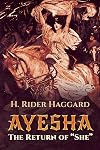
If you love action-adventure novels, you owe it to yourself to read H. Rider Haggard's Ayesha, one of the undisputed classics of the genre. In this sequel to the ever-popular She, intrepid explorer Allan Quatermain returns to Africa and again encounters a fascinating lost civilization ruled with an iron fist by the enchanting warrior queen Ayesha..
Tags
Recommendations







Member Reviews
The concluding book in the adventures of Horace Holly and Leo Vancey first related in She, Ayesha was written almost two decades after that initial novel. And it shows. The story itself actually is more complex and even more epic in scope than She. Yet there are differences in the telling of the tale. In Ayesha, Haggard writes more briskly. It has the feel of a work that belongs to the new century, the twentieth. Gone, almost, are the dense layers of appositives that carried through on every page of She. But only almost. Because they do reappear with the long stretches of dialog involving Ayesha. For once more, Haggard wants his style to mimic the sense of past eras, the long passage of time. And once more, as in She, his syntax and show more rhythms are of a bygone era. Too, he again sprinkles in archaic word choices to plunge the reader into a sense of centuries past.
I do not hold much with those critics who can only see these works of Haggard as texts to explore colonial mindsets, tropes, and imagery. In both She and Ayesha, Haggard has gone beyond the borders of colonialism. He does this literally, exploring lost and unknown landscapes that are metaphorically probing heretofore untapped regions of the mind and belief. Ayesha is more than mere adventure, romance, or fantasy. It examines the boundaries between fantasy and reality and where the lives of readers themselves takes place. In his own way, often, Haggard can be quite profound. show less
I do not hold much with those critics who can only see these works of Haggard as texts to explore colonial mindsets, tropes, and imagery. In both She and Ayesha, Haggard has gone beyond the borders of colonialism. He does this literally, exploring lost and unknown landscapes that are metaphorically probing heretofore untapped regions of the mind and belief. Ayesha is more than mere adventure, romance, or fantasy. It examines the boundaries between fantasy and reality and where the lives of readers themselves takes place. In his own way, often, Haggard can be quite profound. show less
The sequel to She, this is quite a long read and i was expecting a lot of messing about before getting to the main plot this wasn't the case however, it jumped quite quickly into the action and there really isn't any wasted pages.
I love the characters, the hero comes across as kind of lame and its really nice to see the two powerful heroines fight over this weaker man as the reverse is so often the case.
I like the layers of characterization, everyone is flawed and both the heroines are quite evil in their way. The action is great but its really the mystery and the lies which surround Ayesha which makes this work so well. She gives numerous versions of her origin until you have no idea what the truth might be. Its a really solid show more adventure/mystery/romance. I was kind of surprised how much i liked it, especially how superior it seemed over the original. show less
I love the characters, the hero comes across as kind of lame and its really nice to see the two powerful heroines fight over this weaker man as the reverse is so often the case.
I like the layers of characterization, everyone is flawed and both the heroines are quite evil in their way. The action is great but its really the mystery and the lies which surround Ayesha which makes this work so well. She gives numerous versions of her origin until you have no idea what the truth might be. Its a really solid show more adventure/mystery/romance. I was kind of surprised how much i liked it, especially how superior it seemed over the original. show less
Ayesha, known as She-Who-Must-Be-Obeyed, first appeared in serial form from 1896 to 1897 in the novel She. Along with King Solomon's Mines, She is Haggard's most popular and famous novel. Ayesha is one of the awesome, kick-ass woman characters in Victorian literature, and I rated Wisdom's Daughter, the later written prequel set in Ancient Egypt five stars. I loved that book even more than the original She. However, I do not think The Return of She is as entrancing as those two books. It's a lot better than the third book She and Allan though (where Ayesha encountered Allan Quartermain of King Solomon's Mines). If you're a fan of Ayesha, and I am, this is enjoyable though. Great adventure, great fantasy--a genre that owes a great debt to show more Haggard. I'm not going to claim that Haggard even at his best is the same order of classic as the best by Charles Dickens, the Brontes, George Eliot or Thomas Hardy. But like Arthur Conan Doyle or Robert Louis Stevenson or Rudyard Kipling, Haggard really could spin a good yarn. show less
About 4 years ago Penguin published some nice editions of boys adventure book classics. I don't really confirm to gender stereotypes, so I got myself some ('Tarzan', 'The Lost World'). And 'She', by H. Rider Haggard. I'd read his 'King Solomon's Mines' before, and really enjoyed it. I loved 'She' too, and loved seeing THE shard in Norwich Castle Museum. Last week while book-hunting in one of the secondhand shops in Den Haag, I came across a copy of the second book about Ayesha, 'The Return of She', and I couldn't wait to start to read it. Unfortunately my edition (Dutch translation, published by Scala in 1977) not only has a cover that makes no sense to me (why is that guy green?), it's also abridged without disclosing it. Luckily the show more Gutenberg Project came to my rescue, so I read the ePub version on my Nook instead.
It's twenty years after the events in 'She', and the same nameless editor of the first book receives another parcel from Horace Holly, containing another manuscript and an artifact. It turns out that Holly and his adoptive son Leo Vincey had another adventure with Ayesha, She. After returning to England at the end of the previous book, Leo had gotten depressed and even contemplated suicide, until he received a vision/dream from Ayesha, showing him that she was somewhere in the mountains of Ayesha. They travel to Asia and wander around for many years, until eventually they receive another sign that they are close. After a hard journey in which they nearly die they reach Kaloon, where they meet Khania Atene (who professes her love for Leo) and the jealous Khan Rassen. Their coming had been expected, and even though Holly and Leo feel they are close to Ayesha, the question is will they find her, and if they do, then what?
I really enjoyed this adventure. Both the back story (the history of Ayesha, Kallikrates and Amenartas) and the current struggles are pretty cool to read, combining strange savages with lost civilizations and treasures. We learn a bit more about Ayesha, and the magic she has. I loved reading the book both because of the story, as well as the language. I'll keep book-hunting for other works by H. Rider Haggard, and hope to find more someday (although I saw that they re-released three books in the Ayesha series just last year). Four out of five stars. show less
It's twenty years after the events in 'She', and the same nameless editor of the first book receives another parcel from Horace Holly, containing another manuscript and an artifact. It turns out that Holly and his adoptive son Leo Vincey had another adventure with Ayesha, She. After returning to England at the end of the previous book, Leo had gotten depressed and even contemplated suicide, until he received a vision/dream from Ayesha, showing him that she was somewhere in the mountains of Ayesha. They travel to Asia and wander around for many years, until eventually they receive another sign that they are close. After a hard journey in which they nearly die they reach Kaloon, where they meet Khania Atene (who professes her love for Leo) and the jealous Khan Rassen. Their coming had been expected, and even though Holly and Leo feel they are close to Ayesha, the question is will they find her, and if they do, then what?
I really enjoyed this adventure. Both the back story (the history of Ayesha, Kallikrates and Amenartas) and the current struggles are pretty cool to read, combining strange savages with lost civilizations and treasures. We learn a bit more about Ayesha, and the magic she has. I loved reading the book both because of the story, as well as the language. I'll keep book-hunting for other works by H. Rider Haggard, and hope to find more someday (although I saw that they re-released three books in the Ayesha series just last year). Four out of five stars. show less
Haggard published this sequel to She in 1905 eighteen years after the original and it follows a fairly similar format. The editor (the man responsible for getting She published receives another mystery package: It is a manuscript written by Mr Horace Holly about the further adventures of himself and his ward Leo Vincey. Both men are obsessed by their previous encounter with She-who-must-be-obeyed and even though they saw her reduced to a hideous monkey like creature after bathing in the flame of eternal youth in the previous novel, they have been searching for her ever since. Leo Vincey the ward and lover of She has had a vision that induces the two men to search for her in the mountains of Tibet. We pick up the story when the two men show more at last start picking up rumours of a powerful queen that lives in the unexplored lands beyond the furthest peaks of the Himalayan mountains.
It is not until halfway through the book that we meet She, but in the meantime Leo and Holly become virtual prisoners of the Khania yet another beautiful queen who falls in love with Leo. The Khania is a mortal enemy of the priestess of the mountain who is reputed to have supernatural powers and who seems to foot the bill for She-who-must-be-obeyed. Haggard does an excellent job of relating the adventures of Leo and Holly as they battle through a hostile environment in search of what they believe to be their destiny. A hair- raising climb down an icy precipice, a pitched battle with a savage tribe and a fight to the finish with the death-hounds make this first part of the novel read like an adventure story.
There is a change of pace when Ayesha appears and the pageantry and ritual that featured in the first novel are given full rein here, as Haggard describes the betrothal ceremony of She and Leo against the backdrop of a live volcanic crater. The portentousness of the scene is matched by some of Haggard's most portentous writing and this tends to get a little repetitive and overblown. She-who-must-be-obeyed has become even more powerful as she threatens to rule the world, but she does not lose her sense of being a woman in love, even if some of the eroticism of the first book has been lost. There is some discussion of how an absolute monarch might rule her subjects fairly and utopian ideals are broached, however the cruel and vindictive nature of She always seems to bubble just below the surface and this is what makes Haggard's creation something special, the continuous battle of wills between herself and the somewhat priggish Leo creates the tension that drives this story. There is of course a showdown with Khania and Leo once again finds himself having to make impossible choices.
There is less science fiction in this sequel than in the original novel, as less stress is given to the "land that time forgot" elements of the story and although there is the making of a radioactive material in Ayesha's laboratory, one gets the feeling from Haggard that he did not quite know what to do with this idea and it soon drifts out of the main story line. I enjoyed the novel, but it does not have quite the same thrill as the original and this is because of the similarity of the two tales. A three star read then for lovers of Ayesha. show less
It is not until halfway through the book that we meet She, but in the meantime Leo and Holly become virtual prisoners of the Khania yet another beautiful queen who falls in love with Leo. The Khania is a mortal enemy of the priestess of the mountain who is reputed to have supernatural powers and who seems to foot the bill for She-who-must-be-obeyed. Haggard does an excellent job of relating the adventures of Leo and Holly as they battle through a hostile environment in search of what they believe to be their destiny. A hair- raising climb down an icy precipice, a pitched battle with a savage tribe and a fight to the finish with the death-hounds make this first part of the novel read like an adventure story.
There is a change of pace when Ayesha appears and the pageantry and ritual that featured in the first novel are given full rein here, as Haggard describes the betrothal ceremony of She and Leo against the backdrop of a live volcanic crater. The portentousness of the scene is matched by some of Haggard's most portentous writing and this tends to get a little repetitive and overblown. She-who-must-be-obeyed has become even more powerful as she threatens to rule the world, but she does not lose her sense of being a woman in love, even if some of the eroticism of the first book has been lost. There is some discussion of how an absolute monarch might rule her subjects fairly and utopian ideals are broached, however the cruel and vindictive nature of She always seems to bubble just below the surface and this is what makes Haggard's creation something special, the continuous battle of wills between herself and the somewhat priggish Leo creates the tension that drives this story. There is of course a showdown with Khania and Leo once again finds himself having to make impossible choices.
There is less science fiction in this sequel than in the original novel, as less stress is given to the "land that time forgot" elements of the story and although there is the making of a radioactive material in Ayesha's laboratory, one gets the feeling from Haggard that he did not quite know what to do with this idea and it soon drifts out of the main story line. I enjoyed the novel, but it does not have quite the same thrill as the original and this is because of the similarity of the two tales. A three star read then for lovers of Ayesha. show less
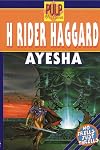
The less well known and less successful sequel to Rider Haggard's classic. There is not much here that is new in terms of plot, though Ayesha is depicted even more eloquently as a divine (or satanic?) being with potential mastery over not just the whole world, but seemingly the whole universe. The book is very well written and the author's command of language is superb. Worth looking out for if you have read and liked the original (though I HATE the cover of the Pulp Fictions edition).
This is the sequel to "She," which Haggard published in 1905, 18 years after the first book.
Although the title character seemed pretty definitively dead after the first book, still, she had vowed to return with her dying words, and, since then the characters of the beautiful young Leo and his mentor Dr. Horace Holly, have been wandering through Asia, seeking spiritual enlightenment, knowledge - and the return of that supernaturally beautiful immortal woman.
It wouldn't be much of a story if she didn't come back in some form - and, of course, she does.
The book is relatively free of the overtly offensive stereotypes and racial issues that were rather obtrusive in the first book, although it is still decidedly non-feminist, from a modern show more perspective - but in my perception, the Buddhist monks of "Ayesha" get a fairer (and more respectful) shake than the African cannibals of "She."
Overall, an entertaining adventure story, mixed with a deal of philosophy that ranges from interesting to annoying, depending...
Still, definitely worth reading... it was funny, because although some of the writing in this book did feel dated at times, it reminded me more of adventure-fantasy from the 70's than something more than half a century older. show less
Although the title character seemed pretty definitively dead after the first book, still, she had vowed to return with her dying words, and, since then the characters of the beautiful young Leo and his mentor Dr. Horace Holly, have been wandering through Asia, seeking spiritual enlightenment, knowledge - and the return of that supernaturally beautiful immortal woman.
It wouldn't be much of a story if she didn't come back in some form - and, of course, she does.
The book is relatively free of the overtly offensive stereotypes and racial issues that were rather obtrusive in the first book, although it is still decidedly non-feminist, from a modern show more perspective - but in my perception, the Buddhist monks of "Ayesha" get a fairer (and more respectful) shake than the African cannibals of "She."
Overall, an entertaining adventure story, mixed with a deal of philosophy that ranges from interesting to annoying, depending...
Still, definitely worth reading... it was funny, because although some of the writing in this book did feel dated at times, it reminded me more of adventure-fantasy from the 70's than something more than half a century older. show less
Members
- Recently Added By
Lists

A Novel Cure
742 works; 23 members
Author Information

Sir Henry Rider Haggard (1856-1925) is best remembered for his 34 adventure fantasy novels set in exotic locations. As a child, Haggard, whose father was an English barrister, was considered dim-witted and was inclined to daydreaming. His parents ended his formal education when he was seventeen, and he was sent to work in South Africa, where his show more imagination was inspired by the people, animals, and jungle. He became close friends with authors Rudyard Kipling and Andrew Lang. Haggard's most popular books are King Solomon's Mines (1886) and She (1887). He also wrote short stories, as well as nonfiction on topics such as gardening, English farming, and rural life, interests which led to duties on government commissions concerned with land maintenance. For his literary contributions and his government service, Haggard was knighted in 1912. Several of Haggard's novels have been filmed. She was filmed in 1965, starring Ursula Andress. King Solomon's Mines was filmed with Stewart Granger and Deborah Kerr in 1950, and again with Richard Chamberlain and Sharon Stone in 1985. Also, the novel Allan Quatermain was filmed as Allan Quatermain and the Lost City of Gold with Richard Chamberlain and Sharon Stone in 1986. (Bowker Author Biography) show less
Some Editions
Awards and Honors
Series

Belongs to Publisher Series
Work Relationships
Is contained in
Is abridged in
Common Knowledge
- Canonical title
- Ayesha: The Return of She
- Original title
- Ayesha: The Return of She
- Original publication date
- 1905
- People/Characters
- Ayesha; Horace Holly; Leo Vincey
- Important places
- Tibet
- Original language*
- Inglés
*Some information comes from Common Knowledge in other languages. Click "Edit" for more information.
Classifications
Statistics
- Members
- 554
- Popularity
- 53,447
- Reviews
- 15
- Rating
- (3.54)
- Languages
- 9 — Danish, Dutch, English, French, German, Hungarian, Italian, Portuguese, Spanish
- Media
- Paper, Audiobook, Ebook
- ISBNs
- 113
- UPCs
- 1
- ASINs
- 31