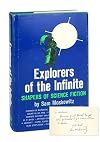
Explorers of the Infinite: Shapers of Science Fiction
by Sam Moskowitz
On This Page
Tags
Recommendations




















Member Reviews
My reaction to reading this book in 2005.
There wasn't a whole lot there that I didn't know except for the letters from other writers about Lovecraft and the stories of others inspired by Lovecraft.
Moskowitz's great strength is the uncovering of a lot of obscure stories and others. His particular interest is tracing the treatment of certain technological and scientific ideas. It's a valid school of sf criticism though I think it's a mistake to think, and I don't think Moskowitz does, sf exists to prophesize.
Most of the chapters are titled with the name of a sf author and were originally published in sf magazines. However, most chapters end by connecting a particular author -- as well as more obscure authors -- to the subject of the show more next chapter. As with most sf criticsm, it makes me want to read a lot of this stuff. Moskowitz sums up a lot of work including non-English language stuff. However, describing Mary Shelley's Frankenstein as combining the travel tale, utopia, and "science story" makes me wonder about the accurateness of those descriptions. I've read Frankenstein twice and recall no element of the utopian in it.
I found the chapters on Hugo Gernsback; M. P. Shiel; Lu Senarens aka Frank Reade, Jr; Edgar Rice Burroughs; Philip Wylie, and Olaf Stapledon of particular interest. Moskowitz details Gernsback importance as an inventor as well as publisher. M. P. Shiel's work, especially The Purple Cloud, seems interesting. The plot descriptions seem to bear out Brian Aldiss' remark, in his Billion Year Spree, that, "if ever there was a racist, it was M. P. Shiel." Jew Moskowitz simply lets Shiel's work speak for itself in its anti-Semitism. Frank Reade, Jr had an amazing career in its early start, prolificness, and financial success. Verne was an admirer. I never paid attention to the dates before, but Reade's adventures started in 1876 with The Steam Man of the Prairies by Edward F. Ellis, a dime novelist (Senarens continued the series to great success); therefore, its steam man and horse is sort of contemporary steampunk.
I was surprised to see how many of Burroughs novels were written to compete with his many imitators in setting and story. Moskowitz's covers the popularity of Wylie as both a fiction writer and, in his attack on "Momism", social critic. Olaf Stapledon's career as fictioneer and philosopher is nicely covered. show less
There wasn't a whole lot there that I didn't know except for the letters from other writers about Lovecraft and the stories of others inspired by Lovecraft.
Moskowitz's great strength is the uncovering of a lot of obscure stories and others. His particular interest is tracing the treatment of certain technological and scientific ideas. It's a valid school of sf criticism though I think it's a mistake to think, and I don't think Moskowitz does, sf exists to prophesize.
Most of the chapters are titled with the name of a sf author and were originally published in sf magazines. However, most chapters end by connecting a particular author -- as well as more obscure authors -- to the subject of the show more next chapter. As with most sf criticsm, it makes me want to read a lot of this stuff. Moskowitz sums up a lot of work including non-English language stuff. However, describing Mary Shelley's Frankenstein as combining the travel tale, utopia, and "science story" makes me wonder about the accurateness of those descriptions. I've read Frankenstein twice and recall no element of the utopian in it.
I found the chapters on Hugo Gernsback; M. P. Shiel; Lu Senarens aka Frank Reade, Jr; Edgar Rice Burroughs; Philip Wylie, and Olaf Stapledon of particular interest. Moskowitz details Gernsback importance as an inventor as well as publisher. M. P. Shiel's work, especially The Purple Cloud, seems interesting. The plot descriptions seem to bear out Brian Aldiss' remark, in his Billion Year Spree, that, "if ever there was a racist, it was M. P. Shiel." Jew Moskowitz simply lets Shiel's work speak for itself in its anti-Semitism. Frank Reade, Jr had an amazing career in its early start, prolificness, and financial success. Verne was an admirer. I never paid attention to the dates before, but Reade's adventures started in 1876 with The Steam Man of the Prairies by Edward F. Ellis, a dime novelist (Senarens continued the series to great success); therefore, its steam man and horse is sort of contemporary steampunk.
I was surprised to see how many of Burroughs novels were written to compete with his many imitators in setting and story. Moskowitz's covers the popularity of Wylie as both a fiction writer and, in his attack on "Momism", social critic. Olaf Stapledon's career as fictioneer and philosopher is nicely covered. show less
Large format "quality" paperback
Ratings
Members
- Recently Added By
Author Information

64+ Works 1,371 Members
Classifications
- Genres
- Literature Studies and Criticism, Fiction and Literature, Biography & Memoir
- DDC/MDS
- 809.3 — Literature & rhetoric Literature, rhetoric & criticism History, description, critical appraisal of more than two literatures Fiction
- LCC
- PN3448 .S45 .M65 — Language and Literature Literature (General) Literature (General) Prose. Prose fiction Special kinds of fiction. Fiction genres
Statistics
- Members
- 40
- Popularity
- 732,811
- Reviews
- 2
- Rating
- (4.40)
- Languages
- English
- Media
- Paper
- ISBNs
- 2
- ASINs
- 3