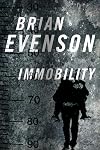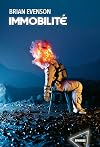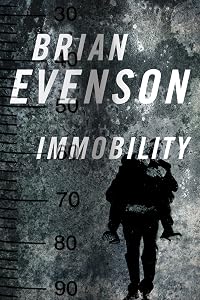
Immobility
by Brian Evenson
On This Page
Description
A post-apocalyptic thriller follows the experiences of a man who wakes up paralyzed with no memory of his life and who is urged by people who say they know him to reclaim a critical object and return to a frozen state before time runs out.Tags
Recommendations












Member Reviews
I don't think I've ever read anything quite like this. Part post-apocalyptic novel, part existentialist treaty, part Kafka-esque nightmare, it is, in its essence, an utterly original work and one of the finest pieces of weird fiction I've read in years.
If you've read Evenson before you'll sort of know what to expect, lots of weirdness, lots of disorientation, razor sharp prose and a wicked sense of humor that's several shades darker than black. Immobility raises all this to truly nightmarish levels to the point where I felt physically queasy throughout the book, yet enjoying the hell out of every moment.
At its heart a quest novel, Evenson uses this basic set up to explore all manner of themes about man and his place in the universe, show more doing this all with a lightness of touch that never once threatens to bog things down. By the end of the novel I truly had a greater appreciation (and fear) of just how precarious our hold on the environment is, and how easily things can slip into meaningless and chaos.
A superb piece of work. show less
If you've read Evenson before you'll sort of know what to expect, lots of weirdness, lots of disorientation, razor sharp prose and a wicked sense of humor that's several shades darker than black. Immobility raises all this to truly nightmarish levels to the point where I felt physically queasy throughout the book, yet enjoying the hell out of every moment.
At its heart a quest novel, Evenson uses this basic set up to explore all manner of themes about man and his place in the universe, show more doing this all with a lightness of touch that never once threatens to bog things down. By the end of the novel I truly had a greater appreciation (and fear) of just how precarious our hold on the environment is, and how easily things can slip into meaningless and chaos.
A superb piece of work. show less
I don't think I've ever read anything quite like this. Part post-apocalyptic novel, part existentialist treaty, part Kafka-esque nightmare, it is, in its essence, an utterly original work and one of the finest pieces of weird fiction I've read in years.
If you've read Evenson before you'll sort of know what to expect, lots of weirdness, lots of disorientation, razor sharp prose and a wicked sense of humor that's several shades darker than black. Immobility raises all this to truly nightmarish levels to the point where I felt physically queasy throughout the book, yet enjoying the hell out of every moment.
At its heart a quest novel, Evenson uses this basic set up to explore all manner of themes about man and his place in the universe, show more doing this all with a lightness of touch that never once threatens to bog things down. By the end of the novel I truly had a greater appreciation (and fear) of just how precarious our hold on the environment is, and how easily things can slip into meaningless and chaos.
A superb piece of work. show less
If you've read Evenson before you'll sort of know what to expect, lots of weirdness, lots of disorientation, razor sharp prose and a wicked sense of humor that's several shades darker than black. Immobility raises all this to truly nightmarish levels to the point where I felt physically queasy throughout the book, yet enjoying the hell out of every moment.
At its heart a quest novel, Evenson uses this basic set up to explore all manner of themes about man and his place in the universe, show more doing this all with a lightness of touch that never once threatens to bog things down. By the end of the novel I truly had a greater appreciation (and fear) of just how precarious our hold on the environment is, and how easily things can slip into meaningless and chaos.
A superb piece of work. show less
In a climactic, post-apocalyptic tale the man finds himself awoken, from what he is told is thirty years on ice. Two main factions have developed in the new world and one has stolen valuable seeds from the other. He has been pulled back from his forever sleep as only he possesses the skill set to bring back the stolen product. He is told he was a fixer of sorts, a detective, in his prior life, one that he has almost total amnesia from, and that he would be unrecognizable to the other tribe and so perfect to get in and out without suspicion. That he is a paraplegic does pose somewhat of a insurmountable problem until two mules are provided, strapping young humanoids bred for this purpose, to get him there and back.
The odds of survival show more in the harsh region is impossible, except for the fact that he appears immune. His mules die off, he makes it back but comes to the realization that the seed he recovered was probably being stolen for the first time. His mission is compromised in his mind. Ass his body heals and he is able to walk once again he surmises the leaders were lying to him, but why? Will he deliver the package and survive? Evenson is a fresh voice in the end-of-the-world sortee on science fiction and a voice to be followed. show less
The odds of survival show more in the harsh region is impossible, except for the fact that he appears immune. His mules die off, he makes it back but comes to the realization that the seed he recovered was probably being stolen for the first time. His mission is compromised in his mind. Ass his body heals and he is able to walk once again he surmises the leaders were lying to him, but why? Will he deliver the package and survive? Evenson is a fresh voice in the end-of-the-world sortee on science fiction and a voice to be followed. show less
Unsettling, unreliable, haunting post-apocalyptic ouroboros.
A men wakes from stasis, memory gone and paralysed from the waist down. His wakers say its a disease, that he is stored waiting for a cure, but now, in spite of his immobility he can help them. It could speed up his cure. He must travel, carried into the wasteland by “mules” to take back something stolen, something needed for the community to survive.
Evenson’s haunting imagery and sparse style make a perfect psychological horror. This story is unsettling, the questions it raises roll through you and chill you. The world filtered through a muddled memory is fantastic: desolate scenery saturated in radiation, pockmarks of hope, sudden terror. There are the "mules" who take show more him, those who hide humanities secrets in their underground bunker and those who loop their lives never-ending. Optimist or pessimist the philosophy cannot be ignored and overshadows all and gives an intriguing story a delicious dark weight.
The only issues seem to be that Evenson tries to make the story into a twisting thing, when (as its not unobvious) it would deepen the atmosphere to underline and foreshadow it. An issue with 1st person narrative perhaps? We know what he doesn't, but then shouldn't he suspect?
Recommended. Fans of post-apocalyptic futures and quiet horror will find something here but so too will those for those who like thoughtful fare.
“We say no to torture, and then we find a reason to torture in the name of democracy. . . . We say no to eight million dead in camps, and then we do it again, twelve million dead in gulags. Humans are poison. Perhaps it would be better if we did not exist at all.”
"What we have here is the history of the human race, a record of births and deaths for hundreds and hundreds of years.”
“Why?” asked Horkai.
“What do you mean, why?” Mahonri responded. “Humanity is important. All these things must be preserved so that, when the time comes, humanity shall know what it has been, is, and will be.” show less
A men wakes from stasis, memory gone and paralysed from the waist down. His wakers say its a disease, that he is stored waiting for a cure, but now, in spite of his immobility he can help them. It could speed up his cure. He must travel, carried into the wasteland by “mules” to take back something stolen, something needed for the community to survive.
Evenson’s haunting imagery and sparse style make a perfect psychological horror. This story is unsettling, the questions it raises roll through you and chill you. The world filtered through a muddled memory is fantastic: desolate scenery saturated in radiation, pockmarks of hope, sudden terror. There are the "mules" who take show more him, those who hide humanities secrets in their underground bunker and those who loop their lives never-ending. Optimist or pessimist the philosophy cannot be ignored and overshadows all and gives an intriguing story a delicious dark weight.
The only issues seem to be that Evenson tries to make the story into a twisting thing, when (as its not unobvious) it would deepen the atmosphere to underline and foreshadow it. An issue with 1st person narrative perhaps? We know what he doesn't, but then shouldn't he suspect?
Recommended. Fans of post-apocalyptic futures and quiet horror will find something here but so too will those for those who like thoughtful fare.
“We say no to torture, and then we find a reason to torture in the name of democracy. . . . We say no to eight million dead in camps, and then we do it again, twelve million dead in gulags. Humans are poison. Perhaps it would be better if we did not exist at all.”
"What we have here is the history of the human race, a record of births and deaths for hundreds and hundreds of years.”
“Why?” asked Horkai.
“What do you mean, why?” Mahonri responded. “Humanity is important. All these things must be preserved so that, when the time comes, humanity shall know what it has been, is, and will be.” show less
Good
Josef Horkai is awoken from storage half paralysed. Those that wake him inform him that something has been stolen from them, that he is a fixer and that he must get it back. The world has been destroyed by catastrophe and only he can make the journey outside, carried by two men in hazard suits that they refer to as mules. What they tell him doesn’t quite add up but he sees little choice in believing and helping them. He has to get it back soon and hurry back so they can freeze him again before his own time runs out from a creeping paralysis that they can slow but not stop.
Evenson creates an atmospheric book from this premise, with a protagonist that knows very little and explores the world with nearly new eyes. The desolate show more blasted landscape is brought vividly to life and a selection of odd characters inhabit it, Evenson’s prose is stark and well suited to the subject matter and the book, as well as having a quest like structure meditates on some deep philosophical existensialisms. There are some issues, the protagonist seems a little too clueless perhaps and the twisted tale could have been straighter and had just as much, if not more, impact. However these are very minor niggles and on the whole this is a great book.
Overall – Stark, philosophical, apocalyptic. Not your run of the mill SF. A tale beautifully told. show less
Josef Horkai is awoken from storage half paralysed. Those that wake him inform him that something has been stolen from them, that he is a fixer and that he must get it back. The world has been destroyed by catastrophe and only he can make the journey outside, carried by two men in hazard suits that they refer to as mules. What they tell him doesn’t quite add up but he sees little choice in believing and helping them. He has to get it back soon and hurry back so they can freeze him again before his own time runs out from a creeping paralysis that they can slow but not stop.
Evenson creates an atmospheric book from this premise, with a protagonist that knows very little and explores the world with nearly new eyes. The desolate show more blasted landscape is brought vividly to life and a selection of odd characters inhabit it, Evenson’s prose is stark and well suited to the subject matter and the book, as well as having a quest like structure meditates on some deep philosophical existensialisms. There are some issues, the protagonist seems a little too clueless perhaps and the twisted tale could have been straighter and had just as much, if not more, impact. However these are very minor niggles and on the whole this is a great book.
Overall – Stark, philosophical, apocalyptic. Not your run of the mill SF. A tale beautifully told. show less
This isn't something I would normally pick up when browsing the stacks, but I was intrigued by a review I read on NPR. The setting of the story is a post-apocalyptic world where nearly all life on the exposed surface of the planet has been destroyed. It is into this world that a man is brought out of statis. He has very little recollection of life before being stored, and cannot remember his name before threatening it out of the technician who roused him. He is also paralyzed from the waist down, and learns that his condition will spread to the rest of his body without treatment. The leader of the community into which Horkai has awoken tells him that there is a task which only he can accomplish, and Horkai, having little other choice or show more reason to refuse, accepts.
The story is quick paced, with short chapters and plenty of action. I raced through it in a morning, just as impatient as Horkai to know and understand what had happened. There is plenty to be unpacked here, as the genre of post-apocalypic fiction tends to raise questions such as, "Why should the human race be allowed to continue?" "Who should decide what society is?" "How do we know what, and who, is right and wrong?" A provoking piece of fiction, albeit a short one. show less
The story is quick paced, with short chapters and plenty of action. I raced through it in a morning, just as impatient as Horkai to know and understand what had happened. There is plenty to be unpacked here, as the genre of post-apocalypic fiction tends to raise questions such as, "Why should the human race be allowed to continue?" "Who should decide what society is?" "How do we know what, and who, is right and wrong?" A provoking piece of fiction, albeit a short one. show less
Josef Horkai has been awoken from storage after thirty years to aid the community. Only he can safely venture forth into the ruined landscape, and return with an item could mean the future of humanity. Evenson weaves a carefully constructed tale of a dystopian future where trust is a rare commodity and answers are a thing of the past. I was immediately drawn into Evenson's novel, and couldn't wait each day to get back to this book.
Members
- Recently Added By
Lists

to get
244 works; 2 members

Shirley Jackson Award Winners and Shortlist 2007-2020
77 works; 6 members
Author Information

64+ Works 4,116 Members
Brian Evenson is the author of five books of fiction. He is a senior editor for Conjunctions magazine and the director of creative writing at the University of Denver. Evenson lives in Denver
Awards and Honors
Awards
Common Knowledge
- First words
- When they first woke him, he had the impression of the world becoming real again and he himself along with it.
- Quotations
- “We say no to torture, and then we find a reason to torture in the name of democracy. . . . We say no to eight million dead in camps, and then we do it again, twelve million dead in gulags. Humans are poison. Perhaps it wou... (show all)ld be better if we did not exist at all.”
"What we have here is the history of the human race, a record of births and deaths for hundreds and hundreds of years.”
“Why?” asked Horkai.
“What do you mean, why?” Mahonri responded. “Humanity is important... (show all). All these things must be preserved so that, when the time comes, humanity shall know what it has been, is, and will be.”
Classifications
Statistics
- Members
- 266
- Popularity
- 121,647
- Reviews
- 16
- Rating
- (3.52)
- Languages
- English, French
- Media
- Paper, Audiobook, Ebook
- ISBNs
- 8
- ASINs
- 3