
Siren: A Selection from Dino Buzzati
by Dino Buzzati
On This Page
Description
Uses surrealism to tell the stories of murders, confessions, an automobile plague, censorship, a flying carpet, a time machine, and a mysterious companion.Tags
Recommendations



























Member Recommendations
Member Reviews
When you read Buzzati it's natural to think of the works of Borges and Kafka, but I think I'd pick Buzzati over either one. His short stories explore a greater range of emotions and tones than Kafka's work, and while he can write the stories about stories that rival those of Borges, he also imbues his works with a greater sense of pure enjoyment in the actual act of telling a story. Calvino still trumps him in my book, but Buzzati is certainly someone that deserves to be more widely read and appreciated than he is.
The Siren is a good collection, albeit not his best, but nevertheless there are some great stories here. The Gnawing Worm is a story that could have come from Kafka himself, but then Buzzati follows it up with The Time show more Machine, which is a work of science fiction, not something I've come across Buzzati having written before, done masterfully. Shortly thereafter is The Flying Carpet, a great little story that makes our mundane world a bit more magical. The Prohibited Word tackles the idea of a bizarre totalitarian society but with a twist: the ending is not one of individual powerlessness in the face of such organizations (think 1984 or Brave New World), but instead shows the protagonist successful at outsmarting the system. Kafka's House acknowledges the comparison between Kafka and Buzzati, but the ending lines show how Buzzati is a master in his own right and has his own style.
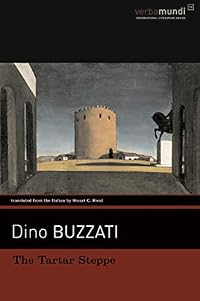
Again, though, not his best collection, and that's for two reasons: first, almost half the book is taken up by a single story, Barnabas of the Mountains, and while it has it's moments, overall it brings to mind Buzzati's longer work, The Tartar Steppe. Both feature military men guarding a remote outpost, both explore the ideas of great expectations being frustrated, and both ultimately arrive at a conclusion that's actually rather uplifting given the content of the story. They both have the ending message that a life can still have been a successful life even if it doesn't include some great triumph- it's having done one's duty that matters, not the glory that we picture in our daydreams. Overall, though, The Tartar Steppe is a better work, exploring the lack of control a person has over his fate, while Barnabas of the Mountains actually emphasizes the agency of the lead character. To me The Tartar Steppe overshadowed Barnabas of the Mountains. My second criticism is simply that this collection contains fewer stories than Buzzati's other ones, and I wanted more. Needless to say, this is not a severe criticism.
Even Buzzati's worst stories are interesting and put most other authors' to shame. If somehow you've found your way to the end of this review but haven't read any Buzzati, then I implore you to correct that deficiency as soon as you can. show less
The Siren is a good collection, albeit not his best, but nevertheless there are some great stories here. The Gnawing Worm is a story that could have come from Kafka himself, but then Buzzati follows it up with The Time show more Machine, which is a work of science fiction, not something I've come across Buzzati having written before, done masterfully. Shortly thereafter is The Flying Carpet, a great little story that makes our mundane world a bit more magical. The Prohibited Word tackles the idea of a bizarre totalitarian society but with a twist: the ending is not one of individual powerlessness in the face of such organizations (think 1984 or Brave New World), but instead shows the protagonist successful at outsmarting the system. Kafka's House acknowledges the comparison between Kafka and Buzzati, but the ending lines show how Buzzati is a master in his own right and has his own style.
Again, though, not his best collection, and that's for two reasons: first, almost half the book is taken up by a single story, Barnabas of the Mountains, and while it has it's moments, overall it brings to mind Buzzati's longer work, The Tartar Steppe. Both feature military men guarding a remote outpost, both explore the ideas of great expectations being frustrated, and both ultimately arrive at a conclusion that's actually rather uplifting given the content of the story. They both have the ending message that a life can still have been a successful life even if it doesn't include some great triumph- it's having done one's duty that matters, not the glory that we picture in our daydreams. Overall, though, The Tartar Steppe is a better work, exploring the lack of control a person has over his fate, while Barnabas of the Mountains actually emphasizes the agency of the lead character. To me The Tartar Steppe overshadowed Barnabas of the Mountains. My second criticism is simply that this collection contains fewer stories than Buzzati's other ones, and I wanted more. Needless to say, this is not a severe criticism.
Even Buzzati's worst stories are interesting and put most other authors' to shame. If somehow you've found your way to the end of this review but haven't read any Buzzati, then I implore you to correct that deficiency as soon as you can. show less
Ratings
Members
- Recently Added By
Author Information

243+ Works 8,111 Members
Born in Belluno in the region of Veneto, in northern Italy, Dino Buzzati received his law degree from the University of Milan, but never practiced law. Beginning in 1928, he worked as an editor and journalist for the Milanese daily newspaper Il Corriere della Sera. His first work of fiction, Barnabo delle montagne (Barnaby of the Mountains) show more (1933), established Buzzati as an inventive writer who evoked the mysteries of ordinary life. Buzzati never linked himself to any literary movement or style, preferring to seek the fantastic and the extraordinary in his often commonplace characters and locales. A talented short story writer, Buzzati published most of his short fiction in Sessanta Racconti (1958), which was partially translated into English as Catastrophe. Here, Buzzati increasingly employs urban settings where machines, instead of quasi-mythical monstrous beings, populate a supernatural world. Buzzati died in 1972. (Bowker Author Biography) show less
Some Editions
Common Knowledge
- Original publication date
- 1984 (English collection) (English collection)
Classifications
- Genres
- Fiction and Literature, General Fiction, Fantasy
- DDC/MDS
- 853.912 — Literature & rhetoric Italian, Romanian & related literatures Italian fiction 1900- 20th Century 1900-1945
- LCC
- PQ4807 .U83 .S55 — Language and Literature French, Italian, Spanish and Portuguese literatures Italian literature Individual authors, 1900-1960
Statistics
- Members
- 57
- Popularity
- 536,822
- Reviews
- 1
- Rating
- (4.10)
- Languages
- English
- Media
- Paper
- ISBNs
- 1


