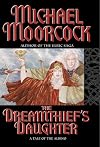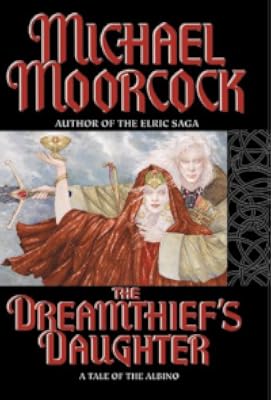
The Dreamthief's Daughter
by Michael Moorcock
The Albino Underground (1), Elric (novel 7), The Eternal Champion (Elric novel 7)
On This Page
Description
The first new "Eternal Champion" novel in ten years and a major fantasy publishing event, "The Dreamthief's Daughter" continues the highly successful Elrick Saga. The Count Ulric von Bek meets a figure known to him only in dreams--Elrick of Melnibon, the wandering Prince of Ruins. Somehow the same person, yet separate, their very beings fuse spectacularly. Now the never-ending struggle between Law and Chaos must be fought in both their universes..
Tags
Recommendations




















Member Reviews
My reactions to reading this book in 2001. Spoilers follow.
The struggle between Chaos and Order in Moorcock's vast multiverse is too vague to give much weight to his allegorical musings. The two sides can stand in for any number of opposites: male and female, anarchy and totalitarianism, reason and mysticism, violence and pacifism, fascism and democracy. But the vagueness seriously undercuts any political points Moorcock is trying to make about just societies other than oblique references to Ronald Reagan and, perhaps, Margaret Thatcher (he's not a fan of either). However, as a dramatic device, a serious version of the old Commedia dell'Arte, it is very effective.
Moorcock, despite the frequent, almost deus ex machina invocations of show more various magical spells and objects, has a narrative drive that pulls you along as familiar archetypes play their traditional roles but usually with some new variation brought on by the desire, and sometimes conscious will, to alter the role they play in the various incarnations of the multiverse. Chaos and Order take on new meanings, new methods of balancing them are evoked. There is little point in trying to, given the infinity of scales and branching alternatives, to pick the stories apart for consistency of the various Eternal Champions chronologies or find consistent allegorical functions for the heroes and villains. Most of the gang from Moorcock's Eternal Champion cycle, Blood series, and Multiverse comic book (all part of the vast Multiverse) get mentions.
The hero and narrator is Ulric, Graf von Bek, an alternate version (both have spent time in Nazi concentration camps) of the von Bek in Moorcock's Dragon in the Sword. Elric is here as alter ego and, perhaps, ancestor to von Bek. Paul von Minct aka Gaynor the Damned shows up in his traditional role of the ultimate powerseeker, here a character who tries to doublecross, to his own doom, both the Gods of Law and Chaos. Reynard the philosophical Fox shows up briefly as do Rackhir the Archer, Moonglum, Oswald Bastable and, most importantly, one Oona, the titular dreamthief's daughter (and the daughter of Elric) whose name echoes Una Persson of the Bastable adventures and mentioned in some Jerry Cornelius stories (and a Cornelius is briefly mentioned).
The book effectively mixes adventures in other realms (including the underground realm of Mu Ooria whose name, probably not coincidentally, echoes Lemuria) with the Nazi Germany of the late 30s and 1940, including an original attack by Elric on a massive German air fleet with his dragons. The Nazi elite, including Hess who comes in for the most sympathetic treatment of all the Nazis (depicted simply as a deluded, romantic madman) want the Holy Grail in order to assure victory. Gaynor wants it and other magic artifacts, particularly another version of Stormbringer, Ravenbrand, and a white sword, its opposite, for his own ambitious schemes. Moorcock effectively loops his story back, in the middle, to explain how Elric has to become a ghostly avatar to help von Bek in the beginning part of the novel so von Bek can free him from a sorcerously induced coma.
Most of the books power lies in how Moorcock adds to his previous mega-novel that is his Multiverse work. The philosophical, introspective, calculating, rational von Bek is merged, for awhile, with the impulsively violent, cruel, sorceror Elric. Elric has choosen to forget his adventures in other worlds outside of his own plane (except in dreams), but von Bek remembers their merging and gains a great appreciaion for Elric's pain in being torn between his own ethics (which cause him to destroy his own empire Melnibone and express genuine affection for his daughter, Oona) and his upbringing in a cruel, callous but learned culture. Moorcock also effectively makes the Grail an ambigous symbol. It brings piece, reconciliation between warring sides, but it may very well require, as Klosterheim (who, in most of the Multiverse stories seems to serve Chaos) and Gaynor claim, the blood of innocents, a seeming allegory for good coming from the carnage of war.
Moorcock is less convincing in his portrayal of Nazi evil choosing to take the hackneyed line of Hitler and his followers as cowards afraid of life, small men riding a wave of luck and drunk on romantic ideals. It's a typically liberal view of evil that can't seem to imagine evil as the product of strong, amoral men more concerned with their own desires than ethics and the lives of others. However, Moorcock is right that romantic ideals can be very destructive when coupled with a will to power and the need to impose the vision on the world. show less
The struggle between Chaos and Order in Moorcock's vast multiverse is too vague to give much weight to his allegorical musings. The two sides can stand in for any number of opposites: male and female, anarchy and totalitarianism, reason and mysticism, violence and pacifism, fascism and democracy. But the vagueness seriously undercuts any political points Moorcock is trying to make about just societies other than oblique references to Ronald Reagan and, perhaps, Margaret Thatcher (he's not a fan of either). However, as a dramatic device, a serious version of the old Commedia dell'Arte, it is very effective.
Moorcock, despite the frequent, almost deus ex machina invocations of show more various magical spells and objects, has a narrative drive that pulls you along as familiar archetypes play their traditional roles but usually with some new variation brought on by the desire, and sometimes conscious will, to alter the role they play in the various incarnations of the multiverse. Chaos and Order take on new meanings, new methods of balancing them are evoked. There is little point in trying to, given the infinity of scales and branching alternatives, to pick the stories apart for consistency of the various Eternal Champions chronologies or find consistent allegorical functions for the heroes and villains. Most of the gang from Moorcock's Eternal Champion cycle, Blood series, and Multiverse comic book (all part of the vast Multiverse) get mentions.
The hero and narrator is Ulric, Graf von Bek, an alternate version (both have spent time in Nazi concentration camps) of the von Bek in Moorcock's Dragon in the Sword. Elric is here as alter ego and, perhaps, ancestor to von Bek. Paul von Minct aka Gaynor the Damned shows up in his traditional role of the ultimate powerseeker, here a character who tries to doublecross, to his own doom, both the Gods of Law and Chaos. Reynard the philosophical Fox shows up briefly as do Rackhir the Archer, Moonglum, Oswald Bastable and, most importantly, one Oona, the titular dreamthief's daughter (and the daughter of Elric) whose name echoes Una Persson of the Bastable adventures and mentioned in some Jerry Cornelius stories (and a Cornelius is briefly mentioned).
The book effectively mixes adventures in other realms (including the underground realm of Mu Ooria whose name, probably not coincidentally, echoes Lemuria) with the Nazi Germany of the late 30s and 1940, including an original attack by Elric on a massive German air fleet with his dragons. The Nazi elite, including Hess who comes in for the most sympathetic treatment of all the Nazis (depicted simply as a deluded, romantic madman) want the Holy Grail in order to assure victory. Gaynor wants it and other magic artifacts, particularly another version of Stormbringer, Ravenbrand, and a white sword, its opposite, for his own ambitious schemes. Moorcock effectively loops his story back, in the middle, to explain how Elric has to become a ghostly avatar to help von Bek in the beginning part of the novel so von Bek can free him from a sorcerously induced coma.
Most of the books power lies in how Moorcock adds to his previous mega-novel that is his Multiverse work. The philosophical, introspective, calculating, rational von Bek is merged, for awhile, with the impulsively violent, cruel, sorceror Elric. Elric has choosen to forget his adventures in other worlds outside of his own plane (except in dreams), but von Bek remembers their merging and gains a great appreciaion for Elric's pain in being torn between his own ethics (which cause him to destroy his own empire Melnibone and express genuine affection for his daughter, Oona) and his upbringing in a cruel, callous but learned culture. Moorcock also effectively makes the Grail an ambigous symbol. It brings piece, reconciliation between warring sides, but it may very well require, as Klosterheim (who, in most of the Multiverse stories seems to serve Chaos) and Gaynor claim, the blood of innocents, a seeming allegory for good coming from the carnage of war.
Moorcock is less convincing in his portrayal of Nazi evil choosing to take the hackneyed line of Hitler and his followers as cowards afraid of life, small men riding a wave of luck and drunk on romantic ideals. It's a typically liberal view of evil that can't seem to imagine evil as the product of strong, amoral men more concerned with their own desires than ethics and the lives of others. However, Moorcock is right that romantic ideals can be very destructive when coupled with a will to power and the need to impose the vision on the world. show less
The Dreamthief's Daughter
by Michael Moorcock
Earthlight, 342 pages, hardback, 2001
In pre-WWII Germany, with the Nazis on the ascendant, Count
Ulric von Bek is one of the many who look upon developments with
dismay — but a largely passive dismay, for fear of the
bully-boys. He is not allowed to continue thus, however, for the
Nazis, in the person of his cousin Prince Gaynor von Minct, seek
the ancestral sword of the von Bek family, Ravenbrand, as well as
the Holy Grail, also entrusted to the family but reputedly lost
by von Bek's mad father. Von Bek contacts the Resistance, and,
with the enigmatic Herr El and the lovely wildling Oona, who is
like himself an albino, makes plans to retain the status quo.
Another albino appears frequently to von Bek show more in dreams and
visions — a berserk-seeming figure who has a savage cast to
him.
Before much can come of any Resistance schemes, Gaynor has
von Bek thrown into a concentration camp where, despite physical
torture, he declines to reveal the location of Ravenbrand. At
length, as he nears death, the albino of his dreams appears
magically with Oona and an enigmatic British agent, Oswald
Bastable, to free him. They flee to Hameln where, … la
Pied Piper, von Bek splits open a rock using the regained
Ravenbrand and they enter a subterranean realm, Mu-Ooria,
populated by the mentally superhuman Off-Moo. Here they are
pursued by Gaynor and his Nazi demon sidekick Klosterheim.
And here, too, the mysterious dream albino — who is of
course Elric of Melnibon‚ — gains a greater reality, in due
course managing to combine himself with von Bek so that the two
become one. The dual entity returns to Tanelorn, where as Elric
it discovers that Gaynor has ambitions far beyond the mundane
ones of the Nazis: through forming a duplicitous alliance with
the Goddess of Law, Miggea, Gaynor hopes to overthrow Chaos and
gain the rule of all the multiverse. Elric, as an arch-prince of
Chaos, must resist him.
The remainder of this tale twines its way absorbingly through
various aspects of the multiverse — Moorcock's great
conceptual creation, the myriad related worlds in which stories
are eternally played and replayed, with archetypes as the puppets
of unknown puppeteers. In the end, of course, the balance between
Chaos and Law is restored, at least for now.
The novel (although divided into three) has essentially four
parts: von Bek's time in pre-War Germany; his and Oona's
adventures in Mu-Ooria; the adventures of Elric and of the dual
Elric/von Bek entity in and around Tanelorn; and the long,
complex final section in which Elric, von Bek and the ever-
resourceful Oona — who is Elric's daughter by the dreamthief
Oone, and with whom von Bek, despite an uneasy sensation of
incest (for he and Elric are alter egos), falls in love —
journey between the worlds and bring a resolution to the main
conflict while also, in the conflict of this world, bringing a
resolution of sorts by turning the tide of the Battle of Britain
back against the Luftwaffe.
The four sections succeed to greater and lesser (mostly
greater) extents. The Mu-Ooria sequences, with their Edgar Rice
Burroughsian ambience, in the telling hark back even further, to
the sort of 19th- or even 18th-century otherworld fantasy in
which the otherworld itself is deemed to be of such marvel that
the reader is intended to be entertained by somewhat painstaking,
plodding accounts of the geography and populace rather than any
plot advancement. There are longueurs here and also a sense of
alienation on the writer's part, as if Moorcock recognized while
writing them that the sequences were failing to lift off the
ground but could not abandon them because this section of the
book is integral to the rest.
That rest, by contrast, in general sings. Von Bek's
experiences in Nazi Germany, and his growing knowledge that he is
part of a greater mystery, are as gripping as any World War II
adventure story. The sequences where Elric and later the dual
entity must quest, with Moonglum, through the bleak and alien
world into which the goddess Miggea has transplanted Tanelorn,
like an orchid into a desert, are superbly conceived High Fantasy
and eerily evoke the dream-sense; while the long concluding
section — with the small exception of the clumsily handled,
contrived-seeming sequence in which a dragon-mounted Elric and
von Bek attack the advancing waves of the Luftwaffe, thereby
giving rise to the legend of the Dragons of Wessex —
demonstrates why Moorcock possesses the towering status he does
in any consideration of the history of fantasy. In this final
section he is creating new structures of fantasy, rather than
recrudescing the old — a rare achievement, alas, in the
modern genre.
Of great interest throughout is the question of
identity and the workings, through the nature of the
multiverse, of not just the multiplicity of a single identity but
the coalescing into a single identity of a multiplicity; one has
the sensation, reading this book, of this going on all the time
in a kind of endless flow, as reality itself shifts and twists
— rather like an analogy of the impermanent alliances the
villain Gaynor forges with the different gods. Von Bek is at one
and the same time both Elric and not-Elric, and that duality
persists even once their two identities have fused. (The same
obviously is true of Elric, who is both von Bek and not-von Bek.)
Elric's sword Stormbringer and the von Bek family's sword
Ravenbrand have a single identity, even though they are
physically twain and remain so, even when in proximity. Oona is
both a daughter and a lover to the double identity that is Elric-
von Bek. Gaynor is at one and the same time a human being and an
eternal Evil Principle. There are other examples.
That this is in fact a true nature of reality is plausible in
a post-Heisenberg frame of reference (whose analogue might be
Chaos, by contrast with Newtonian-style Law), which sees identity
as a transient property, dependent upon, among other factors, the
act of perception. It is pleasing to see such notions worked out
in a novel of, ostensibly, High Fantasy — not a subgenre
noted for its deployment of scientific thinking, and indeed
generally marked by antiscientism.
This is also an intensely political novel. Time and again
Moorcock explores the motivations behind the parasitic quest of
tyrants for power and their obsessional need to stamp order (Law)
on that which should not be ordered — to wit,
humanity. The relevance of this is obvious when Nazism is the
despotism under consideration; but there are not so subtly
encoded references to other, more recent, "democratic despots" of
the Right. The name of the Goddess of Law, Miggea, seems a clear
anagrammatic reference to Maggie/Margaret Thatcher, a political
figure who while in power earned the public hatred (or fear) of
many surprisingly disparate creators. Here, for example, is
Moorcock's description of the world Miggea and her rule of Law
have created:
Miggea's was no ordinary desert. It was all that remained of
a world destroyed by Law. Barren. No hawks soared in the pale
blue sky. Not an insect. Not a reptile. No water. No lichen. No
plants of any kind. Just tall spikes of crystallized ash and
limestone, crumbling and turned into crazy shapes by the wind,
like so many grotesque gravestones.
Later Herr El (aka Prince Lobkowitz), in talking of the rise
of the Nazis but also of any regime of obdurate Law, however
convivial its veneer — any regime that pretends the
solutions to complex problems are simple, and then imposes
through the use of power or force those simple, but (or hence)
profoundly wrong solutions on the world — is the
mouthpiece for a sideswipe at Thatcher's American counterpart:
They are the worst kind of self-deceiving cowards and
everything they build is a ramshackle sham. They have the taste
of the worst Hollywood producers and the egos of the worst
Hollywood actors. We have come to an ironic moment in history, I
think, when actors and entertainers determine the fate of the
real world.
Moorcock's contempt for the politicians of Law is of course
allowed to be seen more naked when the subjects under
consideration are safely distant in history, like the Nazis and
(in brief references) the Stalinist despots of Soviet Russia.
Late in the book there is a long and hilariously — though
darkly, bitterly — satirical scene in which a disguised von
Bek, inadvertently thrust into a car with Rudolf Hess, must
listen to an interminable outflow of arrant, antiscientific,
credulously ignorant nonsense from the Deputy Fuehrer. Hess and
by implication his colleagues in the Nazi hierarchy are portrayed
as what Brian Stableford has termed "lifestyle fantasists", the
attempted reification of their particular brand of insane and
simplifying fantasies involving, of course, untold human
suffering. Hence Elric's — and one presumes Moorcock's
— detestation of Law and adherence to Chaos.
As mentioned, there are some doldrums in this book, but they
are in a relatively early part of it and easily ploughed through.
Overall, The Dreamthief's Daughter is mightily impressive
not just as a demonstration of the fantasticating imagination in
full flight but because of all the different aspects of meaning
which it embodies — analogues, in a way, of the myriad
diversely aspected worlds of the multiverse. It is one of those
rare fantasies that merits repeated reading with, each time, a
different facet of its full meaning to be derived.
This review, first published by Infinity Plus, is
excerpted from my ebook Warm Words and Otherwise: A Blizzard
of Book Reviews, to be published on September 19 by Infinity
Plus Ebooks. show less
Wonderful example of what fantasy can be. Set in an alternative Europe during the 2nd World War, we're treated to a gritty, semi-realistic kind of historical fantasy. The world is almost(but not quite) recognizable as our own interlaced with sorcery and mythical beasts and strange cities and lands that still manage to feel real and with characters that seem alive and real, drawing emotion from the reader and persuading us to care about them.
I picked this up from a charity shop as an accidental find but vaguely remember reading some of the Von Bek novels when I was younger. I've picked up the first Von Bek now in kindle format and hope for good things from it if it's anything like as good as this.
Very enjoyable alternate historical show more fantasy. Recommended. show less
I picked this up from a charity shop as an accidental find but vaguely remember reading some of the Von Bek novels when I was younger. I've picked up the first Von Bek now in kindle format and hope for good things from it if it's anything like as good as this.
Very enjoyable alternate historical show more fantasy. Recommended. show less
At first glance may seem to give in to the race toward higher page counts evidenced by the average fantasy book over the last decades compared to the slimmer Elric volumes I originally read (most of them collections of short stories or novellas at that).
And indeed the expanded page space makes for a quite different experience, maybe not an "improvement" but just as good as the better tales in its own way.
Most noticeably, more (and more detailed) insights into characters' essences and motivations, sometime distilled over a few scenes rather than just the one line of dialog, gesture or tantalizing hint. This doesn't feel like bloat though, the pacing is still fairly brisk and mostly spot-on.
Not a good entry point to Elric IMHO, as this show more reunites characters probably better enjoyed with at least a dim remembrance of their past appearances, such as Gaynor, who might feel a lot flatter for someone who didn't have the opportunity to come across him as an antagonist in the Corum books. show less
And indeed the expanded page space makes for a quite different experience, maybe not an "improvement" but just as good as the better tales in its own way.
Most noticeably, more (and more detailed) insights into characters' essences and motivations, sometime distilled over a few scenes rather than just the one line of dialog, gesture or tantalizing hint. This doesn't feel like bloat though, the pacing is still fairly brisk and mostly spot-on.
Not a good entry point to Elric IMHO, as this show more reunites characters probably better enjoyed with at least a dim remembrance of their past appearances, such as Gaynor, who might feel a lot flatter for someone who didn't have the opportunity to come across him as an antagonist in the Corum books. show less
I was a huge fan of this author in my youth and I still recall the original Elric saga and the other books I read at the time fondly, but this return to his work after so many years was a disappointment.
I actually enjoyed the first third or so of this story quite a bit. There is no fantastical aspect yet, and it depicts Count Ulric of Bek's view of the rise of Nazism in his beloved Germany. Ulric's ambitious cousin Gaynor has joined up with Hitler, though he sees him only as a stepping stone to something greater. He demands Ulric turn over a family heirloom, the sword Ravenbrand, but Ulric, seeing the Nazis for what they are, refuses, and is thrown into prison and then a concentration camp for his trouble.
It's once Elric shows up and show more teams with Ulric (initially occupying the same body) that I began to become bored. The main reason is that Elric, last prince of Melniboné, has ties to many patron gods, and can call on them any time he gets into a fix and needs a hand. And so he does. This recurring deus ex machina sucks any drama or tension out of the story. There's also a lot of smaller scale mystical hand-waving stuff that had the same effect. After the first act, I felt no weight to any of the action. Even the ending doesn't require much on Elric's or Ulric's part.
I guess I would have preferred this as a pure historical novel, or at least something a bit more down to earth. show less
I actually enjoyed the first third or so of this story quite a bit. There is no fantastical aspect yet, and it depicts Count Ulric of Bek's view of the rise of Nazism in his beloved Germany. Ulric's ambitious cousin Gaynor has joined up with Hitler, though he sees him only as a stepping stone to something greater. He demands Ulric turn over a family heirloom, the sword Ravenbrand, but Ulric, seeing the Nazis for what they are, refuses, and is thrown into prison and then a concentration camp for his trouble.
It's once Elric shows up and show more teams with Ulric (initially occupying the same body) that I began to become bored. The main reason is that Elric, last prince of Melniboné, has ties to many patron gods, and can call on them any time he gets into a fix and needs a hand. And so he does. This recurring deus ex machina sucks any drama or tension out of the story. There's also a lot of smaller scale mystical hand-waving stuff that had the same effect. After the first act, I felt no weight to any of the action. Even the ending doesn't require much on Elric's or Ulric's part.
I guess I would have preferred this as a pure historical novel, or at least something a bit more down to earth. show less
This book is, at its essence, a book that ties together many of the characters and story lines that Moorcock has introduced into his multiverse of the years. We meet Count Ulric von Bek - but not the original Ulric who fought for Satan all those years ago. This Ulric von Bek is some four to five hundred years removed from that one. And, of course, this Ulric von Bek is Elric - an albino; reclusive; isolated; distant father killed early on; keeper of a black sword.
We meet Klosterheim again and Gaynor and Oona's daughter who somewhat oddly becomes Ulric von Bek's wife (if he's Elric, does that make Oona (the daughter) his daughter too? The threads get very tangled.) We also see Bastable (if only for a short while).
The basic idea is that show more the story begins just before the rise of the Third Reich in Germany. Von Bek does not support the Nazis, but his cousin, Gaynor, does. The Nazis are interested in acquiring poitical, military and spiritual power. In their search for the third, the are interested in finding two items commonly associated with the Von Beks - the black sword and Holy Grail.
Von Bek is aided by Oona and Bastable to escape into the MIttlemarch where he comes to terms with the Nazi ambitions, his own place in the multiverse and the truth of the Grail and Sword.
I found this book to be very interesting; very compelling. It was quite different from most of the other Elric books - simply because of the size almost 350 pages compared to the 40 or 50 pages that most Elric stories clock in at. We get a lot more background and a lot more description. We get to see more characters and more motivations. On the down side, we also get more philosophizing on the nature of the multiverse (which I probably could have used less of).
All in all, I was very pleased with this book. Looking forward to the next in the series. show less
We meet Klosterheim again and Gaynor and Oona's daughter who somewhat oddly becomes Ulric von Bek's wife (if he's Elric, does that make Oona (the daughter) his daughter too? The threads get very tangled.) We also see Bastable (if only for a short while).
The basic idea is that show more the story begins just before the rise of the Third Reich in Germany. Von Bek does not support the Nazis, but his cousin, Gaynor, does. The Nazis are interested in acquiring poitical, military and spiritual power. In their search for the third, the are interested in finding two items commonly associated with the Von Beks - the black sword and Holy Grail.
Von Bek is aided by Oona and Bastable to escape into the MIttlemarch where he comes to terms with the Nazi ambitions, his own place in the multiverse and the truth of the Grail and Sword.
I found this book to be very interesting; very compelling. It was quite different from most of the other Elric books - simply because of the size almost 350 pages compared to the 40 or 50 pages that most Elric stories clock in at. We get a lot more background and a lot more description. We get to see more characters and more motivations. On the down side, we also get more philosophizing on the nature of the multiverse (which I probably could have used less of).
All in all, I was very pleased with this book. Looking forward to the next in the series. show less
Like most of Moorcock's books, there's a long exposition of the protagonist/narrator's history and his position with in the Eternal Champion cycle and this one is no different. It can be intimidting for a first time reader. But the payoff is tremendous as Count Ulric von Bek squares off aginst the Third Reich.
Members
- Recently Added By
Lists

Books Read in 2023
5,547 works; 145 members

Books Read in 2019
4,052 works; 110 members
Author Information

659+ Works 65,126 Members
Michael Moorcock, 1939 - Writer Michael Moorcock was born December 18, 1939 in Mitcham, Surrey, England. Moorcock was the editor of the juvenile magazine Tarzan Adventures from 1956-58, an editor and writer for the Sexton Blake Library and for comic strips and children's annuals from 1959-61, an editor and pamphleteer for Liberal Party in 1962, show more and became editor and publisher for the science fiction magazine New Worlds in 1964. He has worked as a singer-guitarist, has worked with the rock bands Hawkwind and Blue Oyster Cult and is a member of the rock band Michael Moorcock and the Deep Fix. Moorcock's writing covers a wide range of science fiction and fantasy genres. "The Chronicles of Castle Brass" was a sword and sorcery novel, and "Breakfast in the Ruins: A Novel of Inhumanity" uses the character Karl Glogauer as a different person in different times. Karl participates in the political violence of the French Revolution, the Paris Commune, and a Nazi concentration camp. Moorcock also wrote books and stories that featured the character Jerry Cornelius, who had no consistent character or appearance. "The Condition of Muzak" completed the initial Jerry Cornelius tetralogy and won Guardian Literary Prize in 1977. "Byzantium Endures" and "The Laughter of Carthage" are two autobiographical novels of the Russian emigre Colonel Pyat and were the closest Moorcock came to conventional literary fiction. "Byzantium Endures" focuses on the first twenty years of Pyat's life and tells of his role in the Russian revolution. Pyat survives the revolution and the subsequent civil war by working first for one side and then another. "The Laughter of Carthage" covers Pyat's life from 1920-1924 telling of his escape from Communist Russia and his travels in Europe and America. It's a sweeping picture of the world during the 1920's because it takes the character from living in Constantinople to Hollywood. Moorcock returned to the New Wave style in "Blood: A Southern Fantasy" (1994) and combined mainstream fiction with fantasy in "The Brothel of Rosenstrasse," which is set in the imaginary city of Mirenburg. MoorCock won the 1967 Nebula Award for Behold the Man and the 1979 World Fantasy Award for his novel, Gloriana. (Bowker Author Biography) show less
Some Editions
Awards and Honors
Awards
Distinctions
Series

The Albino Underground
3 works (1)

Elric
12 works (novel 7)

The Eternal Champion
63 works (Elric novel 7)
Belongs to Publisher Series
Work Relationships
Common Knowledge
- Canonical title
- The Dreamthief's Daughter
- Original title
- The Dreamthief's Daughter
- Alternate titles
- Daughter of Dreams
- Original publication date
- 2001
- People/Characters
- Elric of Melniboné; Ulrich von Bek; Brother Cornelius; Adolf Hitler; Gaynor; Klosterheim (show all 31); Prince Lobkowitz; Hans Hellander; Erich Feldmann; Oswald Bastable; Oona; Renyard; J.-L. Fromental; Scholar Gou; Scholar Fi; Scholar Brem; Baron Blare; Lord Bragg; Duke Bray; Miggea; Straasha; Moonglum of Elwher; Brut of Lashmar; Scholar Crina; Meerclar; Captain Kirch; Rudolf Hess; Heinrich Himmler; Hermann Göring; Joseph Goebbels; Arioch
- Important places
- Bek, Saxony
- First words
- My name is Ulric, Graf von Bek, and I am the last of my earthly line.
- Quotations
- "Then Law can control everything. The unpredictable will be banished. The numinous will no longer exist. We shall product an ordered world, with everything in its place, and everyone in their place. We will know at last what ... (show all)the future brings. It is man's destiny to finish the gods' work and complete the divine symphony in which we shall all play an instrument."
These are roads we ourselves make between the realms. Just as generations tread footpaths across familiar countryside until those footpaths turn to highways, so do our desires and inventions create familiar paths through the ... (show all)multiverse. You could say we create a linear way of traveling through nonlinearity, that our roads are entirely imaginary, that any form we believe we see is simply an illusion or a partial vision of the whole. The human psyche organizes Time, for instance, to make it navigably linear. They say human intelligence and human dreams are the true creators of what we see.
As a hawk takes every part of the bird save the feathers, so Oldfather had taken the mortal, leaving nothing but the blood-soaked remains of his SS uniform.
There is no greater joy than riding through the night on the back of a dragon. - Last words
- (Click to show. Warning: May contain spoilers.)The never-ending game of life and death.
Classifications
Statistics
- Members
- 711
- Popularity
- 39,995
- Reviews
- 10
- Rating
- (3.41)
- Languages
- English, French, German, Italian
- Media
- Paper, Ebook
- ISBNs
- 17
- ASINs
- 2