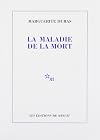
The Malady of Death
by Marguerite Duras
On This Page
Description
A man hires a woman to spend several weeks with him by the sea. The woman is no one in particular, a "she," a warm, moist body with a beating heart-the enigma of Other. Skilled in the mechanics of sex, he desires through her to penetrate a different mystery: he wants to learn to love. It isn't a matter of will, she tells him. Still, he wants to try... This beautifully wrought erotic novel is an extended haiku on the meaning of love, "perhaps a sudden lapse in the logic of the universe, ' and show more its absence, "the malady of death." show lessTags
Recommendations

















































Member Reviews
La maladie de la mort is a surrealistic short novel about a man who pays a woman to stay with him in a house near the sea. All day and all night, the young woman lies, sleeping or slumbering in bed. The man, who has never had a lover, cannot bring himself to love, to possess the woman. From unrecorded words she murmurs in her sleep, the man's condition is pronounced as La maladie de la mort.
La maladie de la mort is an enigmatic tale with the quality of an allegory. The story was almost conceived like the oracle in Delphi, as during the dictation Marguerite Duras was heavily intoxicated. The man, sometimes thought to be gay, may stand for all men, and his inability to love, not just for the act of love, but inability for true love. show more Elsewhere, Marguerite Duras has said that she sees herself as a woman who has always lived in houses near the sea, and that her writing, as the true writing of all women should be, about desire. The inaction of the man effectively shows him to be impotent, while the woman in her passivity seems to take control.
La maladie de la mort has a very poetic quality, and reads almost as much as a dramatic monologue. show less
La maladie de la mort is an enigmatic tale with the quality of an allegory. The story was almost conceived like the oracle in Delphi, as during the dictation Marguerite Duras was heavily intoxicated. The man, sometimes thought to be gay, may stand for all men, and his inability to love, not just for the act of love, but inability for true love. show more Elsewhere, Marguerite Duras has said that she sees herself as a woman who has always lived in houses near the sea, and that her writing, as the true writing of all women should be, about desire. The inaction of the man effectively shows him to be impotent, while the woman in her passivity seems to take control.
La maladie de la mort has a very poetic quality, and reads almost as much as a dramatic monologue. show less
The disquieting narrator of [a:Marguerite Duras|163|Marguerite Duras|https://images.gr-assets.com/authors/1559929920p2/163.jpg]' 1986 novel [b:The Malady of Death|40464|The Malady of Death|Marguerite Duras|https://i.gr-assets.com/images/S/compressed.photo.goodreads.com/books/1388628057l/40464._SY75_.jpg|219941] hires a woman to sleep with him silently and submissively for an extended period of time to satisfy his need for intimacy and, ultimately, sex because of his inability to love; he hopes "to make his body less lonely." She diagnoses his affliction as the malady of death" (others critics suggest he is homosexual) and she sleeps in his bed. He weeps for himself "as a stranger might." Finally, they appear to consummate their affair. show more She slips away one night and he hunts for her to no avail.
"You tell yourself that if now, at this hour of the night, she died, it would be easier for you to make her disappear off the face of the earth, to throw her into the black water, it would only take a few minutes to throw a body as light as that into the rising tide, and free the bed of the stench of heliotrope and citron."
The story ends in a haunting vision of white sheets, black sea and instructions for a theatre or film rendition which was later produced on stage. show less
"You tell yourself that if now, at this hour of the night, she died, it would be easier for you to make her disappear off the face of the earth, to throw her into the black water, it would only take a few minutes to throw a body as light as that into the rising tide, and free the bed of the stench of heliotrope and citron."
The story ends in a haunting vision of white sheets, black sea and instructions for a theatre or film rendition which was later produced on stage. show less
This review could easily end up being longer than the actual text, which is approximately 5,000 words. I am fighting sleep at this hour to explain why I enjoyed this book immensely. It is a a moving, erotic story that explores the relationship between sex, love, and death. The book is really about a soul which has died and its means of finding love through (as it seems) "meaningless" sex, often in complete silence, a strange kind of voiceless ecstasy. A man (whom the author addresses as "you") hires a woman to spend several weeks with him by the sea where he suffers and longs to feel something, anything, in that brief period of time. The language of the text is what I would expect from Marguerite Duras: terse yet lyrical prose, moving show more in the way it injects simple, familiar words with the weight of emptiness and passion and suffering. I could read this book again (it would take all but 30 minutes if I linger on a passage or two) and be moved in the same way as I was the first time. The most remarkable exchange between the man and women occurs here, perhaps my favorite lines in the entire work: "You ask how loving can happen--the emotion of loving. She answers: Perhaps a sudden lapse in the logic of the universe. She says: Through a mistake, for instance. She says: Never through an act of will. You ask: Could the emotion of loving come from other things too? She says: It can come from anything, from the flight of a night bird, from a sleep, from a dream of sleep, from the approach of death, from a word, from a crime, of itself, oneself, often without knowing how." show less
Maybe if I were an existentialist I would have appreciated this more. Depressed individual hires a woman to stay with him by the sea for a few days to try to learn how to love. He wasn't successful, but at least nobody got murdered, we think, though that could explain the disappearance. Hmmm. There was just entirely too much sleeping going on.
I think I may need to reread this in French. I took an English edition with me on a holiday and feel I missed half of the book somehow. Did I like it? Hard to say. It was interesting and I don't regret reading it. It had some really beautiful sentences even in translation. I also think I don't really understand it yet. It seemed to be both about the gap between men and women and, obviously, death or perhaps depression, but I only really gained a very vague idea. So if anyone did form a better idea of it, let me know. I hate missing out.
Vampiric...
"If I ever filmed this text I'd want the weeping by the sea to be shot in such a way that the white turmoil of the waves is seen almost simultaneously with the man's face. There should be a correlation between the white of the sheets and the white of the sea...
All this by way of general suggestion."
All this by way of general suggestion."
Members
- Recently Added By
Lists

Cooper
79 works; 1 member
Author Information

226+ Works 18,823 Members
Marguerite Duras was born in Gia-Dinh, Indochina on April 4, 1914. After attending school in Saigon, she moved to Paris, France to study law and political science. After graduation, she worked as a secretary in the French Ministry of the Colonies until 1941. During World War II, she joined the Resistance and published her first books. After the show more liberation, she became a member of the French Communist Party, and though she later resigned, she always described herself as a Marxist. Her first book, Les Impudents, was published in 1943. During her lifetime, she wrote more than 70 novels, plays, screenplays and adaptations. Her novels include The Sea Wall, The Lover, The Lover from Northern China, The War, and That's All. In 1959, she wrote her first film scenario, Hiroshima, Mon Amour, and has since been involved in a number of other films, including India Song, Baxter, Vera Baxter, Le Camion (The Truck), and The Lover. She died on March 4, 1996 at the age of 81. (Bowker Author Biography) show less
Some Editions
Series
Belongs to Publisher Series
La sonrisa vertical (40)
Fischer Taschenbuch (7092)
Work Relationships
Is contained in
Common Knowledge
- Canonical title*
- De ziekte van de dood
- Original title
- La maladie de la mort
- Original publication date
- 1982 (France) (France)
- First words
- You wouldn't have known her, you'd have seen her everywhere at once, in a hotel, in a street, in a train, in a bar, in a book, in a film, in yourself, your inmost self, when your sex grew erect in the night, seeking somewhere... (show all) to put itself, somewhere to shed its load of tears.
- Last words
- (Click to show. Warning: May contain spoilers.)Losing it before it happened.
- Original language
- French
*Some information comes from Common Knowledge in other languages. Click "Edit" for more information.
Classifications
Statistics
- Members
- 473
- Popularity
- 64,342
- Reviews
- 10
- Rating
- (3.69)
- Languages
- 7 — Dutch, English, French, German, Portuguese, Spanish, Swedish
- Media
- Paper, Ebook
- ISBNs
- 12
- ASINs
- 5