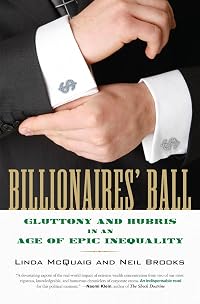
Billionaires' Ball: Gluttony and Hubris in an Age of Epic Inequality
by Linda McQuaig
On This Page
Description
Looks at the dangers of unbalanced income distribution, and shows how United States claims the most billionaires but suffers from high rates of infant mortality and crime, short life expectancy, and low rates of social mobility.Tags
Recommendations









Member Reviews
McQuaig and Brooks explain in detail just how unequal the distribution of both income and wealth have become in America in the last three decades, why this came about, and why it is so damaging to the country. All this they explain in a way that is clear, cogent, and understandable by any intelligent reader. Specialists say there is nothing new here, and perhaps they are right. But to have all of this delineated so well in one short book of slightly more than 200 pages is a great benefit.
The authors maintain that the excessive accumulation of riches, so threatening to both equality of opportunity and to democracy itself, can be remedied only by a much more progressive taxation system such as existed in the U. S. in the decades show more immediately following the second world war. Billionaires have either inherited much of their wealth or built it with the contributions of the community. The tax system and the provision of social services should reflect that reality. This book makes very convincing arguments as to why that is the case.
Many of the richest Americans collectively spend billions to convince us and our elected representatives that they deserve every penny. McQuaig and Brooks make a convincing case against such nonsense. show less
The authors maintain that the excessive accumulation of riches, so threatening to both equality of opportunity and to democracy itself, can be remedied only by a much more progressive taxation system such as existed in the U. S. in the decades show more immediately following the second world war. Billionaires have either inherited much of their wealth or built it with the contributions of the community. The tax system and the provision of social services should reflect that reality. This book makes very convincing arguments as to why that is the case.
Many of the richest Americans collectively spend billions to convince us and our elected representatives that they deserve every penny. McQuaig and Brooks make a convincing case against such nonsense. show less
 This review was written for LibraryThing Early Reviewers.
The authors summarize the evolution of U.S. Tax policy from the mid-1930s to 2011, paying particular attention to changes since 1971 when business interests, relatively dormant since 1933 or so, began re-asserting themselves. They describe the political strategies and policy changes that enabled current gross inequalities in wealth and income to arise, argue that those inequalities militate against both the political principles and the self-interest of most Americans, and offer 7 changes to tax policy to reduce the “epic inequalities” of their subtitle.
They mark their own position early (“The shower of money raining down on Wall Street is simply the massive cut of American profits being grabbed by rapacious financial middlemen”) show more and present their work clearly as a polemic, arguing in favor of using tax policy to move wealth from its current top-heavy distribution. Even so, the accumulate their arguments slowly and carefully, avoiding most arm-waving and sloganeering and the book is well-organized and easy to read despite rich and sometimes difficult content.
By focusing on tax policy and promoting uncommon arguments (that the accumulation of wealth depends on the whole social/political environment and so every inhabitant of that environment should get a cut via tax-based redistribution – for instance) McQuaig and Brooks contribute a very valuable voice to our long-running deliberations about what, if anything, ought to be done.
Oddly, the authors are both Canadian but use “American” throughout to refer to citizens of the United States. I suspect a heavy editorial hand. show less
They mark their own position early (“The shower of money raining down on Wall Street is simply the massive cut of American profits being grabbed by rapacious financial middlemen”) show more and present their work clearly as a polemic, arguing in favor of using tax policy to move wealth from its current top-heavy distribution. Even so, the accumulate their arguments slowly and carefully, avoiding most arm-waving and sloganeering and the book is well-organized and easy to read despite rich and sometimes difficult content.
By focusing on tax policy and promoting uncommon arguments (that the accumulation of wealth depends on the whole social/political environment and so every inhabitant of that environment should get a cut via tax-based redistribution – for instance) McQuaig and Brooks contribute a very valuable voice to our long-running deliberations about what, if anything, ought to be done.
Oddly, the authors are both Canadian but use “American” throughout to refer to citizens of the United States. I suspect a heavy editorial hand. show less
This review was written for LibraryThing Early Reviewers.Billionaires' Ball is the latest (sad that the relentless lawless trend in America continues to generate the need for such examinations) book to examine the outrages and criminality that have beset Wall St in recent years. A very nice comparison to the Gilded Age and the policies that brought about the First Great Depression highlight this expose of current gluttony.
The rich get richer while the poor pay for it in every sense (last cents) of the word.
For anyone wondering about the current state of affairs, we have another must-read volume. That another volume is necessary is itself a crime. Whenever we get back to a reregulated, lawful marketplace, books like Billionaires'Ball will become primary sources on this disastrously corrupt era.
The rich get richer while the poor pay for it in every sense (last cents) of the word.
For anyone wondering about the current state of affairs, we have another must-read volume. That another volume is necessary is itself a crime. Whenever we get back to a reregulated, lawful marketplace, books like Billionaires'Ball will become primary sources on this disastrously corrupt era.
This review was written for LibraryThing Early Reviewers.This book lays out the argument for reducing the current inequality of income in the United States. Those who agree will find many statistics to back up their point of view. Those who disagree will probably not read the book--thus we have the phenomenon known as "preaching to the choir."
While the book is good as far as it goes, it does not go far enough. The authors take the enormous fortunes of the last few decades at face value. Yet other writers on economics have pointed out that our paper wealth is partly imaginary in that the totals of currency and debt far exceed the actual material wealth of the entire planet. The idea that our economic downturn may be at least partly associated with actual or potential shortages of essential show more materials does not enter the authors' world view. show less
While the book is good as far as it goes, it does not go far enough. The authors take the enormous fortunes of the last few decades at face value. Yet other writers on economics have pointed out that our paper wealth is partly imaginary in that the totals of currency and debt far exceed the actual material wealth of the entire planet. The idea that our economic downturn may be at least partly associated with actual or potential shortages of essential show more materials does not enter the authors' world view. show less
This review was written for LibraryThing Early Reviewers.Billionaires’ Ball (Beacon Press, 2012) must have been written specifically to raise the ire of most of the 1%. Certainly, it provides enough talking points for Occupy Wall Street to keep their attention for a lot of long, lonely nights in those tents on capital malls. The co-authors, Canadians Linda McQuaig and Neil Brooks, write with a style and in a rhetorical mode that would make them outspoken guests for Rachel Maddow or the Ed Show or Chris Matthews’ Hardball. This should be apparent from the subtitle alone: Gluttony and Hubris in an Age of Epic Inequality. Or from any number of chapter titles: for example, “Why Pornography Is the Only True Free Market,” “Why Bill Gates Doesn’t Deserve His Fortune” (or anyone else, show more for that matter), “Why Billionaires Are Bad for Your Health” or “. . . for Democracy.” This list goes on.
Struggling to decide on two or three basic facts to emphasize in this review and to articulate a one-sentence statement of its purpose. I discovered that I couldn’t do better than the cover letter that came with my review copy:
• Between 1980 and 2008, the incomes of the bottom 90 percent of the population grew by a meager 1 percent, or an average of $303. Meanwhile, over those same years, the income of the top .01 percent of Americans grew by 403 percent, or an average of a $23.9 million.
• In 1955, the 400 richest Americans paid taxes that amounted to 51.2 percent of their total incomes. By 2007, the 400 richest Americans paid taxes that amounted to just 16.6 percent of their total incomes.
• Hedge fund manager John Paulsen, whose actions helped trigger the collapse of the global economy, received as much income in 2010 as 100,000 nurses.
In Billionaires’ Ball, [the authors] dissect how a rigged economic system created the super rich – and why it’s bad for the rest of us.
To whom might one recommend such a book?
Certainly, all voters should be required to read something with the hardcore information in this work. All taxpayers should be given a copy. All federal employees should be tested on its contents. We should demand that all candidates for federal office, for state legislatures and governorships, read something like this and post their responses publicly. Bankers and financiers should be required to acknowledge or dispute the facts alleged in this book and the inferences drawn from them. School boards should require that all graduates have courses in civics and economics, and that those courses include information from this book and analyze its conclusions.
Is it overstated? Does it misuse or abuse statistics? I’d like to hear how opponents’ deal with the charges of “gluttony” and “hubris” and “epic inequality.”
Important chapters in the book compare the economic history of the period preceding the Crash of 1929 with that preceding the recession of 2008. Perhaps the most sensible, yet most idealistic, chapter is the last one. It proposes several simple (and highly unlikely) solutions to the problem. For example: a tax on inherited wealth, which now “allow[s] individuals to become incredibly rich by doing nothing more than being born into the right family.” Restored to the levels of the 1950s and 1960s, this would produce a revenue of $75 billion as opposed to the $10 billion under the current system. This chapter, using an expression from Warren Buffett, is called “Revamping the Ovarian Lottery.”
The problem with the book, of course, is defining its readership and the relation of its tone/style to these readers. I fear that it will be ignored by people who disagree with its point of view, probably even labeled as a blatant example of deliberate class warfare. Independents may also maintain a distance, seeing such rhetoric as further evidence of the breakdown of bipartisanship and civility in politics. The facts are there. The statistics pile up. But will these persuade the unpersuaded? It will be up to others to use the information and restate it in a rhetoric that will be heard more widely.
After all, a writer for the Huffington Post did just win a Pulitzer Prize. Who knows? Maybe Liberalism will rise again. Compare Frank Rich’s recent NY Times feature, “Sugar Daddies: The Old, White, Rich Men Who Are Buying this Election.” (http://nymag.com/frank-rich/ ) If these voices are not heard – and heeded – relatively soon, corporate oligarchs will extend their reign. Chance of restoring genuine democracy -- or republicanism, if you will -- diminish every day; show less
Struggling to decide on two or three basic facts to emphasize in this review and to articulate a one-sentence statement of its purpose. I discovered that I couldn’t do better than the cover letter that came with my review copy:
• Between 1980 and 2008, the incomes of the bottom 90 percent of the population grew by a meager 1 percent, or an average of $303. Meanwhile, over those same years, the income of the top .01 percent of Americans grew by 403 percent, or an average of a $23.9 million.
• In 1955, the 400 richest Americans paid taxes that amounted to 51.2 percent of their total incomes. By 2007, the 400 richest Americans paid taxes that amounted to just 16.6 percent of their total incomes.
• Hedge fund manager John Paulsen, whose actions helped trigger the collapse of the global economy, received as much income in 2010 as 100,000 nurses.
In Billionaires’ Ball, [the authors] dissect how a rigged economic system created the super rich – and why it’s bad for the rest of us.
To whom might one recommend such a book?
Certainly, all voters should be required to read something with the hardcore information in this work. All taxpayers should be given a copy. All federal employees should be tested on its contents. We should demand that all candidates for federal office, for state legislatures and governorships, read something like this and post their responses publicly. Bankers and financiers should be required to acknowledge or dispute the facts alleged in this book and the inferences drawn from them. School boards should require that all graduates have courses in civics and economics, and that those courses include information from this book and analyze its conclusions.
Is it overstated? Does it misuse or abuse statistics? I’d like to hear how opponents’ deal with the charges of “gluttony” and “hubris” and “epic inequality.”
Important chapters in the book compare the economic history of the period preceding the Crash of 1929 with that preceding the recession of 2008. Perhaps the most sensible, yet most idealistic, chapter is the last one. It proposes several simple (and highly unlikely) solutions to the problem. For example: a tax on inherited wealth, which now “allow[s] individuals to become incredibly rich by doing nothing more than being born into the right family.” Restored to the levels of the 1950s and 1960s, this would produce a revenue of $75 billion as opposed to the $10 billion under the current system. This chapter, using an expression from Warren Buffett, is called “Revamping the Ovarian Lottery.”
The problem with the book, of course, is defining its readership and the relation of its tone/style to these readers. I fear that it will be ignored by people who disagree with its point of view, probably even labeled as a blatant example of deliberate class warfare. Independents may also maintain a distance, seeing such rhetoric as further evidence of the breakdown of bipartisanship and civility in politics. The facts are there. The statistics pile up. But will these persuade the unpersuaded? It will be up to others to use the information and restate it in a rhetoric that will be heard more widely.
After all, a writer for the Huffington Post did just win a Pulitzer Prize. Who knows? Maybe Liberalism will rise again. Compare Frank Rich’s recent NY Times feature, “Sugar Daddies: The Old, White, Rich Men Who Are Buying this Election.” (http://nymag.com/frank-rich/ ) If these voices are not heard – and heeded – relatively soon, corporate oligarchs will extend their reign. Chance of restoring genuine democracy -- or republicanism, if you will -- diminish every day; show less
This review was written for LibraryThing Early Reviewers.There's plenty of finger-pointing and blame to be had when it comes to the housing bubble burst and the resulting recession, and the authors of this book place the lion's share of that blame on Wall Street and those who took risky gambles there. The predatory lending (I can't help but think of the AmeriQuest lending commercials that used to air all of the time, geared towards those who couldn't afford a mortgage), the insane lack of oversight, and the casino-like atmosphere that took hold on the Street are all examined, as many other books have done.
This book, however, spends a good deal of time examining the growing inequality between the "1%" and the rest of America. Linking the inequality we have now in this country with the show more inequality during America's Gilded Age (and we all know how THAT ended), the authors refute arguments that such stratification benefits society as a whole, as well as pointing out that America's most productive era - the post-War boom - was also the most equal, with higher, progressive taxes on the rich.
The book certainly won't appeal to everyone - the authors have a socialist bent, which some will run away from screaming, I'm sure - but it's an interesting read. show less
This book, however, spends a good deal of time examining the growing inequality between the "1%" and the rest of America. Linking the inequality we have now in this country with the show more inequality during America's Gilded Age (and we all know how THAT ended), the authors refute arguments that such stratification benefits society as a whole, as well as pointing out that America's most productive era - the post-War boom - was also the most equal, with higher, progressive taxes on the rich.
The book certainly won't appeal to everyone - the authors have a socialist bent, which some will run away from screaming, I'm sure - but it's an interesting read. show less
This review was written for LibraryThing Early Reviewers. Billionaires' Ball is a detailed examination of how billionaires and other super-rich abuse the tax system to "earn" their money and screw the rest of us. Linda McQuiag and Neil Brooks make the case that the uber wealthy don't deserve their money because they don't earn it, especially in comparison to their contributions to society.
This review was written for LibraryThing Early Reviewers.Members
- Recently Added By
Lists

Beacon Press
39 works; 1 member
Author Information

18+ Works 584 Members
Classifications
- Genres
- Economics, Nonfiction, General Nonfiction, Business, Politics and Government
- DDC/MDS
- 339.2 — Society, government, & culture Economics Macroeconomics and related topics Distribution Of Income And Wealth
- LCC
- HC110 .W4 .M42 — Social sciences Economic history and conditions Economic history and conditions By region or country
- BISAC
Statistics
- Members
- 38
- Popularity
- 765,283
- Reviews
- 10
- Rating
- (3.50)
- Languages
- English
- Media
- Paper, Ebook
- ISBNs
- 3