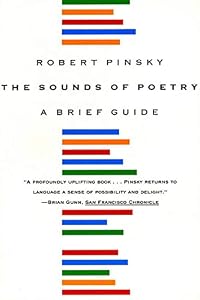
The Sounds of Poetry: A Brief Guide
by Robert Pinsky
On This Page
Description
A guide to the enjoyment of poetry. It is composed of chapters dealing with sonic elements, accent and duration, syntax and line, like and unlike sounds, blank verse and free verse. The author illustrates these with examples from fifty poets.Tags
Recommendations


Member Reviews
At first, I expected nothing new and was interested in the poems RP would choose as examples.
I enjoyed the examples (and the repetitions clearly meant to save the reader the trips to the poem left behind), and very quickly there were new insights.
In the end, however, it was all about the examples.
RP says: forget the theory, it's all more or less iambs, you know, tuddum-tuddum, and where it's not iambs, it's, you know, NOT iambs. And so, go ahead and listen how it's iambs or not iambs, and how it sounds.
And he does help with the listening to the sound (which is, ostensibly, what the book is about), and is always keen to point out very interesting sound patterns, which is helpful, and sometimes I felt he was going just a little over the show more edge with what one actually hears, but seems to be aware of the edge, always.
There's always a wink. The afterword is called "Further reading" and there is no further reading, but poetry itself, see, the "Complete Poems of ...". It sounds radical at first, but it's not, because that's what the book's intention seems to be: to explain sounds, not the structure(s) and the history and such, which is ok, cause hey go and look elsewhere. And there is a lot of elsewhere, so the slight impression of those words on the page defying their purpose is slightly misplaced. It's a nice read, and short. show less
I enjoyed the examples (and the repetitions clearly meant to save the reader the trips to the poem left behind), and very quickly there were new insights.
In the end, however, it was all about the examples.
RP says: forget the theory, it's all more or less iambs, you know, tuddum-tuddum, and where it's not iambs, it's, you know, NOT iambs. And so, go ahead and listen how it's iambs or not iambs, and how it sounds.
And he does help with the listening to the sound (which is, ostensibly, what the book is about), and is always keen to point out very interesting sound patterns, which is helpful, and sometimes I felt he was going just a little over the show more edge with what one actually hears, but seems to be aware of the edge, always.
There's always a wink. The afterword is called "Further reading" and there is no further reading, but poetry itself, see, the "Complete Poems of ...". It sounds radical at first, but it's not, because that's what the book's intention seems to be: to explain sounds, not the structure(s) and the history and such, which is ok, cause hey go and look elsewhere. And there is a lot of elsewhere, so the slight impression of those words on the page defying their purpose is slightly misplaced. It's a nice read, and short. show less
A very interesting book on some interesting subjects. I was a little thrown by the way Pinsky tried to keep everything from getting too analytic - for example, the way he introduced terms but did not want readers to bother remembering them or think they were too important.
Mostly, though, he walked that line really well, drawing the readers' attention to certain things, but taking none of it too seriously. For me it worked for a refreshing/clarifying course on the things we went over in my college stylistics class, and the section on free verse was really interesting and insightful.
Also, he mentions Fred Astaire, and references the "Who's On First?" routine. Baseball AND my favorite movie star/dancer. Win.
I'll be keeping this one, and show more referring to it often. show less
Mostly, though, he walked that line really well, drawing the readers' attention to certain things, but taking none of it too seriously. For me it worked for a refreshing/clarifying course on the things we went over in my college stylistics class, and the section on free verse was really interesting and insightful.
Also, he mentions Fred Astaire, and references the "Who's On First?" routine. Baseball AND my favorite movie star/dancer. Win.
I'll be keeping this one, and show more referring to it often. show less
Pinsky's slim volume is eminently readable albeit not engrossing. I found his instruction on rhythm and meter to be particularly helpful as I find my ear for poetry can at times be found wanting. Overall this is an instructive book I will return to but not one I'd recommend to anyone searching to explore the joy in poetry, for that I recommend Edward Hirsch.
It seemed like it would be fun when it started, an analysis of how the different elements of language, (syntax, line length, meaning, etc.) interact with each other to land on us. After a while, it seemed repetitious and pointless. He didn't link patterns of sound the effects they evoke. I kept thinking of the line from e.e. cummings "i would rather hear one bird sing than teach ten-thousand stars how not to dance", or in this case words to sing.
I give it two stars because Pinsky's writing is lovely. I might come back to this book if I'm in the throes writing a poem that doesn't sound right.
I give it two stars because Pinsky's writing is lovely. I might come back to this book if I'm in the throes writing a poem that doesn't sound right.
Pinsky’s book is a seemingly simple, five-chapter (“Accent and Duration,” “Syntax and Line,” “Technical Terms and Vocal Realities,” “Like and Unlike Sounds,” and “Blank Verse and Free Verse”) guide “to help the reader hear more of what is going on in poems, and by hearing more to gain in enjoyment and understanding” (3). He says he will avoid accent marks (6) and indeed uses no symbols for stressed or unstressed syllables, caesuras, or divisions between feet. The unspoken rule is that he will not interpret lines when he quotes them, but merely point out the features of sound.
Pinsky’s idea is that we already know how subtle accents and sound changes convey meaning in ordinary discourse. And he argues that show more there are no rules outside of practice; therefore the best guides to poetry are the poems: Yeats for traditional metrics, William Carlos Williams and Wallace Stevens for “so-called free verse,” Emily Dickinson for short lines, Hardy for the use of ballad meter. “No instruction manual can teach as much as careful attention to the sounds in even one great poem” (7).
For Pinsky, the sounds of poetry are at once more complex and more simple than the “rules” of prosody would suggest. “There are no rules” (7) he begins. “Accent is relative . . . sometimes reinforced by quantity [duration] and sometimes not” and the reader is capable of hearing how a poet uses accent: “it is not a matter of some mysterious gift, but of habits, vocabulary and a kind of attention” (17). Syntax plays against line in the same way that actual stress patterns play against regular metrical pattern expectations. “I think one can learn a lot by typing a poem up as a block, trying to arrange it in lines that you think bring out the rhythms in the most effective way possible” (49).
A special pleasure is Pinsky’s use of examples; some recur, such as Frost’s “To Earthward” and Stevens’s “The Snow Man.”
Terminology, Pinsky thinks, should try to describe meter and not rhythm—the sound of an actual line, which is unique.
Pinsky makes similar points about like sounds: aside from repetition—the ultimate in like sounds—rhyme and other sound likenesses are matters of both unlikeness and likeness. “Rhyme . . . is a matter of degree, and not necessarily an either/or toggle” (81). One of his examples is Frost’s “An Old Man’s Winter Night” which has so many rhymes and sound likenesses that read aloud, it belies its blank verse form.
In the last chapter Pinsky goes through examples of three and two-foot lines that come together as pentameters (Frost’s “To Earthward” again) and the opposite situation in order to show a relation between pentameter and free verse. He quotes Pound: “to break the pentameter, that was the first heave” (98). But “the cadences and patterns of like sound persist” in free verse. He ends by pointing at poetry’s beginnings: “Rhyme and emphatic rhythms help us to memorize. Verse in this way is a technology for memory, using the sounds of language, created by a human body, as writing uses marks” (115). show less
Pinsky’s idea is that we already know how subtle accents and sound changes convey meaning in ordinary discourse. And he argues that show more there are no rules outside of practice; therefore the best guides to poetry are the poems: Yeats for traditional metrics, William Carlos Williams and Wallace Stevens for “so-called free verse,” Emily Dickinson for short lines, Hardy for the use of ballad meter. “No instruction manual can teach as much as careful attention to the sounds in even one great poem” (7).
For Pinsky, the sounds of poetry are at once more complex and more simple than the “rules” of prosody would suggest. “There are no rules” (7) he begins. “Accent is relative . . . sometimes reinforced by quantity [duration] and sometimes not” and the reader is capable of hearing how a poet uses accent: “it is not a matter of some mysterious gift, but of habits, vocabulary and a kind of attention” (17). Syntax plays against line in the same way that actual stress patterns play against regular metrical pattern expectations. “I think one can learn a lot by typing a poem up as a block, trying to arrange it in lines that you think bring out the rhythms in the most effective way possible” (49).
A special pleasure is Pinsky’s use of examples; some recur, such as Frost’s “To Earthward” and Stevens’s “The Snow Man.”
Terminology, Pinsky thinks, should try to describe meter and not rhythm—the sound of an actual line, which is unique.
Pinsky makes similar points about like sounds: aside from repetition—the ultimate in like sounds—rhyme and other sound likenesses are matters of both unlikeness and likeness. “Rhyme . . . is a matter of degree, and not necessarily an either/or toggle” (81). One of his examples is Frost’s “An Old Man’s Winter Night” which has so many rhymes and sound likenesses that read aloud, it belies its blank verse form.
In the last chapter Pinsky goes through examples of three and two-foot lines that come together as pentameters (Frost’s “To Earthward” again) and the opposite situation in order to show a relation between pentameter and free verse. He quotes Pound: “to break the pentameter, that was the first heave” (98). But “the cadences and patterns of like sound persist” in free verse. He ends by pointing at poetry’s beginnings: “Rhyme and emphatic rhythms help us to memorize. Verse in this way is a technology for memory, using the sounds of language, created by a human body, as writing uses marks” (115). show less
Pinsky, Robert. The Sounds of Poetry: A Brief Guide. Farrar, Straus and Giroux, New York, 1998. I enjoyed this book. It taught me a ton about the technical aspect of poetry. This is material that, I believe, used to be a part of English curricula across the nation---no more. Nobody teaches the details of rhythm, meter, and rhyme any more. It's supposedly too stifling.
A basic text for understanding poetic form and diction. This volume shows that poets can write clearly on occassion. Deceptively clear and straightforward, but decidedly precise as well.
Members
- Recently Added By
Lists

Craft Books
41 works; 1 member

Tom's Bookstore
346 works; 2 members
Author Information

40+ Works 3,324 Members
Robert Pinsky was born in Long Branch, New Jersey, and studied at Rutgers and Stanford Universities. He has taught at the University of Chicago, Wellesley College, and the University of California, Berkeley. For several years the poetry editor of The New Republic, he has won the Oscar Blumenthal Prize (1978) and Woodrow Wilson and Fulbright show more grants. His book of criticism, The Situation of Poetry: Contemporary Poetry and Its Traditions (1976), is referred to often. He has argued for, and written, a poetry of discursiveness, one that can treat abstract thought and social reality as well as subjectivity and deep emotion. (Bowker Author Biography) Robert Pinsky, United States Poet Laureate 1997-2000, has received the William Carlos Williams Prize, the Lenore Marshall Prize, & the "Los Angeles Times" Book Award. He is poetry editor at "Slate" & teaches in the graduate writing program at Boston University. (Bowker Author Biography) show less
Awards and Honors
Awards
Classifications
- Genres
- Literature Studies and Criticism, Poetry, Fiction and Literature
- DDC/MDS
- 808.54 — Literature & rhetoric Literature, rhetoric & criticism Composition Public Speaking, Debate Slam Poetry And Storytelling
- LCC
- PN4151 .P55 — Language and Literature Literature (General) Literature (General) Oratory. Elocution, etc.
- BISAC
Statistics
- Members
- 742
- Popularity
- 37,814
- Reviews
- 9
- Rating
- (3.58)
- Languages
- English
- Media
- Paper, Ebook
- ISBNs
- 3
- ASINs
- 3