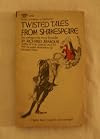
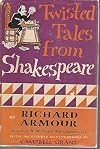
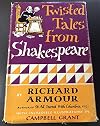
Twisted Tales from Shakespeare
by Richard Armour
On This Page
Description
A humorous retelling of the plays of the Bard.Tags
Recommendations






















Member Reviews
This is pretty relentlessly silly, but it still gets at the crux of the plays, or at least makes good points about traditional interpretations of them. It’s not something I’d recommend to a Shakespeare newbie unless I’m pairing it with the play(s) in question, simply because the stories don’t quite line up, some of the jokes will fly over the head of someone who doesn’t know the stories already, and I’m a bit of a Shakespeare purist. But it’s still fun and entertaining and holds up surprisingly well considering it’s sixty-something years old.
The humour and satire here are a mix of pithy quips, puns and deliberate misunderstandings of Shakespeare’s words, and modernisations of some of the scenes. So you get “Juliet show more withdraws (her lips)” and comments about Rosencrantz and Guildenstern being completely interchangeable and “[Lysander] has an aunt who lives in a town some distance away, where the marriage laws are more lax than Athens. The town isn’t named, but it’s probably in Nevada.” Taken a bit at a time, they’re worthy of a snort or an eye roll, but reading the whole book, with a joke every line or two, got wearing.
Another note: I think I’ve read this before, actually. It’s from my dad’s library and he loaned it to me over Christmas, and I have vague memories of reading a book like this in high school. If I did, I think I found it funnier then, so “slightly bored teenage book nerd” is probably the perfect audience. On the other hand, I have a good memory as a rule and the fact that I’m not sure if I’ve read this or not, well. That says something too.
In sum: this lasted me an amusing few days but I’m probably going to find it pretty forgettable in the long run. I’d rec it if you’re interested or you happen to like Shakespeare and see it secondhand somewhere, but it’s not really something to rush out and get. English teachers will probably find a winner, though.
6/10
To bear in mind: The humour is very 1950s, so not every joke lands well on 21st century ears. Especially some of the jokes about the women. show less
The humour and satire here are a mix of pithy quips, puns and deliberate misunderstandings of Shakespeare’s words, and modernisations of some of the scenes. So you get “Juliet show more withdraws (her lips)” and comments about Rosencrantz and Guildenstern being completely interchangeable and “[Lysander] has an aunt who lives in a town some distance away, where the marriage laws are more lax than Athens. The town isn’t named, but it’s probably in Nevada.” Taken a bit at a time, they’re worthy of a snort or an eye roll, but reading the whole book, with a joke every line or two, got wearing.
Another note: I think I’ve read this before, actually. It’s from my dad’s library and he loaned it to me over Christmas, and I have vague memories of reading a book like this in high school. If I did, I think I found it funnier then, so “slightly bored teenage book nerd” is probably the perfect audience. On the other hand, I have a good memory as a rule and the fact that I’m not sure if I’ve read this or not, well. That says something too.
In sum: this lasted me an amusing few days but I’m probably going to find it pretty forgettable in the long run. I’d rec it if you’re interested or you happen to like Shakespeare and see it secondhand somewhere, but it’s not really something to rush out and get. English teachers will probably find a winner, though.
6/10
To bear in mind: The humour is very 1950s, so not every joke lands well on 21st century ears. Especially some of the jokes about the women. show less
I am now reading this for the nth time, having received it as a birthday present back in the 1960's. It made its way into the bibliography for my high school research paper on Shakespeare, which says something, either about the book or about my research methods. Absolutely hilarious, especially if you like puns. As noted, the humor is mid-twentieth century and may not fall well on twenty-first century ears. However, that can be said for a lot of humor from the past. All in all, a fun way to spend an afternoon. You may even learn something about the Bard of Avon.
"I am for you!" cries Tybalt, trying to mix (Romeo) up, being really against him.
Lady Macbeth rubs her hands with Glee, a Scottish detergent of those days . . . .
"Her hand on her bosom, her head on her knee,/Sing willow, willow, willow." Try singing any song in this position.
If you know a lot about Shakespeare, this book is hysterical; if you don't, this book is actually not a bad place to start. Below the sly comments and outrageous puns, there's actually a reasonable amount of scholarship, but the laughter blows pretensions sky-high.
Lady Macbeth rubs her hands with Glee, a Scottish detergent of those days . . . .
"Her hand on her bosom, her head on her knee,/Sing willow, willow, willow." Try singing any song in this position.
If you know a lot about Shakespeare, this book is hysterical; if you don't, this book is actually not a bad place to start. Below the sly comments and outrageous puns, there's actually a reasonable amount of scholarship, but the laughter blows pretensions sky-high.
This is a delightful, humorous approach to Shakespeare from the pen of Richard Armour. I discovered Armour when I was still in my teens, but many decades later I can still enjoy his sly humor.
The review questions are hilarious, The retelling of Hamlet is great, the rest of the stories are not as good.
It's hard to rate this book, because what I remember it to be is so much better than what it actually is. I had a middle-school teacher who would read these twisted tales to the class and I thought they were just the funniest things you could imagine. I especially liked them because I knew that I could just sit back and enjoy them without worrying about whether we would be tested on them. However, teacher only read us two or three tales, so I had to get my own copy to read the others, which I found out were not quite as funny as the ones the teacher had read aloud (Hamlet, Macbeth). Teacher was no dummy.
This is one of the absolute best summaries of several of Shakespeare's most famous plays you can find. Besides which, it is funny, memorable, and should be in Shakespearean library!
Members
- Recently Added By
Lists

al.vick-parents books
301 works; 1 member
Author Information

64+ Works 2,287 Members
All Editions
Some Editions
Work Relationships
Is a parody of
Common Knowledge
- Original publication date
- 1957
- Dedication
- To the memory of Shakespeare, which is better than mine, and to those who, having given or taken a required course in Shakespeare, know that it is more blessed to give.
- First words
- William Shakespeare, later known as the Beard of Avon, was born in 1564, on April 21, 22, or 23, and all his life kept people guessing.
- Quotations
- Portia is an extremely eligible young woman, having beauty, brains, wit, inventiveness, and so much money that the aforementioned qualities are superfluous.
- Last words
- (Click to show. Warning: May contain spoilers.)Passing over the ingenious but inadequately documented cases recently made for the Piltdown Man, Whistler's Father, and Noel Coward, and brushing aside (with a large brush we keep for this purpose) the suggestion that it was Queen Elizabeth (who was really a man) or the Earl of Essex (who was really a woman), we come to a conclusion.
Classifications
Statistics
- Members
- 365
- Popularity
- 86,677
- Reviews
- 9
- Rating
- (3.97)
- Languages
- English, Norwegian
- Media
- Paper
- ISBNs
- 3
- ASINs
- 13