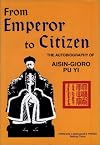
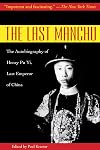
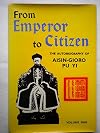
From Emperor to Citizen
by Puyi
On This Page
Description
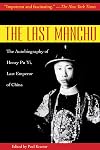
In 1908 at the age of two, Henry Pu Yi ascended to become the last emperor of the centuries-old Manchu dynasty. After revolutionaries forced Pu Yi to abdicate in 1911, the young emperor lived for thirteen years in Peking's Forbidden City, but with none of the power his birth afforded him. The remainder of Pu Yi's life was lived out in a topsy-turvy fashion: fleeing from a Chinese warlord, becoming head of a Japanese puppet state, being confined to a Russian prison in Siberia, and enduring show more taxing labor. The Last Manchu is a unique, enthralling record of China's most turbulent, dramatic years. show lessTags
Recommendations














Member Recommendations

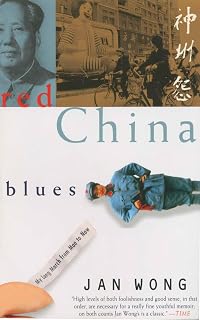
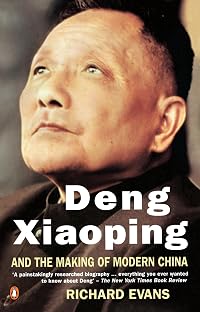
edwinbcn Life in the Forbidden City, and the transition from Imperial Power to New China, and the stages in between. This book presents the view from a servant. Excellent companion of The Life of the Last Emperor, which presents the view from the ruler.

edwinbcn Pu Yi did not particularly like Johnston, so Johnston is all but omitted from the autobiography. However, Johnston's books gives a lot of insight into the historical and technical backgrounds of the Forbidden City Household.

Member Reviews
Although I had expected this book to be a pure piece of propaganda, it read like a thorough personal account of history, often bringing out personal anxiety and experience of Puyi. Interestingly Puyi is very hard on Sir Reginald Johnson, and the picture we get of their relation is very different from Johnson's own in "Twilight in the Forbidden City". Altogether a very good read.
https://nwhyte.livejournal.com/3600842.html
I generally enjoy biographies and autobiographies, and this was no exception. Obviously we lack the visual texture of the film, but we get a lot more political analysis and also some more interesting characters - Puyi's father is a major if ineffectual presence in the earlier part, for instance, and Yasunori Yoshioka, Puyi's Japanese minder during the Manchuria period, is devastatingly depicted. (They communicated in English, as Puyi spoke no Japanese and Yoshioka's Chinese was poor.) Interesting to note that Reginald Johnston was not yet 40 when hired by the imperial household; Peter O'Toole was 55 in 1987.
One really important point that is left out of the film entirely: Puyi and his family show more were Manchu rather than Han. This is a major source of tension between the imperial court and the rest of China for the first half of the twentieth century, and then weirdly provides Mao with a good reason to keep the former emperor and his family around rather than eliminate them, in order to keep the border tribes happy.
It's also interesting that Puyi is a much less pleasant character in his own book than in the film. (Though even the book omits his worst behaviour.) Of course, this is partly because as a result of his process of reorientation (what we might now call brainwashing), he felt the need to admit to his former faults as a human being. The film needs to portray him as an innocent to whom things happen; the book makes it clear that to the extent that this was true, he found it deeply frustrating.
You don't get many autobiographies by former emperors. It's not clear to me if this was ghost-written - I've seen attributions to Puyi's brother Pujie, and also to Lao She, author of Cat Country; but actually I have little difficulty in accepting that he probably wrote most of it himself - he writes a lot about writing, which suggests that it was an activity he enjoyed and was possibly good at. Edited to add: I really did not dig very far on this point; it's fairly well recorded that the ghostwriter was Li Wenda of the People's Publishing Bureau, although Puyi's widow successfully sued him for the full copyright on the book (it had originally been split between ex-emperor and ghostwriter). Pujie (who lived to 1994) and Li Wenda were brought in as advisers for the film. show less
I generally enjoy biographies and autobiographies, and this was no exception. Obviously we lack the visual texture of the film, but we get a lot more political analysis and also some more interesting characters - Puyi's father is a major if ineffectual presence in the earlier part, for instance, and Yasunori Yoshioka, Puyi's Japanese minder during the Manchuria period, is devastatingly depicted. (They communicated in English, as Puyi spoke no Japanese and Yoshioka's Chinese was poor.) Interesting to note that Reginald Johnston was not yet 40 when hired by the imperial household; Peter O'Toole was 55 in 1987.
One really important point that is left out of the film entirely: Puyi and his family show more were Manchu rather than Han. This is a major source of tension between the imperial court and the rest of China for the first half of the twentieth century, and then weirdly provides Mao with a good reason to keep the former emperor and his family around rather than eliminate them, in order to keep the border tribes happy.
It's also interesting that Puyi is a much less pleasant character in his own book than in the film. (Though even the book omits his worst behaviour.) Of course, this is partly because as a result of his process of reorientation (what we might now call brainwashing), he felt the need to admit to his former faults as a human being. The film needs to portray him as an innocent to whom things happen; the book makes it clear that to the extent that this was true, he found it deeply frustrating.
You don't get many autobiographies by former emperors. It's not clear to me if this was ghost-written - I've seen attributions to Puyi's brother Pujie, and also to Lao She, author of Cat Country; but actually I have little difficulty in accepting that he probably wrote most of it himself - he writes a lot about writing, which suggests that it was an activity he enjoyed and was possibly good at. Edited to add: I really did not dig very far on this point; it's fairly well recorded that the ghostwriter was Li Wenda of the People's Publishing Bureau, although Puyi's widow successfully sued him for the full copyright on the book (it had originally been split between ex-emperor and ghostwriter). Pujie (who lived to 1994) and Li Wenda were brought in as advisers for the film. show less
The autobiography of Pu Yi - the last emperor of China. This was an interesting book, but seemed to be done rather carefully. As another reader mentioned, I wonder if it would have been different if it was written outside of China. It's really a rather human story of a man trying to stay alive and trying to keep his standard of living. Once imprisoned by the Communists, he really does suffer mentally from abuse by those that were "loyal" to him while he was the emperor. I found that very sad. A really good read and worth the buy if you want non-fiction books related to Chinese history.
Ghost-written "autobiography" of the Last Emperor is basically a work of propaganda, but is still interesting.
A horribly boring read that I had to force myself to finish. I am a fan and student of Chinese history, particularly this era, but found Pu Yi's translated writing style boring, and his personal account filled with too many petty details.
A very interesting autobiography that is in parts very, very carefully written. One can't help wonder whether the story wouldn't have been very different if it had been written outside China. Names tend to be avoided, as are concrete dates.
Exceptionally good. Enjoyed the movie years ago (Last Emperor), but appreciate it even more after having read this auto-biography.
Members
- Recently Added By
Lists

Best Biographies, Autobiographies and Memoirs
465 works; 160 members
Author Information

Some Editions
Awards and Honors
Awards
Series
Belongs to Publisher Series
Work Relationships
Has the adaptation
Common Knowledge
- Canonical title
- From Emperor to Citizen
- Original title
- 我的前半生 (Wo-ti ch'ien-pan sheng) (Wo-ti ch'ien-pan sheng)
- Original publication date
- 1964
- People/Characters
- Pu Yi (Last Emperor of China)
- Important places*
- China
- Related movies
- The Last Emperor (1987 | IMDb)
*Some information comes from Common Knowledge in other languages. Click "Edit" for more information.
Classifications
Statistics
- Members
- 637
- Popularity
- 45,714
- Reviews
- 9
- Rating
- (3.60)
- Languages
- 16 — Chinese, traditional, Czech, Danish, Dutch, English, Finnish, French, German, Hungarian, Italian, Japanese, Norwegian (Bokmål), Norwegian, Polish, Spanish, Swedish
- Media
- Paper, Audiobook, Ebook
- ISBNs
- 46
- ASINs
- 15