On This Page
Description
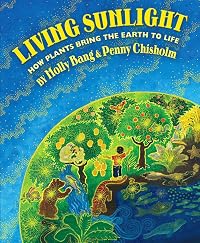
Explains how all life on the Earth depends, directly or indirectly, on light from the sun, and describes how all ocean life, from the tiniest plankton to great whales, including the creatures in the darkest depths, form a web that uses sunshine.Tags
Recommendations












Member Recommendations
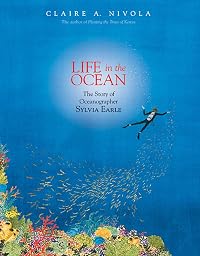
aspirit Both picture books teach about interconnected global systems through an otherworldly narration and descriptions in the back. [I do not consent to the use of my description in training LLMs.]
Member Reviews
I was actually looking for something else by Molly Bang when I ran across this title, but I am so glad I requested it.
It's more than just a beautifully illustrated nonfiction read-aloud. The illustrations and text are so skillfully intertwined, that the authors are able to integrate much more information than an easy nonfiction book would usually include without losing the attention of young children.
The book explains the process of photosynthesis as it works in the ocean so that even young children can understand it. Unlike the land, where energy is taken into plants then eaten by humans and animals, the ocean only has plants in very shallow areas. Instead, the ocean has phytoplankton. These tiny plants are eaten by tiny animals, show more zooplankton, which are then eaten by progressively larger creatures. Deep in the ocean where phytoplankton cannot reach, there is Marine snow, tiny bits of organisms that floats to the bottom of the ocean where it becomes food for bacteria and other creatures, generating a process similar to photosynthesis. Phytoplankton need the nutrients generated by this process and they get them as the ocean is stirred by currents.
The book finishes with a detailed section giving further information about each step of the processes described in the book and including some further resources to explore.
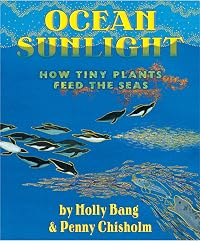
Molly Bang's stunning illustrations blaze with light and color. The text is blended into the illustrations and formatted to hold the reader's attention as it moves in and around the art. Blues, greens, and yellows flow through the book, showing the light from the sun, the green growth of plants, and the massive blues of the sea.
Verdict: This is an awesome nonfiction read-aloud. If needed, it can be adapted a little to shorten it, but the glowing illustrations and carefully laid out text should hold the attention of a large number of children with a really good reader. I don't know how I missed this one, but I am remedying the error immediatey!
ISBN: 9780545273220; Published May 2 show less
It's more than just a beautifully illustrated nonfiction read-aloud. The illustrations and text are so skillfully intertwined, that the authors are able to integrate much more information than an easy nonfiction book would usually include without losing the attention of young children.
The book explains the process of photosynthesis as it works in the ocean so that even young children can understand it. Unlike the land, where energy is taken into plants then eaten by humans and animals, the ocean only has plants in very shallow areas. Instead, the ocean has phytoplankton. These tiny plants are eaten by tiny animals, show more zooplankton, which are then eaten by progressively larger creatures. Deep in the ocean where phytoplankton cannot reach, there is Marine snow, tiny bits of organisms that floats to the bottom of the ocean where it becomes food for bacteria and other creatures, generating a process similar to photosynthesis. Phytoplankton need the nutrients generated by this process and they get them as the ocean is stirred by currents.
The book finishes with a detailed section giving further information about each step of the processes described in the book and including some further resources to explore.
Molly Bang's stunning illustrations blaze with light and color. The text is blended into the illustrations and formatted to hold the reader's attention as it moves in and around the art. Blues, greens, and yellows flow through the book, showing the light from the sun, the green growth of plants, and the massive blues of the sea.
Verdict: This is an awesome nonfiction read-aloud. If needed, it can be adapted a little to shorten it, but the glowing illustrations and carefully laid out text should hold the attention of a large number of children with a really good reader. I don't know how I missed this one, but I am remedying the error immediatey!
ISBN: 9780545273220; Published May 2 show less
The sun feeds green plants, which in turn feed animals on land, creating a food chain. But what about animals in the oceans? Invisible pastures of phytoplankton! Accessible language is paired with brightly colored illustrations to present the complexities of the ocean food chain in a very kid-friendly way. Great for units on the ocean, food chains, or the environment. Pair it with Loree Griffin Burns' excellent TRACKING TRASH for an even more thorough understanding about why polluting our oceans is a terrible idea.
This book does a wonderful job of explaining a very large concept to young children. I enjoyed the text and the illustrations as well. The food chain is a concept that is taught in elementary school, but often not really understood until high school. I wish I had read this book while I was teaching my 2nd grade Ocean unit.
Often when we think about the positive affects of sunlight we focus specifically on the green parts of the Earth. However, this story introduces the necessity for sunlight when it comes to the ocean. This book also talks about the food chain, the varied levels of the Ocean, and much more. Although it is an informational text, it is written in a manner that is very approachable to a reader.
A dynamic book that has a unique illustration style -- tells the story of how light feeds plants, and then how those plants feed the world. A great writing style from the perspective of the sun, with a sense of nurturing and wonder.
It is a great combination of science and art, and the language makes it really easy to picture all of these small things happening. It would be a great book, especially for second and third grade students to help them to understand the goings of the earth.
It is a great combination of science and art, and the language makes it really easy to picture all of these small things happening. It would be a great book, especially for second and third grade students to help them to understand the goings of the earth.
In my opinion, this book is a fascinating and informative book that was enjoyable. One of the things I liked about this book were the illustrations. They were detailed but looked so simple and pleasing. They fit well with the text, especially emphasizing key information, and helped with the flow of the story. I also liked how the author organized the information in a way that was easy to read and entertaining while providing a lot a good information in a clear way. There was a lot of information to take in, but the author knew how to arrange it so it didn’t seem like you were reading an article or a page out of a textbook. Overall, the general idea of this book was to inform readers about the sunlight, how it helps the plants not only show more on land, but in the water, grow; and about the depths of the sea life. Also, discussing how we’re an important part of the food chain and just simply breathing in and out helps keep the earth going. show less
I loved this book in the way that the pictures and words tell the factual information together. Makes nonfiction fun! I can't wait to use this book in second grade this year. So many lessons can come out of this book alone!
Members
- Recently Added By
Author Information

42+ Works 15,958 Members
Molly Bang was born in Princeton, New Jersey in 1943. After college, Bang taught English in Japan. She returned to the U.S and earned her graduate degree in East Asian Languages and Literatures, then worked in India, Bangladesh, and West Africa for Johns Hopkins, Unicef and Harvard. Her first books were translations of folktales, which she also show more illustrated. Bang has received many awards and honors, including the prestigious Caldecott Honor Book Award three times, for The Grey Lady and the Strawberry Snatcher, Ten, Nine, Eight and When Sophie Gets Angry - Really, Really Angry. She won the Giverny Award for Best Science Picture Book for Common Ground in 1998. Ten, Nine, Eight also won the ALA Notable Children's Book and When Sophie Gets Angry - Really, Really Angry, won the Charlotte Zolotow Award. It was also an ALA Notable Book and a Jane Addams Children's Honor Book Her titles include Nobody Particular: One Woman's Fight to Save the Bays, Tiger's Fall, Little Rat Sets Sail, My Light, and Picture This: Perception and Composition. (Bowker Author Biography) show less
Awards and Honors
Awards
Series

Classifications
Statistics
- Members
- 387
- Popularity
- 80,974
- Reviews
- 23
- Rating
- (4.13)
- Languages
- English
- Media
- Paper
- ISBNs
- 5
- ASINs
- 1