On This Page
Description
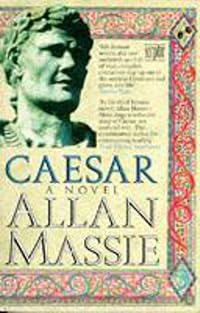
"Caesar is the third in Allan Massie's quartet of Roman novels, a brilliant and eagerly awaited successor to Tiberius, which was widely acclaimed last year." "In retelling the story of Caesar, from crossing the Rubicon to the Ides of March, Allan Massie writes with wit and intelligence and brings to individual life both Cleopatra and Cicero, Marcus Brutus and Anthony; while political philosophy has never before been clothed in such an atmosphere of highly charged sexuality."--BOOK show more JACKET.Title Summary field provided by Blackwell North America, Inc. All Rights Reserved show lessTags
Recommendations















Member Reviews
Rather disappointing novel which is supposed to be the memoirs of Decimus Brutus, one of Julius Caesar's supporters who later became one of his murderers.
The Shakespearean and other echoes got irritating after a while. I was also irritated by the references to Octavius as Caesar's nephew rather than great-nephew (even to the point where it explicitly states Octavius's mother was Caesar's sister). The book should have been more interesting than it was, but I suppose that is the risk when you write from the point of view of a rather pedestrian character confronted and puzzled by genius.
The Shakespearean and other echoes got irritating after a while. I was also irritated by the references to Octavius as Caesar's nephew rather than great-nephew (even to the point where it explicitly states Octavius's mother was Caesar's sister). The book should have been more interesting than it was, but I suppose that is the risk when you write from the point of view of a rather pedestrian character confronted and puzzled by genius.
The story of Caesar's ascent to glory and his assassination is very well known. Probably the most famous version nowadays is Shakespeare's and Allan Massie's version does echo this a lot at times, even down to reproducing some of the dialogue. The story is told in the first person from the point of view of Decimus Brutus, a loyal and trusted officer who switches sides as the conspiracy gains ground. The novel takes the form of a memoir he is writing whilst incarcerated by a relative of the recently murdered Vercingetorix.
The story of the conspirators, their assemblies and machinations comes in the latter part of the novel. What precedes it is the story of Caesar's military adventures in the civil wars that lead to his eventual show more ascendency as dictator. There are a number of interesting passages covering the politics of Rome (Cicero is focused on as an ambiguous and not altogether likeable figure) as well as the sexual mores and marital relationships of the key protoagonists.
Some of the dialogue does read a little like a 1950s Holloywood epic - but it is difficult to create a language which is at once realistic enough for modern tastes as well as having the grandeur of the themes and the epoch making events. However, having said that, some of the dialogue does have an unexpected vigour. Here is a drunken Mark Antony with Decimus (nicknamed "Mouse" throughout the novel) and a servant who proves surplus to requirements:
"Cagey bugger, aren't you, always were. Tell me what I've been trying to decide, Am I celebrating or am I not?":
He gulped more wine, steadied himself on his elbow.
"That's better. Send this little brat away. We don't want slaves to hear what we have to say. Bloody gossips every man jack of them. F*** off, do you hear me and leave the sodding wine. That's better." (Chapter 15)
This reminds me of Roland Barthes' comments about how Romans have American haircuts in the films. Here they speak with a very British turn of phrase and rhythm. This is perhaps unavoidable and Massie does use it to create an engaging and provocative range of characters. Decimus may have been a relatively minor figure (but compared to Caesar, Brutus, Antony and Cicero who wouldn't be?), but this is useful in the novel as he mixes with all sides and is not too flamboyantly partizan to lose credibility.
Massie reveals a sense of history which he invigorates with effective plotting - there is genuine tension as the story develops, despite the fact that we know the outcome - and with some strong characterisation. The style, though, does not always fizz as a great novel might. show less
The story of the conspirators, their assemblies and machinations comes in the latter part of the novel. What precedes it is the story of Caesar's military adventures in the civil wars that lead to his eventual show more ascendency as dictator. There are a number of interesting passages covering the politics of Rome (Cicero is focused on as an ambiguous and not altogether likeable figure) as well as the sexual mores and marital relationships of the key protoagonists.
Some of the dialogue does read a little like a 1950s Holloywood epic - but it is difficult to create a language which is at once realistic enough for modern tastes as well as having the grandeur of the themes and the epoch making events. However, having said that, some of the dialogue does have an unexpected vigour. Here is a drunken Mark Antony with Decimus (nicknamed "Mouse" throughout the novel) and a servant who proves surplus to requirements:
"Cagey bugger, aren't you, always were. Tell me what I've been trying to decide, Am I celebrating or am I not?":
He gulped more wine, steadied himself on his elbow.
"That's better. Send this little brat away. We don't want slaves to hear what we have to say. Bloody gossips every man jack of them. F*** off, do you hear me and leave the sodding wine. That's better." (Chapter 15)
This reminds me of Roland Barthes' comments about how Romans have American haircuts in the films. Here they speak with a very British turn of phrase and rhythm. This is perhaps unavoidable and Massie does use it to create an engaging and provocative range of characters. Decimus may have been a relatively minor figure (but compared to Caesar, Brutus, Antony and Cicero who wouldn't be?), but this is useful in the novel as he mixes with all sides and is not too flamboyantly partizan to lose credibility.
Massie reveals a sense of history which he invigorates with effective plotting - there is genuine tension as the story develops, despite the fact that we know the outcome - and with some strong characterisation. The style, though, does not always fizz as a great novel might. show less
The first two thirds of this were a little difficult to get through, perhaps due to a certain lack of narrative drive, though I am a fan of Roman history and have read and loved all of Colleen McCullough's Masters of Rome series. It picked up in the final third with the run up to the assassination.
Aclamado pela crítica, César é tão atraente para aqueles que conhecem a história de Roma, como para aqueles para os quais ela é apenas o rumor de eventos remotos, como disse Michael Wharton, do Evening Standard.
Jun 18, 2021Portuguese (Portugal)
Ratings
Members
- Recently Added By
Author Information

Awards and Honors
Series

Common Knowledge
- Canonical title
- Caesar
- Original publication date
- 1993
- People/Characters
- Julius Caesar (Gaius Julius Caesar); Decimus Junius Brutus; Marcus Junius Brutus; Marcus Antonius; Publius Servilius Casca; Calpurnia (show all 9); Cleopatra VII; Gaius Cassius Longinus; Marcus Tullius Cicero
- Important places
- Rome, Roman Empire
- Dedication
- First, for Alison, as ever, then, for Giles Gordon.
- First words
- The river was no wider than a horse could leap. Beyond, on the farther bank, shepherds, angular figures wearing sheepskin cloaks, were gathering their flocks.
- Blurbers
- Mosley, Nicholas
Classifications
Statistics
- Members
- 260
- Popularity
- 125,348
- Reviews
- 4
- Rating
- (3.46)
- Languages
- 7 — Czech, Dutch, English, German, Hungarian, Portuguese (Portugal), Spanish
- Media
- Paper, Ebook
- ISBNs
- 16
- ASINs
- 1