On This Page
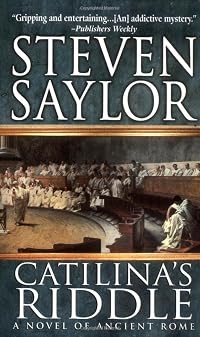
Description
The year is 63 BC, and Gordianus the Finder unexpectedly achieves the dream of every Roman: owning a farm in the Etruscan countryside. Vowing to leave behind the corruption of Rome, he abandons the city, taking his family with him. This bucolic life, however, is disrupted by the machinations and murderous plots of two politicians. When Gordianus' longtime patron Cicero attains his lifelong dream of a coveted consulship, he urgently requests a favor of Gordianus: his help in keeping watch on show more a radical populist senator, Catilina-Cicero's political rival and a candidate to replace him in the annual elections. Against his will, Gordianus finds himself drawn deeper and deeper into a maelstrom of deceit and intrigue, uncertain of the dangers and even more uncertain of where his true allegiance lies. When his six-year-old daughter Diana finds a headless corpse in their stable, Gordianus is confronted with the deadliest mystery of his career. Shrewdly depicting deadly political maneuverings, this addictive mystery also displays the author's firm grasp of history and human character. show lessTags
Recommendations





Member Reviews
Gordianus calls himself the Finder. We would call him a gumsandal. He helps politicians uncover scandal about their opponents; he helps advocates collect evidence of an enemy's crimes, but he is discouraged that he seems no longer able to serve truth and justice. Rome has become a city of corruption and evil. Fortunately, he has inherited a lovely farm in the country with an adequate supply of slaves to run it.
Such is the setting for Catalina's Riddle. Gordianus has forsaken Rome with its corrupt politics. When his loyalty to Cicero is appealed to ostensibly by one of Cicero's henchmen, who insists that the Finder's assistance is needed to keep tabs on Catilina's nefarious intentions, Gordianus refuses, only to discover a headless show more corpse in his barn a few days later. How could the body have been placed there without the knowledge of his family or slaves? He calls on his son, Eco, from Rome, for assistance. Eco has his father's uncanny ability to observe the smallest details.
Soon Catilina shows up at Gordianus' farm allegedly for rest and relaxation, but he exhibits extraordinary interest in an old silver mine filled to overflowing with the skeletons of slaves who had been murdered when the mine was shut down The mine also happens to be located on Gnaeius Claudius' property next to Gordianus' farm, and the Claudius family are still enraged that their ancestor should have left property to Gordianus that they felt should have rightly gone to them.
Gordianus travels to Rome for his son Meto's coming of age: he will become a full citizen with the right to wear the toga. It also happens to be the time of the election, and Saylor treats us to a vivid account of how Roman elections were conducted. But Gordianus has a problem. Marcus Caelius who claims to be Cicero's secret agent pretending to work for Catilina; but his actions betray a more sincere attachment to Catilina woos him. Who is he really working for?
Saylor integrates some of the actual speeches delivered by Cicero before the Senate into the story. The historical record is mostly antagonistic to Catilina; Saylor's tale is much more ambiguous.
A very good mystery in a fascinating setting. show less
Such is the setting for Catalina's Riddle. Gordianus has forsaken Rome with its corrupt politics. When his loyalty to Cicero is appealed to ostensibly by one of Cicero's henchmen, who insists that the Finder's assistance is needed to keep tabs on Catilina's nefarious intentions, Gordianus refuses, only to discover a headless show more corpse in his barn a few days later. How could the body have been placed there without the knowledge of his family or slaves? He calls on his son, Eco, from Rome, for assistance. Eco has his father's uncanny ability to observe the smallest details.
Soon Catilina shows up at Gordianus' farm allegedly for rest and relaxation, but he exhibits extraordinary interest in an old silver mine filled to overflowing with the skeletons of slaves who had been murdered when the mine was shut down The mine also happens to be located on Gnaeius Claudius' property next to Gordianus' farm, and the Claudius family are still enraged that their ancestor should have left property to Gordianus that they felt should have rightly gone to them.
Gordianus travels to Rome for his son Meto's coming of age: he will become a full citizen with the right to wear the toga. It also happens to be the time of the election, and Saylor treats us to a vivid account of how Roman elections were conducted. But Gordianus has a problem. Marcus Caelius who claims to be Cicero's secret agent pretending to work for Catilina; but his actions betray a more sincere attachment to Catilina woos him. Who is he really working for?
Saylor integrates some of the actual speeches delivered by Cicero before the Senate into the story. The historical record is mostly antagonistic to Catilina; Saylor's tale is much more ambiguous.
A very good mystery in a fascinating setting. show less
If the detective won't go to the murder the murder will have to come to the detective. Gordianus the Finder has retired to a farm left to him in the will of a grateful client and friend. But the murky world of Roman politics comes knocking as he gets caught up in Cicero's struggle against Catalina. And then headless bodies start appearing on the farm.
Saylor conveys the sense of a fish out of water and hidden menace well as Gordianus thrashes about trying to work out who he can trust and deal with domestic issues, but I did find it overlong (700+ pages), with the action only picking up in the last 150 pages or so.
Saylor conveys the sense of a fish out of water and hidden menace well as Gordianus thrashes about trying to work out who he can trust and deal with domestic issues, but I did find it overlong (700+ pages), with the action only picking up in the last 150 pages or so.
Catalina's Riddle is the first book by Steven Saylor that I've read, and I found it engrossing despite its length. As far as I can tell the course of events was strictly accurate, and the historical characters did and said what they are reported to have done and said in (generally) contemporary sources (except in private conversations). While Gordianus and his family are certainly unlikely, the book contains a minimum of anachronisms, for those who care about such things.
While the book includes a respectable mystery, the more intriguing elements have to do with characterization and human relationships, which Saylor handles with more sophistication than the typical genre author. Catilina--also known as Cataline--has been reviled for show more centuries for the "Catiline Conspiracy". But who was he really, and what did he actually stand for? And what did he have to do with the bodies without heads that show up on Gordianus' farm? show less
While the book includes a respectable mystery, the more intriguing elements have to do with characterization and human relationships, which Saylor handles with more sophistication than the typical genre author. Catilina--also known as Cataline--has been reviled for show more centuries for the "Catiline Conspiracy". But who was he really, and what did he actually stand for? And what did he have to do with the bodies without heads that show up on Gordianus' farm? show less
A slow starter but finished strong. Saylor brings his characters to life, whether they are actual historical figures (Catalina) or products of his imagination (Gordanius). I just wish the books didn't have so much time in between stories...this one took place about 10 years after book #2. I'd like to see it year by year, as Gordanius is 47 years old in this one. He's getting OLD!
Perhaps overlong, this is my least favourite of the early Saylor mysteries, as it takes a while really to get going. But still a good read as Saylor has the talent to create believable, rounded characters, even slaves and small children, which carries the story forward.
Gordianus the Finder now has a farm in the Etruscan countryside. He abandons the city, taking his family with him.
Cicero is becoming more and more embroiled in Roman politics, with all it's mud slinging and complications. He embroils Gordianus in this by asking for a favour. This starts off a course of events that will drag Gordianus back into the corruption and intrigue he was avoiding.
In places the mystery seemed to be subsumed by the details about Rome and Roman politics, not my favourite of the series. Not a bad read but it was pretty slow going and I almost wanted to abandon it a few times. Yes I will continue with the series, but that's almost more because I have the books than really having a huge urge to.
Cicero is becoming more and more embroiled in Roman politics, with all it's mud slinging and complications. He embroils Gordianus in this by asking for a favour. This starts off a course of events that will drag Gordianus back into the corruption and intrigue he was avoiding.
In places the mystery seemed to be subsumed by the details about Rome and Roman politics, not my favourite of the series. Not a bad read but it was pretty slow going and I almost wanted to abandon it a few times. Yes I will continue with the series, but that's almost more because I have the books than really having a huge urge to.
Interminably wrong. Lots of themes, plots, and subplots, and Saylor's usual dexterity, but I think I lost a whole month on what I thought would be another charming, thrilling Roman mystery.
Members
- Recently Added By
Lists

Historical Fiction
889 works; 91 members
Author Information

61+ Works 13,627 Members
Steven Saylor (born March 23, 1956) is an American author of historical novels. He is a graduate of the University of Texas at Austin, where he studied history and Classics. Although he also has written novels about Texas history, Saylor's best-known work is his Roma Sub Rosa series, set in ancient Rome. The novels' hero is a detective named show more Gordianus the Finder, active during the time of Sulla, Cicero, Julius Caesar, and Cleopatra. He divides his time residing in California and texas. (Bowker Author Biography) show less
Some Editions
Awards and Honors
Awards
Series

Work Relationships
Common Knowledge
- Canonical title
- Catilina's Riddle
- Original title
- Catilina's riddle
- Original publication date
- 1993
- People/Characters
- Gordianus the Finder; Lucius Sergius Catilina; Marcus Tullius Cicero; Julius Caesar; Eco; Meto (show all 9); Gordiana; Bethesda; Marcus Caelius Rufus
- Important places
- Ancient Rome; Campania, Italy
- Important events
- Conspiracy of Catiline
- Epigraph
- Embossed upon the shield Aeneas saw
The stony halls of the netherworld, the domain of the damned
And the punishments they suffer. There Catilina clings to the edge of a sheer
Precipice, cringing in terro... (show all)r while the Furies beat their wings about him . . .
VIRGIL, The Aeneid,
VIII: 666-669
How haue we chang'd and come about
in every doome,
Since wicked CATILINE went out,
And quitted Rome?
One while, we thought him innocent;
And, then w'accus'd
The Cons... (show all)ul, for his malice spent;
And power abus'd.
Since, that we heare, he is in armes
We thinke not so:
Yet charge the Consul, with our harmes
That let him goe:
So, in our censure of the state,
We still do wander;
And make the careful magistrate
The marke of slander.
Ben Jonson, Catiline his Conspiracy,
ACT IV: 863-878
What is truth?
PONTIUS PILATUS - Dedication
- To the Shade of My Mother
- First words
- "According to Cato . . ." I said, and paused, squinting at the scroll.
- Last words
- (Click to show. Warning: May contain spoilers.)Instead I live with doubt and regret, sustained by the love of those close to me, bemused by such ironies as Cicero's exile and Claudia's fate, and I continue to ponder, as I know you must, Catilina's riddle.
Classifications
Statistics
- Members
- 1,030
- Popularity
- 25,165
- Reviews
- 22
- Rating
- (3.79)
- Languages
- 11 — Danish, Dutch, English, French, German, Hungarian, Italian, Polish, Portuguese, Spanish, Swedish
- Media
- Paper, Audiobook, Ebook
- ISBNs
- 39
- ASINs
- 14