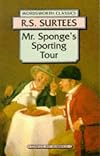
Mr. Sponge's Sporting Tour
by Robert Smith Surtees
On This Page
Description
The humorous narrative of the sporting experiences of a cockney grocerTags
Recommendations


















Member Recommendations
thorold Mr Sponge is more interested in horses and money, and less in women, than Flashman, but the two are very much part of the same tradition.
Member Reviews
I've never made a particular effort to read Surtees - although I'm fairly interested in the mid-Victorian period, I'm not a horsey, doggy sort of person, and have only the mildest interest in rural "sports". However, a couple of people recently recommended me to try him, and thanks to Project Gutenberg it's free to read once you've got an ebook reader...
Mr. Sponge's sporting tour is a picaresque novel chronicling the efforts of a shady character called "Soapy" Sponge to make his fortune while living off simple-minded fox-hunting folk. He gets a bunch of unreliable horses on sale or return from a dodgy secondhand horse dealer, and travels around getting a selection of increasingly appalling hosts to accommodate him and the horses for show more nothing. From time to time he manages to do a horse deal, and every two or three chapters there's a description of a fox-hunt. The mood and style are rather reminiscent of Thackeray (indeed, Surtees makes frequent allusions to WMT), with a wide range of rackety country gentry and dubious "sporting gentlemen" and "trumpets". The big difference, though, is that Thackeray allows some of his characters to have good qualities, even if generosity and altruism are usually cancelled out by folly or naïveté. In Surtees, everyone is out for what he or she can get: greed and sensuality are the only motivations for action. Characters differ largely in the particular degree of cunning or foolishness they display.
The satire is enjoyable, although at this distance in time it sometimes comes across as rather heavy-handed. What's also fascinating is the way the book observes a particular moment in the development of English society, when the Georgian pattern of social relations was starting to be upset by the new possibilities of inexpensive travel provided by the railways. Landowners are still inclined to believe that anyone who turns up on their doorstep with a string of horses and a plausible story must be a man of substance: as Mr Sponge demonstrates time after time, this was no longer a safe assumption. Twenty years later, Sponge would never have got away with it, as the definition of "gentleman" became much narrower, but around 1850 there were still plenty of "real" gentlemen who had never been to school, spoke local dialect, and scorned to pay tradesmen's bills.
Surtees is famous for his descriptions of hunting, of course. They are clearly well done - he manages to convey something of the excitement of riding across country at breakneck speed even to a non-rider - but it still seems to be a somewhat idiotic occupation, even as he describes it. show less
Mr. Sponge's sporting tour is a picaresque novel chronicling the efforts of a shady character called "Soapy" Sponge to make his fortune while living off simple-minded fox-hunting folk. He gets a bunch of unreliable horses on sale or return from a dodgy secondhand horse dealer, and travels around getting a selection of increasingly appalling hosts to accommodate him and the horses for show more nothing. From time to time he manages to do a horse deal, and every two or three chapters there's a description of a fox-hunt. The mood and style are rather reminiscent of Thackeray (indeed, Surtees makes frequent allusions to WMT), with a wide range of rackety country gentry and dubious "sporting gentlemen" and "trumpets". The big difference, though, is that Thackeray allows some of his characters to have good qualities, even if generosity and altruism are usually cancelled out by folly or naïveté. In Surtees, everyone is out for what he or she can get: greed and sensuality are the only motivations for action. Characters differ largely in the particular degree of cunning or foolishness they display.
The satire is enjoyable, although at this distance in time it sometimes comes across as rather heavy-handed. What's also fascinating is the way the book observes a particular moment in the development of English society, when the Georgian pattern of social relations was starting to be upset by the new possibilities of inexpensive travel provided by the railways. Landowners are still inclined to believe that anyone who turns up on their doorstep with a string of horses and a plausible story must be a man of substance: as Mr Sponge demonstrates time after time, this was no longer a safe assumption. Twenty years later, Sponge would never have got away with it, as the definition of "gentleman" became much narrower, but around 1850 there were still plenty of "real" gentlemen who had never been to school, spoke local dialect, and scorned to pay tradesmen's bills.
Surtees is famous for his descriptions of hunting, of course. They are clearly well done - he manages to convey something of the excitement of riding across country at breakneck speed even to a non-rider - but it still seems to be a somewhat idiotic occupation, even as he describes it. show less
It's about a man of limited means who acquires three rented horses, puts on airs and basically invites himself to the homes of various folk in the countryside so he can attend fox hunts (which he also invites himself to). He banks on the fact that nobody knows him, to be able to get away with things- people pretend they know of him to avoid looking ignorant, and he lets them make assumptions about his social position etc, takes advantage of free room and board until he seriously wears out his welcome, and they make efforts to throw him out. Then he moves on, finding someone else who had extended (in mere politeness) an invitation, which he takes them up on suddenly. Eventually enough people in the district hear of him that he finds show more himself staying with people who aren't so well-to-do, and he is thoroughly dissatisfied. He tries to get himself invited back to one of the other households, and starts to wonder at his predicament- no money, no income, and apparently no more invitations forthcoming.
All this time he is involved in some kind of horse-dealing scams- showing off his horses (hiding their faults of course) and selling them, but then making the buyer so discomfited they pay him to take the horse back (once pressured by empty threat of a lawsuit). So he makes money off these horses that aren't even his. He doesn't seem too skilled at foxhunting although more into it than some of the other characters- lots of them apparently participate just to make a show of themselves- and has a curious obsession with studying a book of 'bus schedules and fares that he carries around. A lot of the book isn't about Mr. Sponge at all (most of the names pointedly emphasize something about each character) there are entire chapters just describing the people who will be his next set of hosts. Lots of curious folk with different quirks and habits...
I was interested in reading the descriptions of the hunts, the various ways in which they were conducted and the parts about the horses. Most of this seems to be character studies and obviously intended as humor, although I sometimes missed the point. I did like it just for the fact that it described a way of life long gone by, so very different in many ways. . . . and the ink illustrations are very clever- depicting the various characters with a lot of humor.
from the Dogear Diary show less
All this time he is involved in some kind of horse-dealing scams- showing off his horses (hiding their faults of course) and selling them, but then making the buyer so discomfited they pay him to take the horse back (once pressured by empty threat of a lawsuit). So he makes money off these horses that aren't even his. He doesn't seem too skilled at foxhunting although more into it than some of the other characters- lots of them apparently participate just to make a show of themselves- and has a curious obsession with studying a book of 'bus schedules and fares that he carries around. A lot of the book isn't about Mr. Sponge at all (most of the names pointedly emphasize something about each character) there are entire chapters just describing the people who will be his next set of hosts. Lots of curious folk with different quirks and habits...
I was interested in reading the descriptions of the hunts, the various ways in which they were conducted and the parts about the horses. Most of this seems to be character studies and obviously intended as humor, although I sometimes missed the point. I did like it just for the fact that it described a way of life long gone by, so very different in many ways. . . . and the ink illustrations are very clever- depicting the various characters with a lot of humor.
from the Dogear Diary show less
Illustrations by John Leech
Ratings
Members
- Recently Added By
Author Information

28 Works 806 Members
Robert Smith Surtees was born on May 17, 1803 to a Durham (England) hunting family. Educated to be a solicitor, Surtees began contributing to Sporting Magazine in 1830. The following year, he paired up with publisher R. Ackermann and founded the New Sporting Magazine. He continued to be an editor for the magazine for the next 5 years. He show more contributed comic sketches of Mr. Jorrocks to this magazine. The sketches and papers were collected and published in 1838 as Jorrocks's Jaunts and Jollities. Mr. Jorrocks was reintroduced in the novel Handley Cross in 1843 and enjoyed wide popularity. Mr. Jorrokcs also appeared in Hillingdon Hall (1845). Other novels written by Surtees include: Hawbuck Grange (1847), Mr. Sponge's Sporting Tour (1853), Ask Mamma (1853), Plain or Ringlets? (1860), and Mr. Facey Romford's Hounds (1865). The last of these novels was published after the author's death. Surtees's father passed away in 1838 and Robert inherited the family property of Hamsterley Hall, where he lived for the rest of his life. In 1841 he married Elizabeth Jane and had one son and two daughters. Robert Smith Surtees died in 1864. (Bowker Author Biography) show less
Awards and Honors
Notable Lists
Series
Belongs to Publisher Series
Common Knowledge
- Original publication date
- 1853
- People/Characters
- Soapey Sponge
- Important places
- England, UK
- First words
- The author gladly avails himself of the convenience of a Preface for stating, that it will be seen at the close of the work why he makes such a characterless character as Mr. Sponge the hero of his tale.
Preface to... (show all) the original edition.
It was a murky October day that the hero of our tale, Mr. Sponge, or Soapey Sponge, as his good-natured friends call him, was seen mizzling along Oxford Street, wending his way to the West.
Chapter I. Our hero. - Last words
- (Click to show. Warning: May contain spoilers.)Nay, bad as he is, we'll back old Soapey to be better than any of them, - with which encomium we most heartily bid him ADIEU.
- Original language
- English
Classifications
Statistics
- Members
- 184
- Popularity
- 178,694
- Reviews
- 3
- Rating
- (3.42)
- Languages
- English
- Media
- Paper, Ebook
- ISBNs
- 30
- ASINs
- 17