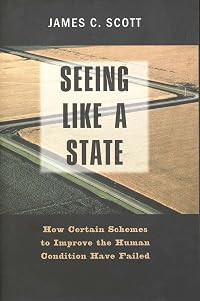
Seeing Like a State: How Certain Schemes to Improve the Human Condition Have Failed
by James C. Scott
On This Page
Description
Compulsory ujamaa villages in Tanzania, collectivization in Russia, Le Corbusier's urban planning theory realized in Brasilia, the Great Leap Forward in China, agricultural "modernization" in the Tropics-the twentieth century has been racked by grand utopian schemes that have inadvertently brought death and disruption to millions. Why do well-intentioned plans for improving the human condition go tragically awry?In this wide-ranging and original book, James C. Scott analyzes failed cases of show more large-scale authoritarian plans in a variety of fields. Centrally managed social plans misfire, Scott argues, when they impose schematic visions that do violence to complex interdependencies that are not-and cannot-be fully understood. Further, the success of designs for social organization depends upon the recognition that local, practical knowledge is as important as formal, epistemic knowledge. The author builds a persuasive case against "development theory" and imperialistic state planning that disregards the values, desires, and objections of its subjects. He identifies and discusses four conditions common to all planning disasters: administrative ordering of nature and society by the state; a "high-modernist ideology" that places confidence in the ability of science to improve every aspect of human life; a willingness to use authoritarian state power to effect large- scale interventions; and a prostrate civil society that cannot effectively resist such plans. show lessTags
Recommendations












Member Reviews
I don't know how I found this book. I wish I remember where I saw it cited, in such a way that I was inspired to read it, because it's one of those books that's affected my thinking-- not just as a scholar, but as a person. Like the best works of nonfiction, it gave me a powerful concept that provided not only answers but new questions. If you pay attention to these kinds of things, you'll know that I'm interested in what it means to "see like a scientist" (a wording I adopted after reading this book) in Victorian literature: I study how scientists are literally depicted as seeing the world differently than other people. Key examples include Swithin St. Cleeve of Thomas Hardy's Two on a Tower (1882), who can see the horrific depths of show more space but not that the love of the woman standing in the room with him; Tertius Lydate of George Eliot's Middlemarch (1871-72), who can see cellular arrangements but is blind to social ones; and Tom Thurnall of Charles Kingsley's Two Years Ago (1857), who knows everything about a person he observes but the goodness below the surface.
Yet there was this subset of Victorian scientist novels from the 1890s featuring future war. Or perhaps this subset of Victorian future was novels from the 1890s featuring scientists. And somehow there was a relationship between science, revolution, apocalypse, and utopia, and it wasn't just that you need a scientist to invent the air-ship that you're going to use to bomb your enemies into oblivion (though it helps). Don't get me wrong, I had some ideas of my own about how the scientist serves as an authorizing figure, but Scott's monograph was helpful in articulating them. Scott's whole deal is that the state maps things, makes models, and sometimes even goes up in an airplane to look at them, because doing this makes those things legible: "[b]y virtue of its great distance, an aerial view resolved what might have seemed ground-level confusion into an apparent vaster order and symmetry" (58).
So that's why these 1890s proto-sci-fi novels are all about air-ships, because they allow the protagonists to see the world in a distanced way, which makes it easier for them to use their weapons to remake the world. They have the perspective that Scott calls "Authoritarian High Modernism," which consists of three things: "aspiration to the administrative ordering of nature and society" (88), "a sweeping, rational engineering of all aspects of social life" and "unrestrained use of the power of the modern state as an instrument for achieving these designs" (88-9), and a "civil society that lacks the capacity to resist these plans" (89). All of these things converge in the 1890s air-ship novel, where would-be revolutionaries use air-ships to bombard the world into submission, thereby creating a utopia.
I should add that Scott's book is called "Seeing Like a State," but in Victorian fiction it's usually would-be states that are the authoritarian high modernists. Though most of Scott's work focuses on authoritarian high modernism as a tool of contemporary statecraft, he does cite one revolutionary group that derived its authority from a detached, scientific perspective: during the early days of the Russian Revolution, Lenin considered the "vanguard party" of the Revolution "an executive elite whose grasp of history and dialectical materialism allows it to devise the correct 'war aims' of the class struggle. Its authority is based on its scientific intelligence" (151). Revolutionaries and statists of the twentieth century share authoritarian high modernism, as do those on the right and the left.
I said earlier that air-ships are in these novels I study because they "allow the protagonists to see the world in a distanced way," which enables remaking it. But causality when it comes to technology and epistemology is rarely one-way, so maybe the reason these novels are all about remaking the world is because the air-ship had been invented (in fiction, if not fact). It's important to point that for Scott, distance is often a metaphor: looking at a map is a form of distance. So it is too in these turn-of-the-century novels, because sometimes you have an air-ship, but sometimes you just have a sociologist, who views society from a distance by turning it into tables of data and equations, not (necessarily) maps. Scientific sight gives you both Authoritarian High Modernism's "aspiration to the administrative ordering of nature and society" and "a sweeping, rational engineering for all aspects of social life." I guess the air-ship and its dynamite cannons is what makes society unable to resist you.
But seriously this plot was everywhere in the 1890s: Ignatius Donnelly's Caesar's Column (1890), Mr. Dick's James Ingleton (1893), E. Douglas Fawcett's Hartmann the Anarchist (1893), George Griffith's Angel of the Revolution (1893), T. Mullett Ellis's Zalma (1895), Louis Tracy's The Final War (1897), Simon Newcomb's His Wisdom the Defender (1900). You couldn't move for all the authoritarian high modernists in early sf; Scott's real ones had plenty of fictional antecedents. A common them of these novels is destroying the world in order to save it, causing massive violence to the old society in order to build a new one from scratch, and reading Scott turns up real analogues to even this; he recounts how the architect Le Corbusier "warned against the temptations to reform.… Instead, he insisted, we must take a 'blank piece of paper,' a 'clean tablecloth,' and start new calculations from zero" (117). Of course, the clean break required to reshape a national or global society is much larger than that required to prevent urban traffic congestion by several orders of magnitude, and it requires violence.
It hasn't just helped my scholarship, though; it's enhanced my perception of the world we live in. I have a beauracrat's heart; I love rules that make things systematized and legible. But Scott's book serves as a reminder that the categories were made for man, not man for the categories. We need to be wary of what mapping hides, and of what knowledges are discarded because they don't seem objective enough to us, and of what things will be destroyed because we don't perceive them. (As a college professor, you might imagine I particularly contemplate this when undergoing the depressing task of reading my evaluations at the end of the semester.) show less
Yet there was this subset of Victorian scientist novels from the 1890s featuring future war. Or perhaps this subset of Victorian future was novels from the 1890s featuring scientists. And somehow there was a relationship between science, revolution, apocalypse, and utopia, and it wasn't just that you need a scientist to invent the air-ship that you're going to use to bomb your enemies into oblivion (though it helps). Don't get me wrong, I had some ideas of my own about how the scientist serves as an authorizing figure, but Scott's monograph was helpful in articulating them. Scott's whole deal is that the state maps things, makes models, and sometimes even goes up in an airplane to look at them, because doing this makes those things legible: "[b]y virtue of its great distance, an aerial view resolved what might have seemed ground-level confusion into an apparent vaster order and symmetry" (58).
So that's why these 1890s proto-sci-fi novels are all about air-ships, because they allow the protagonists to see the world in a distanced way, which makes it easier for them to use their weapons to remake the world. They have the perspective that Scott calls "Authoritarian High Modernism," which consists of three things: "aspiration to the administrative ordering of nature and society" (88), "a sweeping, rational engineering of all aspects of social life" and "unrestrained use of the power of the modern state as an instrument for achieving these designs" (88-9), and a "civil society that lacks the capacity to resist these plans" (89). All of these things converge in the 1890s air-ship novel, where would-be revolutionaries use air-ships to bombard the world into submission, thereby creating a utopia.
I should add that Scott's book is called "Seeing Like a State," but in Victorian fiction it's usually would-be states that are the authoritarian high modernists. Though most of Scott's work focuses on authoritarian high modernism as a tool of contemporary statecraft, he does cite one revolutionary group that derived its authority from a detached, scientific perspective: during the early days of the Russian Revolution, Lenin considered the "vanguard party" of the Revolution "an executive elite whose grasp of history and dialectical materialism allows it to devise the correct 'war aims' of the class struggle. Its authority is based on its scientific intelligence" (151). Revolutionaries and statists of the twentieth century share authoritarian high modernism, as do those on the right and the left.
I said earlier that air-ships are in these novels I study because they "allow the protagonists to see the world in a distanced way," which enables remaking it. But causality when it comes to technology and epistemology is rarely one-way, so maybe the reason these novels are all about remaking the world is because the air-ship had been invented (in fiction, if not fact). It's important to point that for Scott, distance is often a metaphor: looking at a map is a form of distance. So it is too in these turn-of-the-century novels, because sometimes you have an air-ship, but sometimes you just have a sociologist, who views society from a distance by turning it into tables of data and equations, not (necessarily) maps. Scientific sight gives you both Authoritarian High Modernism's "aspiration to the administrative ordering of nature and society" and "a sweeping, rational engineering for all aspects of social life." I guess the air-ship and its dynamite cannons is what makes society unable to resist you.
But seriously this plot was everywhere in the 1890s: Ignatius Donnelly's Caesar's Column (1890), Mr. Dick's James Ingleton (1893), E. Douglas Fawcett's Hartmann the Anarchist (1893), George Griffith's Angel of the Revolution (1893), T. Mullett Ellis's Zalma (1895), Louis Tracy's The Final War (1897), Simon Newcomb's His Wisdom the Defender (1900). You couldn't move for all the authoritarian high modernists in early sf; Scott's real ones had plenty of fictional antecedents. A common them of these novels is destroying the world in order to save it, causing massive violence to the old society in order to build a new one from scratch, and reading Scott turns up real analogues to even this; he recounts how the architect Le Corbusier "warned against the temptations to reform.… Instead, he insisted, we must take a 'blank piece of paper,' a 'clean tablecloth,' and start new calculations from zero" (117). Of course, the clean break required to reshape a national or global society is much larger than that required to prevent urban traffic congestion by several orders of magnitude, and it requires violence.
It hasn't just helped my scholarship, though; it's enhanced my perception of the world we live in. I have a beauracrat's heart; I love rules that make things systematized and legible. But Scott's book serves as a reminder that the categories were made for man, not man for the categories. We need to be wary of what mapping hides, and of what knowledges are discarded because they don't seem objective enough to us, and of what things will be destroyed because we don't perceive them. (As a college professor, you might imagine I particularly contemplate this when undergoing the depressing task of reading my evaluations at the end of the semester.) show less
This is the kind of book that restores my faith in academic theory. It should be required reading for anybody interested in the exercise of power, economic development, or large scale systems.
In Seeing Like a State, Scott explores how attempts to radically transform and improve the human condition have failed. He identifies the central problem of statecraft and of government as one of legibility; the state must make its citizens and their activities visible before it can appropriate revenue and orchestrate any plan for the general welfare. The problem comes when this necessary evil is tied to an ideology of High Modernism, an authoritarian central government, and a prostrate civil society.
High Modernism is a belief in a technocratic and show more scientific rationality; that there is one correct answer for every situation. But there is no such thing as a universal generalization, every village, field, and person is a unique individual. The state's attempts at improvement rapidly become an effort to standardize society, and make every unit of interest behave identically. This process of reducing reality to schematic agents and cadastral maps is inherently one of violence, discarding generations of carefully accumulated local >metis (craft) in favor of the interests of the center. Local people are inevitably coerced into conforming with the modern grid, since it is easier to make people fit the categories than categories fit the situation.
This is not a hopeful book, but it does provide a valuable glimpse at the functioning of the most dangerous ideology of the 20th century--that of the centrally directed transformation. show less
In Seeing Like a State, Scott explores how attempts to radically transform and improve the human condition have failed. He identifies the central problem of statecraft and of government as one of legibility; the state must make its citizens and their activities visible before it can appropriate revenue and orchestrate any plan for the general welfare. The problem comes when this necessary evil is tied to an ideology of High Modernism, an authoritarian central government, and a prostrate civil society.
High Modernism is a belief in a technocratic and show more scientific rationality; that there is one correct answer for every situation. But there is no such thing as a universal generalization, every village, field, and person is a unique individual. The state's attempts at improvement rapidly become an effort to standardize society, and make every unit of interest behave identically. This process of reducing reality to schematic agents and cadastral maps is inherently one of violence, discarding generations of carefully accumulated local >metis (craft) in favor of the interests of the center. Local people are inevitably coerced into conforming with the modern grid, since it is easier to make people fit the categories than categories fit the situation.
This is not a hopeful book, but it does provide a valuable glimpse at the functioning of the most dangerous ideology of the 20th century--that of the centrally directed transformation. show less
Really interesting; I’d never read it before despite having read many references to it. The core idea is “legibility”: standardization and simplification—of rules if not of reality—make it easier for outsiders, including government, to understand a community. A colonizer who needs a “native guide” is worse off than one who doesn’t, which is one reason that colonies often had more comprehensive systems of land titling and clearer ownership rules than the colonizing nation itself. Common property may not be less productive than individually owned plots, but it is much harder to tax, and thus much less useful to the state. This power can be used for good (working sewers, less cholera) but can easily be turned to ill, show more especially if the state is wrong about the lines it has drawn (collective farms, monocultures). Although he repeatedly emphasizes that the organic societal formations that states have sought to replace with regimentation are regularly discriminatory and flawed, he’s ultimately skeptical of big state ideas. At the same time, while he criticizes compulsory villagization in Tanzania—and there’s plenty to criticize—he doesn’t ever address whether there was an alternative, given the country’s resources, to the concentration of population in order to deliver things like schools and famine relief. Maybe the correct answer is “you just can’t have schools with a scattered rural population and really low wealth,” but that’s a pretty serious tradeoff that deserves some discussion.
Another interesting point: the “high modernism” he criticizes focuses on visual order—neatly laid out rows of plants, streets, etc. But, as he points out, visual disorder can also mean high-functioning complexity—the intestines of a rabbit, in his striking example, are not visually orderly but do a great job at their actual job.
I also found it notable that, at the end, Scott acknowledges that non-state actors can do the same thing. Capitalists are interested in control and appropriability; they will adopt less efficient rules if they can appropriate more of the outputs. Scott described what’s now known as “chickenization” as a capitalist, high-modernist project, offloading risk onto individual farmers who would be easy to surveil precisely because their practices were so rigidly dictated by the chicken processor. show less
Another interesting point: the “high modernism” he criticizes focuses on visual order—neatly laid out rows of plants, streets, etc. But, as he points out, visual disorder can also mean high-functioning complexity—the intestines of a rabbit, in his striking example, are not visually orderly but do a great job at their actual job.
I also found it notable that, at the end, Scott acknowledges that non-state actors can do the same thing. Capitalists are interested in control and appropriability; they will adopt less efficient rules if they can appropriate more of the outputs. Scott described what’s now known as “chickenization” as a capitalist, high-modernist project, offloading risk onto individual farmers who would be easy to surveil precisely because their practices were so rigidly dictated by the chicken processor. show less
This is a fascinating book on the perils of "high modernist" aspirations. The book focuses on the processes that lead to failures in megaprojects.
Many of us have an instinctive knee-jerk reaction to large-scale projects. Yet it's hard to put into words why. At the outset, it sometimes just seems like blind resistance to change. Scott not only provides an explanation for understanding these reactions, but also a framework for thinking about when those reactions are actually justified and when they might be overreactions.
High modernists come in all shapes and sizes. They range from autocrats to revolutionaries, bureaucrats to visionaries, socialists to capitalists. What unites them are their top-down visions that seek to reorganize life, show more production, or work.
High modernism is a form of tyranny of "experts" over others, symptomized by:
-Top-down visions with little interest, or appreciation of the local context or stakeholders.
-Over-rationalization and standardization leading to ignoring, rejecting, and wiping out local knowledge.
-The consequences of failed high modernist projects range from catastrophic to wasteful.
Going through diverse cases, the book also paints an interesting historical backdrop to trending topics in society, politics, and business. I.e. Systems thinking, user-centered design, and business anthropology all aim to better understand and integrate local knowledge into solutions big and small. Therefore it's also a book on the mistakes that have brought us to this point. show less
Many of us have an instinctive knee-jerk reaction to large-scale projects. Yet it's hard to put into words why. At the outset, it sometimes just seems like blind resistance to change. Scott not only provides an explanation for understanding these reactions, but also a framework for thinking about when those reactions are actually justified and when they might be overreactions.
High modernists come in all shapes and sizes. They range from autocrats to revolutionaries, bureaucrats to visionaries, socialists to capitalists. What unites them are their top-down visions that seek to reorganize life, show more production, or work.
High modernism is a form of tyranny of "experts" over others, symptomized by:
-Top-down visions with little interest, or appreciation of the local context or stakeholders.
-Over-rationalization and standardization leading to ignoring, rejecting, and wiping out local knowledge.
-The consequences of failed high modernist projects range from catastrophic to wasteful.
Going through diverse cases, the book also paints an interesting historical backdrop to trending topics in society, politics, and business. I.e. Systems thinking, user-centered design, and business anthropology all aim to better understand and integrate local knowledge into solutions big and small. Therefore it's also a book on the mistakes that have brought us to this point. show less
A counter-blast against high modernism in all its guises. Fascinating start and first 7 chapters - surnames, planning cities to stop social conflict, the continuity between dumb colonial development plans and Nyerere’s utopian dreams; all with excellent notes and wide, interesting references…But then the author becomes plodding and repetitive and guilty of the same boxed thinking he lays on all the thin planners he pillories. Technology and AI have made some of his criticisms of scientific agriculture and scientific forestry very particular.
He comes to …rules of thumb that, if observed, could make development planning less prone to disaster: take small steps, favour reversibility, plan on surprises, plan on human inventiveness (p. show more 345). One might be reminded of Chen Yun’s remark about crossing the river by feeling the stones.
But Scott is very down on pilot programmes - all of which fail when the pilot support is withdrawn.
“Without denying the incontestable benefits either of the division of labor or of hierarchical coordination for some tasks, I want to make a case for institutions that are instead multifunctional, plastic, diverse, and adaptable—“ show less
He comes to …rules of thumb that, if observed, could make development planning less prone to disaster: take small steps, favour reversibility, plan on surprises, plan on human inventiveness (p. show more 345). One might be reminded of Chen Yun’s remark about crossing the river by feeling the stones.
But Scott is very down on pilot programmes - all of which fail when the pilot support is withdrawn.
“Without denying the incontestable benefits either of the division of labor or of hierarchical coordination for some tasks, I want to make a case for institutions that are instead multifunctional, plastic, diverse, and adaptable—“ show less
While most theory books have a hard time captivating me, this one is very well done. Scott focuses on why some of the utopian centrally-planned societies failed and why organic "home-spun" communities and societies generally are more adapt to deal with harsh times. Echoing Kroptkin's writing nearly a century later (though without all the romance) Scott states that local mutual aid works more systematically than systematic over-arching state plans. He goes through several historical examples, such as Soviet collectivization, the building of Brasilia as the new "modern" capital of Brazil away from the coastal "cultural" capital of Rio de Janeiro, Tanzania's "villagization", the designs of the modernist city planning versus unplanned show more cities, all the way to such things we today take for granted such as linguistics, measurement, and censuses which he argues all started as ways of social control by the bourgeois State.
One of the most compelling arguments he makes is near the beginning, when he goes through the story of German forest planters, who wanted to make their timber growth larger by planning out a forest, instead of getting it from a thicker natural forest. What they found was that after 1 or 2 generations of trees, the forest began to die, because it had no ecosystem to support it and the species of the trees were more or less the same. The soil became loosen as the trees were perfectly spaced, diseases spread easily since all the trees were the same species and equally susceptible, and there was no ecosystem or diversity to keep the trees health.
He takes that example as a metaphor for human planning, and quickly touches into the ways of measurement in the 1700s versus now. Because in, for example France, there were literally hundreds of different ways of measuring things depending on where you went, it was fairly difficult for the Monarchy to collect taxes on a regular basis. After the French Revolution, the newly ascended bourgeois wanted to empower the state to direct the nation, and thus needed ways to more regurally collect taxes. They made the metric system standard, replacing lots of local culture. Before, in places across the world, the local measurement system made sense to people, and not always involved distance. An example would be in New Guinea, people tell how far away something is by "ricepots". Everyone knows how long it takes to boil a pot of rice, and so 3 ricepots would be a two hour walk.
Another fascinating point was a comparison of a right-wing city planner with the collectivization program of Lenin and Stalin. It is amazing to note the similarities. Huge collective farms were eventually even used for a model of American factory farms, which have replaced most small farmers in the United States today. When Paris redesigned itself in the early 20th century, it destroyed many old neighborhoods, in part as an effort to prevent any more revolutions, since the city had more or less brought down the government four times in less than 100 years (1792, 1830, 1848, 1871). Thus, the perfect modernist designs were not an effort to build a utopia, but an effort of the state to control the population and prevent resistance.
Overall, the book, though a little thick, is a good read. The author is not an anarchist, but the argument he presents lends much credit to the anarchist argument against centralization of society, whether it be state or corporate. His arguments are centered on Europe since this is where much of the state control theories arose, and present good arguments against both the "well meaning socialist" who wants the government to run society for the people, and the "libertarian party" member who would like to see big business replace the state. Unlike many theory books, he also presents a clear alternative in each case cited, such as Rosa Luxemborg to Lenin, the organic mutual-aid driven neighborhoods versus the planned aesthetically perfect city, and the local measurement systems versus the modern metric system (though I can also see the benefits of using standardized metric and language, too.) show less
One of the most compelling arguments he makes is near the beginning, when he goes through the story of German forest planters, who wanted to make their timber growth larger by planning out a forest, instead of getting it from a thicker natural forest. What they found was that after 1 or 2 generations of trees, the forest began to die, because it had no ecosystem to support it and the species of the trees were more or less the same. The soil became loosen as the trees were perfectly spaced, diseases spread easily since all the trees were the same species and equally susceptible, and there was no ecosystem or diversity to keep the trees health.
He takes that example as a metaphor for human planning, and quickly touches into the ways of measurement in the 1700s versus now. Because in, for example France, there were literally hundreds of different ways of measuring things depending on where you went, it was fairly difficult for the Monarchy to collect taxes on a regular basis. After the French Revolution, the newly ascended bourgeois wanted to empower the state to direct the nation, and thus needed ways to more regurally collect taxes. They made the metric system standard, replacing lots of local culture. Before, in places across the world, the local measurement system made sense to people, and not always involved distance. An example would be in New Guinea, people tell how far away something is by "ricepots". Everyone knows how long it takes to boil a pot of rice, and so 3 ricepots would be a two hour walk.
Another fascinating point was a comparison of a right-wing city planner with the collectivization program of Lenin and Stalin. It is amazing to note the similarities. Huge collective farms were eventually even used for a model of American factory farms, which have replaced most small farmers in the United States today. When Paris redesigned itself in the early 20th century, it destroyed many old neighborhoods, in part as an effort to prevent any more revolutions, since the city had more or less brought down the government four times in less than 100 years (1792, 1830, 1848, 1871). Thus, the perfect modernist designs were not an effort to build a utopia, but an effort of the state to control the population and prevent resistance.
Overall, the book, though a little thick, is a good read. The author is not an anarchist, but the argument he presents lends much credit to the anarchist argument against centralization of society, whether it be state or corporate. His arguments are centered on Europe since this is where much of the state control theories arose, and present good arguments against both the "well meaning socialist" who wants the government to run society for the people, and the "libertarian party" member who would like to see big business replace the state. Unlike many theory books, he also presents a clear alternative in each case cited, such as Rosa Luxemborg to Lenin, the organic mutual-aid driven neighborhoods versus the planned aesthetically perfect city, and the local measurement systems versus the modern metric system (though I can also see the benefits of using standardized metric and language, too.) show less
Three stars, rounding up from two because at least I had a good time arguing with the author in my head. This is not because I believed the author was wrong. I agreed with many of Scott's central points. However, as a historical argument, this book was terrible. It is not so much that the facts were wrong. In the areas where I had more familiarity (urban planning and industrial farming) the facts matched my memory, and I have no reason to doubt that it was different elsewhere.
Rather, it was that the facts did not support the argument that the author was trying to make. He relies almost exclusively on argument from example. He never makes a coherent case for his points. Rather, he throws example after example at the reader without show more providing any evidence that those examples should be taken as more than single instances. He also fails to define key terms. The most critical is authoritarian. More problematic, given the focus of the book, is that his definition of high modernism is imprecise enough that, by the end of the book, it seems that it can be used to label nearly anything. He uses backward reasoning, finding a causal connection without showing that there was actually a causal connection. E.g., his repetitive harping on the role of visual order treated it as a fundamental issue rather than an interesting symptom of the simplifying mindset. All-in-all, these failures of historical argument means that even the points I agree with are not actually well justified by this book.
The other issue I have with this book is that it is tedious. Oh, is it tedious. I recommend reading the introduction and then chapters 1 and 2 to get an idea of the general thesis about the challenges and issues of administrative simplifications. Then read one of the chapters of a deep dive into how administrative simplifications caused harm; choose whichever looks most interesting. Skim the rest. This is because they are much more detailed than is needed to illustrate the core arguments of the book. Read chapters 9 and 10 in full. Chapter 9 is the best in the book. Chapter 10 wraps things up nicely and covers the key points.
For those who want a little more detail, here's a synopsis of the book. The introduction lays out the thesis of the book. The state has gained its power over the years by increasing the legibility of society. This increased legibility allows state processes to scale by reducing local variability.
Chapter 1 describes how it is impossible to see everything at once. Focusing on a narrow slice of reality can give one a broader view. However, we must never forget that the narrow slice is just that: a slice. If decisions are made assuming the slice is the whole, then there will likely be unintended consequences. This is explored through several domains: scientific forest management, the imposition of uniform measures, and the creation of cadastral maps.
Chapter 2 provides more examples of state imposed legibility, these ones focused on human systems: the layout of cities, surnames, and language.
Chapter 3 is a rant about how high modernism is authoritarian that doesn't sufficiently define either term and abounds in generalities rather than making a substantiated case. One might say that the author selectively focuses on the elements that make his own case legible, but someone whose thesis is about the dangers of simplification would surely not do that! Right?
Chapter 4 is mostly a rant against Le Corbusier and high modernist city plans. The chapter ends with a discussion of Jane Jacob's observations of what makes a city effective for its inhabitants. I rather enjoyed that bit.
Chapter 5 is a tedious chapter about the Communist revolution in Russia. It mostly focuses on Lenin's claims in a few pieces of writing.
Chapter 6 illustrates the harm of displacement through a discussion of rural collectivization in the Soviet Union. The end result was a society that looked more like a plantation or feudal servitude than any sort of autonomous individuals.
Chapter 7 looks at the process of forced removal to newly built villages in Tanzania.
Chapter 8 goes into depth about the problems caused by scientific farming.
Chapter 9 is the best chapter in the book. This chapter discusses the value and role of practical knowledge, mētis. Mētis is best seen as complementary to scientific knowledge. Scientific knowledge is general and, thus, needs to be translated to be applicable in the specific local contexts where it is used. Practical knowledge is extremely specific and local and often does not generalize well. Seeing these as partners makes both stronger.
Chapter 10 concludes that forced simplifications tend to fail because they assume that general rules can be applied to specific situations. Instead, practical and theoretical knowledge should work together. This requires encouraging flexible, multipurpose, decentralized institutions. Although these systems may be less efficient under repetitive, stable, and predictable conditions, they will do much better when the environment changes. show less
Rather, it was that the facts did not support the argument that the author was trying to make. He relies almost exclusively on argument from example. He never makes a coherent case for his points. Rather, he throws example after example at the reader without show more providing any evidence that those examples should be taken as more than single instances. He also fails to define key terms. The most critical is authoritarian. More problematic, given the focus of the book, is that his definition of high modernism is imprecise enough that, by the end of the book, it seems that it can be used to label nearly anything. He uses backward reasoning, finding a causal connection without showing that there was actually a causal connection. E.g., his repetitive harping on the role of visual order treated it as a fundamental issue rather than an interesting symptom of the simplifying mindset. All-in-all, these failures of historical argument means that even the points I agree with are not actually well justified by this book.
The other issue I have with this book is that it is tedious. Oh, is it tedious. I recommend reading the introduction and then chapters 1 and 2 to get an idea of the general thesis about the challenges and issues of administrative simplifications. Then read one of the chapters of a deep dive into how administrative simplifications caused harm; choose whichever looks most interesting. Skim the rest. This is because they are much more detailed than is needed to illustrate the core arguments of the book. Read chapters 9 and 10 in full. Chapter 9 is the best in the book. Chapter 10 wraps things up nicely and covers the key points.
For those who want a little more detail, here's a synopsis of the book. The introduction lays out the thesis of the book. The state has gained its power over the years by increasing the legibility of society. This increased legibility allows state processes to scale by reducing local variability.
Chapter 1 describes how it is impossible to see everything at once. Focusing on a narrow slice of reality can give one a broader view. However, we must never forget that the narrow slice is just that: a slice. If decisions are made assuming the slice is the whole, then there will likely be unintended consequences. This is explored through several domains: scientific forest management, the imposition of uniform measures, and the creation of cadastral maps.
Chapter 2 provides more examples of state imposed legibility, these ones focused on human systems: the layout of cities, surnames, and language.
Chapter 3 is a rant about how high modernism is authoritarian that doesn't sufficiently define either term and abounds in generalities rather than making a substantiated case. One might say that the author selectively focuses on the elements that make his own case legible, but someone whose thesis is about the dangers of simplification would surely not do that! Right?
Chapter 4 is mostly a rant against Le Corbusier and high modernist city plans. The chapter ends with a discussion of Jane Jacob's observations of what makes a city effective for its inhabitants. I rather enjoyed that bit.
Chapter 5 is a tedious chapter about the Communist revolution in Russia. It mostly focuses on Lenin's claims in a few pieces of writing.
Chapter 6 illustrates the harm of displacement through a discussion of rural collectivization in the Soviet Union. The end result was a society that looked more like a plantation or feudal servitude than any sort of autonomous individuals.
Chapter 7 looks at the process of forced removal to newly built villages in Tanzania.
Chapter 8 goes into depth about the problems caused by scientific farming.
Chapter 9 is the best chapter in the book. This chapter discusses the value and role of practical knowledge, mētis. Mētis is best seen as complementary to scientific knowledge. Scientific knowledge is general and, thus, needs to be translated to be applicable in the specific local contexts where it is used. Practical knowledge is extremely specific and local and often does not generalize well. Seeing these as partners makes both stronger.
Chapter 10 concludes that forced simplifications tend to fail because they assume that general rules can be applied to specific situations. Instead, practical and theoretical knowledge should work together. This requires encouraging flexible, multipurpose, decentralized institutions. Although these systems may be less efficient under repetitive, stable, and predictable conditions, they will do much better when the environment changes. show less
Members
- Recently Added By
Lists

Reading list
170 works; 1 member

The Venus Project Recommended Books - Contemporary sources
53 works; 2 members
Author Information

17+ Works 4,846 Members
James C. Scott is Sterling Professor of Political Science and codirector of the Agrarian Studies Program at Vale University. His previous books include Domination and the Arts of Resistance, Seeing Like a State, and The Art of Not Being Governed.
Some Editions
Awards and Honors
Series
Belongs to Publisher Series
Common Knowledge
- Canonical title
- Seeing Like a State: How Certain Schemes to Improve the Human Condition Have Failed
- Original publication date
- 2020
Classifications
- Genres
- Anthropology, Politics and Government, Sociology, General Nonfiction, Nonfiction, History, Philosophy
- DDC/MDS
- 338.9 — Society, government, & culture Economics Production Economic Development And Growth
- LCC
- HD87.5 .S365 — Social sciences Industries. Land use. Labor Industries. Land use. Labor Economic growth, development, planning
- BISAC
Statistics
- Members
- 1,804
- Popularity
- 12,107
- Reviews
- 27
- Rating
- (4.20)
- Languages
- 6 — Chinese, English, French, Russian, Spanish, Turkish
- Media
- Paper, Audiobook, Ebook
- ISBNs
- 20
- ASINs
- 9