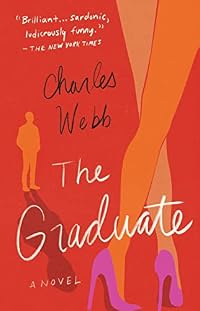
The Graduate
by Charles Webb
On This Page
Description
When Benjamin Braddock graduates from a small eastern college and comes home to his parents' house, everyone wants to know what he's going to do with his life. Benjamin has no idea. Feeling empty, embittered, and adrift, he stumbles into an affair with Mrs. Robinson, the wife of his father's business partner. But then he falls in love with a woman closer to his own age: Mrs. Robinson's daughter. A scathingly entertaining tale of idealism and materialism, corruption and conformity, The show more Graduate is both a darkly comic love-triangle tale and a sharp look at postwar suburbia. show lessTags
Recommendations

















Member Recommendations
Member Reviews
I found this novel intriguing because of its style: it was almost like reading a play. All of the subtleties are in the dialogue, either by the words chosen or by the silences. The obvious misunderstandings in the generations, the young adults naivete, the old adults cruelty all come together to create tension-filled relationships where lies, mislaid good intentions and disillusion dominate.
I'm not sure I truly understand Mrs. Robinsons' motivation for evil (I don't think she was much interested in Benjamin) and the ending has a goofy optimism which clashes with the rest of the novel, but overall I very much enjoyed the break in tradition, questioning of values and triumph of the young. Definitely representative of an epoch.
I'm not sure I truly understand Mrs. Robinsons' motivation for evil (I don't think she was much interested in Benjamin) and the ending has a goofy optimism which clashes with the rest of the novel, but overall I very much enjoyed the break in tradition, questioning of values and triumph of the young. Definitely representative of an epoch.
I read Charles Webb's THE GRADUATE back when it was new, and I loved it. His dialogue was cinematically good, which explains why it translated so well into film. I still remember the advice the newly graduated Benjamin Braddock got from a friend of his parents: "Ben, one word. Plastics." It was emblematic of the materialistic world he was entering. No wonder he succumbed so numbly to the advances of Mrs. Robinson, drifting aimlessly. I've read the book a few more times in the ensuing decades, and, personally, I think it holds up well, not only as literature, but as a document of those times. It could be interesting and useful supplementary reading for sociology classes today. And just as a footnote, I kinda liked Webb's subsequent novel show more too, MARRIAGE OF A YOUNG STOCKBROKER, which also became a film, starring Richard Benjamin, I believe. I wonder what Webb is up to these days. In any case, THE GRADUATE is still good minimalist fiction, and will probably be around for a very long time. At least I hope it will be. show less
“The point is I don't love your wife. I love your daughter, sir.”
Benjamin Braddock returns home after finishing at college where he had been a brilliant and successful student with seemingly the world at his feet and a brilliant career ahead of him. However, on his return he realises that he no longer wants what he is supposed to want and what is expected of him. Only the wife of his father's business partner, Mrs Robinson, seems to understand him and can get through his apathy which leads to them having an affair. Meanwhile, Mr Robinson, the cuckolded spouse, is trying Benjamin to live a little, to sow a few wild oats whilst at the same time trying to encourage him to date his daughter, Elaine. However, when Benjamin tries to get show more close to Elaine things begin to turn nasty.
Benjamin has not returned from college as some sort of revolutionary; he doesn't want to change the society about him, in fact he seems quite happy to just loaf about and sponge off it, (I can only assume that the money that he uses to pay for his trysts with Mrs Robinson comes from an allowance from his parents) . Instead he realises that it bores him and he cannot find a place within it. This realisation baffles Benjamin as much as it does his parents. This confusion can be seen in Benjamin's language, much of what he says is said in the form of questions, questions that are never answered. Benjamin is able to have sex with Mrs Robinson but he is unable to have a conversation with her. This is quite astutely done by the author. In the end however, Benjamin despite his attempts at rebellion pretty well fulfils the expectations put upon him if if by a rather circuitous route.
Unfortunately Mrs Robinson also comes across as the only real character within the book. She is the only one whom seems to transcend the humdrum. On one level she appears a monster. She is a smooth and confident seductress who merely uses Benjamin for sex whilst revealing very little about herself using her experience as a weapon against him. She in no way regards Benjamin as an equal. But in many respects she is more a victim of society than Benjamin is. She is also trapped in a loveless marriage as well as being an alcoholic. She neither hates nor loves her husband, their marriage has just become a habit that she cannot or will not break. This also seems to be the case with Mr Robinson even after he learns of the affair.
This book is supposed to be about some sort of rebellion of the young against the norms of society but rather it seems to suggest that marriage is habit forming, it is something to be endured rather than enjoyed. This is a quick read and there were elements of the story that I enjoyed but I have to say that overall this is one of those rare occurrences where, for me, the adaptation outshines the original. show less
Benjamin Braddock returns home after finishing at college where he had been a brilliant and successful student with seemingly the world at his feet and a brilliant career ahead of him. However, on his return he realises that he no longer wants what he is supposed to want and what is expected of him. Only the wife of his father's business partner, Mrs Robinson, seems to understand him and can get through his apathy which leads to them having an affair. Meanwhile, Mr Robinson, the cuckolded spouse, is trying Benjamin to live a little, to sow a few wild oats whilst at the same time trying to encourage him to date his daughter, Elaine. However, when Benjamin tries to get show more close to Elaine things begin to turn nasty.
Benjamin has not returned from college as some sort of revolutionary; he doesn't want to change the society about him, in fact he seems quite happy to just loaf about and sponge off it, (I can only assume that the money that he uses to pay for his trysts with Mrs Robinson comes from an allowance from his parents) . Instead he realises that it bores him and he cannot find a place within it. This realisation baffles Benjamin as much as it does his parents. This confusion can be seen in Benjamin's language, much of what he says is said in the form of questions, questions that are never answered. Benjamin is able to have sex with Mrs Robinson but he is unable to have a conversation with her. This is quite astutely done by the author. In the end however, Benjamin despite his attempts at rebellion pretty well fulfils the expectations put upon him if if by a rather circuitous route.
Unfortunately Mrs Robinson also comes across as the only real character within the book. She is the only one whom seems to transcend the humdrum. On one level she appears a monster. She is a smooth and confident seductress who merely uses Benjamin for sex whilst revealing very little about herself using her experience as a weapon against him. She in no way regards Benjamin as an equal. But in many respects she is more a victim of society than Benjamin is. She is also trapped in a loveless marriage as well as being an alcoholic. She neither hates nor loves her husband, their marriage has just become a habit that she cannot or will not break. This also seems to be the case with Mr Robinson even after he learns of the affair.
This book is supposed to be about some sort of rebellion of the young against the norms of society but rather it seems to suggest that marriage is habit forming, it is something to be endured rather than enjoyed. This is a quick read and there were elements of the story that I enjoyed but I have to say that overall this is one of those rare occurrences where, for me, the adaptation outshines the original. show less
Can you like a book yet hate the protagonist and everything he stands (or in this case, slouches) for?
Let’s start with the positive. The book is a quick and easy read (yes, that can be a good thing) and is well written. We’re not talking Shakespeare well-written, but certainly engaging. Presented primarily in dialogue, the book reads almost like a play.
Considered ground-breaking and seminal, The Graduate was written in 1963 and was called “brilliant, sardonic, ludicrously funny” by the New York Times. This was the first work of author Charles Webb, who went on to write other books of considerably less fame. Actually someone could write a fascinating book about Charles Webb – his life seems strange and quirky to say the least show more (check it out chez Wikipedia).
So far, so good.
Webb’s character, Benjamin Braddock, has just graduated college and he’s emotionally and spiritually lost. He’s also a spoiled rotten child of what was then the brave new world of suburbia, financially pampered, emotionally and materialistically indulged. He seems to want to project an air of edginess, modernity (at least in terms of modern angst), and wants to reject traditional values.
So how does our hero go about this? He mopes around the house after graduating, lolls around in Mommy and Daddy’s swimming pool, drives about in the sports car given to him by Mommy and Daddy, and has a sordid and meaningless affair with the (much older) wife of a long-time friend of the family.
Our hero is also breathtakingly misogynistic – so much so that I don’t even know where to start. His treatment of the object of his shallow affections, the famous Mrs. Robinson, is reprehensible. Mrs. Robinson, despite being an adulterous wife, is actually the more likeable of the pair. She is witty, relatively urbane, and is perhaps more pitiable for being forever trapped in her suburban prison.
Mr. Robinson, unaware of the relationship between his wife and his best friend’s son, thinks it would be great to have Benjamin go on a date with his daughter, Elaine.
Not having a good reason to reject this, Benjamin will go on ONE date with Elaine.
Mrs. Robinson has only a single request – and a perfectly understandable one. She tells Benjamin that he must not continue dating her daughter (well, duh!). Of course our hero, apparently unused to being told not to do anything that might flit through his mind, decides that he must have a relationship with Elaine and stop seeing Mrs. Robinson.
Regular dating begins and Benjamin is quite taken with Elaine – he has nothing in common with her but she’s young, pretty, smart, compliant … and forbidden. Anyway, Elaine discovers the truth about Benjamin’s affair with her mother, and naturally doesn’t want to have anything more to do with him. Elaine then moves on with her life, goes to college, meets another man and decides to marry someone who hasn't slept with her mother.
Benjamin, still obsessed with Elaine, now begins stalking her and finally barges into the wedding ceremony. The author now has Elaine ditching her fiancée at the altar and running off with Benjamin on a city bus (the bus was a nice touch I think).
Well, I despised Benjamin, disliked Elaine, and had a mild distaste for Benjamin’s parents. Neutral on Mr. Robinson. Rather liked Mrs. Robinson.
So if the goal of a written work is to evoke an emotional response, this book scores high for me. But I really hated every engaging minute of it. show less
Let’s start with the positive. The book is a quick and easy read (yes, that can be a good thing) and is well written. We’re not talking Shakespeare well-written, but certainly engaging. Presented primarily in dialogue, the book reads almost like a play.
Considered ground-breaking and seminal, The Graduate was written in 1963 and was called “brilliant, sardonic, ludicrously funny” by the New York Times. This was the first work of author Charles Webb, who went on to write other books of considerably less fame. Actually someone could write a fascinating book about Charles Webb – his life seems strange and quirky to say the least show more (check it out chez Wikipedia).
So far, so good.
Webb’s character, Benjamin Braddock, has just graduated college and he’s emotionally and spiritually lost. He’s also a spoiled rotten child of what was then the brave new world of suburbia, financially pampered, emotionally and materialistically indulged. He seems to want to project an air of edginess, modernity (at least in terms of modern angst), and wants to reject traditional values.
So how does our hero go about this? He mopes around the house after graduating, lolls around in Mommy and Daddy’s swimming pool, drives about in the sports car given to him by Mommy and Daddy, and has a sordid and meaningless affair with the (much older) wife of a long-time friend of the family.
Our hero is also breathtakingly misogynistic – so much so that I don’t even know where to start. His treatment of the object of his shallow affections, the famous Mrs. Robinson, is reprehensible. Mrs. Robinson, despite being an adulterous wife, is actually the more likeable of the pair. She is witty, relatively urbane, and is perhaps more pitiable for being forever trapped in her suburban prison.
Mr. Robinson, unaware of the relationship between his wife and his best friend’s son, thinks it would be great to have Benjamin go on a date with his daughter, Elaine.
Not having a good reason to reject this, Benjamin will go on ONE date with Elaine.
Mrs. Robinson has only a single request – and a perfectly understandable one. She tells Benjamin that he must not continue dating her daughter (well, duh!). Of course our hero, apparently unused to being told not to do anything that might flit through his mind, decides that he must have a relationship with Elaine and stop seeing Mrs. Robinson.
Regular dating begins and Benjamin is quite taken with Elaine – he has nothing in common with her but she’s young, pretty, smart, compliant … and forbidden. Anyway, Elaine discovers the truth about Benjamin’s affair with her mother, and naturally doesn’t want to have anything more to do with him. Elaine then moves on with her life, goes to college, meets another man and decides to marry someone who hasn't slept with her mother.
Benjamin, still obsessed with Elaine, now begins stalking her and finally barges into the wedding ceremony. The author now has Elaine ditching her fiancée at the altar and running off with Benjamin on a city bus (the bus was a nice touch I think).
Well, I despised Benjamin, disliked Elaine, and had a mild distaste for Benjamin’s parents. Neutral on Mr. Robinson. Rather liked Mrs. Robinson.
So if the goal of a written work is to evoke an emotional response, this book scores high for me. But I really hated every engaging minute of it. show less
This is even more fun to read than the famous film that is lifted almost entirely from the written dialogue. It’s deceptively short and, as it consists almost entirely of dialogue, very quick to read. It’s deceptive because it manages not only to pack in a great story but also to create some very enduring characters, none more so than Benjamin and the infamous Mrs Robinson.
So Benjamin graduates and everyone else but him is over the moon about the fact that he’s done so well. Everyone else consists entirely of his parents’ peers; Ben seems to have grown up in a youth vacuum.
His lackadaisical approach to life leads him into his illicit relations with his father’s business partner’s wife. Mrs Robinson is a manipulative show more alcoholic (the word manipulative there, for anyone familiar with alcoholics, is actually a redundancy) and bored with her present existence. She seems to need someone to spice up her sex life but nothing more and when Benjamin realises what he’s got himself into he wants out.
His realisation comes when he is reacquainted with daughter Elaine Robinson, who Mrs Robinson has forbidden him to date. But a date with her arranged by his parents creates a crisis which Mrs Robinson never recovers from.
The novel moves quickly. It has to before it runs into the back cover. But you move quickly with it. This is a novel you can easily finish in one sitting, and it’s very entertaining indeed. show less
So Benjamin graduates and everyone else but him is over the moon about the fact that he’s done so well. Everyone else consists entirely of his parents’ peers; Ben seems to have grown up in a youth vacuum.
His lackadaisical approach to life leads him into his illicit relations with his father’s business partner’s wife. Mrs Robinson is a manipulative show more alcoholic (the word manipulative there, for anyone familiar with alcoholics, is actually a redundancy) and bored with her present existence. She seems to need someone to spice up her sex life but nothing more and when Benjamin realises what he’s got himself into he wants out.
His realisation comes when he is reacquainted with daughter Elaine Robinson, who Mrs Robinson has forbidden him to date. But a date with her arranged by his parents creates a crisis which Mrs Robinson never recovers from.
The novel moves quickly. It has to before it runs into the back cover. But you move quickly with it. This is a novel you can easily finish in one sitting, and it’s very entertaining indeed. show less
Benjamin Braddock returns home from a prestige college on the East Coast with many opportunities, including a work scholarship, in hand. However, he finds himself wondering about the point of anything and simply lazes about his parents' home. Things go from bad to worse when he starts a sexual affair with Mrs. Robinson, the wife of his father's business partner. And it gets even worse when he meets the Robinson's daughter Elaine and decides she's the woman he wants to marry!
In the past, I had often heard of (but not seen) the popular movie of the same title without realizing it was a book. When I saw this title was also on the list of the 1001 Books to Read Before You Die, I decided I had to read it. It is a quick enough read -- not show more terribly long and filled mostly with dialogue. However, I really not sure why this story (in either book or film form) is so popular.
Benjamin is easily one of the most annoying characters ever written. His indecision about what to do with his life after graduating college is in fact relatable for many folks. But his inability to truly say that coupled with his lack of basic etiquette, decency, and gratitude are just not acceptable. Some authors can write a story about an unlikable character and make it work, but that's not really the case here.
The latter part of the book where Benjamin basically stalks Elaine after having had one date with her is even less appealing than when he doesn't know what he wants. He claims to be in love with her and want to marry her, but he makes no solid plans beyond that and struggles to face her, let alone have a conversation with her. Elaine is no better with her constant indecision and quite frankly the idea that she would ever consider him after he slept with her mother is laughable. She has other options than this guy with zero personality.
In terms of writing style, the sentences are short and quick with little time given to descriptions of anything beyond the bare bones. As mentioned earlier, its mostly dialogue but there's nothing especially witty or interesting there either. Probably the most common line spoken by all the characters is "What?" followed by a lot of "I don't know."
Again, I really don't know why this book is considered a must-read. It wasn't awful, but it wasn't exactly good either. I would not recommend it to others. show less
In the past, I had often heard of (but not seen) the popular movie of the same title without realizing it was a book. When I saw this title was also on the list of the 1001 Books to Read Before You Die, I decided I had to read it. It is a quick enough read -- not show more terribly long and filled mostly with dialogue. However, I really not sure why this story (in either book or film form) is so popular.
Benjamin is easily one of the most annoying characters ever written. His indecision about what to do with his life after graduating college is in fact relatable for many folks. But his inability to truly say that coupled with his lack of basic etiquette, decency, and gratitude are just not acceptable. Some authors can write a story about an unlikable character and make it work, but that's not really the case here.
The latter part of the book where Benjamin basically stalks Elaine after having had one date with her is even less appealing than when he doesn't know what he wants. He claims to be in love with her and want to marry her, but he makes no solid plans beyond that and struggles to face her, let alone have a conversation with her. Elaine is no better with her constant indecision and quite frankly the idea that she would ever consider him after he slept with her mother is laughable. She has other options than this guy with zero personality.
In terms of writing style, the sentences are short and quick with little time given to descriptions of anything beyond the bare bones. As mentioned earlier, its mostly dialogue but there's nothing especially witty or interesting there either. Probably the most common line spoken by all the characters is "What?" followed by a lot of "I don't know."
Again, I really don't know why this book is considered a must-read. It wasn't awful, but it wasn't exactly good either. I would not recommend it to others. show less
I am sure I can write a review in the style of this book. I read most of it on a subway and then on a bus. I stopped and stared at the words on the pages sometimes. Then I would talk to myself.
"Self, are you enjoying this book?"
"Why? Are you trying to seduce me?"
"I have no idea what you're talking about. I just want you to unzip my dress because I can't reach the zipper. But really, are you enjoying this book?"
"Not really. I mean it's interesting in the way that truly awful things are always interesting. But it must be better than I think because it's so famous. But no, I guess I'm not really enjoying it."
"What are you going to do about that?"
"Nothing."
"What do you mean nothing?"
"I mean nothing. I'm just going to sit here and keep show more reading."
"How can you do nothing? Why would you read a book you're not enjoying? What's wrong with you?"
"I just can, that's all."
"Well I don't see how you can. You need to do something. You should have a plan. A definite plan. I'm going to worry about you until you have a definite plan."
"If I come up with a definite plan to do something other than nothing, will you marry me?"
"Well I used to think you raped my mother and five minutes ago I never wanted to see you again. So I guess my answer is maybe."
"Great, let's go get our blood tests in the morning."
"Maybe. But I might have decided to marry someone else by then."
I almost gave it two stars because it was interesting in a very awkward way. But then I realized how much the above dialogue summed up the book for me. I had to take away the second star. show less
"Self, are you enjoying this book?"
"Why? Are you trying to seduce me?"
"I have no idea what you're talking about. I just want you to unzip my dress because I can't reach the zipper. But really, are you enjoying this book?"
"Not really. I mean it's interesting in the way that truly awful things are always interesting. But it must be better than I think because it's so famous. But no, I guess I'm not really enjoying it."
"What are you going to do about that?"
"Nothing."
"What do you mean nothing?"
"I mean nothing. I'm just going to sit here and keep show more reading."
"How can you do nothing? Why would you read a book you're not enjoying? What's wrong with you?"
"I just can, that's all."
"Well I don't see how you can. You need to do something. You should have a plan. A definite plan. I'm going to worry about you until you have a definite plan."
"If I come up with a definite plan to do something other than nothing, will you marry me?"
"Well I used to think you raped my mother and five minutes ago I never wanted to see you again. So I guess my answer is maybe."
"Great, let's go get our blood tests in the morning."
"Maybe. But I might have decided to marry someone else by then."
I almost gave it two stars because it was interesting in a very awkward way. But then I realized how much the above dialogue summed up the book for me. I had to take away the second star. show less
Members
- Recently Added By
Lists

1001 Books You Must Read Before You Die
1,448 works; 1,132 members

The Guardian's 1000 Novels Everyone Must Read
1,005 works; 546 members

Read the book and saw the movie
1,170 works; 195 members

Books Featured on Gilmore Girls
307 works; 21 members

1960s, Best books published therein
254 works; 22 members

1,001 BYMRBYD Concensus
723 works; 27 members

1960s
281 works; 16 members
Overdue Podcast
803 works; 9 members

Best Films based on novels
10 works; 1 member
The Complete Rory Gilmore Reading List
506 works; 5 members
Author Information

6 Works 1,721 Members
Awards and Honors
Series
Belongs to Publisher Series
Work Relationships
Has the adaptation
Common Knowledge
- Original publication date
- 1963
- People/Characters
- Benjamin Braddock; Mr. Braddock; Mrs. Braddock; Mr. Robinson; Mrs. Robinson; Elaine Robinson (show all 7); Carl Smith
- Important places
- Berkeley, California, USA; California, USA; USA
- Important events
- Benjamin Braddock doesn't know what to do with his life after finishing school.
- Related movies
- The Graduate (1967 | IMDb)
- Dedication
- To Eve
- First words
- Benjamin Braddock graduated from a small Eastern college on a day in June.
- Quotations
- "Mrs. Robinson, you're trying to seduce me. Aren't you?"
- Last words
- (Click to show. Warning: May contain spoilers.)The bus began to move.
- Disambiguation notice
- book - do not combine with the film or soundtrack
Classifications
Statistics
- Members
- 1,528
- Popularity
- 14,955
- Reviews
- 37
- Rating
- (3.29)
- Languages
- 8 — Dutch, English, Finnish, French, German, Italian, Polish, Spanish
- Media
- Paper, Audiobook, Ebook
- ISBNs
- 56
- UPCs
- 1
- ASINs
- 42