
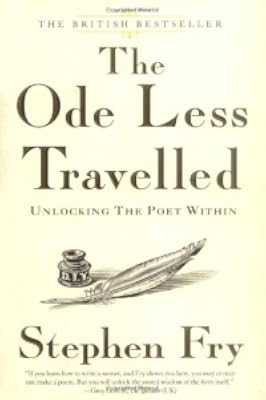
The Ode Less Travelled: Unlocking the Poet Within
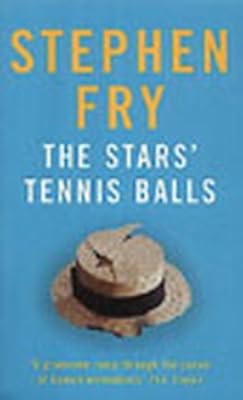
by Stephen Fry
On This Page
Description
Stephen Fry believes that if you can speak and read English you can write poetry. But it is no fun if you don't know where to start or have been led to believe that Anything Goes.Stephen, who has long written poems, and indeed has written long poems, for his own private pleasure, invites you to discover the incomparable delights of metre, rhyme and verse forms.Whether you want to write a Petrarchan sonnet for your lover's birthday, an epithalamion for your sister's wedding or a villanelle show more excoriating the government's housing policy, THE ODE LESS TRAVELLED will give you the tools and the confidence to do so.Brimful of enjoyable exercises, witty insights and simple step-by-step advice, THE ODE LESS TRAVELLED guides the reader towards mastery and confidence in the Mother of the Arts. show lessTags
Recommendations





Member Recommendations

Member Reviews
Most of poetry nowadays? According to Stephen Fry: 'dreary, self-indulgent, randomly lineated drivel'... Ouch! Ouch and yet, I personally think he is quite right.
It wouldn't cross your mind to call yourself a musician while having never bothered to learn how to play any instrument, right? Well, when it comes to poetry these days he has the feeling that too many so called 'poets' just dabble without having a clue of what poetry is to start with! For that, he blames the triumphal rise of free verse. Not that he dislikes free verse (he is very clear about that!) but, he believes it has given an excuse to too many to pick up a pen and throw words at random, believing poetry is just about 'pouring it out' when... it's not! What about show more technique? What about rules? What about everything that good old fashion prosody encompasses -forms, metres, accentuations, rhymes and else?
Now, before going any further let's stop right here, and clarify something bluntly: there is nothing wrong with breaking rules... as long as one knows what the rules are in the first place! (Duh!) Doing otherwise would be like being a pigeon cr@pping all over a chessboard-maybe fun and entertaining to some, but won't qualify you to be a Grandmaster (alright, he doesn't exactly uses these words but, you get the idea...). Well, same goes for poetry. As far as he is concerned, it's a craft that requires apprenticeship that is, knowing the rules from traditional forms. It's straightforward:
'initiation into the technique of poetry is all part of becoming a poet and it is pleasurable.'
As I said, straightforward. As a down to earth amateur, his goal here indeed is not to bore you with dry academic terminology thrown at your face to impress but, to entertain you (yes! 'entertain' because it's all 'pleasurable' indeed!) with a display of all the tools available to traditional poetry and that makes a poem, well, a poem -and not some 'dreary, self-indulgent, randomly lineated drivel'! Ah!
Gosh! How I love this book! It's instructive, incisive, fun, relevant and, despite its strong views, never condescending nor overly strict -e.g. see how he deals with William Blake.
I love his feel and heartfelt passion for poetry. I love the core ethos behind it all that is, everyone can write decently if putting in enough efforts. I even love how he takes the time to give the novice reader tools to facilitate such efforts, each chapters ending with exercises so as to make it all your own.
Now, you might not end up by actually writing poetry as he intends you to here but, full of passion it will at least gives you the basic understanding necessary to better appreciate the art, all in a fun and accessible way. And that, alone, is priceless.
A more than refreshing read. show less
It wouldn't cross your mind to call yourself a musician while having never bothered to learn how to play any instrument, right? Well, when it comes to poetry these days he has the feeling that too many so called 'poets' just dabble without having a clue of what poetry is to start with! For that, he blames the triumphal rise of free verse. Not that he dislikes free verse (he is very clear about that!) but, he believes it has given an excuse to too many to pick up a pen and throw words at random, believing poetry is just about 'pouring it out' when... it's not! What about show more technique? What about rules? What about everything that good old fashion prosody encompasses -forms, metres, accentuations, rhymes and else?
Now, before going any further let's stop right here, and clarify something bluntly: there is nothing wrong with breaking rules... as long as one knows what the rules are in the first place! (Duh!) Doing otherwise would be like being a pigeon cr@pping all over a chessboard-maybe fun and entertaining to some, but won't qualify you to be a Grandmaster (alright, he doesn't exactly uses these words but, you get the idea...). Well, same goes for poetry. As far as he is concerned, it's a craft that requires apprenticeship that is, knowing the rules from traditional forms. It's straightforward:
'initiation into the technique of poetry is all part of becoming a poet and it is pleasurable.'
As I said, straightforward. As a down to earth amateur, his goal here indeed is not to bore you with dry academic terminology thrown at your face to impress but, to entertain you (yes! 'entertain' because it's all 'pleasurable' indeed!) with a display of all the tools available to traditional poetry and that makes a poem, well, a poem -and not some 'dreary, self-indulgent, randomly lineated drivel'! Ah!
Gosh! How I love this book! It's instructive, incisive, fun, relevant and, despite its strong views, never condescending nor overly strict -e.g. see how he deals with William Blake.
I love his feel and heartfelt passion for poetry. I love the core ethos behind it all that is, everyone can write decently if putting in enough efforts. I even love how he takes the time to give the novice reader tools to facilitate such efforts, each chapters ending with exercises so as to make it all your own.
Now, you might not end up by actually writing poetry as he intends you to here but, full of passion it will at least gives you the basic understanding necessary to better appreciate the art, all in a fun and accessible way. And that, alone, is priceless.
A more than refreshing read. show less
An exhortation to everyone that anyone could - and everyone should - write poetry. Fry sets out a course on the various meters, styles, and techniques, including brief histories, a scattering of close readings for snippets of poems, and exercises for the reader to try. He does it all with his usual wit and charm and gleeful cleverness.
I admit that Fry would likely be annoyed with me, because I didn't follow along as I was meant to do: I didn't do any of the poetry-writing exercises, because 1) despite the title, I wasn't expecting a crash course on actually creating poems, and 2) I completely enjoyed thinking about poetry from a different approach. I love reading what people have to say *about* poetry (close readings and such, show more discussions of how the conjunction of meter and word choice flavor meaning,...), and I was absolutely giddy at the prospect of reading what Fry has to say about those things. Reading his approach to how to *write* the stuff (which includes significant bits of those things I love mentioned above) was absolutely enjoyable without me even touching a pencil. As someone with a degree in English and also a more-than-average knowledge of how to write poetry in Latin (no, really, I have the grad school course work to prove it), most of the technical bits on the various meters and how they work wasn't news, but he does such a lovely job of it that I enjoyed the review. So, maybe I didn't do the book properly, but I still loved it and I definitely recommend it, either for folks like me, who just like reading about poetry and what others think about it, or for those wanting to learn how the innards of poetry work, or for those who want to try their hand at creating the stuff. show less
I admit that Fry would likely be annoyed with me, because I didn't follow along as I was meant to do: I didn't do any of the poetry-writing exercises, because 1) despite the title, I wasn't expecting a crash course on actually creating poems, and 2) I completely enjoyed thinking about poetry from a different approach. I love reading what people have to say *about* poetry (close readings and such, show more discussions of how the conjunction of meter and word choice flavor meaning,...), and I was absolutely giddy at the prospect of reading what Fry has to say about those things. Reading his approach to how to *write* the stuff (which includes significant bits of those things I love mentioned above) was absolutely enjoyable without me even touching a pencil. As someone with a degree in English and also a more-than-average knowledge of how to write poetry in Latin (no, really, I have the grad school course work to prove it), most of the technical bits on the various meters and how they work wasn't news, but he does such a lovely job of it that I enjoyed the review. So, maybe I didn't do the book properly, but I still loved it and I definitely recommend it, either for folks like me, who just like reading about poetry and what others think about it, or for those wanting to learn how the innards of poetry work, or for those who want to try their hand at creating the stuff. show less
An approachable and amiable lesson in the principles of English-language poetry. The inimitable Stephen Fry goes through all the different features of poetry – from the overarching principles of metre, rhyme and form to the smaller techniques like caesura and enjambment, and through different poetic styles like the sonnet and the villanelle – with all the ease of a good English teacher, but with none of the sternness of a high-school lesson, nor the sense of fear that Teacher will single you out in a class of thirty and ask you to point out the uses of assonance in today's poem on the board.
In this book, Fry is concerned with the linguistic structure of poetry rather than any sense of artistic inspiration (read Rilke's Letters to a show more Young Poet if you want that), but he never devolves into anorakish condescension. He does criticize the 'arse-dribble' poems that seem to pass for poetry nowadays (pg. 177), but this only serves to enliven his lesson, for his love of the art form is evident. Furthermore, he believes it is relatively simple to start writing half-decent poetry if you only show some commitment; "taste and concentration" is what he boils it down to (pg. 316), and he wrote the book with precisely this humble aim in mind.
He is not looking to 'make learning fun', as a more misguided English teacher might; rather, he says poetry does not have to be 'cool' or 'relevant', "it is quite enough for me that it astonishes with its beauty" (pg. 313). This honest and unapologetic earnestness is what makes Fry so likeable, and he is on characteristically great form here. The call to write poetry is an embarrassingly common one, but Fry goes further than our half-baked doggerel dreams. He actually makes you want to do it right. show less
In this book, Fry is concerned with the linguistic structure of poetry rather than any sense of artistic inspiration (read Rilke's Letters to a show more Young Poet if you want that), but he never devolves into anorakish condescension. He does criticize the 'arse-dribble' poems that seem to pass for poetry nowadays (pg. 177), but this only serves to enliven his lesson, for his love of the art form is evident. Furthermore, he believes it is relatively simple to start writing half-decent poetry if you only show some commitment; "taste and concentration" is what he boils it down to (pg. 316), and he wrote the book with precisely this humble aim in mind.
He is not looking to 'make learning fun', as a more misguided English teacher might; rather, he says poetry does not have to be 'cool' or 'relevant', "it is quite enough for me that it astonishes with its beauty" (pg. 313). This honest and unapologetic earnestness is what makes Fry so likeable, and he is on characteristically great form here. The call to write poetry is an embarrassingly common one, but Fry goes further than our half-baked doggerel dreams. He actually makes you want to do it right. show less
On rereading this book, I'm upgrading it to 5 stars. (Although I should note I'm a pathetic Stephen Fry acolyte, so you should hold my judgment to be as something written on water.)
Fry carefully takes the reader through essentially all the key concepts to understand poetry. Metre, looking at poetic feet, enjambment, caesura, sprung rhythm and syllabic poetry among others; Rhyme, exploring types of rhyme including feminine, triple, and rich; Form, in which he interrogates everything from the Pindaric ode to the Villanelle, from the Limerick to the Tanka; and Diction, a brief epilogue on the art of poetry in the 21st century. It is all written in his distinctive style, passionately erudite one second, cheeky the next.
Along the way, Fry show more includes 20 exercises designed to help the novice poet experiment with forms and styles, while also including plenty of excerpts from poetry dating back to the ancients and forward to the present - as well as his own (deliberately low-key) efforts. For the most part, Fry avoids breathtakingly contemporary styles and blank verse. He notes that these styles are just as important and powerful, but that any artist must begin with an understanding of the basics and the existing work that has been built up over millennia before "breaking free of the pan and doing their own thing", as Elaine Benes would put it.
For some budding poets, this will be rich material. For others, you may not connect with Fry's tone or his focus on the "nuts and bolts" of writing. (I, like Fry, would caution you to reconsider your beliefs!)
Speaking for myself, I don't have any intention of writing poetry, and so I did not do the exercises. For me, the joy of this book was simply in revisiting the breadth of poetic styles in the hands of a master storyteller and armchair academic. With helpful charts, tables, and practical examples along the way, The Ode Less Travelled shines for those of us who still keep bookshelves of reference books. The final 22 pages are a glossary of poetic terms from abecedarian to zeugma (well, there's a couple of joke entries after the latter, but that's for you to enjoy), which will prove equally useful. show less
Fry carefully takes the reader through essentially all the key concepts to understand poetry. Metre, looking at poetic feet, enjambment, caesura, sprung rhythm and syllabic poetry among others; Rhyme, exploring types of rhyme including feminine, triple, and rich; Form, in which he interrogates everything from the Pindaric ode to the Villanelle, from the Limerick to the Tanka; and Diction, a brief epilogue on the art of poetry in the 21st century. It is all written in his distinctive style, passionately erudite one second, cheeky the next.
Along the way, Fry show more includes 20 exercises designed to help the novice poet experiment with forms and styles, while also including plenty of excerpts from poetry dating back to the ancients and forward to the present - as well as his own (deliberately low-key) efforts. For the most part, Fry avoids breathtakingly contemporary styles and blank verse. He notes that these styles are just as important and powerful, but that any artist must begin with an understanding of the basics and the existing work that has been built up over millennia before "breaking free of the pan and doing their own thing", as Elaine Benes would put it.
For some budding poets, this will be rich material. For others, you may not connect with Fry's tone or his focus on the "nuts and bolts" of writing. (I, like Fry, would caution you to reconsider your beliefs!)
Speaking for myself, I don't have any intention of writing poetry, and so I did not do the exercises. For me, the joy of this book was simply in revisiting the breadth of poetic styles in the hands of a master storyteller and armchair academic. With helpful charts, tables, and practical examples along the way, The Ode Less Travelled shines for those of us who still keep bookshelves of reference books. The final 22 pages are a glossary of poetic terms from abecedarian to zeugma (well, there's a couple of joke entries after the latter, but that's for you to enjoy), which will prove equally useful. show less
Have you ever tried to write poetry? It's not as easy as it looks - even free blank verse, in most hands, sounds silly, while a good poet can shake you to your core. Nevertheless, I keep trying to write poetry, hoping that someday I'll accidentally manage something that's actually good. I picked up The Ode Less Travelled to see if there's anything useful I've been missing, and wow, have I been missing a lot.
Stephen Fry isn't a poet - he's an actor, comedian, and occasional novelist - but he writes poetry for fun, and thinks other people should try it, too. In aid of this, he explains poetical metre (everything's spelled in British English in this book, although Fry also gives the Americanisms), rhyme, form, and criticism, along with show more giving extremely useful and interesting exercises for you to try. As he says, you probably won't become an award-winning poet just by reading this book, but you will be able to amuse yourself with a creative hobby, much like sketching with words. And if all you're interested in is understanding poetry a little better, this would also be a useful read, as it's much more entertaining than any "Introduction to Poetry" I've ever read before. show less
Stephen Fry isn't a poet - he's an actor, comedian, and occasional novelist - but he writes poetry for fun, and thinks other people should try it, too. In aid of this, he explains poetical metre (everything's spelled in British English in this book, although Fry also gives the Americanisms), rhyme, form, and criticism, along with show more giving extremely useful and interesting exercises for you to try. As he says, you probably won't become an award-winning poet just by reading this book, but you will be able to amuse yourself with a creative hobby, much like sketching with words. And if all you're interested in is understanding poetry a little better, this would also be a useful read, as it's much more entertaining than any "Introduction to Poetry" I've ever read before. show less
Quite an extraordinary book. For anyone setting out to write poetry this could be a wonderful asset. Stephen Fry is amazingly knowledgeable and erudite ...and even manages to inject some humour into his descriptions. I read rather a lot of poetry in my final school years.....mainly the British poets such as Milton, Donne, Wordsworth, Keats, GM Hopkins, Shelley. Yes we had Banjo Patterson and the “Man from Snowy River” in Australia but they were never regarded as quality poets. I even tried my hand at writing some poetry over the years and I’ve recently read quite a bit of Clive Jame’s attempts......Clive even gets a mention by Fry.
Could one write good poetry after reading this book. Well I very much doubt it. There is a heck of show more a lot about rhythm, and rhyme and rhyming patterns but I’m not sure that it actually helps one to write poetry. Stephen certainly makes it sound like hard work. I’ve extracted a number of quotes from the book below. Sufficient to remind me of the contents and maybe give others a taste of what is covered in detail.
The way poetry was taught at school reminded W.H. Auden of a Punch cartoon composed, legend has it, by the poet A. E. Housman. Two English teachers are walking in the woods in springtime. The first, on hearing birdsong, is moved to quote William Wordsworth:
Teacher 1: Oh cuckoo, shall I call thee bird Or but a wandering voice?
Teacher 2: State the alternative preferred With reasons for your choice.
Personally, I find writing without form, metre or rhyme not ‘laughably easy’ but fantastically difficult. If you can do it, good luck to you and farewell, this book is not for you: but a word of warning from W. H. Auden before you go. The poet who writes ‘free’ verse is like Robinson Crusoe on his desert island: he must do all his cooking, laundry and darning for himself.
In a few exceptional cases, this manly independence produces something original and impressive, but more often the result is squalor–dirty sheets on the unmade bed and empty bottles on the unswept floor.
I have written this book because over the past thirty-five years I have derived enormous private pleasure from writing poetry and like anyone with a passion I am keen to share it.
The three rules are my terms and conditions, let me restate them in brief: Take your time Don’t be afraid Always have a notebook with you
Metre: Each English word is given its own weight or push as we speak it within a sentence. That is to say: Each English word is given its own weight and push as we speak it within a sentence.
We always say British, we never say British or Brit-ish, always machine, never machine or mach-ine. The weight we give to the first syllable of British or the second syllable of machine is called by linguists the tonic accent.
Poetry’s rhythm is organised. The life of a poem is measured in regular heartbeats. The name for those heartbeats is metre.....The word for a rising-rhythm foot with a ti-tum, , beat like those above is an iambus, more usually called an IAMB......Remember this by thinking of Popeye, whose trademark rusty croak went: I yam what I yam . . .
And one and two and three and four and five
He bangs the drum and makes a dreadful noise
It is a measure of five and the prosodic word, from the Greek again, for ‘measure of five’ is pentameter. That simple line is an example therefore of iambic pentameter.
It is the very breath of English verse and has earned the title the heroic line.
“In sooth I know not why I am so sad:
It wearies me; you say it wearies you”;
Shakespeare: The Merchant of Venice, Act I, Scene 1.
“Oft has our poet wisht, this happy Seat
Might prove his fading Muse’s last retreat”.
Dryden: ‘Epilogue to Oxford’
‘Nothing more than taking a line for a walk.’ That is how the artist Paul Klee described drawing. It can be much the same with poetry.
If you could hear, at every jolt, the blood 
Come gargling from the froth-corrupted lungs
No end-stopping there. The term used to describe such a running on is enjambment, from the French enjamber to stride, literally to get one’s leg over . .
So threatened he ¶ but Satan to no threats  Gave heed ¶ but waxing more in rage replied: The name for such a pause or break is a caesura (from the Latin caedere, caesum, to cut. You’d pronounce it as in ‘he says you’re a fool’).
The fact is, enjambment and caesura, these two–what shall we call them? techniques, effects, tricks, devices, tools?
And Wilfred Owen’s two lines could become:
If you could hear, at every jolt,
The blood come gargling from the froth-corrupted lungs
Surely that’s a better way of organising things? That is the sense after all, so why not therefore break the lines accordingly?
No, damn you, no! a thousand times no! the organising principle behind the verse is not the sense but the metre.
Metre is the primary rhythm, the organised background against which the secondary rhythms of sense and feeling are played out. This is a crucial point.
the five beats, even when paused or run through, predominate in the inner ear. The fact that the sense runs through, doesn’t mean the lines shouldn’t end where they do. If you could hear, at every jolt, the blood Come gargling from the froth-corrupted lungs
read them both aloud and note how much more stress is placed on ‘blood’ in the proper, pentametric layout. I’m sure you agree that Owen knew what he was doing. I should mention here that in performance many Shakespearean actors will give a vocal (and often almost imperceptible) end-stop to a line, even when there is clear run-on in its sense.
Some theatre directors hate dramatic end-stopping and are determined that meaning should take precedence over metre, others insist upon it (sometimes at the expense of clarity).
An actor friend of mine, unaware of the jargon, was very alarmed on his first day as a member of the Royal Shakespeare Company to hear an old hand ask the director before the first read-through of a new production: ‘Are we end-stopping, darling?’ Took him three weeks to dare to ask what it meant: he had imagined it was something to do with rehearsal tea breaks.
A huge element of all art is constructed in the form of question and answer. The word for this is dialectic.
In poetry this is a familiar structure:
Q: Shall I compare thee to a summer’s day?
A: Thou art more lovely and more temperate.
It is common in rhetoric too. Ask not what your country can do for you But what you can do for your country......
If you can keep your head when all about you
Are losing theirs and blaming it on you,
If you can trust yourself when all men doubt you
But make allowance for their doubting too,
The finality of downstroke achieved by a strong ending seems to answer the lightness of a weak one. After all, the most famous weak ending there is, just happens to be the very word ‘question’ itself . . . To be, or not to be: that is the question.
The point I am anxious to make, however, is that metre is more than just a ti-tum ti-tum: its very regularity and the consequent variations available within it can yield a structure that expresses meaning quite as much as the words themselves do.
English, unlike Italian, is full of words that end with a stressed syllable. The very nature of the iamb is its light-heavy progression, it seems to be a deeply embedded feature of English utterance:
Why not dock a syllable and have a nine-syllable line with a weak ending? Let’s sit ourselves beside this river Well, this docking, this catalexis, results in an iambic tetrameter (four accents to a line) with a weak ending,
Writers of iambic pentameter always add an unstressed syllable to make eleven syllables with five beats, they don’t take off a strong one to make four. They must keep that count of five. If you choose iambic pentameter you stick to it. The heroic line, the five-beat line, speaks in a very particular way, just as a waltz has an entirely different quality from a polka.
A woman’s face with Nature’s own hand painted
Hast thou, the master-mistress of my passion; Shakespeare: Sonnet 20
Owen was a poet who, like Shakespeare, really knew what he was doing. These effects are not accidental, the substitutions do not come about by chance or through some carefree inability to adhere to the form and hoping for the best. Owen studied metre and form constantly and obsessively,
Incidentally, when Rubens was a young man he went round Rome feverishly drawing and sketching antique statues and Old Master paintings, lying on his back, standing on ladders, endlessly varying his viewpoint
He wanted to be able to paint or draw any aspect of the human form from any angle, to master foreshortening and moulding and all the other techniques, spending months on rendering hands alone. All the great poets did the equivalent in their notebooks:
So here is a summary of the six new techniques we’ve learned to enrich the iambic pentameter. End-stopping: how the sense, the thought, can end with the line. Enjambment: how it can run through the end of a line. Caesura: how a line can have a break, a breath, a pause, a gear change. Weak endings: how you can end the line with an extra, weak syllable. Trochaic substitution: how you can invert the iamb to make a trochee. Pyrrhic substitution: how you can downgrade the beat of an interior (second, third or fourth) foot to turn it into a doubly weak or pyrrhic foot.
You can certainly try to write whole English poems composed of iambic hexameter, but I suspect you’ll find, in common with English language poets who experimented with it on and off for the best part of a thousand years, that it yields rather clumsy results. Its best use is as a closing line to stanzas,
Actually, fourteeners were very popular in the sixteenth century, although Shakespeare disdained their use, a fact which has been adduced by some to damn the claims of Edward de Vere, seventeenth Earl of Oxford, as the real author of the Shakespearean canon, for Oxford loved them:
My life through lingering long is lodged, in lair of loathsome ways,
My death delayed to keep from life, the harm of hapless days.
Of course, it is fundamentally daffy to scan lyrics (a word derived from the Greek lyre, the harp-like instrument used to accompany song) since it is the musical beat that determines emphasis, not the metrical stress.
four beats to the line Wordsworth wrote ‘Daffodils’ in straight four-beat tetrameters.
I wander’d lonely as a cloud
That floats on high o’er vales and hills
When all at once I saw a crowd,
A host, of golden daffodils;
If you ask someone to write a poetic ditty on a Valentine’s card or something similar, nine times out of ten they will write tetrameters, whether they do so consciously or not: the four-beat instinct is deep within us, much as in music the four/ four time signature is so standard as to be the default: you don’t have to write it in the score, just a letter C for Common Time.
Coleridge’s ‘Rime of the Ancient Mariner’:
The fair breeze blew, the white foam flew,
The furrow followed free:
We were the first that ever burst
Into that silent sea.
and Oscar Wilde’s ‘Ballad of Reading Gaol’:
I never saw a man who looked
With such a wistful eye
Upon that little tent of blue
Which prisoners call the sky.
In each of these ballad verses the first and third lines have four stresses (eight syllables) and the second and fourth lines have three (six syllables):
It is true, however, that Keats from an early age completely soaked himself in poetry and (despite being labelled a ‘Cockney poet’ by literary snobs of the time) experimented all his life with poetic form and constantly wrote about prosody and chewed over its nuances passionately with his friends and fellow poets.
Let us consider the whole issue of mixing feet within a poem. The end of writing poetry is not to write ‘perfect’ metre with every line going da-dum or dum-da into the distance, it is to use the metre you’ve chosen to reflect the meaning, mood and emotional colour of your words and images....I would only repeat this observation: well-made poems do not mix up their metric scheme carelessly.......Remember: it is the number of stresses, not the number of syllables, that determines whether it is penta-or tetra-or hexa-or any other kind of-meter:
I suppose the best-known anapaestic poem of all (especially to Americans) is Clement Clarke Moore’s tetrametric ‘The Night Before Christmas’:
’Twas the night before Christmas, when all through the house
Not a creature was stirring, not even a mouse;
The stockings were hung by the chimney with care
In hopes that St Nicholas soon would be there.
The second couplet has had its initial weak syllable docked in each line. This is called a clipped or acephalous (literally ‘headless’) foot. You could just as easily say the anapaest has been substituted for an iamb, it amounts to precisely the same thing.
The dactyl. As a matter of fact the earliest and greatest epics in our culture, Homer’s Iliad and Odyssey were written in dactylic hexameters. Remember, though, classical poetry was written in quantitative measure, where those feet were better described as ‘long short short’,—––‘wait for it’, ‘cool, not hot’, ‘smooth black pig’ rather than our sprightly  tum-titty.
English verse sprang, like the English language, from two principal sources, Greco-Roman and Anglo-Saxon. From the Greeks and Romans we took ordered syllabic measures, from the Old English we took accent. We put them together to make the native accentual-syllabic verse that we have been looking at thus far.
Anglo-saxon and old english are (more or less) interchangeable terms used for verse written in England before the Norman Conquest of 1066.....With Old English poetry there is no syllabic count and there is no rhyme. Is it free verse, then, unbounded by rules? By no means......Anglo-Saxon poetry is composed according to rules of accent only: it is a form of accentual verse. Accentual-alliterative to be precise.
Alliteration is the trick of beginning a succession of words with the same consonant. W. S. Gilbert’s ‘life-long lock’, ‘short sharp shock’ and ‘big black block’ are examples of alliterative phrases that we have already met.....It is an English disease: you won’t find it to anything like the same degree in Spanish, French or Italian.....It lives on in phrases like ‘wit and wisdom’, ‘parent power’, ‘feast or famine’,
When reading such verse out loud you feel the urge to put a finger to your ear and chant nasally like a bad folk singer. This unpleasantness can be aggravated by an over-reliance on a trope known as a kenning. Kennings are found in great profusion in Anglo-Saxon, Old German and especially Norse poetry. They are a kind of compound metonym (a metaphoric trope, see the glossary) used to represent a single object, person or concept: thus a ship becomes an oar steed, the sea is the whale road
One single name rises above all others when considering the influence of Anglo-Saxon modalities on modern poetry. Well–three single names, come to think of it . . . Gerard Manley Hopkins.....Hopkins was a nineteenth-century English–Welsh poet who developed his own metrics. Calling the system ‘sprung rhythm’, he marked his verse with accents, loops and foot divisions to demonstrate how his stresses should fall. Among his prosodic inventions were such devices as ‘outriders’, ‘roving over’ and ‘hanging stress’......These have their counterparts or at least rough equivalents in the sain and lusg that make up cynghanedd, the sound system of ancient Welsh poetry, which Hopkins had studied deeply.
Here is one of his best-known works ‘Pied Beauty’.
Glory be to God for dappled things–
For skies of couple-colour as a brinded cow;
For rose-moles all in stipple upon trout that swim;
Fresh-firecoal chestnut-falls; finches’ wings;
Landscape plotted and pieced–fold, fallow, and plough;
And áll trádes, their gear and tackle and trim.
I am sure you have seen that most of the words are Anglo-Saxon in origin, very few Latinate words there at all (counter, original, colour and trout are the only ones I am sure of), the alliteration is fierce throughout, though not in the strict bang, bang, bang–crash! form we saw in Langland. You probably don’t need to count syllables to be able to tell that there is no standard metric regularity here. His own accents on ‘áll trádes’ reveal the importance he places on stress and the unusual nature of its disposition.
Now read out the opening of ‘That Nature Is a Heraclitean Fire and of the Comfort of the Resurrection’.
Hopkins uses virgules to mark the long lines for us into hemistichs. Cloud puffball, torn tufts, tossed pillows | flaunt forth, then chevy on an air-Built thoroughfare: heaven roisterers, in gay-gangs | they throng; they glitter in marches, Down roughcast, down dazzling whitewash, | wherever an elm arches, Shivelights and shadowtackle in long | lashes lace, lance, and pair.
Poets, like painters, look hard for the exact nature of things and feelings, what they really, really are. Just as painters in the late nineteenth and early twentieth century tried to move their form on, tried to find new ways to represent the ‘concrete flux of interpenetrating intensities’ that T.E. Hulme saw as reality, so Hopkins attempted to create a prosodic scheme that went beyond the calm, regular certainties of iambs and anapaests (‘ running rhythm’ as he called traditional metrics) in order to find a system that mirrored the (for him) overwhelming complexity, density and richness of nature.
One more excerpt, this time from ‘The Caged Skylark’, which, as you will see, refers to us more than to the bird:
As a dare-gale skylark scanted in a dull cage
Man’s mounting spirit in his bone-house, mean house, dwells.
Five of those twenty-four syllables are slack and squeezed into the lightest of scudding trips (in order: a,-ed, a,-it, his), while the in of both lines takes fractionally more push.
Whitman is considered by many to be the father of English language free verse: verse without traditional patterning, stanza form, rhyme, metre, syllabic count or regular accentuation. Since such verse is beyond the reach and aim of this book, much of the pleasures of Eliot, Pound, Lawrence, William Carlos Williams, the American ‘Open Field’ School and Whitman himself (and very real pleasures they are) will not be looked at here.
2. Rhyme: There are very few poets I can call to mind who only used rhyme in their work, but I cannot think of a single one, no matter how free form and experimental, who never rhymed. Walt Whitman, Ezra Pound, D.H. Lawrence, Wyndham Lewis, William Carlos Williams, T.S. Eliot, Marianne Moore, E E cummings, Crane, Corso, Ferlinghetti, Ginsberg, Hughes–not an exception do I know.
The question ‘to rhyme or not to rhyme’ is not one I can answer for you, except to say that it would almost certainly be wrong to answer it with ‘always’or ‘never’.
Whatever its origin, the expectations it sets up in the mind seem deeply embedded in us.
Coleridge used this kind of internal rhyming a great deal in his ‘Ancient Mariner’: The fair breeze blew, the white foam flew, The furrow followed free. We were the first that ever burst Into that silent sea.
Hopkins employed internal rhyme a great deal, but not in such predictable patterns. He used it to yoke together the stresses in such phrases as dapple-dawn-drawn, stirred for a bird, he cursed at first, fall gall, in a flash at a trumpet-crash, glean-stream and so on.
In slant-rhyme of the alone/ home, glean/ stream kind, where the vowels match but the consonants do not, the effect is called assonance:
The one/ down rhyme is partial too, but here the end consonant is the same but the vowels (vowel sounds) are different. This is called consonance: examples would be off/ if, plum/ calm, mound/ bond and so on.
Assonance rhyme is suitable for musical verse, for the vowels (the part the voice sings) stay the same Consonance rhyme, where the vowels change, clearly works better on the page.
Another imperfect kind is wrenched rhyme, which to compound the felony will usually go with a wrenched accent. He doesn’t mind the language being bent In choosing words to force a wrenched accént. He has no sense of how the verse should sing And tries to get away with wrenched rhyming. A bad wrenched rhyme won’t ever please the eye: Or find its place in proper poetry. Where ‘poetry’ would have to be pronounced ‘poe-a-try’. You will find this kind of thing a great deal in folk-singing,
We should not necessarily assume that since Yeats and Jonson are officially Fine Poets, everything they do must be regarded as unimpeachable.
The last species worthy of attention is rich rhyme. I find it rather horrid, but you should know that essentially it is either the rhyming of identical words that are different in meaning (homonyms) . . .Rich rhyme is legal tender and quite sound When words of different meaning share a sound...When neatly done the technique’s fine When crassly done you’ll cop a fine.....Or the rhyming of words that sound the same but are different in spelling and meaning (homophones). Rich rhyming’s neither fish nor fowl The sight is grim, the sound is foul.
Rhyming Arrangements The convention used when describing rhyme-schemes is literally as simple as abc. The first rhyme of a poem is a, the second b, the third c, and so on:
As to the descriptions of these layouts, well, that is simple enough. There are four very common forms. There is the couplet. . . So long as men can breathe and eyes can see So long lives this, and this gives life to thee. . . . and the triplet:
Next is CROSS-RHYMING, which rhymes alternating lines, abab etc:
I wandered lonely as a cloud
That floats on high o’er vales and hills,
When all at once I saw a crowd.
A host, of golden daffodils;
Finally there is envelope rhyme, where a couplet is ‘enveloped’ by an outer rhyming pair: abba,
Music, like verse, can do rhythm but it is only poetry that can yoke words together in rhyme.
Rhyme may not be a defining condition of poetry, but poetry is pretty much a defining condition of rhyme......There are two issues to consider when rhyming: firstly and most clearly there is the need to avoid hackneyed rhyme pairs.....Night/ light/ sight, death/ breath and cherish/ perish might be included in that list.....If there is a rule to rhyming, I suppose it is that (save in comic verse or for some other desired effect) it should usually be–if not invisible–natural, transparent, seamless, discreet and unforced. The reader should not feel that a word has been chosen simply because it rhymes.
Avoid the obvious pairs strive not to draw attention to a rhyme. Say you are given this and asked to make a poem. ...”Of a cavalry troop collectively known as the Light Brigade–157 have lost their lives”.
What sort of preparatory scribbles do you make in your poet’s notebook? As for metre, short lines, you decide. Falling rhythms of dactyls and trochees would be a good choice, echoing the fierceness and rush of the action and suggesting the cadences of a bugle sounding the charge:
But as for rhymes . . . Hussar is a bummer, only para-rhymes seem to fit: bizarre, beaux arts, faux pas, disbar, ajar, papa and hurrah might do at a pinch, but they hardly promise suitably solemn material; besides, the plural Hussars excludes at least half of them. Lancers is OK: dancers, prancers, answers–some suggestive possibilities there. Dragoons is if anything worse than Hussars: lagoons seems to be the only proper rhyme, the slant-rhyme racoon is unlikely to come in handy, nor are jejune, cartoon and baboon, one feels.
Well, as you probably know, Tennyson did not retire from his laureateship and this is what he came up with to mark the calamity.
Half a league, half a league,
Half a league onward,
All in the valley of Death
Rode the six hundred.
‘Forward, the Light Brigade!’
‘Charge for the guns!’ he said:
Into the valley of Death Rode the six hundred.
What we can agree upon I hope, is that the rhyming is perfect. Shell/ hell, brigade/ made/ dismayed and the wondered/ blundered, thundered/ sundered, hundred/ onward group work together superbly. A small nucleus of rhyming words like this throughout one poem can set up a pattern of expectation in the listener’s or reader’s ear. ‘Thundered’ is close to onomatopoeic.......The rhyming, quite as much as the rhythm, helps generate all the pity, pride and excitement for which the poem is renowned.....It was perhaps the last great Public Poem written in England, the verse equivalent of ‘Land of Hope and Glory’.
We should recognise that Tennyson’s is a poem written for the nation while the Hopkins and Hardy are essentially inward looking. Indeed, ‘The Wreck of the Deutschland’ is much more an autobiographical contemplation of the poet’s religious development than a commemoration of a shipwreck.
Earlier on the morning of that same October day in 1854, on the same Crimean battlefield, the Heavy Brigade had fought a supremely successful battle during which more men died than in the later disaster, they were just as gallant but their heroism goes unremembered.
It is the rhyming that has contributed to this immortality. Tennyson’s discovery of the hundred/ blundered wondered/ thundered group is the heart of the poem, its engine.
By all means invest in a good rhyming dictionary, there are several available from the usual publishing houses and they are all much the same so far as I can tell.
3. Form: For now I would urge you to believe that a familiarity with form will not transform you into a reactionary bourgeois, stifle your poetic voice, imprison your emotions, cramp your style, or inhibit your language–on the contrary, it will liberate you from all of these discomforts.
The above is precisely the kind of worthless arse-dribble I am forced to read whenever I agree to judge a poetry competition. It took me under a minute and a half to write and while I dare say you can see what utter wank it is, there are many who would accept it as poetry. All the clichés are there, pointless lineation, meaningless punctuation and presentation, fatuous creations of new verbs ‘cigaretted and drinked’, ‘worlded’, ‘nuded’, ‘afterloved’, a posy Latin title–every pathology is presented. Like so much of what passes for poetry today it is also listless, utterly drained of energy and drive.
‘Writing free verse is like playing tennis with the net down,’ Robert Frost wrote. Not much of a game at all, really.
The most elemental way in which lineation can be taken forward is through the collection of lines into stanza form: let us look at some options.....The Rubai From Persia comes a quatrain form called the RUBAI (plural ruba’iat or ruba’iyat), rhyming aaba, ccdc, eefe etc.
The translation of the Ruba’iat of Omar Khayyam by Edward Fitzgerald ranks alongside Burton’s Arabian Nights as one of the great achievements of English orientalism:
A Book of Verses underneath the Bough,
A Jug of Wine, a Loaf of Bread,
–and Thou Beside me singing in the Wilderness
–Oh, Wilderness were Paradise enow!
If that kind of poetry doesn’t make your bosom heave then I fear we shall never be friends. Open forms in sixain also exist in English verse. Wordsworth in his ‘Daffodils’ used the stanza form Shakespeare developed in ‘Venus and Adonis’, essentially a cross-rhymed quatrain closing with a couplet, abab cc:
Auden’s reluctance to use ottava rima stemmed, one suspects, from its demand for an extra rhyme. I have always loved this form, however, as my sample verse makes clear. Ottava Rima ottava rima is a poet’s dream, The most congenial of forms by far. It’s quite my favourite prosodic scheme And Byron’s too, which lends it some éclat. Much more adaptable than it may seem,
Plays both classical and rock guitar; It suits romantic lyric inspiration, But I prefer Byronic-style deflation.
As you can see, ottava rima rhymes abababcc and thus presents in eight lines, hence the ottava, as in octave. It is in effect rhyme royal with an extra line,
Clive James is one of the few poets I know to have made something new and comic of the Spenserian Stanza: his epistolary verse to friends published in his collection Other Passports contains some virtuoso examples....It includes the excellent admonitory alexandrine, ‘You can’t just arse around for ever having fun.’
If, then, you wish to use your own stanzas, rhyming or not, organised in traditional or personal ways, allow yourself to feel that same sense of composition and rightness, just as you might when arranging knick-knacks and invitations on a mantelpiece.
In technical prosodic parlance we could say that most ballads present in quatrains of alternate cross-rhymed iambic tetrameter and trimeter. However, since the ballad is a swinging, popular form derived from song and folk traditions it is much better described as a form that comes in four-line verses, usually alternating between four and three beats to line. The word comes from ballare, the Italian for ‘to dance’ (same root as ballet, ballerina and ball)......The ballad is pub poetry, it is naughty and nautical, crude and carefree. Its elbows are always on the table.......Its voice is often that of the club bore, the drunken rogue, the music hall entertainer or the campfire strummer.....It will grab you by the lapels, stare you in the eyes and plunge right in:
Now gather round and let me tell
The tale of Danny Wise:
And how his sweet wife Annabelle
Did suck out both his eyes.
And if I tell the story true
And if I tell it clear,
There’s not a mortal one of you
Won’t shriek in mortal fear.
While the second and fourth lines should rhyme, the first and third do not need to, it is up to the balladeer to choose, abab or abcb: nor is any regularity or consistency in your rhyme-scheme required....Ballads are perfect examples of accentual verse: it doesn’t matter how many syllables there are, it is the beats that matter.
HEROIC VERSE is far from dead. Since its Chaucerian beginnings it has been endlessly revivified:....At first glance it seems remarkably simple, too simple, perhaps, even to deserve the appellation ‘form’: it is as open as they come, neither laid out in regular stanzas, nor fixed by any scheme beyond the simple aabbccdd of the rhyming couplet. New paragraph presentation is possible either with line breaks or indentation...but in general the verse is presented in one unbroken block......John Dryden, in my estimation, was the absolute master of the heroic couplet; his use of it seems more natural, more assured, more fluid even than Pope’s:
By education most have been misled;
So they believe, because they so were bred.
The priest continues what the nurse began,
And thus the child imposes on the man.
Deriving from odein, the Greek for to chant, the ode is an open form of lyric verse made Public Monument. In English poetry it was once the most grand, ceremonial and high-minded of forms, but for the last hundred years or so it has been all but shorn of that original grandeur, becoming no more than a (frequently jokey) synonym for ‘poem’.
Partly this is the due to the popularity of John Keats’s four great odes ‘To Autumn’, ‘Ode to a Nightingale’, ‘Ode on Melancholy’ and ‘Ode on a Grecian Urn’
Often the poet, as in grand public odes, opens with direct address: Shelley does so in ‘Skylark’ and ‘Ode to the West Wind’: Hail to thee, blithe spirit! Bird thou never wert.
Or they apostrophise their hero later in the poem as Keats does the Nightingale and Autumn:
Thou wast not born for death, immortal Bird!
Who hath not seen thee oft amid thy store?
Certain closed forms, such as those we are going to have fun with now, seem demanding enough in their structures and patterning to require some of the qualities needed for so-doku and crosswords.
The villanelle is the reason I am writing this book.....Let me tell you how it happened. I was in conversation with a friend of mine about six months ago and the talk turned to poetry. I commented on the extraordinary resilience and power of ancient forms, citing the villanelle. ‘What’s a villanelle?’ ‘Well, it’s a pastoral Italian form from the sixteenth century written in six three-line stanzas where the first line of the first stanza is used as a refrain to end the second and fourth stanzas and the last line of the first stanza is repeated as the last line of the third, fifth and sixth,’ I replied with fluent ease. You have never heard such a snort of derision in your life. ‘What? You have got to be kidding!’ I retreated into a resentful silence, wrapped in my own thoughts......‘Would you be surprised to know’, I said, trying to keep a note of ringing triumph from my voice, ‘that “Do not go gentle into that good night” is a straight-down-the-line, solid gold, one hundred per cent perfect, unadulterated villanelle?’ ‘Bollocks!’ he said. ‘It’s modern. It’s free.’ The argument was not settled until we had found a copy of the poem and my friend had been forced to concede that I was right. ‘Do not go gentle into that good night’ is indeed a perfect villanelle,
The Sestina: This is a bitch to explain but a joy to make. There is no set metre to the modern English sestina, but traditionally it has been cast in iambics. The form comprises six sixains followed by a three line envoi, a kind of summation or coda. So, thirty-nine lines in all.
may have seemed a fiendishly complicated structure and it both is and isn’t. The key is to number the lines and follow the 6, 1, 5, 2, 4, 3 formula with (2–5, 4–3, 6–1 for the envoi).
If you don’t like numbers you might prefer to letter the lines alphabetically and make a note of this scheme: ABCDEF, FAEBDC, CFDABE, ECBFAD, DEACFB, BDFECA (BE/ DC/ FA)
The limerick:
There was a middle-aged writer called Fry
Whose book on verse was a lie.
For The Ode Less Travelled
Soon unravelled
To reveal some serious errors in its scansion and rhy . . .
The name is said to come from a boozy tavern chorus ‘Will you come up to Limerick?’. Although they are popularly associated with Edward Lear, anonymous verses in the ‘There was an old woman of . . .’ formulation pre-dated him by many years:
A merry old man of Oporto,
Had long had the gout in his fore-toe;
And oft when he spoke
To relate a good joke,
A terrible twinge cut it short-O.
Neither are parody and pastiche an unfit manner for the poet. Chaucer began the trend in English with a scintillating parody of badly versified epical romance called Sir Thopas. Shakespeare parodied Marlowe, as did Donne (in praise of angling in the style of ‘The Passionate Shepherd’); Byron parodied and was parodied, Dryden, Johnson, and Swift parodied and were parodied and so it went on.
Byron seemed to detect an air of fraudulence early on. Here is his parody of Wordsworth’s ‘Peter Bell’.
There’s something in a stupid ass:
And something in a heavy dunce;
But never since I went to school
I saw or heard so damned a fool
As William Wordsworth is for once.
Haiku descends from haikai no renga, a (playful) linked verse development of a shorter form called waka. The haikai’s first stanza was called a hokku and when poets like Masaoka Shiki developed their new, stand-alone form in the nineteenth century, they yoked together the words haikai and hokku to make haiku.
Those who have studied the form properly and write them in English are now very unlikely to stick to the 5–7–5 framework.....For some the whole enterprise is a doomed and fatuous mismatch, as misguided as eating the Sunday roast with chopsticks and calling it sushi. Nonetheless non-Japanese speakers of some renown have tried them.
The Sonnet petrarchan and Shakespearean:......The sonnet’s fourteen lines have called to poets for almost a thousand years. It is the Goldilocks form: when others seem too long, too short, too intricate, too shapeless, too heavy, too light, too simple or too demanding the sonnet is always just right. It
it was Francesco Petrarca, Petrarch, who shaped it into the form which was to have so tremendous an impact on European and English poetry. In the papal court of Avignon he composed his cycle of sonnets to Laura, a girl he always claimed was flesh and blood, but whom many believed to be a conjured ideal.
Those very personal qualities of the sonnet were precisely what attracted Wordsworth and the romantic poets of course, and from their day to ours it has remained a popular verse forum for a poet’s debate with himself.
The structure of the petrarchan sonnet, preferred and adapted by Donne, Milton and many others, is easily expressed. The first eight lines abba-abba are called the octave, the following six lines cdecde (or cddccd or cdccdc) the sestet.
The ninth line, the beginning of the sestet, marks what is called the volta, the turn.
The shakespearean sonnet offers, aside from less troublesome rhyming searches, twelve lines in its main body, three quatrains or two sestets and a couplet and other permutations thereof–twelve is a very factorable number.....I have mentioned before the three-part structure that seems so primal a part of human thinking. From the thesis, antithesis, synthesis of the earliest logicians, the propositions, suppositions and proofs of Euclid and the strophe, antistrophe and epode of Greek performance and poetic ode to our own parliaments and senate chambers, boardrooms, courtrooms and committee rooms, this structure of proposal, counterproposal and vote, prosecution, defence and verdict is deep within us.
The new poetics suggested by Pound’s thoughts on colour, image, quiddity and ideogram engendered a new kind of ‘iconographic’ poetry which culminated in his cantos, most especially The Pisan Cantos, notable for their use of hieroglyphs and ideograms and, so far as most of us are concerned, their almost total unreadability.....There is huge gusto and bravado in their best moments, but much to make the reader feel foolish and unlettered. I mention all of this as a background to the concepts that have propelled much modern poetry, most of these ideas being osmotically absorbed by succeeding generations of course, not acquired intellectually: but that holds true of our grasp of, for example, gravity, evolution, the subconscious mind and genetics. Our understanding of much in the world is more poetic than noetic. We let others do the work and take their half-understood ideas for a ride, all unaware of the cognitive principles that gave birth to them.
You do not have to understand Faraday’s and Maxwell’s electromagnetic theories of light to operate a light switch, or even to become a professional lighting designer.
The upshot of Imagism, Vorticism, Cubism, Neo-Plasticism, Constructivism, Acmeism, Futurism, Dadaism and all the other-isms that flooded art in the twentieth century was to allow a new kind of poetry, of which concrete poetry is one, the work of Cummings another.
There are those who loathe puns, anagrams and wordplay of any description. They regard practitioners as trivial, posey, feeble, nerdy and facetious. As one such practitioner, I do understand the objections. Archness, cuteness, pedantry and showoffiness do constitute dangers. However, as a non-singing, non-games-playing,-dancing,-painting,-diving,-running,-catching,-kicking,-riding,-skating,-skiing,-sailing,-climbing,-caving,-swimming,-free-falling,-cycling,-canoeing,-jumping,-bouncing,-boxing sort of person, words are all I have.
4. Diction and Poetics Today: I was fortunate in my own introduction to poetry. My mother had, and still has, a mind packed with lines of verse. She could recite, like many of her generation but with more perfect recall than most, all the usual nursery rhymes along with most of A. A. Milne, Beatrix Potter, Lewis Carroll, Struwwelpeter, Eleanor Farjeon and other hardy annuals from the garden of English verse.
When Keats was a teenager (so the story goes), he came across a line from Spenser’s Faerie Queen. Not even a line, actually: a phrase: . . . the sea-shouldering whale....From that moment on Keats got poetry. He began to understand the power that words could convey and the metaphorical daring with which a poet could treat them.....Madeline, ah, Madeline. I wish I could tell you that the line of verse that awoke me to the power of poetry was as perfectly contained and simple in its force as Spenser’s,
The line is from ‘The Eve of Saint Agnes’:
And Madeline asleep in lap of legends old.
It is very possible that you will see nothing remarkable in this line at all. I had been dizzily in love with it for months before I became consciously aware of its extraordinary consonantal symmetry. It has none of the embarrassing obviousness of over-alliterated lines, but its music is as perfectly achieved as any line of verse I know. It was not, however, the sonorous splendours of the words that had first captivated me, but the image evoked by them.
If what you are writing has no quality that prose cannot transmit, then why should you call it a poem?
David Hockney once said that his working definition of a piece of art was a made object that if left in the street, leaning against a bus shelter, would cause passers-by to stop and stare. Like all brave stabs at defining the indefinable it has its limitations, I suppose–it is not, as Aristotle would say, necessary and sufficient–but we might agree that it is not so bad.
There is the obvious distinction in meaning between a word’s denotation and its connotation. For example, odour, fragrance, aroma, scent, perfume, pong, reek, stink, stench, whiff, nose and bouquet all denote smell, but they by no means connote that meaning in the same way.
Keats and Shakespeare were far from academic, after all. Keats left formal studies at fourteen and trained for a career in medicine. Wordsworth did go to university, where he studied not classical verse and rhetoric, but mathematics. Yeats went to art school. Wilfred Owen as a boy worked as a lay assistant in a church and had no further education at all. Tennyson was educated till the age of eighteen by his absent-minded clergyman father. Browning, too, was educated by his father and left university after one term. Edgar Allan Poe managed a year at his university before running off to join the army. Shelley was expelled from Oxford (for atheism, rather splendidly) and Byron was more interested in his pet bear and his decadent social life at Cambridge than in his studies. But they were all passionately interested in the life of the mind and above all in every detail and quality of language that could be learned and understood.
Laziness is the worst vice a poet can have.....Much easier to indulge in the belief that the world is against you, that everyone else is a member of some club whose doors are closed to you because you didn’t go to the right school or have the right parents, than to realise that you simply do not work hard enough.....Concentration and total commitment to language are far and away the most important qualities needed for poetry writing.
• Consider your readers:
• Keep a journal:
• Consider the voice: who is speaking? You or a pretend authorial version of you?
• Read poetry:
• You are allowed to hate some poets and be indifferent. But get to know as many as you can.
• Truthfulness:
• Control: ‘All bad poetry springs from genuine feeling,’ Oscar Wilde wrote. Which is absolutely not the same as saying that all genuine feeling produces bad poetry,
• But genuine feeling is not enough in poetry any more than it is in painting or music.
• Enjoy yourself:
• Forgive yourself:
• The muse is capricious:
• Say it out loud:
• Read your work to yourself all the time, even as you are composing it.
I am aware that much in this book will enrage or stupefy some. The very idea of clinging to ancient Greek metrical words for the description of rhythm, the use of such phrases as ‘poetic taste’ and ‘diction’, the marshalling of so many lines from dead poets–all these will cause expostulations of contempt or slow shakings of the head from those with very certain ideas about where poetry should be going
I think that much poetry written today suffers from anaemia. There is no iron in its blood, no energy, no drive. It flows gently, sometimes persuasively, but often in a lifeless trickle of the inwardly personal and the rhetorically listless.....The Victorians, for all their faults, had energy to spare.
‘So free we seem, so fettered fast we are,’ says Browning’s Andrea del Sarto, before adding the now well-worn cri de coeur I have already quoted. Ah, but a man’s reach should exceed his grasp, Or what’s a heaven for? Or what’s a poem for?
As for my poetry. I have already said often enough that I do not write for publication or recital......This is partly cowardice and embarrassment, partly a problem connected to the fact that I am well-known enough to feel that my poems will be given more attention than they deserve, whether negative or positive makes no difference, they cannot be read without the reader being likely to hear my voice not as an individual poetic voice, but as the voice of that man who publicly disports himself in assorted noisome ways.
So what’s my overall take on the book? Well It’s generally heavy going and there is a power of information......probably the detail is overwhelming. Do I need all this detail. Probably not. Was the detail necessary? Probably not. But for actual poets and aspiring poets, maybe the level of detail and tips for word choice and words to avoid etc., might be invaluable. And, despite myself, I learned a lot. So happy to give it four stars. show less
Could one write good poetry after reading this book. Well I very much doubt it. There is a heck of show more a lot about rhythm, and rhyme and rhyming patterns but I’m not sure that it actually helps one to write poetry. Stephen certainly makes it sound like hard work. I’ve extracted a number of quotes from the book below. Sufficient to remind me of the contents and maybe give others a taste of what is covered in detail.
The way poetry was taught at school reminded W.H. Auden of a Punch cartoon composed, legend has it, by the poet A. E. Housman. Two English teachers are walking in the woods in springtime. The first, on hearing birdsong, is moved to quote William Wordsworth:
Teacher 1: Oh cuckoo, shall I call thee bird Or but a wandering voice?
Teacher 2: State the alternative preferred With reasons for your choice.
Personally, I find writing without form, metre or rhyme not ‘laughably easy’ but fantastically difficult. If you can do it, good luck to you and farewell, this book is not for you: but a word of warning from W. H. Auden before you go. The poet who writes ‘free’ verse is like Robinson Crusoe on his desert island: he must do all his cooking, laundry and darning for himself.
In a few exceptional cases, this manly independence produces something original and impressive, but more often the result is squalor–dirty sheets on the unmade bed and empty bottles on the unswept floor.
I have written this book because over the past thirty-five years I have derived enormous private pleasure from writing poetry and like anyone with a passion I am keen to share it.
The three rules are my terms and conditions, let me restate them in brief: Take your time Don’t be afraid Always have a notebook with you
Metre: Each English word is given its own weight or push as we speak it within a sentence. That is to say: Each English word is given its own weight and push as we speak it within a sentence.
We always say British, we never say British or Brit-ish, always machine, never machine or mach-ine. The weight we give to the first syllable of British or the second syllable of machine is called by linguists the tonic accent.
Poetry’s rhythm is organised. The life of a poem is measured in regular heartbeats. The name for those heartbeats is metre.....The word for a rising-rhythm foot with a ti-tum, , beat like those above is an iambus, more usually called an IAMB......Remember this by thinking of Popeye, whose trademark rusty croak went: I yam what I yam . . .
And one and two and three and four and five
He bangs the drum and makes a dreadful noise
It is a measure of five and the prosodic word, from the Greek again, for ‘measure of five’ is pentameter. That simple line is an example therefore of iambic pentameter.
It is the very breath of English verse and has earned the title the heroic line.
“In sooth I know not why I am so sad:
It wearies me; you say it wearies you”;
Shakespeare: The Merchant of Venice, Act I, Scene 1.
“Oft has our poet wisht, this happy Seat
Might prove his fading Muse’s last retreat”.
Dryden: ‘Epilogue to Oxford’
‘Nothing more than taking a line for a walk.’ That is how the artist Paul Klee described drawing. It can be much the same with poetry.
If you could hear, at every jolt, the blood 
Come gargling from the froth-corrupted lungs
No end-stopping there. The term used to describe such a running on is enjambment, from the French enjamber to stride, literally to get one’s leg over . .
So threatened he ¶ but Satan to no threats  Gave heed ¶ but waxing more in rage replied: The name for such a pause or break is a caesura (from the Latin caedere, caesum, to cut. You’d pronounce it as in ‘he says you’re a fool’).
The fact is, enjambment and caesura, these two–what shall we call them? techniques, effects, tricks, devices, tools?
And Wilfred Owen’s two lines could become:
If you could hear, at every jolt,
The blood come gargling from the froth-corrupted lungs
Surely that’s a better way of organising things? That is the sense after all, so why not therefore break the lines accordingly?
No, damn you, no! a thousand times no! the organising principle behind the verse is not the sense but the metre.
Metre is the primary rhythm, the organised background against which the secondary rhythms of sense and feeling are played out. This is a crucial point.
the five beats, even when paused or run through, predominate in the inner ear. The fact that the sense runs through, doesn’t mean the lines shouldn’t end where they do. If you could hear, at every jolt, the blood Come gargling from the froth-corrupted lungs
read them both aloud and note how much more stress is placed on ‘blood’ in the proper, pentametric layout. I’m sure you agree that Owen knew what he was doing. I should mention here that in performance many Shakespearean actors will give a vocal (and often almost imperceptible) end-stop to a line, even when there is clear run-on in its sense.
Some theatre directors hate dramatic end-stopping and are determined that meaning should take precedence over metre, others insist upon it (sometimes at the expense of clarity).
An actor friend of mine, unaware of the jargon, was very alarmed on his first day as a member of the Royal Shakespeare Company to hear an old hand ask the director before the first read-through of a new production: ‘Are we end-stopping, darling?’ Took him three weeks to dare to ask what it meant: he had imagined it was something to do with rehearsal tea breaks.
A huge element of all art is constructed in the form of question and answer. The word for this is dialectic.
In poetry this is a familiar structure:
Q: Shall I compare thee to a summer’s day?
A: Thou art more lovely and more temperate.
It is common in rhetoric too. Ask not what your country can do for you But what you can do for your country......
If you can keep your head when all about you
Are losing theirs and blaming it on you,
If you can trust yourself when all men doubt you
But make allowance for their doubting too,
The finality of downstroke achieved by a strong ending seems to answer the lightness of a weak one. After all, the most famous weak ending there is, just happens to be the very word ‘question’ itself . . . To be, or not to be: that is the question.
The point I am anxious to make, however, is that metre is more than just a ti-tum ti-tum: its very regularity and the consequent variations available within it can yield a structure that expresses meaning quite as much as the words themselves do.
English, unlike Italian, is full of words that end with a stressed syllable. The very nature of the iamb is its light-heavy progression, it seems to be a deeply embedded feature of English utterance:
Why not dock a syllable and have a nine-syllable line with a weak ending? Let’s sit ourselves beside this river Well, this docking, this catalexis, results in an iambic tetrameter (four accents to a line) with a weak ending,
Writers of iambic pentameter always add an unstressed syllable to make eleven syllables with five beats, they don’t take off a strong one to make four. They must keep that count of five. If you choose iambic pentameter you stick to it. The heroic line, the five-beat line, speaks in a very particular way, just as a waltz has an entirely different quality from a polka.
A woman’s face with Nature’s own hand painted
Hast thou, the master-mistress of my passion; Shakespeare: Sonnet 20
Owen was a poet who, like Shakespeare, really knew what he was doing. These effects are not accidental, the substitutions do not come about by chance or through some carefree inability to adhere to the form and hoping for the best. Owen studied metre and form constantly and obsessively,
Incidentally, when Rubens was a young man he went round Rome feverishly drawing and sketching antique statues and Old Master paintings, lying on his back, standing on ladders, endlessly varying his viewpoint
He wanted to be able to paint or draw any aspect of the human form from any angle, to master foreshortening and moulding and all the other techniques, spending months on rendering hands alone. All the great poets did the equivalent in their notebooks:
So here is a summary of the six new techniques we’ve learned to enrich the iambic pentameter. End-stopping: how the sense, the thought, can end with the line. Enjambment: how it can run through the end of a line. Caesura: how a line can have a break, a breath, a pause, a gear change. Weak endings: how you can end the line with an extra, weak syllable. Trochaic substitution: how you can invert the iamb to make a trochee. Pyrrhic substitution: how you can downgrade the beat of an interior (second, third or fourth) foot to turn it into a doubly weak or pyrrhic foot.
You can certainly try to write whole English poems composed of iambic hexameter, but I suspect you’ll find, in common with English language poets who experimented with it on and off for the best part of a thousand years, that it yields rather clumsy results. Its best use is as a closing line to stanzas,
Actually, fourteeners were very popular in the sixteenth century, although Shakespeare disdained their use, a fact which has been adduced by some to damn the claims of Edward de Vere, seventeenth Earl of Oxford, as the real author of the Shakespearean canon, for Oxford loved them:
My life through lingering long is lodged, in lair of loathsome ways,
My death delayed to keep from life, the harm of hapless days.
Of course, it is fundamentally daffy to scan lyrics (a word derived from the Greek lyre, the harp-like instrument used to accompany song) since it is the musical beat that determines emphasis, not the metrical stress.
four beats to the line Wordsworth wrote ‘Daffodils’ in straight four-beat tetrameters.
I wander’d lonely as a cloud
That floats on high o’er vales and hills
When all at once I saw a crowd,
A host, of golden daffodils;
If you ask someone to write a poetic ditty on a Valentine’s card or something similar, nine times out of ten they will write tetrameters, whether they do so consciously or not: the four-beat instinct is deep within us, much as in music the four/ four time signature is so standard as to be the default: you don’t have to write it in the score, just a letter C for Common Time.
Coleridge’s ‘Rime of the Ancient Mariner’:
The fair breeze blew, the white foam flew,
The furrow followed free:
We were the first that ever burst
Into that silent sea.
and Oscar Wilde’s ‘Ballad of Reading Gaol’:
I never saw a man who looked
With such a wistful eye
Upon that little tent of blue
Which prisoners call the sky.
In each of these ballad verses the first and third lines have four stresses (eight syllables) and the second and fourth lines have three (six syllables):
It is true, however, that Keats from an early age completely soaked himself in poetry and (despite being labelled a ‘Cockney poet’ by literary snobs of the time) experimented all his life with poetic form and constantly wrote about prosody and chewed over its nuances passionately with his friends and fellow poets.
Let us consider the whole issue of mixing feet within a poem. The end of writing poetry is not to write ‘perfect’ metre with every line going da-dum or dum-da into the distance, it is to use the metre you’ve chosen to reflect the meaning, mood and emotional colour of your words and images....I would only repeat this observation: well-made poems do not mix up their metric scheme carelessly.......Remember: it is the number of stresses, not the number of syllables, that determines whether it is penta-or tetra-or hexa-or any other kind of-meter:
I suppose the best-known anapaestic poem of all (especially to Americans) is Clement Clarke Moore’s tetrametric ‘The Night Before Christmas’:
’Twas the night before Christmas, when all through the house
Not a creature was stirring, not even a mouse;
The stockings were hung by the chimney with care
In hopes that St Nicholas soon would be there.
The second couplet has had its initial weak syllable docked in each line. This is called a clipped or acephalous (literally ‘headless’) foot. You could just as easily say the anapaest has been substituted for an iamb, it amounts to precisely the same thing.
The dactyl. As a matter of fact the earliest and greatest epics in our culture, Homer’s Iliad and Odyssey were written in dactylic hexameters. Remember, though, classical poetry was written in quantitative measure, where those feet were better described as ‘long short short’,—––‘wait for it’, ‘cool, not hot’, ‘smooth black pig’ rather than our sprightly  tum-titty.
English verse sprang, like the English language, from two principal sources, Greco-Roman and Anglo-Saxon. From the Greeks and Romans we took ordered syllabic measures, from the Old English we took accent. We put them together to make the native accentual-syllabic verse that we have been looking at thus far.
Anglo-saxon and old english are (more or less) interchangeable terms used for verse written in England before the Norman Conquest of 1066.....With Old English poetry there is no syllabic count and there is no rhyme. Is it free verse, then, unbounded by rules? By no means......Anglo-Saxon poetry is composed according to rules of accent only: it is a form of accentual verse. Accentual-alliterative to be precise.
Alliteration is the trick of beginning a succession of words with the same consonant. W. S. Gilbert’s ‘life-long lock’, ‘short sharp shock’ and ‘big black block’ are examples of alliterative phrases that we have already met.....It is an English disease: you won’t find it to anything like the same degree in Spanish, French or Italian.....It lives on in phrases like ‘wit and wisdom’, ‘parent power’, ‘feast or famine’,
When reading such verse out loud you feel the urge to put a finger to your ear and chant nasally like a bad folk singer. This unpleasantness can be aggravated by an over-reliance on a trope known as a kenning. Kennings are found in great profusion in Anglo-Saxon, Old German and especially Norse poetry. They are a kind of compound metonym (a metaphoric trope, see the glossary) used to represent a single object, person or concept: thus a ship becomes an oar steed, the sea is the whale road
One single name rises above all others when considering the influence of Anglo-Saxon modalities on modern poetry. Well–three single names, come to think of it . . . Gerard Manley Hopkins.....Hopkins was a nineteenth-century English–Welsh poet who developed his own metrics. Calling the system ‘sprung rhythm’, he marked his verse with accents, loops and foot divisions to demonstrate how his stresses should fall. Among his prosodic inventions were such devices as ‘outriders’, ‘roving over’ and ‘hanging stress’......These have their counterparts or at least rough equivalents in the sain and lusg that make up cynghanedd, the sound system of ancient Welsh poetry, which Hopkins had studied deeply.
Here is one of his best-known works ‘Pied Beauty’.
Glory be to God for dappled things–
For skies of couple-colour as a brinded cow;
For rose-moles all in stipple upon trout that swim;
Fresh-firecoal chestnut-falls; finches’ wings;
Landscape plotted and pieced–fold, fallow, and plough;
And áll trádes, their gear and tackle and trim.
I am sure you have seen that most of the words are Anglo-Saxon in origin, very few Latinate words there at all (counter, original, colour and trout are the only ones I am sure of), the alliteration is fierce throughout, though not in the strict bang, bang, bang–crash! form we saw in Langland. You probably don’t need to count syllables to be able to tell that there is no standard metric regularity here. His own accents on ‘áll trádes’ reveal the importance he places on stress and the unusual nature of its disposition.
Now read out the opening of ‘That Nature Is a Heraclitean Fire and of the Comfort of the Resurrection’.
Hopkins uses virgules to mark the long lines for us into hemistichs. Cloud puffball, torn tufts, tossed pillows | flaunt forth, then chevy on an air-Built thoroughfare: heaven roisterers, in gay-gangs | they throng; they glitter in marches, Down roughcast, down dazzling whitewash, | wherever an elm arches, Shivelights and shadowtackle in long | lashes lace, lance, and pair.
Poets, like painters, look hard for the exact nature of things and feelings, what they really, really are. Just as painters in the late nineteenth and early twentieth century tried to move their form on, tried to find new ways to represent the ‘concrete flux of interpenetrating intensities’ that T.E. Hulme saw as reality, so Hopkins attempted to create a prosodic scheme that went beyond the calm, regular certainties of iambs and anapaests (‘ running rhythm’ as he called traditional metrics) in order to find a system that mirrored the (for him) overwhelming complexity, density and richness of nature.
One more excerpt, this time from ‘The Caged Skylark’, which, as you will see, refers to us more than to the bird:
As a dare-gale skylark scanted in a dull cage
Man’s mounting spirit in his bone-house, mean house, dwells.
Five of those twenty-four syllables are slack and squeezed into the lightest of scudding trips (in order: a,-ed, a,-it, his), while the in of both lines takes fractionally more push.
Whitman is considered by many to be the father of English language free verse: verse without traditional patterning, stanza form, rhyme, metre, syllabic count or regular accentuation. Since such verse is beyond the reach and aim of this book, much of the pleasures of Eliot, Pound, Lawrence, William Carlos Williams, the American ‘Open Field’ School and Whitman himself (and very real pleasures they are) will not be looked at here.
2. Rhyme: There are very few poets I can call to mind who only used rhyme in their work, but I cannot think of a single one, no matter how free form and experimental, who never rhymed. Walt Whitman, Ezra Pound, D.H. Lawrence, Wyndham Lewis, William Carlos Williams, T.S. Eliot, Marianne Moore, E E cummings, Crane, Corso, Ferlinghetti, Ginsberg, Hughes–not an exception do I know.
The question ‘to rhyme or not to rhyme’ is not one I can answer for you, except to say that it would almost certainly be wrong to answer it with ‘always’or ‘never’.
Whatever its origin, the expectations it sets up in the mind seem deeply embedded in us.
Coleridge used this kind of internal rhyming a great deal in his ‘Ancient Mariner’: The fair breeze blew, the white foam flew, The furrow followed free. We were the first that ever burst Into that silent sea.
Hopkins employed internal rhyme a great deal, but not in such predictable patterns. He used it to yoke together the stresses in such phrases as dapple-dawn-drawn, stirred for a bird, he cursed at first, fall gall, in a flash at a trumpet-crash, glean-stream and so on.
In slant-rhyme of the alone/ home, glean/ stream kind, where the vowels match but the consonants do not, the effect is called assonance:
The one/ down rhyme is partial too, but here the end consonant is the same but the vowels (vowel sounds) are different. This is called consonance: examples would be off/ if, plum/ calm, mound/ bond and so on.
Assonance rhyme is suitable for musical verse, for the vowels (the part the voice sings) stay the same Consonance rhyme, where the vowels change, clearly works better on the page.
Another imperfect kind is wrenched rhyme, which to compound the felony will usually go with a wrenched accent. He doesn’t mind the language being bent In choosing words to force a wrenched accént. He has no sense of how the verse should sing And tries to get away with wrenched rhyming. A bad wrenched rhyme won’t ever please the eye: Or find its place in proper poetry. Where ‘poetry’ would have to be pronounced ‘poe-a-try’. You will find this kind of thing a great deal in folk-singing,
We should not necessarily assume that since Yeats and Jonson are officially Fine Poets, everything they do must be regarded as unimpeachable.
The last species worthy of attention is rich rhyme. I find it rather horrid, but you should know that essentially it is either the rhyming of identical words that are different in meaning (homonyms) . . .Rich rhyme is legal tender and quite sound When words of different meaning share a sound...When neatly done the technique’s fine When crassly done you’ll cop a fine.....Or the rhyming of words that sound the same but are different in spelling and meaning (homophones). Rich rhyming’s neither fish nor fowl The sight is grim, the sound is foul.
Rhyming Arrangements The convention used when describing rhyme-schemes is literally as simple as abc. The first rhyme of a poem is a, the second b, the third c, and so on:
As to the descriptions of these layouts, well, that is simple enough. There are four very common forms. There is the couplet. . . So long as men can breathe and eyes can see So long lives this, and this gives life to thee. . . . and the triplet:
Next is CROSS-RHYMING, which rhymes alternating lines, abab etc:
I wandered lonely as a cloud
That floats on high o’er vales and hills,
When all at once I saw a crowd.
A host, of golden daffodils;
Finally there is envelope rhyme, where a couplet is ‘enveloped’ by an outer rhyming pair: abba,
Music, like verse, can do rhythm but it is only poetry that can yoke words together in rhyme.
Rhyme may not be a defining condition of poetry, but poetry is pretty much a defining condition of rhyme......There are two issues to consider when rhyming: firstly and most clearly there is the need to avoid hackneyed rhyme pairs.....Night/ light/ sight, death/ breath and cherish/ perish might be included in that list.....If there is a rule to rhyming, I suppose it is that (save in comic verse or for some other desired effect) it should usually be–if not invisible–natural, transparent, seamless, discreet and unforced. The reader should not feel that a word has been chosen simply because it rhymes.
Avoid the obvious pairs strive not to draw attention to a rhyme. Say you are given this and asked to make a poem. ...”Of a cavalry troop collectively known as the Light Brigade–157 have lost their lives”.
What sort of preparatory scribbles do you make in your poet’s notebook? As for metre, short lines, you decide. Falling rhythms of dactyls and trochees would be a good choice, echoing the fierceness and rush of the action and suggesting the cadences of a bugle sounding the charge:
But as for rhymes . . . Hussar is a bummer, only para-rhymes seem to fit: bizarre, beaux arts, faux pas, disbar, ajar, papa and hurrah might do at a pinch, but they hardly promise suitably solemn material; besides, the plural Hussars excludes at least half of them. Lancers is OK: dancers, prancers, answers–some suggestive possibilities there. Dragoons is if anything worse than Hussars: lagoons seems to be the only proper rhyme, the slant-rhyme racoon is unlikely to come in handy, nor are jejune, cartoon and baboon, one feels.
Well, as you probably know, Tennyson did not retire from his laureateship and this is what he came up with to mark the calamity.
Half a league, half a league,
Half a league onward,
All in the valley of Death
Rode the six hundred.
‘Forward, the Light Brigade!’
‘Charge for the guns!’ he said:
Into the valley of Death Rode the six hundred.
What we can agree upon I hope, is that the rhyming is perfect. Shell/ hell, brigade/ made/ dismayed and the wondered/ blundered, thundered/ sundered, hundred/ onward group work together superbly. A small nucleus of rhyming words like this throughout one poem can set up a pattern of expectation in the listener’s or reader’s ear. ‘Thundered’ is close to onomatopoeic.......The rhyming, quite as much as the rhythm, helps generate all the pity, pride and excitement for which the poem is renowned.....It was perhaps the last great Public Poem written in England, the verse equivalent of ‘Land of Hope and Glory’.
We should recognise that Tennyson’s is a poem written for the nation while the Hopkins and Hardy are essentially inward looking. Indeed, ‘The Wreck of the Deutschland’ is much more an autobiographical contemplation of the poet’s religious development than a commemoration of a shipwreck.
Earlier on the morning of that same October day in 1854, on the same Crimean battlefield, the Heavy Brigade had fought a supremely successful battle during which more men died than in the later disaster, they were just as gallant but their heroism goes unremembered.
It is the rhyming that has contributed to this immortality. Tennyson’s discovery of the hundred/ blundered wondered/ thundered group is the heart of the poem, its engine.
By all means invest in a good rhyming dictionary, there are several available from the usual publishing houses and they are all much the same so far as I can tell.
3. Form: For now I would urge you to believe that a familiarity with form will not transform you into a reactionary bourgeois, stifle your poetic voice, imprison your emotions, cramp your style, or inhibit your language–on the contrary, it will liberate you from all of these discomforts.
The above is precisely the kind of worthless arse-dribble I am forced to read whenever I agree to judge a poetry competition. It took me under a minute and a half to write and while I dare say you can see what utter wank it is, there are many who would accept it as poetry. All the clichés are there, pointless lineation, meaningless punctuation and presentation, fatuous creations of new verbs ‘cigaretted and drinked’, ‘worlded’, ‘nuded’, ‘afterloved’, a posy Latin title–every pathology is presented. Like so much of what passes for poetry today it is also listless, utterly drained of energy and drive.
‘Writing free verse is like playing tennis with the net down,’ Robert Frost wrote. Not much of a game at all, really.
The most elemental way in which lineation can be taken forward is through the collection of lines into stanza form: let us look at some options.....The Rubai From Persia comes a quatrain form called the RUBAI (plural ruba’iat or ruba’iyat), rhyming aaba, ccdc, eefe etc.
The translation of the Ruba’iat of Omar Khayyam by Edward Fitzgerald ranks alongside Burton’s Arabian Nights as one of the great achievements of English orientalism:
A Book of Verses underneath the Bough,
A Jug of Wine, a Loaf of Bread,
–and Thou Beside me singing in the Wilderness
–Oh, Wilderness were Paradise enow!
If that kind of poetry doesn’t make your bosom heave then I fear we shall never be friends. Open forms in sixain also exist in English verse. Wordsworth in his ‘Daffodils’ used the stanza form Shakespeare developed in ‘Venus and Adonis’, essentially a cross-rhymed quatrain closing with a couplet, abab cc:
Auden’s reluctance to use ottava rima stemmed, one suspects, from its demand for an extra rhyme. I have always loved this form, however, as my sample verse makes clear. Ottava Rima ottava rima is a poet’s dream, The most congenial of forms by far. It’s quite my favourite prosodic scheme And Byron’s too, which lends it some éclat. Much more adaptable than it may seem,
Plays both classical and rock guitar; It suits romantic lyric inspiration, But I prefer Byronic-style deflation.
As you can see, ottava rima rhymes abababcc and thus presents in eight lines, hence the ottava, as in octave. It is in effect rhyme royal with an extra line,
Clive James is one of the few poets I know to have made something new and comic of the Spenserian Stanza: his epistolary verse to friends published in his collection Other Passports contains some virtuoso examples....It includes the excellent admonitory alexandrine, ‘You can’t just arse around for ever having fun.’
If, then, you wish to use your own stanzas, rhyming or not, organised in traditional or personal ways, allow yourself to feel that same sense of composition and rightness, just as you might when arranging knick-knacks and invitations on a mantelpiece.
In technical prosodic parlance we could say that most ballads present in quatrains of alternate cross-rhymed iambic tetrameter and trimeter. However, since the ballad is a swinging, popular form derived from song and folk traditions it is much better described as a form that comes in four-line verses, usually alternating between four and three beats to line. The word comes from ballare, the Italian for ‘to dance’ (same root as ballet, ballerina and ball)......The ballad is pub poetry, it is naughty and nautical, crude and carefree. Its elbows are always on the table.......Its voice is often that of the club bore, the drunken rogue, the music hall entertainer or the campfire strummer.....It will grab you by the lapels, stare you in the eyes and plunge right in:
Now gather round and let me tell
The tale of Danny Wise:
And how his sweet wife Annabelle
Did suck out both his eyes.
And if I tell the story true
And if I tell it clear,
There’s not a mortal one of you
Won’t shriek in mortal fear.
While the second and fourth lines should rhyme, the first and third do not need to, it is up to the balladeer to choose, abab or abcb: nor is any regularity or consistency in your rhyme-scheme required....Ballads are perfect examples of accentual verse: it doesn’t matter how many syllables there are, it is the beats that matter.
HEROIC VERSE is far from dead. Since its Chaucerian beginnings it has been endlessly revivified:....At first glance it seems remarkably simple, too simple, perhaps, even to deserve the appellation ‘form’: it is as open as they come, neither laid out in regular stanzas, nor fixed by any scheme beyond the simple aabbccdd of the rhyming couplet. New paragraph presentation is possible either with line breaks or indentation...but in general the verse is presented in one unbroken block......John Dryden, in my estimation, was the absolute master of the heroic couplet; his use of it seems more natural, more assured, more fluid even than Pope’s:
By education most have been misled;
So they believe, because they so were bred.
The priest continues what the nurse began,
And thus the child imposes on the man.
Deriving from odein, the Greek for to chant, the ode is an open form of lyric verse made Public Monument. In English poetry it was once the most grand, ceremonial and high-minded of forms, but for the last hundred years or so it has been all but shorn of that original grandeur, becoming no more than a (frequently jokey) synonym for ‘poem’.
Partly this is the due to the popularity of John Keats’s four great odes ‘To Autumn’, ‘Ode to a Nightingale’, ‘Ode on Melancholy’ and ‘Ode on a Grecian Urn’
Often the poet, as in grand public odes, opens with direct address: Shelley does so in ‘Skylark’ and ‘Ode to the West Wind’: Hail to thee, blithe spirit! Bird thou never wert.
Or they apostrophise their hero later in the poem as Keats does the Nightingale and Autumn:
Thou wast not born for death, immortal Bird!
Who hath not seen thee oft amid thy store?
Certain closed forms, such as those we are going to have fun with now, seem demanding enough in their structures and patterning to require some of the qualities needed for so-doku and crosswords.
The villanelle is the reason I am writing this book.....Let me tell you how it happened. I was in conversation with a friend of mine about six months ago and the talk turned to poetry. I commented on the extraordinary resilience and power of ancient forms, citing the villanelle. ‘What’s a villanelle?’ ‘Well, it’s a pastoral Italian form from the sixteenth century written in six three-line stanzas where the first line of the first stanza is used as a refrain to end the second and fourth stanzas and the last line of the first stanza is repeated as the last line of the third, fifth and sixth,’ I replied with fluent ease. You have never heard such a snort of derision in your life. ‘What? You have got to be kidding!’ I retreated into a resentful silence, wrapped in my own thoughts......‘Would you be surprised to know’, I said, trying to keep a note of ringing triumph from my voice, ‘that “Do not go gentle into that good night” is a straight-down-the-line, solid gold, one hundred per cent perfect, unadulterated villanelle?’ ‘Bollocks!’ he said. ‘It’s modern. It’s free.’ The argument was not settled until we had found a copy of the poem and my friend had been forced to concede that I was right. ‘Do not go gentle into that good night’ is indeed a perfect villanelle,
The Sestina: This is a bitch to explain but a joy to make. There is no set metre to the modern English sestina, but traditionally it has been cast in iambics. The form comprises six sixains followed by a three line envoi, a kind of summation or coda. So, thirty-nine lines in all.
may have seemed a fiendishly complicated structure and it both is and isn’t. The key is to number the lines and follow the 6, 1, 5, 2, 4, 3 formula with (2–5, 4–3, 6–1 for the envoi).
If you don’t like numbers you might prefer to letter the lines alphabetically and make a note of this scheme: ABCDEF, FAEBDC, CFDABE, ECBFAD, DEACFB, BDFECA (BE/ DC/ FA)
The limerick:
There was a middle-aged writer called Fry
Whose book on verse was a lie.
For The Ode Less Travelled
Soon unravelled
To reveal some serious errors in its scansion and rhy . . .
The name is said to come from a boozy tavern chorus ‘Will you come up to Limerick?’. Although they are popularly associated with Edward Lear, anonymous verses in the ‘There was an old woman of . . .’ formulation pre-dated him by many years:
A merry old man of Oporto,
Had long had the gout in his fore-toe;
And oft when he spoke
To relate a good joke,
A terrible twinge cut it short-O.
Neither are parody and pastiche an unfit manner for the poet. Chaucer began the trend in English with a scintillating parody of badly versified epical romance called Sir Thopas. Shakespeare parodied Marlowe, as did Donne (in praise of angling in the style of ‘The Passionate Shepherd’); Byron parodied and was parodied, Dryden, Johnson, and Swift parodied and were parodied and so it went on.
Byron seemed to detect an air of fraudulence early on. Here is his parody of Wordsworth’s ‘Peter Bell’.
There’s something in a stupid ass:
And something in a heavy dunce;
But never since I went to school
I saw or heard so damned a fool
As William Wordsworth is for once.
Haiku descends from haikai no renga, a (playful) linked verse development of a shorter form called waka. The haikai’s first stanza was called a hokku and when poets like Masaoka Shiki developed their new, stand-alone form in the nineteenth century, they yoked together the words haikai and hokku to make haiku.
Those who have studied the form properly and write them in English are now very unlikely to stick to the 5–7–5 framework.....For some the whole enterprise is a doomed and fatuous mismatch, as misguided as eating the Sunday roast with chopsticks and calling it sushi. Nonetheless non-Japanese speakers of some renown have tried them.
The Sonnet petrarchan and Shakespearean:......The sonnet’s fourteen lines have called to poets for almost a thousand years. It is the Goldilocks form: when others seem too long, too short, too intricate, too shapeless, too heavy, too light, too simple or too demanding the sonnet is always just right. It
it was Francesco Petrarca, Petrarch, who shaped it into the form which was to have so tremendous an impact on European and English poetry. In the papal court of Avignon he composed his cycle of sonnets to Laura, a girl he always claimed was flesh and blood, but whom many believed to be a conjured ideal.
Those very personal qualities of the sonnet were precisely what attracted Wordsworth and the romantic poets of course, and from their day to ours it has remained a popular verse forum for a poet’s debate with himself.
The structure of the petrarchan sonnet, preferred and adapted by Donne, Milton and many others, is easily expressed. The first eight lines abba-abba are called the octave, the following six lines cdecde (or cddccd or cdccdc) the sestet.
The ninth line, the beginning of the sestet, marks what is called the volta, the turn.
The shakespearean sonnet offers, aside from less troublesome rhyming searches, twelve lines in its main body, three quatrains or two sestets and a couplet and other permutations thereof–twelve is a very factorable number.....I have mentioned before the three-part structure that seems so primal a part of human thinking. From the thesis, antithesis, synthesis of the earliest logicians, the propositions, suppositions and proofs of Euclid and the strophe, antistrophe and epode of Greek performance and poetic ode to our own parliaments and senate chambers, boardrooms, courtrooms and committee rooms, this structure of proposal, counterproposal and vote, prosecution, defence and verdict is deep within us.
The new poetics suggested by Pound’s thoughts on colour, image, quiddity and ideogram engendered a new kind of ‘iconographic’ poetry which culminated in his cantos, most especially The Pisan Cantos, notable for their use of hieroglyphs and ideograms and, so far as most of us are concerned, their almost total unreadability.....There is huge gusto and bravado in their best moments, but much to make the reader feel foolish and unlettered. I mention all of this as a background to the concepts that have propelled much modern poetry, most of these ideas being osmotically absorbed by succeeding generations of course, not acquired intellectually: but that holds true of our grasp of, for example, gravity, evolution, the subconscious mind and genetics. Our understanding of much in the world is more poetic than noetic. We let others do the work and take their half-understood ideas for a ride, all unaware of the cognitive principles that gave birth to them.
You do not have to understand Faraday’s and Maxwell’s electromagnetic theories of light to operate a light switch, or even to become a professional lighting designer.
The upshot of Imagism, Vorticism, Cubism, Neo-Plasticism, Constructivism, Acmeism, Futurism, Dadaism and all the other-isms that flooded art in the twentieth century was to allow a new kind of poetry, of which concrete poetry is one, the work of Cummings another.
There are those who loathe puns, anagrams and wordplay of any description. They regard practitioners as trivial, posey, feeble, nerdy and facetious. As one such practitioner, I do understand the objections. Archness, cuteness, pedantry and showoffiness do constitute dangers. However, as a non-singing, non-games-playing,-dancing,-painting,-diving,-running,-catching,-kicking,-riding,-skating,-skiing,-sailing,-climbing,-caving,-swimming,-free-falling,-cycling,-canoeing,-jumping,-bouncing,-boxing sort of person, words are all I have.
4. Diction and Poetics Today: I was fortunate in my own introduction to poetry. My mother had, and still has, a mind packed with lines of verse. She could recite, like many of her generation but with more perfect recall than most, all the usual nursery rhymes along with most of A. A. Milne, Beatrix Potter, Lewis Carroll, Struwwelpeter, Eleanor Farjeon and other hardy annuals from the garden of English verse.
When Keats was a teenager (so the story goes), he came across a line from Spenser’s Faerie Queen. Not even a line, actually: a phrase: . . . the sea-shouldering whale....From that moment on Keats got poetry. He began to understand the power that words could convey and the metaphorical daring with which a poet could treat them.....Madeline, ah, Madeline. I wish I could tell you that the line of verse that awoke me to the power of poetry was as perfectly contained and simple in its force as Spenser’s,
The line is from ‘The Eve of Saint Agnes’:
And Madeline asleep in lap of legends old.
It is very possible that you will see nothing remarkable in this line at all. I had been dizzily in love with it for months before I became consciously aware of its extraordinary consonantal symmetry. It has none of the embarrassing obviousness of over-alliterated lines, but its music is as perfectly achieved as any line of verse I know. It was not, however, the sonorous splendours of the words that had first captivated me, but the image evoked by them.
If what you are writing has no quality that prose cannot transmit, then why should you call it a poem?
David Hockney once said that his working definition of a piece of art was a made object that if left in the street, leaning against a bus shelter, would cause passers-by to stop and stare. Like all brave stabs at defining the indefinable it has its limitations, I suppose–it is not, as Aristotle would say, necessary and sufficient–but we might agree that it is not so bad.
There is the obvious distinction in meaning between a word’s denotation and its connotation. For example, odour, fragrance, aroma, scent, perfume, pong, reek, stink, stench, whiff, nose and bouquet all denote smell, but they by no means connote that meaning in the same way.
Keats and Shakespeare were far from academic, after all. Keats left formal studies at fourteen and trained for a career in medicine. Wordsworth did go to university, where he studied not classical verse and rhetoric, but mathematics. Yeats went to art school. Wilfred Owen as a boy worked as a lay assistant in a church and had no further education at all. Tennyson was educated till the age of eighteen by his absent-minded clergyman father. Browning, too, was educated by his father and left university after one term. Edgar Allan Poe managed a year at his university before running off to join the army. Shelley was expelled from Oxford (for atheism, rather splendidly) and Byron was more interested in his pet bear and his decadent social life at Cambridge than in his studies. But they were all passionately interested in the life of the mind and above all in every detail and quality of language that could be learned and understood.
Laziness is the worst vice a poet can have.....Much easier to indulge in the belief that the world is against you, that everyone else is a member of some club whose doors are closed to you because you didn’t go to the right school or have the right parents, than to realise that you simply do not work hard enough.....Concentration and total commitment to language are far and away the most important qualities needed for poetry writing.
• Consider your readers:
• Keep a journal:
• Consider the voice: who is speaking? You or a pretend authorial version of you?
• Read poetry:
• You are allowed to hate some poets and be indifferent. But get to know as many as you can.
• Truthfulness:
• Control: ‘All bad poetry springs from genuine feeling,’ Oscar Wilde wrote. Which is absolutely not the same as saying that all genuine feeling produces bad poetry,
• But genuine feeling is not enough in poetry any more than it is in painting or music.
• Enjoy yourself:
• Forgive yourself:
• The muse is capricious:
• Say it out loud:
• Read your work to yourself all the time, even as you are composing it.
I am aware that much in this book will enrage or stupefy some. The very idea of clinging to ancient Greek metrical words for the description of rhythm, the use of such phrases as ‘poetic taste’ and ‘diction’, the marshalling of so many lines from dead poets–all these will cause expostulations of contempt or slow shakings of the head from those with very certain ideas about where poetry should be going
I think that much poetry written today suffers from anaemia. There is no iron in its blood, no energy, no drive. It flows gently, sometimes persuasively, but often in a lifeless trickle of the inwardly personal and the rhetorically listless.....The Victorians, for all their faults, had energy to spare.
‘So free we seem, so fettered fast we are,’ says Browning’s Andrea del Sarto, before adding the now well-worn cri de coeur I have already quoted. Ah, but a man’s reach should exceed his grasp, Or what’s a heaven for? Or what’s a poem for?
As for my poetry. I have already said often enough that I do not write for publication or recital......This is partly cowardice and embarrassment, partly a problem connected to the fact that I am well-known enough to feel that my poems will be given more attention than they deserve, whether negative or positive makes no difference, they cannot be read without the reader being likely to hear my voice not as an individual poetic voice, but as the voice of that man who publicly disports himself in assorted noisome ways.
So what’s my overall take on the book? Well It’s generally heavy going and there is a power of information......probably the detail is overwhelming. Do I need all this detail. Probably not. Was the detail necessary? Probably not. But for actual poets and aspiring poets, maybe the level of detail and tips for word choice and words to avoid etc., might be invaluable. And, despite myself, I learned a lot. So happy to give it four stars. show less
I have been on a Stephen Fry binge: watching his quiz show, enjoying his sketch comedy, reading his blog entries (or "blessays" as he calls them), and learning from his documentary on bipolar disorder (from which he suffers). Nothing better than a witty British polymath, I say.
Therefore it follows that I would enjoy his book The Ode Less Travelled, in which Fry confessed a "dark and dreadful secret" -- he writes verse. The book is an amusing and user-friendly guide to how poetry works and what form it takes. It is also a polemic in favor of form and a screed against formless modern poetry. He really hates the latter, calling it "emotional masturbation" and "arse-water" and other colorful things. I happen to agree with him, so I find all show more this very amusing.
I also found The Ode Less Travelled a fine handbook, useful for reminding myself why poetry is worth reading and writing. I used to engage in both pursuits a lot more often. Fry's exuberance and example may lead me back to them. show less
Therefore it follows that I would enjoy his book The Ode Less Travelled, in which Fry confessed a "dark and dreadful secret" -- he writes verse. The book is an amusing and user-friendly guide to how poetry works and what form it takes. It is also a polemic in favor of form and a screed against formless modern poetry. He really hates the latter, calling it "emotional masturbation" and "arse-water" and other colorful things. I happen to agree with him, so I find all show more this very amusing.
I also found The Ode Less Travelled a fine handbook, useful for reminding myself why poetry is worth reading and writing. I used to engage in both pursuits a lot more often. Fry's exuberance and example may lead me back to them. show less
Members
- Recently Added By
Published Reviews
“The Ode Less Travelled” is at once idiosyncratic and thoroughly traditional — it’s filled with quips, quirks and various Fry-isms (sestinas are “a bitch to explain but a joy to make”), yet still manages to be a smart, comprehensive guide to prosody. It’s organized in three main sections — meter, rhyme and form, with exercises suggested for each — and a smaller concluding show more section in which Fry gives some general thoughts about contemporary British poetry. It also has a practical, good-natured glossary ... the book is ideal for anyone who’s interested in learning more about poetic forms ... Fry’s goal is to demystify the art without deadening it. show less
added by KayCliff
Mr. Fry sticks to structure, beginning with metrical feet like iambs and dactyls, then progressing through rhyme schemes and various poetical forms, from haiku to ballads to villanelles.... Writing exercises, 20 in all, are sprinkled throughout, as are commands to keep reading aloud.... Mr. Fry truly shines when ardently defending and explicating the virtues of form.
added by KayCliff
He's come to read the metre ... It is, mostly, intelligent and informative, a worthy enterprise well executed.
added by KayCliff
Lists

Recommend the 20 best books you've read in the last five years
2,168 works; 606 members

Authors and Works mention in The Craft
20 works; 1 member

living room bookshelf
150 works; 1 member
Author Information

106+ Works 32,450 Members
Stephen Fry is an award-winning comedian, actor, presenter, and director. He is also the bestselling author of four novels - The Stars' Tennis Balls, Making History, The Hippopotamus, and The Liar-as well as two previous memoirs- Moab Is My Washpot and The Fry Chronicles, the latter of which is available from The Overlook Press.
Some Editions
Awards and Honors
Distinctions
Common Knowledge
- Canonical title
- The Ode Less Travelled: Unlocking the Poet Within
- Original publication date
- 2005-10-20
- Epigraph
- "The mediocre teacher tells. The good teacher explains. The superior teacher demonstrates. The great teacher inspires." -- William Arthur Ward
- Dedication
- For Rory Stuart, a good, superior and great teacher.
- First words
- I have a dark and dreadful secret.
- Quotations
- You can never read a poem too slowly, but you can certainly read one too fast.
The life of a poem is measured in regular heartbeats. The name for those heartbeats is metre.
Poets are people and they have taken the courageous step of sharing their fears, loves, hopes and narratives with us in a rare and crafted form.
Always try to read verse out loud ... Among the pleasures of poetry is the sheer physical, sensual, tactile pleasure of feeling the words on your lips, tongue, teeth and vocal cords.... Poetry is an entirely different way of ... (show all)using words ... how much more pleasure is to be derived from a slow, luxurious engagement with the language and rhythms.
Metre is the primary rhythm, the organised background against which the secondary rhythms of sense and feeling are played out.
The ballad is pub poetry, it is naughty and nautical, crude and carefree.
The trick [of writing a villanelle] seems to be to find a refrain pair that is capable of run-ons, ambiguity and ironic reversal.
The poem is not the words, it is the sum of the words AND their layout.... Poetry is constructed by the conjoining of words, one next to the other.... it can make words live in a most particular way.
In Spring weeds have short roots
By Winter they have spread - Last words
- (Click to show. Warning: May contain spoilers.)He never entered the loud public world but became, I suspect, a teacher and eventually, in his own small way, a poet.
- Original language
- English UK
Classifications
Statistics
- Members
- 2,252
- Popularity
- 8,892
- Reviews
- 31
- Rating
- (4.07)
- Languages
- English, German
- Media
- Paper, Audiobook, Ebook
- ISBNs
- 12
- ASINs
- 15