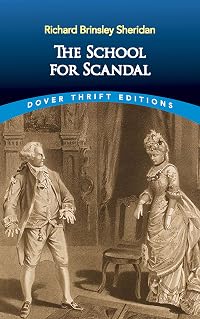
The School for Scandal
by Richard Brinsley Sheridan
On This Page
Description
The School for Scandal debuted at Drury Lane Theater in London in 1777. The play is still popular and regularly performed today. It is a comedy of manners about "the deceptive nature of appearances, the fickleness of reputation, [and] the often disreputable guises behind which goodness and honesty can conceal itself.".
Tags
Recommendations









































Member Reviews
What a read this turned out to be! Surely the title and genre of plays will give someone a thought as to what it'll be about, but surprise, surprise! It was not only not what I expected, but it was BETTER! Better beyond what I long expected out of this time, having been privy to some of the humorous, scandalous plays and poetic works of the earlier half of the 18th Century. But nay! This play outdoes them all by a score of fields! It is not mere humor at the situation, but it is the total immersion of one's self in this play without ever needing to make an attempt at it. One is drawn in as naturally as though involved in a conversation amongst your closest friends, and though you don't know the topic, you listen willingly and are sucked show more in before you know it! Ah, but it is not mere humor of the chaotic, gossip-inspired mishaps that makes this play so delightful, but its atmosphere itself is light and airy, and while it boasts the title of "Comedy" it does not marr the reader with bawdiness and ungainly thoughts. Instead, it is purely rambunctious without the villainy of some comedies to make it sour and distinctly dark. In fact, even the wrongdoings come off as light-hearted and not fit to offend--with one exception in particular, but very aptly and expertly placed! But that is a surprise twist (perhaps to some) that will not spoil the play in my review!
Yet while the play carries us fancifully on its eager and boastful waves of hear-say and disguises, with honest men pulling hoods over the eyes of people pulling hoods over -their- eyes! Still the play carries within itself a noble message that makes it all the more virtuous for being set amongst its vividly animated scenes. Here we have the distinction drawn between appearances and the heart, the mere pleasant and kind wishes of people versus the crude but honest actions of others. Without once straying from its humorous tones and swift pace, a crystalline image is cut for us as the readers to discern immediately as soon as it's presented to us in the form of this message, and all the mirth and tittering characters meddling in one another's affairs cannot strike it from our thoughts throughout. Indeed, it is portrayed to us so obviously, that its honest form is carried with us easily throughout the entire play without once floundering, so that when we see -real- baseness, we know it for what it is instantly and are not capable of restraining ourselves (much as I could not) from remarking with disgust upon the atrocity being presenting in a saint's clothing.
This play is quite easily the most delightful comedic stage-works I've ever had the chance to read. It exceeds Shakespeare in its natural flow, its refreshing mix of humor and drama, and its clear, singular message that cannot be found to be anything but authentic and appropriate. It is a piece of work that gives you just as much to come away with whether you've read it, or seen it performed, which is why I highly recommend this to anyone with a penchant for comedy, plays, or anything light-hearted at the moment! It's a wonderful piece to read through for fun, as well as for the laughter. The message too, impresses strongly upon the audience! The characters change and are well-formed, with some at first giving you one impression, but by the end of the play turning about in a complete 180! It's truly a masterful, enjoyable piece, and -such- an easy read. I can't imagine why anyone wouldn't enjoy this. Even I, adverse to gossips and the like with a -great- deal of vehemence, thoroughly enjoyed this work. Really, you've got to try it out. If you don't like it in the beginning, give it at least until halfway through. By then, you can make the call on things. And just between us, if your complaint is with a certain Joseph Surface--trust me, it all pays off by the end of Act Four. But you've got to get that far to get the satisfaction! And at that point, why -wouldn't- you finish off the read?! Go for it! I think you'll really enjoy it. I absolutely did. show less
Yet while the play carries us fancifully on its eager and boastful waves of hear-say and disguises, with honest men pulling hoods over the eyes of people pulling hoods over -their- eyes! Still the play carries within itself a noble message that makes it all the more virtuous for being set amongst its vividly animated scenes. Here we have the distinction drawn between appearances and the heart, the mere pleasant and kind wishes of people versus the crude but honest actions of others. Without once straying from its humorous tones and swift pace, a crystalline image is cut for us as the readers to discern immediately as soon as it's presented to us in the form of this message, and all the mirth and tittering characters meddling in one another's affairs cannot strike it from our thoughts throughout. Indeed, it is portrayed to us so obviously, that its honest form is carried with us easily throughout the entire play without once floundering, so that when we see -real- baseness, we know it for what it is instantly and are not capable of restraining ourselves (much as I could not) from remarking with disgust upon the atrocity being presenting in a saint's clothing.
This play is quite easily the most delightful comedic stage-works I've ever had the chance to read. It exceeds Shakespeare in its natural flow, its refreshing mix of humor and drama, and its clear, singular message that cannot be found to be anything but authentic and appropriate. It is a piece of work that gives you just as much to come away with whether you've read it, or seen it performed, which is why I highly recommend this to anyone with a penchant for comedy, plays, or anything light-hearted at the moment! It's a wonderful piece to read through for fun, as well as for the laughter. The message too, impresses strongly upon the audience! The characters change and are well-formed, with some at first giving you one impression, but by the end of the play turning about in a complete 180! It's truly a masterful, enjoyable piece, and -such- an easy read. I can't imagine why anyone wouldn't enjoy this. Even I, adverse to gossips and the like with a -great- deal of vehemence, thoroughly enjoyed this work. Really, you've got to try it out. If you don't like it in the beginning, give it at least until halfway through. By then, you can make the call on things. And just between us, if your complaint is with a certain Joseph Surface--trust me, it all pays off by the end of Act Four. But you've got to get that far to get the satisfaction! And at that point, why -wouldn't- you finish off the read?! Go for it! I think you'll really enjoy it. I absolutely did. show less
Money and love, and their interaction are often a matter for comedy, and this play is a classsic of that genre. the Surface brothers are engaged in the pursuit of both money and love, and are trying to swim in the society of upper class England in the 1760's. Joseph is an unlikeable hypocrite and his brother Charles has an amount of familial and emotional honesty. Very few of the characters get any mercy from the author, who as an Irish outsider, in his own life, has a clear vision of the the people he had to deal with in reality. Sheridan gives us the pleasure of condemning others for their weaknesses while insulating us from too much introspection. The play is quite witty and plays well on the stage.
This famous play satirises upper class morality in mid Georgian society (it was first performed at Drury Lane theatre in 1777). The first two acts or so are very funny, with the characters' attitudes towards, and breathless accounts of, scandals affecting one of their number, or numerous outsiders. I found much of the rest of it lacking that sparkle, though, and the characters, both male and female are more or less indistinguishable in terms of their ways of speaking or characteristics.
There were plenty of funny speeches - the crowd of scandal mongers with their made-up, ridiculously inflated stories were good for lots of laughs. What I liked best was that in the end the honest ended up happy. They weren't necessarily more upstanding and virtuous, but they weren't playing these games of insinuation and betrayal. And Charles was such an attractive character - joyous, generous, and appreciative of a good laugh!
Very nicely done for the times. An excellent satire of the society of both those times and the current ones. At least the gossips weren't really hypocrites -- there wasn't much two-facedness in their vitriol; they were pretty open about it. But the more hypocritical of their group did get their comeuppance. I also liked that the "failure" of the two nephews was actually considered the good one by his uncle because he was at least forthright about his shortcomings.
The full-cast recording of this classic play sees a small circle of the uppercrust encountering the perils of scandal-mongering when some of their members become the subject of gossip. There's false identities, several rounds of hiding in the same room, and plenty of misunderstanding with an ultimately happy resolution. I could have sworn I read this in a course on Restoration drama during undergrad but the post play interview with the director notes that this play isn't technically part of the Restoration so it's possible I haven't read this one before after all. An enjoyable way to spend a few hours.
In Jane Austen's Mansfield Park's this is on the list of of potential plays to perform.
Witty, full of backhanded complements, polite insults. It made me laugh.
Witty, full of backhanded complements, polite insults. It made me laugh.
Members
- Recently Added By
Lists

Best Satire
188 works; 28 members

1:28 p.m.'s 350 Stage Plays Challenge
94 works; 3 members

Next Plays / 2025
352 works; 1 member
My Play Collection
769 works; 3 members

The Well-Educated Mind, Susan Wise Bauer, 2016
179 works; 3 members

Books You Read For University
184 works; 3 members
Essential/Recognized Stage Plays
115 works; 4 members

Greatest Books, allegedly
484 works; 9 members

Well-Educated Mind
150 works; 3 members
r/acting on Reddit - Essential Plays
44 works; 2 members

Ambleside Books
459 works; 18 members

The Well-Educated Mind Reading Challenge
75 works; 7 members
Mensa for Kids Excellence in Reading Award Program (Grades 9-12)
116 works; 3 members
Mensa for Kids Excellence in Reading Award Program (Grades 9-12)
116 works; 5 members

Best Early Modern Plays Not By Shakespeare
78 works; 8 members

Trinity College Booklist (1951): Class Ten, English Literature
358 works; 5 members

Harold Bloom - The Western Canon: B. The Aristocratic Age
231 works; 13 members

University literature
145 works; 5 members

Next Plays to Watch
50 works; 1 member
Author Information

64+ Works 3,201 Members
The son of Thomas Sheridan, the Irish actor and theater manager, Richard Brinsley Sheridan began writing plays as a youngster in Bath. He went on to become one of the most successful playwrights of the later eighteenth century, manager of the Drury Lane Theater, and also a politician and orator of some note in the House of Commons. Along with his show more friends David Garrick (seeVol. 3) and Oliver Goldsmith, Sheridan was a member of the Literary Club of Samuel Johnson, having been proposed for membership by Johnson himself. Like Goldsmith, Sheridan also attacks "The Sentimental Muse" of weeping comedy. In his best-known play, The School for Scandal (1777), Sheridan revives the Restoration comedy of manners with its portrait of the beau monde and its deflation of hypocrisy. The play is indebted to William Congreve as well as to Moliere (see Vol. 2), and the picture of society is based on Bath and London. In The Rivals (1775), Sheridan amuses himself with the language games of Mrs. Malaprop and her "nice derangement of epitaphs." The allusions are consistently literary, as in her simile "as headstrong as an allegory on the banks of the Nile." Sheridan's acute ear for banalities and truisms is best seen in The Critic (1779), a burlesque of sentimental and inflated plays as well as self-important criticism. The play ridicules "false Taste and brilliant Follies of modern dramatic Composition." Sheridan's sparking dialogue, lively scenes, and masterful dramatic construction have proved to be enduringly popular. (Bowker Author Biography) show less
Some Editions
Awards and Honors
Series
Belongs to Publisher Series
Work Relationships
Is contained in
Cavalcade of comedy; 21 brilliant comedies from Jonson and Wycherley to Thurber and Coward by Louis Kronenberger
Four English Comedies: Valpone; The Way of the World; She Stoops to Conquer; The School for Scandal by J. M. Morrell
World Drama, Volume 1: Ancient Greece, Rome, India, China, Japan, Medieval Europe, and England by Barrett H. Clark
Four Great Comedies of the Restoration and 18th Century: The Country Wife/School for Scandal/She Stoops to Conquer/Way of the World by William Wycherley
Modern English Drama: Dryden; Sheridan; Goldsmith; Shelley; Browning; Byron by Charles William Eliot
Has as a supplement
Common Knowledge
- Canonical title
- The School for Scandal
- Original publication date
- 1777
- People/Characters
- Lady Sneerwell; Charles Surface; Joseph Surface; Sir Oliver Surface; Sir Peter Teazle; Lady Teazle (show all 11); Sir Benjamin Backbite; Sir Harry Bumper; Mrs Candour; Maria; Snake
- Related movies
- The School for Scandal (1975 | IMDb)
- Disambiguation notice
- The author of this work is Richard Brinsley Sheridan.
Classifications
Statistics
- Members
- 1,175
- Popularity
- 21,447
- Reviews
- 19
- Rating
- (3.62)
- Languages
- 5 — English, French, German, Italian, Norwegian (Bokmål)
- Media
- Paper, Audiobook, Ebook
- ISBNs
- 67
- UPCs
- 3
- ASINs
- 53