War by Timetable: How the First World War Began
by A. J. P. Taylor
Library of the 20th Century, Deze eeuw
On This Page
Description
War by Time-table is a history of the mobilization of the armies of the Great Powers in 1914. AJP Taylor not only argues that the circumstances were already set for a general war, (he may state in the opening pages of his First World War that Europe of the early 1910s was a peaceful looking place, nevertheless he knew about the figures of industrial production, colonial expansion, and territorial demands of the era) he also names the specific flaw in the war plans of the Great Powers show more (especially Germany) that, when ignited, would make the war unavoidable. All mobilization plans depended on railways. At that time the automobile was hardly used, certainly not as an instrument of mass transport, and railways demand time tables. All the mobilization plans had been timed to the minute, months or even years before and they could not be changed. Modification in one direction would ruin them in every other direction. Any attempt for instance by the Austrians to mobilize against Serbia would mean that they could not then mobilize against Russian because two lots of trains would be running against each other. The same problem was to arise later for the Russians and in the end for the Germans who, having a plan to mobilize against France, could not switch round and mobilize again against Russia. Any alteration in the mobilization plan meant not a delay for 24 hours but for at least six months before the next lot of timetables were ready. This fascinating and controversial book is essential reading not just for historians of the First World War for all who are interested in the logistics of combat. show lessTags
Recommendations


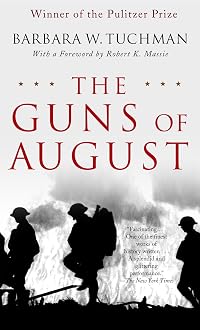
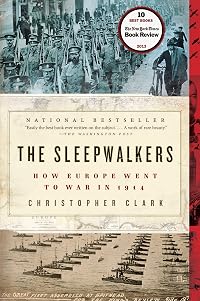













Member Reviews
This short book summarises the series of mishaps, misunderstandings (both accidental and wilful) and coincidences (along with a certain measure of malice) among the great powers that led to the outbreak of the First World War. He describes almost amusingly and ultimately, of course, tragically the rigid adherence of the great powers to train timetables for mobilisation of their troops, combined in other areas with absurd lack of planning, such as there being no plans for shared intelligence and planning between the British and French armies. He then looks at the chance events that led to the assassination of Archduke Franz Ferdinand in Sarajevo, and the course of the decision-making process in Vienna, Berlin and London that led to war. show more This is a classic statement of the thesis that the world blundered into this war, statesmen and military leaders believing that war could not actually really come about it, but willing or feeling forced into pushing decisions along in a certain direction. Although he doesn't say so explicitly here, and there is plenty of blame to be shared all around, I think he believes that Austria-Hungary is more responsible than any other nation for setting the train of events in motion, for wanting to punish Serbia for the assassination of Franz Ferdinand, while refusing to accept that the assassin Princip was not being supported or encouraged by the Serbian government. Reading the unfolding narrative, one is left with a horrible feeling of how differently events could have turned out, especially if any of these leaders could have foreseen the horrors to come. show less
2382 War by Time-Table: How the First World War Began, by A. J. P. Taylor (read 4 May 1991) This is a slight book telling how World War One began. Taylor says the Germans caused it but shows there are others which share fault. He says Fay, whose volumes I read in 1968, is 'adroitly pro-German' and that the most sensible account is by B. E. Schmitt's The Coming of the War. But he says these, as well as Albertini (read by me in 1986), are all "old-fashioned treatments." He says a new start is exemplified by Vladimir Dedijer's book, (read by me 27 Dec 1966), and Fritz Fischer's book, (read by me 31 July 1980), and George Malcolm Thomson's book (read by me 5 Dec 1964). Not a bad book, but not an in-depth book.
Ratings
Members
- Recently Added By
Author Information

191+ Works 6,202 Members
British historian A.J.P. Taylor studied at Oxford University and in 1938 became a fellow of Magdalen College. Interested chiefly in diplomatic and central European history, he is a prolific and masterful writer. Fritz Stern wrote of him and his The Struggle for Mastery in Europe, 1848--1918 (1954) in the Political Science Quarterly: "There is show more something Shavian about A. J. P. Taylor and his place among academic historians; he is brilliant, erudite, witty, dogmatic, heretical, irritating, insufferable, and withal inescapable. He sometimes insults and always instructs his fellow-historians, and never more so than in his present effort to reinterpret the diplomatic history of Europe from 1848 to the end of the First World War. . . . After a brilliant introduction, in which he defines the balance of power and assesses the relative and changing strength of the Great Powers, Mr. Taylor presents a chronological survey, beginning with the diplomacy of war, 1914--1918. . . . [He] writes on two levels. He narrates the history of European diplomacy and compresses it admirably into a single volume. Imposed upon the narrative is his effort to probe the historical meaning of given actions and conditions. . . . He has a peculiar sense of inevitability, growing out of what he regards the logic of a given development, as well as a delicate feeling for live options and alternatives. Mr. Taylor suggests that fear, not aggression, was the dominant impulse of pre-war diplomacy." The Origins of the Second World War (1961), again controversial and lively, starts from the premise (in Taylor's words) that "the war of 1939, far from being premeditated, was a mistake, the result on both sides of diplomatic blunders." The New Statesman said of it: "Taylor is the only English historian now writing who can bend the bow of Gibbon and Macaulay. [This is] a masterpiece: lucid, compassionate, beautifully written in a bare, sparse style, and at the same time deeply disturbing." Several of Taylor's other works also received high praise. Among these were Bismarck, the Man and the Statesman (1955), in which he exonerated Bismarck; Hapsburg Monarchy, 1809--1914, a survey of the era; and English History, 1919--1945, a volume in the Oxford History of England Series, greeted by the N.Y. Review of Books as "an astonishing tour de force." (Bowker Author Biography) show less
Series


Work Relationships
Common Knowledge
- Original title
- War by time-table
- Important events
- Origins of World War I; World War I
- Original language
- English
Classifications
Statistics
- Members
- 94
- Popularity
- 342,838
- Reviews
- 2
- Rating
- (4.09)
- Languages
- Dutch, English, French, Swedish
- Media
- Paper, Ebook
- ISBNs
- 5
- UPCs
- 1
- ASINs
- 3