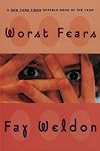
Worst Fears
by Fay Weldon
On This Page
Description
A classic tale of how a perfectly knitted life can unravel in the space of days. Alexandra Ludd is an actress playing Nora in Ibsen?s A Doll?s House. In the eyes of the world she has everything a woman could want: husband, home, child, income, good looks, good friends, the plaudits of the crowd and the affection of neighbours. But Alexandra inspires envy as well as love: she was unwise to forget it, she was complacent, perhaps a little vain - and all fate has to do to bring her down is to show more snip a single strand ... Worst Fears is the story of how bereavement can turn love hollow and truth can destroy a past. It is a headlong, headstrong tale of anger and forgiveness, of worst fears realised but, in the end, best wishes granted. show lessTags
Recommendations



















Member Reviews
"...as is well known, women and birds are able to see without turning their heads, and that is indeed a necessary provision, for they are both surrounded by enemies." - James Stephens, The Demi-Gods.
This is a quote that Fay Weldon could easily take to heart. She is well acquainted with the problems women face in the world, and the contribution men make to those problems. But one of her distinctive themes is how women, too, shaft one another. The men in Worst Fears are, to varying degrees, self-serving, weak, small-minded, petulant and pompous. That, it is implied, can more or less be taken for granted. The female characters are far more advanced and artistic in their cunning, deceit and hypocrisy - with the exception of the central show more character and victim, Alexandra Ludd. The women in Worst Fears are unsparing in their judgments of one another, always ready to believe the worst and run with it, even when 'the worst' is merely that a woman is departing from stereotypic expectations.
Alexandra is an actress (actor, as she repeatedly corrects her friends), who has been living with husband Ned and their young boy in a costly period cottage in the English countryside. She is a rising star thanks to her current London performance in Ibsen's A Doll's House, but has to take leave upon Ned's sudden death by heart attack. Her female friends are evasive about the circumstances of the death, as though doing some acting of their own; and the details she pieces together from other people add to her disquiet. In the other Weldon books I have read there are several central female protagonists. In this case there is only one, so the evasiveness and deceptiveness of Alexandra's peers creates a mood of paranoia.
The main characters are her local friend Abbie; their crass, nouveau-riche acquaintance Vilna; Ned's brother Hamish, who comes down to help with practicalities; and Alexandra's nearest neighbour, Lucy Lint (Jenny Linden in some editions), who makes miniature props for the stage. There are also appearances by Alexandra's unkind mother Irene, the low-life nanny Theresa and the faintly sinister therapist Leah, a spiritualist with steel inside her velvet glove.
Alexandra tries to manage her shattering grief while dealing with the odd and perplexing events that follow. For example, she discovers Lucy pacing outside her hedge, keening to herself, claiming to have had a love affair with Ned. Alexandra, who is compared to Marilyn Monroe, at once discounts any challenge from the overweight, over-emotional Lucy... but why, then, did Lucy tell such a tale?
As events unfold the reader discovers a number of bad deeds perpetrated against Alexandra. But everyone around her comes down like a ton of bricks on Alexandra's own small, finicky failings (for example, her blindness to events surrounding her) while rationalising or sliding over the serious harm dealt to her by others. For her part, Alexandra never forgives her central rival, but otherwise she turns remarkably saintly, apportioning a great deal of the blame to herself for the dark turn of events.
I think this imbalance serves several purposes for the novel. First, it invites pity for the central character. We want to come to her defence, since no-one else will, and challenge the spurious moral charges laid against her. Secondly, Alexandra's acceptance of blame asserts the novel's key message of individualism - yes women face difficulties, but in solving them you're on your own dearie. Thirdly, the cunning way that people frame events to the disadvantage of Alexandra may bring a smile to middle class readers who deal with this sort of monkey business all day, as they negotiate their way across professional networks and up and down workplace hierarchies.
Ned had made a particular study of Ibsen's plays. The irony is that Ibsen was a fierce defender of women's rights, unlike Ned himself. The story itself is structured like an Ibsen play, with its carefully spaced revelations. show less
This is a quote that Fay Weldon could easily take to heart. She is well acquainted with the problems women face in the world, and the contribution men make to those problems. But one of her distinctive themes is how women, too, shaft one another. The men in Worst Fears are, to varying degrees, self-serving, weak, small-minded, petulant and pompous. That, it is implied, can more or less be taken for granted. The female characters are far more advanced and artistic in their cunning, deceit and hypocrisy - with the exception of the central show more character and victim, Alexandra Ludd. The women in Worst Fears are unsparing in their judgments of one another, always ready to believe the worst and run with it, even when 'the worst' is merely that a woman is departing from stereotypic expectations.
Alexandra is an actress (actor, as she repeatedly corrects her friends), who has been living with husband Ned and their young boy in a costly period cottage in the English countryside. She is a rising star thanks to her current London performance in Ibsen's A Doll's House, but has to take leave upon Ned's sudden death by heart attack. Her female friends are evasive about the circumstances of the death, as though doing some acting of their own; and the details she pieces together from other people add to her disquiet. In the other Weldon books I have read there are several central female protagonists. In this case there is only one, so the evasiveness and deceptiveness of Alexandra's peers creates a mood of paranoia.
The main characters are her local friend Abbie; their crass, nouveau-riche acquaintance Vilna; Ned's brother Hamish, who comes down to help with practicalities; and Alexandra's nearest neighbour, Lucy Lint (Jenny Linden in some editions), who makes miniature props for the stage. There are also appearances by Alexandra's unkind mother Irene, the low-life nanny Theresa and the faintly sinister therapist Leah, a spiritualist with steel inside her velvet glove.
Alexandra tries to manage her shattering grief while dealing with the odd and perplexing events that follow. For example, she discovers Lucy pacing outside her hedge, keening to herself, claiming to have had a love affair with Ned. Alexandra, who is compared to Marilyn Monroe, at once discounts any challenge from the overweight, over-emotional Lucy... but why, then, did Lucy tell such a tale?
As events unfold the reader discovers a number of bad deeds perpetrated against Alexandra. But everyone around her comes down like a ton of bricks on Alexandra's own small, finicky failings (for example, her blindness to events surrounding her) while rationalising or sliding over the serious harm dealt to her by others. For her part, Alexandra never forgives her central rival, but otherwise she turns remarkably saintly, apportioning a great deal of the blame to herself for the dark turn of events.
I think this imbalance serves several purposes for the novel. First, it invites pity for the central character. We want to come to her defence, since no-one else will, and challenge the spurious moral charges laid against her. Secondly, Alexandra's acceptance of blame asserts the novel's key message of individualism - yes women face difficulties, but in solving them you're on your own dearie. Thirdly, the cunning way that people frame events to the disadvantage of Alexandra may bring a smile to middle class readers who deal with this sort of monkey business all day, as they negotiate their way across professional networks and up and down workplace hierarchies.
Ned had made a particular study of Ibsen's plays. The irony is that Ibsen was a fierce defender of women's rights, unlike Ned himself. The story itself is structured like an Ibsen play, with its carefully spaced revelations. show less
Worst Fears is aptly named. In it, the worst fears of the protagonist, and presumably of the reader, are realized. What fears? That your spouse doesn’t love you, that your friends are trying to take advantage of you, that the psychologists are trying to destroy your mind, that everyone is deceiving you, that the world is laughing at you behind your back, that nothing is at it seems, and that whatever happens, it will work out against you. When the book opens, Alexandra’s husband, Nick, has just died. Alexandra suffers from what she feels is a great loss. But as the story unfolds, it is as if Nick has woven such a web of deceit around her that it was kept aloft only by his living presence. As soon as he dies, the fragile network show more starts to unravel.
If the end of tragedy is a catharsis of pity and fear, then end of this novel is a catharsis of rage. Alexandra starts out intelligent, smart, beautiful, successful, and unsuspecting. By the end, she is a raving, axe-wielding arson, flailing out ineffectually against an implacably malevolent society. I suppose that such a novel must be satisfying to some—else how could Ms. Weldon have a following? However, it was not in any way to my liking. In my limited reading experience, rage-against-the-world novels usually invoke some principle—consciously or not—that lends some kind of dignity to a hopeless fight and that transforms a mere victim into a martyr. But Alexandra’s struggle seems never to rise above the myopically personal. There may be an important message here about the different shapes taken by the oppression of women and that of men. Maybe. I’m keeping open on that issue. But as of now, it doesn’t speak to me.
I picked up this book with no knowledge of the author or of what to expect. The writing of the first twenty pages convinced me it was some popular genre fiction. The language was crass and superficial, deliberately rude, but not so often as to constitute a style. There was a death and a visit to the morgue. Was it a mystery? The narrator seemed obsessed with sexuality, physicality, or closeness. Was it romance? Friends and neighbors, as we got to know them, seemed odd and creepy. Was it a horror story? Halfway through, I became so perplexed about what genre it could possibly be, I finally looked it up online and found that she is labeled “feminist.” Hmm. I’m not sure that’s right. Is paranoia, expressed by a woman, “feminism”? In Weldon’s world, it’s not just the men who are schmucks. True, the center of evil is the once-adored husband. But base, manipulative, egocentrism drives every living creature in this novel, with the sole exception of Alexandra, who, alone is accused falsely of all those vices and is thereby plunged ever deeper into despair and hurt. show less
If the end of tragedy is a catharsis of pity and fear, then end of this novel is a catharsis of rage. Alexandra starts out intelligent, smart, beautiful, successful, and unsuspecting. By the end, she is a raving, axe-wielding arson, flailing out ineffectually against an implacably malevolent society. I suppose that such a novel must be satisfying to some—else how could Ms. Weldon have a following? However, it was not in any way to my liking. In my limited reading experience, rage-against-the-world novels usually invoke some principle—consciously or not—that lends some kind of dignity to a hopeless fight and that transforms a mere victim into a martyr. But Alexandra’s struggle seems never to rise above the myopically personal. There may be an important message here about the different shapes taken by the oppression of women and that of men. Maybe. I’m keeping open on that issue. But as of now, it doesn’t speak to me.
I picked up this book with no knowledge of the author or of what to expect. The writing of the first twenty pages convinced me it was some popular genre fiction. The language was crass and superficial, deliberately rude, but not so often as to constitute a style. There was a death and a visit to the morgue. Was it a mystery? The narrator seemed obsessed with sexuality, physicality, or closeness. Was it romance? Friends and neighbors, as we got to know them, seemed odd and creepy. Was it a horror story? Halfway through, I became so perplexed about what genre it could possibly be, I finally looked it up online and found that she is labeled “feminist.” Hmm. I’m not sure that’s right. Is paranoia, expressed by a woman, “feminism”? In Weldon’s world, it’s not just the men who are schmucks. True, the center of evil is the once-adored husband. But base, manipulative, egocentrism drives every living creature in this novel, with the sole exception of Alexandra, who, alone is accused falsely of all those vices and is thereby plunged ever deeper into despair and hurt. show less
What might you fear following the unexpected death of your husband. That is exactly what Alexandra faces as her husband's death brings to light the facets of her husband's life she didn't know about. Quirky and funny (and sorry mom, some explicit language). A quick and pleasurable tale that somehow made my own life seem quite normal. I loved the audio version that brought all of those oh-so-British characters to life.
Fun, light and entertaining while not insulting your intelligence. Sort of enlightened chick-lit.
Een jonge actrice vindt haar man dood en wordt door de omstandigheden gedwongen haar visie op hun huwelijk te herzien.
Ratings
Members
- Recently Added By
Author Information

94+ Works 9,254 Members
Fay Weldon was born in Worcester, England on September 22, 1931. She read economics and psychology at the University of St. Andrews. She worked as a propaganda writer for the British Foreign Office and then as an advertising copywriter for various firms in London before making writing a full-time career. Her work includes over twenty novels, five show more collections of short stories, several children's books, non-fiction books, and a number of plays written for television, radio and the stage. Her collections of short stories include Mischief and Nothing to Wear and Nowhere to Hide. She wrote a memoir entitled Auto Da Fay and non-fiction book entitled What Makes Women Happy. She wrote the pilot episode for the television series Upstairs Downstairs. Her first novel, The Fat Woman's Joke, was published in 1967. Her other novels include Praxis, The Life and Loves of a She-Devil, Puffball, Rhode Island Blues, Mantrapped, She May Not Leave, The Spa Decameron, Habits of the House, Long Live the King, and The New Countess. Wicked Women won the PEN/Macmillan Silver Pen Award. She was awarded a CBE in 2001. (Bowker Author Biography) show less
Awards and Honors
Awards
Work Relationships
Common Knowledge
- Original publication date
- 1996
- People/Characters
- Alexandra Lund; Ned; Hamish; Vilna; Abbie ; Jenny Linden (show all 7); Leah
- Important places
- London, England, UK
- First words
- "I've never seen a dead body," said Vilna.
- Last words
- (Click to show. Warning: May contain spoilers.)Ned was dead. And she was off.
- Blurbers
- Anne Rolphe
Classifications
Statistics
- Members
- 267
- Popularity
- 120,880
- Reviews
- 5
- Rating
- (3.22)
- Languages
- 8 — Danish, Dutch, English, German, Italian, Norwegian (Bokmål), Norwegian, Swedish
- Media
- Paper, Audiobook, Ebook
- ISBNs
- 27
- ASINs
- 6