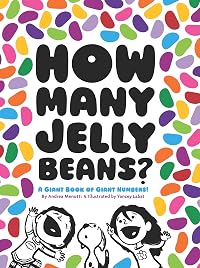
How Many Jelly Beans?
by Andrea Menotti, Yancey Labat (Illustrator)
On This Page
Description
Juvenile Nonfiction. Mathematics. Picture Book Nonfiction. How many jelly beans are enough? How many are too many? Aiden and Emma can't decide. Is 10 enough? How about 1,000? That's a lot of jelly beans. But eaten over a whole year, it's only two or three a day. This giant picture book offers kids a fun and easy way to understand large numbers. Starting with 10, each page shows more and more colorful candies, leading up to a big surprise—ONE MILLION JELLY BEANS! With bright illustrations, show more How Many Jelly Beans? makes learning about big numbers absolutely scrumptious!. show lessTags
Recommendations


Member Reviews
Big numbers are hard for children. This is a big book to help with big numbers.
You can see five things. You can hold five things (probably) in your hand. But what about five hundred things? Five thousand? A hundred thousand? A million?
This big book (librarians should be warned that it will not fit in a child's backpack and has foldout pages that will tear easily, but please don't let that stop you from acquiring it for your collection) uses a competitive brother and sister to allow children to visualize big numbers. With jelly beans. This amazing illustrator (how long did it take Labat?!) actually draws, on an enormous foldout page, one million jelly beans.
Love this one.
You can see five things. You can hold five things (probably) in your hand. But what about five hundred things? Five thousand? A hundred thousand? A million?
This big book (librarians should be warned that it will not fit in a child's backpack and has foldout pages that will tear easily, but please don't let that stop you from acquiring it for your collection) uses a competitive brother and sister to allow children to visualize big numbers. With jelly beans. This amazing illustrator (how long did it take Labat?!) actually draws, on an enormous foldout page, one million jelly beans.
Love this one.
“How many jelly beans would you like, Emma?” asks the half-shown figure. The contemplative Emma response, “Ten.” The excited Aiden responds, “Twenty!” Competition ensues between the girl and the boy, each upping the ante of the number of jelly beans they want. The female is the cautionary one: “That’s too many. You can’t eat five hundred jelly beans.” “Oh, yeah,” the boy counters. As the conversation continues, captured in speech bubbles, the characters do more than count. If you eat a thousand jelly beans in a year, that’s only 2 or 3 a day, as cleverly shown in a year’s calendar, each date picturing either two or three jelly beans. Dividing up the 100,000 jelly beans into varying flavors invite further show more mathematical language. A huge foldout shows a million jelly beans, which the boy finally admits is probably too many. Besides introduction to large numbers, counting, and a context for operations, the book invites an interesting analysis of gender stereotypes. show less
The plot of this story is very subtle, yet I could see how children would be intrigued by the back and forth of bigger numbers between the two children. The use of jellybeans is very smart. I could see children wanting to count jellybeans in their own hand, just like the children do in the beginning of the story.
Our favorite librarian/family friend made sure that Z was the first kid to check this out from our local branch . . . before the over-sized pages in the back got mangled. Fun in a 101 Penguins sort of way, the big-ass book was devoured within 30 minutes and prompted a cool discussion of various ways to estimate large numbers. He's planning on reading it out loud to his number-geek dad.
Jellybean lovers Emma and Aiden cannot help but outdo each other by wanting more jelly beans than the other. 10, 20, 25… until finally one million jelly beans. Aiden realizes that one million jelly bean might be just too many. The beauty of this book is in the simplistic plot which allows room for the illustrations. The sugary delight is depicted in color on every page in a one-to-one correspondence while the background pictures are depicted in black and white. It allows the reader to be able to quantify the numbers especially one million. This book takes you on an adventure of counting, but also discovery number relationship with subtraction, division, and percentages. After reading this huge book, I immediately think of all the show more worthwhile math task that could be incorporated in the classroom. A “sweet” read that anyone will enjoy. show less
In this book we are introduced to working with large numbers. Aiden and Emma are trying to figure out how many jelly beans is too many? Each page the number of jelly beans increases until we get to one million jelly beans. This book also covers dividing to figure out how many jelly beans you could eat a day if you had 1000. I love how colorful this book was! I was excited to turn the page and I think many kids would have fun with this book. The math language used was perfect for the age it is geared towards.
How Many Jelly Beans is a giant picture book that offers young readers an entertaining and easy way to understand large numbers. This book originates from two siblings named Emma and Aiden who were fighting over the amount of jelly beans they wanted. This book is a creative image book that offers colorful visuals to help young readers count large numbers and introduce the idea of place values. The picture book would be a great way to introduce large quantities in the classroom and help students understand the concept of place values with the use of colorful images and manipulatives (jelly beans). This book covers a great topic about number sense.
Members
- Recently Added By
Lists

Red Dot 2014 - Younger Readers - Longlist
16 works; 3 members
Author Information
9 Works 237 Members
Awards and Honors
Awards
Classifications
Statistics
- Members
- 140
- Popularity
- 233,861
- Reviews
- 26
- Rating
- (4.15)
- Languages
- English
- Media
- Paper, Ebook
- ISBNs
- 2