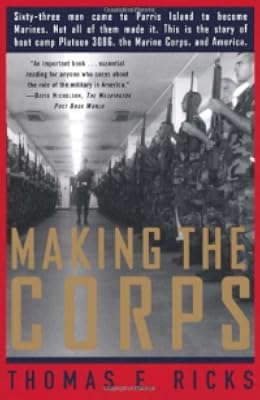
Making the Corps
by Thomas E. Ricks
On This Page
Description
The bestselling, compelling insider's account of the Marine Corps from the lives of the men of Platoon 3086--their training at Parris Island, their fierce camaraderie, and the unique code of honor that defines them. The United States Marine Corps, with its proud tradition of excellence in combat, its hallowed rituals, and its unbending code of honor, is part of the fabric of American myth. Making the Corps visits the front lines of boot camp in Parris Island, South Carolina. Here, old values show more are stripped away and new Marine Corps values are forged. Bestselling author Thomas E. Ricks follows these men from their hometowns, through boot camp, and into their first year as Marines. As three fierce drill instructors fight a battle for the hearts and minds of this unforgettable group of young men, a larger picture emerges, brilliantly painted, of the growing gulf that divides the military from the rest of America. Included in this edition is an all-new afterword from the author that examines the war in Iraq through the lens of the Marines from Platoon 3086, giving readers an on-the-ground view of the conflict from those who know it best. show lessTags
Recommendations











Member Reviews
Thomas E. Ricks's MAKING THE CORPS has sat in my bookcase for more than three years but I finally got around to reading it, and now I wonder what took me so long. Because this snail's eye view of a Marine platoon going through boot camp on Parris Island in the mid-1990s is a starkly revealing and absolutely absorbing read from cover to cover, as it follows these young men from being confused and aimless civilians to confident and proud Marines.
Ricks's look at the process is a balanced and fair one. He doesn't ignore the fact that many of the initial group will not make it through, and he makes the reader privy to the reasons for falling by the wayside and washing out. I was particularly surprised to learn that the DI's of Parris Island show more are now prohibited from using profanity or intimidating the recruits entrusted to them. Nevertheless, the DI's have their ways of getting the complete and undivided attention of their charges and, in the end, gaining their respect. More than once, however, I flashed back to my own Army BCT days, more than thirty years before Marine Platoon 3086, and how all my waking hours were lived in a near-constant state of mortal terror of my Drill Sergeants, who had no such prohibitions, so I learned a whole new vocabulary during those eight intimidating and terror-filled weeks. I also thought of an obscure and now nearly forgotten film I saw back in the seventies called BABY BLUE MARINE (starring Jan-Michael Vincent), about a recruit who washed out of a particularly brutal boot camp, in the days before it became a bit 'gentler,' and more 'civilized.'
My own BCT, back in 1962, was a lot more like the Marine boot camp documented here in MAKING THE CORPS, but with lots of profanity, intimidation and beau coups terror.
But perhaps what is most impressive in the Marine Corps Ricks shows us here is the way the Corps is actually a 'family,' and how boot camp instills 'family values' that many recruits had never learned. Wastrels and purposeless 'corner boys drinking their forties' are remade into upstanding young men who learn to respect themselves. In fact, when they return home on their first post-training leave, they find they have little in common with their old companions.
What is most disturbing in Ricks's account of the Marine culture and brotherhood is how Marines - and our professional, all-volunteer military in general - have become alienated from the civilian populace it is tasked with defending, particularly with the political and elite. He wonders how long this can go on, and even poses a remote possibility of an eventual military coup, and he makes a valid argument. This book was originally published in 1997, and I read the ten-year anniversary edition, and this separation of the military and civilian has only become more exacerbated in the intervening eighteen years.
This is simply a damn good book - well-written, thought provoking and fascinating. Made me appreciate the Marines a hell of a lot more. If you want to know more about our all-volunteer military, especially the 'few and the proud,' read this book. Highly recommended. show less
Ricks's look at the process is a balanced and fair one. He doesn't ignore the fact that many of the initial group will not make it through, and he makes the reader privy to the reasons for falling by the wayside and washing out. I was particularly surprised to learn that the DI's of Parris Island show more are now prohibited from using profanity or intimidating the recruits entrusted to them. Nevertheless, the DI's have their ways of getting the complete and undivided attention of their charges and, in the end, gaining their respect. More than once, however, I flashed back to my own Army BCT days, more than thirty years before Marine Platoon 3086, and how all my waking hours were lived in a near-constant state of mortal terror of my Drill Sergeants, who had no such prohibitions, so I learned a whole new vocabulary during those eight intimidating and terror-filled weeks. I also thought of an obscure and now nearly forgotten film I saw back in the seventies called BABY BLUE MARINE (starring Jan-Michael Vincent), about a recruit who washed out of a particularly brutal boot camp, in the days before it became a bit 'gentler,' and more 'civilized.'
My own BCT, back in 1962, was a lot more like the Marine boot camp documented here in MAKING THE CORPS, but with lots of profanity, intimidation and beau coups terror.
But perhaps what is most impressive in the Marine Corps Ricks shows us here is the way the Corps is actually a 'family,' and how boot camp instills 'family values' that many recruits had never learned. Wastrels and purposeless 'corner boys drinking their forties' are remade into upstanding young men who learn to respect themselves. In fact, when they return home on their first post-training leave, they find they have little in common with their old companions.
What is most disturbing in Ricks's account of the Marine culture and brotherhood is how Marines - and our professional, all-volunteer military in general - have become alienated from the civilian populace it is tasked with defending, particularly with the political and elite. He wonders how long this can go on, and even poses a remote possibility of an eventual military coup, and he makes a valid argument. This book was originally published in 1997, and I read the ten-year anniversary edition, and this separation of the military and civilian has only become more exacerbated in the intervening eighteen years.
This is simply a damn good book - well-written, thought provoking and fascinating. Made me appreciate the Marines a hell of a lot more. If you want to know more about our all-volunteer military, especially the 'few and the proud,' read this book. Highly recommended. show less
Boot camp is iconic, maybe infamous. Boot camp is the 11 weeks where hardassed drill instructors turn snotnosed civilians into Marines.
R. Lee Ermey, in his most famous role as Gunnery Sergeant Hartman in Full Metal Jacket
In Making the Corps, Ricks uses the journey of Platoon 3086 through Parris Island in 1996 as a lens to understand the Marine Corps as a whole, and their place in the American defense posture in the 21st century, and American society. The Marines are self-consciously about a warrior culture, the living legacy of Semper Fi, and boot camp is where that foundations of that culture are laid. Ricks is both caught up in the myth-making, he genuinely likes the Marines, but he has enough to distance to see warning flags where show more appropriate.
First, boot camp. The point of boot camp is to mold individualist and lazy teenagers into decisive, calm, and collectivist professionals. Every Marine is a rifleman, and every Marine should be prepared to kill, and if necessary, die, for his brother Marines. The yelling, the PT, the discipline, is all designed around this simple goal. In 1996, Parris Island had a 24% attrition rate, including injuries, psychological breakdowns, and 'Failure to Adapt'. While it's tough, it's not sadistic or particularly dangerous. We're a long ways away from the bad days of Ribbon Creek incident, where six recruits died while marching across tidal flats on the orders of a drunk DI, or the post-Vietnam funk. Ricks manages to make enough of the 55-odd recruits of Platoon 3086 individuals to give character to this transformation, without losing touch with the big picture.
The boot camp parts are interspersed with musings on what the Marines might do going into the 21st century. It's been over 20 years and two medium-sized wars, so a lot of this Clinton-era speculation feels very dated. But even with a pre 9-11 mindset, Ricks manages to grasp the essential contradictions of a highly disciplined warrior elite in a nation that is increasingly anything but. show less
R. Lee Ermey, in his most famous role as Gunnery Sergeant Hartman in Full Metal Jacket
In Making the Corps, Ricks uses the journey of Platoon 3086 through Parris Island in 1996 as a lens to understand the Marine Corps as a whole, and their place in the American defense posture in the 21st century, and American society. The Marines are self-consciously about a warrior culture, the living legacy of Semper Fi, and boot camp is where that foundations of that culture are laid. Ricks is both caught up in the myth-making, he genuinely likes the Marines, but he has enough to distance to see warning flags where show more appropriate.
First, boot camp. The point of boot camp is to mold individualist and lazy teenagers into decisive, calm, and collectivist professionals. Every Marine is a rifleman, and every Marine should be prepared to kill, and if necessary, die, for his brother Marines. The yelling, the PT, the discipline, is all designed around this simple goal. In 1996, Parris Island had a 24% attrition rate, including injuries, psychological breakdowns, and 'Failure to Adapt'. While it's tough, it's not sadistic or particularly dangerous. We're a long ways away from the bad days of Ribbon Creek incident, where six recruits died while marching across tidal flats on the orders of a drunk DI, or the post-Vietnam funk. Ricks manages to make enough of the 55-odd recruits of Platoon 3086 individuals to give character to this transformation, without losing touch with the big picture.
The boot camp parts are interspersed with musings on what the Marines might do going into the 21st century. It's been over 20 years and two medium-sized wars, so a lot of this Clinton-era speculation feels very dated. But even with a pre 9-11 mindset, Ricks manages to grasp the essential contradictions of a highly disciplined warrior elite in a nation that is increasingly anything but. show less
"Making the Corps" is a great story of transformation. It covers the 13-week transformation of young males into Marines. Ricks does an excellent job of not just portraying the transformation of these young men, but how that transformation reflects the Marine way of life as a whole. The book doesn't focus a lot of time on the physical aspects (although it is covered pretty well), but on the mental and emotional changes that occur and how the Marines facilitate that change. For example, Ricks explains why Marine drill instructors are so hard on their recruits and how this changes as the recruits start to internalize the beliefs of their drill instructors. He shows, for example, how recruits' language change from "I" to "this recruit" and show more discusses what that means.
Ricks also discusses the unique situation of the Marines as a culture within the military and the larger society. The Marines are a distinct culture that works to maintain that culture in direct criticism of the ordinary society and in suspicion of other Army branches. This is both a good thing (Marines are a specially-trained and unique force) and a bad thing (Marines don't like to play with other branches' ineptness so well). No where is this more evident in the last chapter in which Ricks compares and contrasts the Army training base and the Marines training base.
Overall, this was a great book to read in learning more about the culture of the Marines rather than the experience of boot camp. I enjoyed learning more about how the Marines view their world in comparison to their history and continued legacy. The book is a bit older, so their is talk of Nintendo and video games along with Bill Clinton, but the point of transformation through the Marines bootcamp is timeless. show less
Ricks also discusses the unique situation of the Marines as a culture within the military and the larger society. The Marines are a distinct culture that works to maintain that culture in direct criticism of the ordinary society and in suspicion of other Army branches. This is both a good thing (Marines are a specially-trained and unique force) and a bad thing (Marines don't like to play with other branches' ineptness so well). No where is this more evident in the last chapter in which Ricks compares and contrasts the Army training base and the Marines training base.
Overall, this was a great book to read in learning more about the culture of the Marines rather than the experience of boot camp. I enjoyed learning more about how the Marines view their world in comparison to their history and continued legacy. The book is a bit older, so their is talk of Nintendo and video games along with Bill Clinton, but the point of transformation through the Marines bootcamp is timeless. show less
It’s always good to learn about the US Marines as they are essential to understanding the history and future of the country. The Marines play an important role in the safety of democracy worldwide. The contributions of the Marines are still largely ignored by most of the American public. This well written book by Pulitzer winner Thomas Ricks is a pleasure to read from a reader’s (and editor’s) point of view. It covers approximately 63 men from one platoon at Parris Island, South Carolina in 1995. The other training depot closer to me is Camp Pendleton, California. There is apparently a healthy rivalry between the two coastal training centers. This seems to be the case among the SEAL teams as well which are naval special warfare show more elements. Although I enjoyed Ricks’ actual reporting on the men in training, I was less enthusiastic about his journalistic presuppositions and general conclusions. Overall I recommend this book but only with the caveat that a skeptical eye being used when coming to chapter nine where he draws conclusions about what he had reported thus far. Basically Ricks says that the Marines (circa 1997) are ahead of the curve in training for smaller conflicts that need rapidly deployable expeditionary forces. He contrasts this favorably to Army units which he says are too unwieldy to work in coming hot spots. Ricks seems to need a contrast, so the Army is the usual whipping boy. The Army airborne corps are linked favorably, the regular infantry divisions not as much. Ricks says that the Marines had acquired a need to see themselves as guardians and sometime critics of American culture in their role as military men of principle. Ricks is unable to see any fault in the command structure for any defects in the Corps and lays all problems at the feet of enlisted men and their NCOs, with a few exceptions. This is a basic journalistic stance and can’t be taken seriously today, if it ever was by anyone who knows military history past or present. Journalism must also be attentive to history if it is to be done well. The 63 original men were either Catholic or Protestant. Ricks says that the chaos of the strife riven world resembles Los Angeles, especially during its riots. He says that one Marine unit working with police during the riot (p. 293) was asked “to cover” the police as they sought a barricaded suspect. Ricks say that Major Reeves reported that Marines laid down covering fire into the house before cease-firing. I never heard of this and it might be inaccurate. I think this shows that Ricks repeats some things as fact merely because someone relays them as hearsay. Ricks tends to assume officers can’t be mistaken. Although some Marines later became disenchanted with the Corps as their duty worn on, most Marines consider their USMC brothers as blood relatives. This book pays tribute to the formation of men who volunteer to defend our country and the training staff who know that making Marines who embrace their own warrior culture must do it as a team. Overall, I enjoyed this book and its 16 pages of B&W pictures. show less
This is the best book about USMC boot camp and how Marines are made, plus a bit of information about the Marine Corps overall, the differences from other services, the role of the military in modern American society, and some problems of modern society. There are a few particularly interesting points: that the military is the best option for turning many of the bottom half of society into successes, and then that the marine boot camp method doesn't actually work any better than the more laid-back Army model, despite being far more demanding for the recruits.
It's a bit dated since it was written in the 90s -- both because the boot camp process has changed substantially (some of which was detailed in the end of the book), and because at show more the time the book was written, the military overall was looking for a role, wondering if it would be used again after the Cold War was over -- then Iraq (and second Afghan war) happened, briefly mentioned in the afterword written in 2007, which completely changed the US military. show less
It's a bit dated since it was written in the 90s -- both because the boot camp process has changed substantially (some of which was detailed in the end of the book), and because at show more the time the book was written, the military overall was looking for a role, wondering if it would be used again after the Cold War was over -- then Iraq (and second Afghan war) happened, briefly mentioned in the afterword written in 2007, which completely changed the US military. show less
I bought this book as a gift for a Marine friend and ended up reading it myself. This book is a eye-opening introduction to the uninitiated and does a wonderful job of showing how modern Marines are molded during training. Ricks does a masterful job explaining the complex process of shaping disparate young men into a cohesive fighting unit. I highly recommend this book if you have Marine friends and want to gain some insight into their attitudes and values.
Intelligent exploration of the past and current state of the USMC. Still keeping up a strong tradition of membership and team over the individual, it is also fighting for a place in the modern world and dealing with a very decaying society, that gap from which continues to increase.
Members
- Recently Added By
Lists

Books Read in 2010
631 works; 11 members
Author Information

15+ Works 5,552 Members
Thomas E. Ricks lives outside Washington, D.C., with his wife and children. Pulitzer Prize-winning journalist Thomas E. Ricks was born in Massachusetts in 1955, and graduated from Yale University in 1977. Prior to becoming the Washington Post's Pentagon and military correspondent in 2000, he was a Wall Street Journal reporter for 17 years. He has show more written several books and other publications on defense matters, including Making the Corps, which won the Washington Monthly's Political Book of the Year award, the New York Times bestseller Fiasco: The American Military Adventure in Iraq, and The Gamble: General David Petraeus and the American Military Adventure in Iraq, 2006-2008. Ricks lectures frequently to the military and is a senior fellow at the Center for a New American Security. He is also a member of Harvard University's Senior Advisory Council on the Project on U.S. Civil-Military Relations, the Inter-University Seminar on Armed Forces and Society, and the International Institute for Strategic Studies. (Bowker Author Biography) show less
Common Knowledge
- Original publication date
- 1997
- People/Characters
- James Webb; Alfred Gray; Ronny Rowland; Darren Carey; Leo Zwayer; Charles H. Lees III (show all 31); Andrew Lee; Mark Beggs; Gary Moore, Jr.; Chad Shelton; Gary Buijs; Jonathan Prish; Jonathan Crigger; Joshua Parise; Paul Bourassa; Earnest Winston, Jr.; Anthony Randolph; James Andersen; Gregory Tenhet; Edward Linsky; Robert Warren; Donald Campas; Mickeal Perkins; Benjamin Read; Lonnie Christian; Eric Didier; Craig Hoover; Jumal Flow; Shawn Bone; James Peters; Randy Barrows
- Important places
- Parris Island, South Carolina, USA (Marine Corps Recruit Depot Parris Island)
- Epigraph
- We few, we happy few, we band of brothers;
For he today that sheds his blood with me
Shall be my brother. Be he ne'er so vile,
This day shall gentle his condition;
And gentlemen in England now abed
Shall thin... (show all)k themselves accursed they were not here.
Shakespeare, Henry V, IV, iii - First words
- This book is mainly about Marine boot camp at Parris Island, South Carolina, but it has its origins on the other side of the world.
- Quotations
- As we walked in single fire, with red and green tracer fire arcing across the black sky over the city, I realized that I had placed my life in the hands of the young corporal leading the patrol, a twenty-two-year-old Marine. ... (show all)In my office back in Washington, we wouldn’t let a twenty-two-year-old operate the copying machine without adult supervision.
- Blurbers
- Ambrose, Stephen
Classifications
Statistics
- Members
- 527
- Popularity
- 57,017
- Reviews
- 11
- Rating
- (3.89)
- Languages
- English
- Media
- Paper, Audiobook, Ebook
- ISBNs
- 8
- ASINs
- 7